


logo
EverydayChaos
Everyday Chaos
Too Big to Know
Too Big to Know
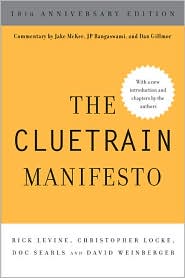
Cluetrain 10th Anniversary edition
Cluetrain 10th Anniversary
Everything Is Miscellaneous
Small Pieces cover
Small Pieces Loosely Joined
Cluetrain cover
Cluetrain Manifesto
My face
Speaker info
Who am I? (Blog Disclosure Form) Copy this link as RSS address Atom Feed

April 26, 2011

Michael Porter’s Shared Value vs Don’t Be Evil

Harvard Business Review has just posted my response to the article by Michael Porter and Mark Kramer in which they propose moving business to a strategy that includes creating Shared Value. Obviously I support the idea of businesses taking seriously their obligation to create a better, sustainable world. But I’m not as optimistic about businesses embracing that strategy solely on the grounds that Porter and Kramer propose.

It’ll make the HBR folks happier — and therefore me too — if you comment there rather than here.

Tweet
Follow me

Categories: business, cluetrain, peace Tagged with: cluetrain • csr • porter • socrates • strategy Date: April 26th, 2011 dw

Be the first to comment »

March 16, 2011

Episcopalian Rector prohibited from adopting Muslim rituals for Lent

According to an article at St. Louis Today by Cynthia Billhartz Gregorian of the St. Louis Post-Dispatch, Steve Lawlor, a part-time rector at an Episcopal church took up elements of Islamic ritual for Lent.

On Wednesday, the first day of Lent, he began performing salah five times a day, by facing east, toward Mecca, and praying to Allah. He also started studying the Quran and following Islamic dietary restrictions by abstaining from alcohol, pork and fish. During Holy Week, he planned to fast from dawn to sunset as Muslims do during Ramadan.

He avoided rituals that would have conflicted with church doctrine; for example, he skipped the prayers declaring Mohammed to be G-d’s prophet.

Steve did this as a way of understanding Islam, especially in the light of the McCarthyite hearings being held by Rep. Peter King.

But, Bishop George Wayne Smith considered it to be a forsaking of his Christianity, and to be play-acting. The Bishop forbade Steve from continuing, saying:

“I believe what he’s trying to accomplish or says he’s trying to accomplish, which is to deepen his understanding of Islam, is admirable,” he continued. “But you dishonor another faith by pretending to take it on. You build bridges by building relationships with neighbors who are Muslim.”

Not an unreasonable statement, nor an islamophobic one (although we could have done without the “or says he’s trying to accomplish” statement of distrust). But, it’s a false disjunction. You can build bridges both ways. More important, what Steve was doing was not quite pretending. Rather, it was enacting the rituals and finding in them similarities of meaning. I can understand the Bishop’s discomfort with this. For example, as I understand it, Jews are forbidden from kneeling while praying, and thus could not perform the five daily prayers the Muslim way, for ritual has meaning. That’s why performing — enacting — another religion’s rituals can help in understanding that religion. Performing another religion’s rituals thus is subject to contradictory objections: (a) The performance of empty gestures is mere play-acting and thus disrespectful. Or, (b) the performance of ritual is never mere play-acting because ritual always carries inner meaning, so performing the rituals of another religion is transgressive of one’s own religion.

Yet, between these poles of negativity there can be respectful intent, the possibility of genuinely furthering one’s understanding, and make a statement of shared humanity in the face of the shameful fear-mongering of Rep. King and his followers.


Two references, of very different sorts. First, there’s Stephen Colbert’s bit about giving up Christianity for Lent. Second, Islamicate mentions (in the post where I found the link to the “Muslim for Lent” story) that s/he has spent the past six weeks in an Episocpal seminary. Fascinating.

Tweet
Follow me

Categories: peace Tagged with: islam • mccarthy • peace • peter king • religion • ritual Date: March 16th, 2011 dw

4 Comments »

February 18, 2011

GlobalVoices live from Bahrain

GlobalVoices [twitter:globalvoices] is all over the Bahrainian protests:

Starting with our coverage of the Tunisian Revolution, Global Voices Online was one of the few media outlets following the story from its inception. GV authors have even become directly involved with the rebuilding of their country. During the #Jan25 Egyptian Revolution, GV authors were breaking through information blockades by reporting the events on the ground as the Egyptian government was switching the internet off. And now as protests begin to gather strength in Libya, Yemen, and Bahrain, Global Voices will be there to give you the firsthand accounts of citizen media journalists.

We invite you to follow our special coverage pages on Egypt, Tunisia, and Bahrain, and the rest of our Global Voices articles as we follow and amplify the voices of citizen media from around the world!

Tweet
Follow me

Categories: journalism, peace Tagged with: bahrain • globalvoices Date: February 18th, 2011 dw

Be the first to comment »

February 14, 2011

The “Twitter doesn’t topple dictators” cliche undone, but leaderless networks don’t stay that way

Jay Rosen has a great post, full of links (because Jay practices what he preaches about transparency) on the popular article that keeps getting written that argues that Twitter does not topple dictators. By the time Jay is done exposing the predictable pattern those bogus articles take, you will not be able to take them seriously ever again. For which we should thank Prof. Rosen.

One extremely fruitful place the conversation can move to is Zeynep Tufecki’s fabulous post on why leaderless networks tend to develop leaders. “Preferential attachment” just tends to have that outcome, as much for political leaders as for bloggers (as per Clay Shirky’s famous “power law” argument). Zeynep writes, for instance:

It is not enough for the network to start out as relatively flat and it is not enough for the current high-influence people to wish it to remain flat, and it is certainly not enough to assume that widespread use of social media will somehow automatically support and sustain flat and diffuse networks.

On the contrary, influence in the online world can actually spontaneously exhibit even sharper all-or-nothing dynamics compared to the offline world, with everything below a certain threshold becoming increasingly weaker while those who first manage to cross the threshold becoming widely popular.

Zeynep’s analysis and presentation are brilliant. I come out of it only wondering if the almost-inevitable clustering around particular nodes is an indicator of leadership, and, if so, how much that itself changes the nature of leadership. That is, the fact that Wael Ghonim and Mohamed El-Baradei are likely to gain many, many Twitter followers, and to loom large in Web link maps makes them important social media personalities. But Ashton Kutcher by that measure is also important. Kutcher (because there is a God who loves us) is not a leader. But Ghonim and El-Baradei are. This seems to me to be a very different sense of leadership, indicating a serious change in the mechanics and semantics of leadership.


[The next day:] Paul Hartzog responds, criticizing Zeynep’s assumptions for presenting “one side of the evolution of networks, i.e. the growth phenomena, without presenting the other side, which are the constraining phenomena, such as carrying capacity.”

Tweet
Follow me

Categories: egov, peace, social media Tagged with: egypt • journalism • leadership • media • twitter Date: February 14th, 2011 dw

7 Comments »

February 11, 2011

Freedom for Egypt: Some tweets, a thought about a future of journalism, and a question about networked leadership

This is such a miraculous day for our sisters and brothers in Egypt. As an American, a father, a Jew, and a fellow human being, I am overwhelmed with happiness for you and what you have so courageously accomplished.


A couple of tweets:

@MOHAMMEDFAS: words of joy will be everywhere only thoes who have oppressed this day will speachless!!

@peterglaser: Heute fängt das 21. Jahrhundert an – nicht am 11. September [The 21st century starts here, not on 9/11]


I learned a lot from Paul Amar’s article that tries to lay out Egypt’s power structure and political landscape. Of course, I cannot evaluate its accuracy. (I heard about it from a tweet by Matthew Stoller.


Andy Carvin [twitter:acarvin] is one of the faces of the future of journalism. He curated and retweeted thousands of tweets, a stream that gave better continuous coverage than was available on any of the broadcast channels. His retweeting of messages from the ground, from other Twitterers, from the mainstream media gave us a Channel of One. Andy’s stream was transparent — he was on the side of the protestors, duh (and, btw, CNN certainly gave up any pretense of objectivity on that score)— and imbued with his personality and his sense of humor.

Sure, Andy’s twitter stream was not a sufficient source of information, but what was? And sure, tweets are only 140 characters long, but they can include links to longer pieces.

Andy became a central part of the media ecology for many of us. While Andy is unique, the role he played is replicable. Smart media companies will be out looking for their own Andy Carvins. Even so, most will get it wrong, because they will assume that being inside a media company helps. I’m not sure that it does, although being paid by a media company certainly must.

(Some people (including me) have made donations to their local NPR stations to support Andy’s efforts. You can donate here. If you do, how about tweeting it with the hashtag #gave4andy so the the motive for your donation will be clear?)

(Later that day: Nieman Lab has an excellent post on the gave4Andy meme.)


A question: We’re going to be arguing forever about the role and importance of social media in the Egyptian revolution, but I want to ask a smaller question: Would the Egyptian Revolution been leaderless without the presence of social media?

I ask this as a genuine question. And I understand that I don’t know how leaderless it was.

Tweet
Follow me

Categories: journalism, peace, social media Tagged with: egypt • journalism • twitter Date: February 11th, 2011 dw

14 Comments »

January 29, 2011

Religions of the Mideast

I know everyone except me has this down cold, but here’s a handy map of the religions of the Middle East, provided by Columbia University.

map of religions of the mideast

Click on the image to see the full map

Tweet
Follow me

Categories: peace Tagged with: egypt • middle east • mideast • religion • tunisia Date: January 29th, 2011 dw

3 Comments »

January 11, 2011

Tech for Peace report

I haven’t had a chance to read this yet, but it sounds promising:

10 January 2011, Switzerland: The ICT4Peace Foundation, in collaboration with the Berkman Center for Internet and Society at Harvard University and GeorgiaTech, is pleased to release, on the occasion of the anniversary of the devastating earthquake in Haiti, the first in a series of papers looking at the increasingly important role of information and communication technology (ICT) in conflict prevention, peacebuilding, peacekeeping and crisis response.

Unlike other papers on innovative technologies (crowdsourcing, social networking etc) dealing with crisis response, reconstruction and humanitarian aid, this collection of thought provoking pieces by esteemed writers, including former Finnish President and Nobel Peace Prize Winner Martti Athisaari and a younger generation of cutting edge practitioners and scholars in this fast moving space, aims to encourage meaningful debate and action on how to solve the serious challenges that still exist in the effective use of ICTs.

You can download it here.

Tweet
Follow me

Categories: berkman, peace Tagged with: peace Date: January 11th, 2011 dw

Be the first to comment »

December 20, 2010

Effect of DDoS on human rights

Ethan Zuckerman has an excellent post about the new Berkman report on the use of Distributed Denial of Service attacks to silence human rights groups

Here’s an abbreviation of Ethan’s summary of the “take-aways”:

  • DDoS is a pretty common form of attack against human rights and independent media sites, and the volume of attacks does not appear to be slowing.

  • DDoS doesn’t usually affect independent media and human rights organizations in isolation.

  • Attacks don’t need massive amounts of bandwidth to adversely affect sites.

  • For many organizations, DDoS can be a crippling attack, making sites inaccessible for long periods of time..

  • We see no silver bullets for the independent media and human rights community.

Tweet
Follow me

Categories: censorship, peace Tagged with: ddos • human rights Date: December 20th, 2010 dw

1 Comment »

« Previous Page


Creative Commons License
This work is licensed under a Creative Commons Attribution-NonCommercial-ShareAlike 3.0 Unported License.
TL;DR: Share this post freely, but attribute it to me (name (David Weinberger) and link to it), and don't use it commercially without my permission.

Joho the Blog uses WordPress blogging software.
Thank you, WordPress!