logo
EverydayChaos
Everyday Chaos
Too Big to Know
Too Big to Know
Cluetrain 10th Anniversary edition
Cluetrain 10th Anniversary
Everything Is Miscellaneous
Small Pieces cover
Small Pieces Loosely Joined
Cluetrain cover
Cluetrain Manifesto
My face
Speaker info
Who am I? (Blog Disclosure Form) Copy this link as RSS address Atom Feed

June 2, 2011

[lodlam] The rise of Linked Open Data

At the Linked Open Data in Libraries, Archives and Museums conf [LODLAM], Jonathan Rees casually offered what I thought was useful a distinction. (Also note that I am certainly getting this a little wrong, and could possibly be getting it entirely wrong.)


Background: RDF is the basic format of data in the Semantic Web and LOD; it consists of statements of the form “A is in some relation to B.”


My paraphrase: Before LOD, we were trying to build knowledge representations of the various realms of the world. Therefore, it was important that the RDF triples expressed were true statements about the world. In LOD, triples are taken as a way of expressing data; take your internal data, make it accessible as RDF, and let it go into the wild…or, more exactly, into the commons. You’re not trying to represent the world; you’re just trying to represent your data so that it can be reused. It’s a subtle but big difference.


I also like John Wilbanks‘ provocative tweet-length explanation of LOD: “Linked open data is duct tape that some people mistake for infrastructure. Duct tape is awesome.”


Finally, it’s pretty awesome to be at a techie conference where about half the participants are women.
Tweet
Follow me

Categories: everythingIsMiscellaneous, open access, too big to know Tagged with: 2b2k • everythingIsMiscellaneous • lod-lam • lodlam • rdf • semantic web • semweb Date: June 2nd, 2011 dw

3 Comments »

May 27, 2011

A Declaration of Metadata Openness

Discovery, the metadata ecology for UK education and research, invites stakeholders to join us in adopting a set of principles to enhance the impact of our knowledge resources for the furtherance of scholarship and innovation…

What follows are a set of principles that are hard to disagree with.

Tweet
Follow me

Categories: copyright, education, egov, everythingIsMiscellaneous, open access, too big to know Tagged with: 2b2k • everythingIsMiscellaneous • metadata • open access Date: May 27th, 2011 dw

1 Comment »

May 4, 2011

Open Access soars

Some facts and stats, compiled at PoeticEconomics:

# of open access journals : over 6,000. Growth rate: 4 per day.

# of freely available journals: over 28,000. Growth rate: 10 per day.

# of open access repositories: close to 2,000 . Growth rate: 1 per day.

# of documents freely available: 25 million. Growth rate: 6,000 per day.

# of open access mandate policies: 271. Growth rate: 1 per week or 5 per month.

% of world’s scholarly literature that is freely available: 20%

The sources are here.

Tweet
Follow me

Categories: copyright, open access Tagged with: copyright • oa • open access Date: May 4th, 2011 dw

1 Comment »

April 21, 2011

How books were made

Jeff Goldenson, my colleague at the Harvard Library Innovation Lab found this fabulous 1947 short documentary on how books used to be made. (He posted it at the LiL blog.)


What a production! It’s hard to believe (or, for some of us, to remember) how hard it used to be to print books.

(Jeff found the video at Y-Combinator.)

Tweet
Follow me

Categories: culture, libraries, open access, too big to know Tagged with: books Date: April 21st, 2011 dw

1 Comment »

April 8, 2011

How-to guide for moving a journal to Open Access

The Association for Learning Technology has published a detailed and highly practical guide, based on its own experience, for journals moving toward an Open Access model. Indeed, the guide is of even broader utility than that, since it considers the practicalities of moving from an existing contract with publishers for any reason.

ALT’s journal has been renamed Research in Learning Technology, and it will be fully Open Access as of January 2012. (Thanks to Seb Schmoller for the tip.)

Tweet
Follow me

Categories: open access, too big to know Tagged with: 2b2k • copyright • open access Date: April 8th, 2011 dw

4 Comments »

March 28, 2011

ePublishing business models

I’m at an education conference put on by CET in Tel Aviv. This is the second day of the conference. The opening session is on business models for supporting the webification of the educational system.

NOTE: Live-blogging. Getting things wrong. Missing points. Omitting key information. Introducing artificial choppiness. Over-emphasizing small matters. Paraphrasing badly. Not running a spellpchecker. Mangling other people’s ideas and words. You are warned, people.

Eli Hurvitz (former deputy director of the Rothschild Foundation, the funder of CET) is the moderator. The speakers are Michael Jon Jensen (Dir of Strategic Web Communications, National Academies Press), Eric Frank (co-founder of Flat World Knowledge) and Sheizaf Rafaelli (Dir. of the Sagy Center for Internet Research at Haifa Univ.)

Michael Jensen says he began with computers in 1980, thinking that books would be online within 5 yrs. He spent three yearsat Project Muse (1995-8), but left because they were spending half their money on keeping people away from their content. He went to the National Academies Press (part of the National Academy of Science). The National Academies does about 200 reports a year, the result of studies by about 20 experts focused on some question. While there are many wonderful things about crowd-sourcing, he says, “I’m in favor of expertise. Facts and opinions on the Web are cheap…but expertise, expert perspective and sound analysis are costly.” E.g., that humans are responsible for climate change is not in doubt, should not be presented as if it were in doubt, and should not be crowd-sourced, he says.

The National Academy has 4,800 books online, all available to be read on line for free. (This includes an algorithmic skimmer that extacts the most important two-sentence chunk from every page.) [Now that should be crowd-sourced!] Since 2005, 65% are free for download in PDF. They get 1.4M visitors/month, each reading 7 page on average. But only 0.2% buy anything.

The National Academy Press’ goal is access and sustainability. In 2001, they did an experiment: When people were buying a book, they were offered a download of a PDF for 80% of the price, then 60%, then 40%, then for free. 42% took the free PDF. But it would have been too expensive to make all PDF’s free. The 65% that are now free PDFs are the “long tail” of books. “We are going to be in transition for the next 20 yrs.” Book sales have gone from 450,00/yr in 2002 to 175,000 in 2010. But, as they have given away more, they are disseminating about 850,000 units per year. “That means we’re fulfilling our publishing mission.” 260,000 people have opted in for getting notified of new books.

Michael goes through the available business options. NAP’s offerings are too broad for subscriptions. They will continue selling products. Authors fund some of the dissemination. And booksellers provide some revenue. There are different models for long-form content vs. articles vs. news vs. databases. Further, NAP has to provide multiple and new forms of content.

General lessons: Understand your mission. Make sure your strategy supports your mission. But digital strategies are a series of tactics. Design fot the future. and “The highest resolution is never enough…Never dumb down.” “The print-based mindset will work for the next few years, but is a long-term dead end.” “‘Free’ of some kind is required.” Understand your readers, and develop relationships with them. Go where the audiences are. “Continue experimenting.” There is no single best model. “We are living in content hyperabundance, and must compete with everything else in the world.”


Eric Frank of Flat World Knowledge (“the largest commercial publisher of” open source textbooks) says that old business models are holding us back from achieving what’s possible with the Net. He points to a “value gap” in the marketplace. Many college textbooks are $200. The pain is not evenly distributed. Half of college students are in 2 yr colleges, where the cost of textbooks can be close to their tuition costs. The Net is disrupting the text book market already, e.g.,through the online sale of used books, or text book rental models, or “piracy.” So, publishers are selling fewer units per year, and are raising pricves to protect their revenues. There’s a “vicious downward spiral,” making everyone more and more unhappy.

Flat World Knowledge has two business models. First, it puts textbooks through an editorial process, and publishes them under open licenses. They vet their authors, and peer review the books. They publish their books under a Creative Commons license (attribution, non-commercial, share-alike); they retain the copyright, but allow users to reuse, revise, remix, and redistribute them. They provide a customization platform that looks quite slick: re-order the table of content, add content, edit the content. It then generates multiple formats, including html, pdf, ePub, .mobi, digital Braille, .mp3. Students can choose the format that works best for them. The Web-based and versions for students with disabilities are free. They sell softwcover books ($35 fofr b&w, $70 for color) and the other formats. They also sell study guides, online quizzes, and flashcards. 44% read for free online. 66% purchase something: 33% print, 3% audiobooks, 17% print it yourself, 3% ebooks.

Second business model: They license all of their intellectual property to an institution that buys a site license at $20/student, who then get access to the material in every format. Paper publishers’ unit sales tend to zero out over just a few semesters as students turn to other ways of getting the book. Free World Knowledge’s unit sales tend to be steady. They pay authors 20% royalty (as opposed to a standard 13%), which results in higher cumulative revenues for the authors.

They currently have 112 authors (they launched in 2007 and published their first book in Spring 2009). 36 titles published; 42 in pipeline. Their costs are about a third of the industry and declining. Their time to market is about half of the traditionals (18 months vs. 40 months). 1,600 faculty have formally adopted their books, in 44 countries. Sales are growing at 320%. Their conversion rate of free to paid is currently at 61% and growing. They’ve raised $30M in venture capital. Bertelsmann has put in $15M. Random House today invested.

He ends by citing Kevin Kelly: The Net is a giant copy machine. When copies are super-abundant, and worthless. So, you need to seel stuff that can’t be copied. Kevin lists 8 things that can’t be copied: immediacy, personalization, interpretation (study aids), authenticity (what the prof wants you to read), accessibility, embodiment (print copy), patronage (people want to pay creators), findability. Future for FWK: p2p tutoring, user-generated marketplace, self-assessment embedded within the books, data sales. “Knowledge is the black gold of the 21st century.”

[Sheizaf Rafaelli’s talk was excellent — primarily about what happens when books lose bindings — but he spoke very quickly, and the talk itself did not lend itself to livebloggery, in part because I was hearing it in translation, which required more listening and less typing. Sorry. His slides are here. ]

Tweet
Follow me

Categories: business, education, experts, libraries, liveblog, open access, too big to know Tagged with: copyright • e-books • ebooks • publishing Date: March 28th, 2011 dw

5 Comments »

March 7, 2011

Imperial College in showdown with closed-access journals

Felix Online, the online news of Imperial College in the UK, reports (in an article by Kadhim Shubber) that Deborah Shorley, Director of the Imperial College London Library, is threatening to end the library’s subscriptions to journals published by Elsevier and Wiley Blackwell, two of the major publishers in the UK. Rather than giving into the bundling of journals with 6% annual subscription prices (well above inflation, and in the face of a growth in profits at Elsevier from £1B to £1.6B from 2005 to 2009), she is demanding a 15% reduction in fees, as well as other concessions.

Says the article: “…if an agreement or an alternative delivery plan is not in place by January 2nd next year, researchers at Imperial and elsewhere will lose access to thousands of journals. But Deborah Shorley is determined to take it to the edge if necessary: ‘I will not blink.'”

As the article mentions, in 2010, after a 400% fee increase, the University of California threatened to boycott the Nature Publishing Group, including not engaging in peer review for NPG’s journals. (NPG claims that the rise in fees was due to the reduction of a discount from 88% to 50%. UC disputes this.) In August of 2010, NPG and UC made nice and announced “an agreement to work together to address the current licensing challenges as well as the larger issues of sustainability in the scholarly communication process.” [more and more]

Wow, we’re in a painful transition period. Open access will win.

Tweet
Follow me

Categories: copyright, libraries, open access Tagged with: 2b2k • copyright • libraries • open access Date: March 7th, 2011 dw

2 Comments »

March 1, 2011

Digital Public Library of America

I’m at the first workshop of the Digital Public Library of America, which is studying how we might build such a thing. Fascinating meeting so far. But it’s under Chatham House rules, which means that there’s no attribution of ideas and quotes. So, I’m tweeting it without attributions. Hashtag: #dpla. John Palfrey is liveblogging it.

Tweet
Follow me

Categories: libraries, open access, too big to know Tagged with: dpla • library • open access Date: March 1st, 2011 dw

1 Comment »

February 2, 2011

Open access welcomes Nature

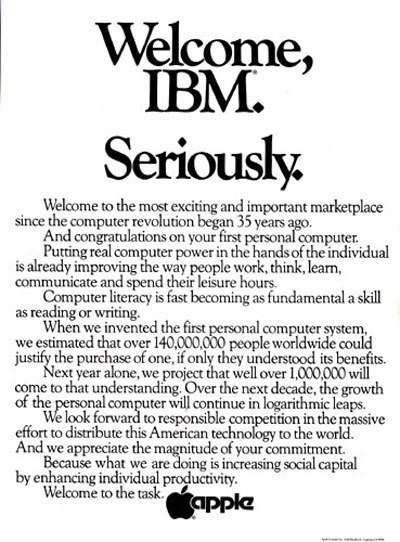
A couple of weeks ago, when Nature magazine announced it was starting a peer-reviewed open access journal, PLoS One (a peer reviewed open access journal) welcomed them the way Apple welcomed IBM into the personal computing market:

On January 6, 2011, Nature announced a new Open Access (OA) publication called Scientific Reports. Nature’s news underscores the growing acceptance of OA, as reflected in recent OA journal launches from other traditional publishers such as the BMJ, Sage,  AIP (American Institute of Physics) and APS (American Physical Society). Please spread the word either via this blog post or download this PDF.


Inspired by Apple
.

The Nature entry into the open access field is a big deal. So is Nature’s support of Creative Commons. I’ve had a chance to spend some little time with folks at Nature, and know them to be passionate about making the work of science more accessible. So, this is good news all around.

Tweet
Follow me

Categories: open access, science, too big to know Tagged with: 2b2k • nature • npg • open access • plos • science Date: February 2nd, 2011 dw

2 Comments »

January 29, 2011

Another open access journal, and when closed access journals go rogue

On the one hand, a new peer-reviewed open access journal is starting up: The Journal of Media and Communication Studies. It’s promising to work toward a four-week decision process for submitted articles, with publication in the next issue. Good luck to JMCS.

On the other hand, Jonathan Zittrain blogs about a European journal currently being sued because it refused to give in to an author’s demand that a short, critical book review be removed. The editor’s courteous, respectful, generous response is here. (I posted about this when Harry Lewis blogged about it earlier.)

Just to give you a sense of how “libelous” the book is, here’s its final paragraph:

Karin Calvo-Goller has undoubtedly invested much time and effort into this book, which – but for regrettably sloppy editing – might well serve as a first systematic introduction to the procedural issues confronting the ICC. What is still missing is a book that might help to resolve these issues.

Oh why can’t we all just get along?

Tweet
Follow me

Categories: copyright, open access Tagged with: open access Date: January 29th, 2011 dw

3 Comments »

« Previous Page | Next Page »


Creative Commons License
This work is licensed under a Creative Commons Attribution-NonCommercial-ShareAlike 3.0 Unported License.
TL;DR: Share this post freely, but attribute it to me (name (David Weinberger) and link to it), and don't use it commercially without my permission.

Joho the Blog uses WordPress blogging software.
Thank you, WordPress!