




logo
EverydayChaos
Everyday Chaos
Too Big to Know
Too Big to Know
Cluetrain 10th Anniversary edition
Cluetrain 10th Anniversary
Everything Is Miscellaneous
Small Pieces cover
Small Pieces Loosely Joined
Cluetrain cover
Cluetrain Manifesto
My face
Speaker info
Who am I? (Blog Disclosure Form) Copy this link as RSS address Atom Feed

April 25, 2011

8th graders make awesome Net neutrality explainer

Congratulations to eighth graders Melissa Yu, Katy Becker, and Sara Atkins for winning first prize in C-SPAN’s StudentCam contest. Their 7:45 minute video explainer of Net neutrality — the policy and the politics — is clear, fair, and smart.

Tweet
Follow me

Categories: journalism, media, net neutrality Tagged with: journalism • net neutrality Date: April 25th, 2011 dw
3 Comments »

February 10, 2011

[2b2k] Jay Rosen on Huffington’s path to somewhere

Jay Rosen wonders if there’s any room in AOL’s buyout of HuffingtonPost for “ideological innovation.” He suggests a four-part policy for AOL’s media:

1. Pluralism. Many points of view.

2. Transparency. All contributors explain where they are coming from.

3. “The view from somewhere.” Media sites will be upfront about their general stand point.

4. “Non-negotiables.” Accuracy, fairness, a fact-checking form for every article, etc.

It may look like #1 and #3 conflict. But, as I understand Jay’s point, pluralism applies to AOL, while having a standpoint would apply to sites like HuffPo and to individual topical sub-sites within HuffPo. (Note that pluralism is very different from balance.)

I like this a lot (surprise surprise!), but I wonder about the right level at which to apply the pluralism criterion. If AOL and other media conglomerates follow Jay’s advice, we will have a bunch of pluralistic hens, with one large, ferociously dedicated Fox in the henhouse.

In any case, I hope AOL listens to Jay. And I hope HuffPo stays ideologically committed, stops running the stupid gossip and pin-up articles, and gets off Obama’s back. But that’s just me.

Tweet
Follow me

Categories: journalism, media, too big to know Tagged with: 2b2k • journalism • media • newspapers Date: February 10th, 2011 dw

2 Comments »

February 4, 2011

Gladwell proves too much

Malcolm Gladwell is going further out on his cranky branch. His reading of the role of social media in Tunisia and Egypt actually seems to lead to conclusions that I think he would acknowledge are extreme and extremely unlikely. (I look at his new post in some detail after the big box below.)

Gladwell is in the unfortunate position of having published a New Yorker article dismissive of the effect of social media on social protest movements just weeks before the Tunisian and Egyptian revolts. Now Gladwell has posted a 200-word commentary that maintains his position without emendation. (Mathew Ingram has an excellent response to Gladwell’s latest post.)

I was among the many who replied to Gladwell’s initial article. I began that piece by trying to outline Gladwell’s argument, in a neutral and fair way. This is what I came up with:

In 1960, four college students staged a sit-in in NC. Within a week, sit-ins had started to spread like “a fever.”

Gladwell now states the claim he is going debunk: “The world, we are told, is in the midst of a revolution. The new tools of social media have reinvented social activism.” He then points to world events that have been claimed to support that view.

But, (he continues) those events were not really brought about by social media. Why would we think they were? It’s not due just to over-enthusiasm for social media. Fifty years after the civil rights movement, “we seem to have forgotten what activism is.” It is really our understanding of activism that is at issue.

Now, back to the sit-ins. They were dangerous. Civil rights activism took courage. That courage required strong ties to other activists. This was true not just of the civil rights movement in the US, but is a general characteristic of activism.

But, “The kind of activism associated with social media isn’t like this at all.” Social media (Twitter, Facebook) are all about weak ties. Weak ties are “in many ways a wonderful thing…But weak ties seldom lead to high-risk activism.” Social media activism works when little is asked of people.

Activism requires not just strong ties, but also strong, centralized, hierarchical organization. Not networks. You need a hierarchy “if you’re taking on a powerful and organized establishment…”

As an example, Gladwell ridicules the opening story in Clay Shirky’s Here Comes Everybody, about how “the crowd” got a smart phone returned to its rightful owner. “A networked, weak-tie world is good at things like helping Wall Streeters get phones back from teen-age girls.”

Now apply that to Tunisia and Egypt. You would think that these were pretty dramatic counter-examples. Gladwell does not think so. In fact, his recent post reads as if he’s exasperated that anyone is still bothering to disagree with him:

But surely the least interesting fact about them is that some of the protesters may (or may not) have at one point or another employed some of the tools of the new media to communicate with one another. Please. People protested and brought down governments before Facebook was invented.

Even the fact the post is only 200 words long gives the impression that the two Mideast upheavals are barely worth his time.

Let’s look at each of the post’s two paragraphs.

Paragraph #1. This is a paragraph of ridicule: Paying attention to social media is like hearing a famous revolutionary statement from Mao Zedong, paying scant attention to its content and import, and instead getting all excited because of the medium he used.

Yes, it is possible to pay too much attention to the medium as opposed to the message. But, as with so many arguments by ridicule, this one doesn’t advance our thought at all. We can counter by trying to make the analogy more exact: If in 1935 Mao had said “Power springs from the barrel of a gun,” and it had spread through, say, a new-fangled telephone tree so that it reached beyond the boundaries of government-controlled radio, and if that statement had signaled a turn to violent uprising, it would be irresponsible to ignore the role of the medium in the dissemination of the message. Or, if government printers had in the 1960s refused to publish the Little Red Book that spread that quote, the lack of a medium for it would surely be worth discussing. Media play an important role. When the medium is new, it is right to examine that role. That is not to say that the medium is a sufficient cause, or is the only thing worth discussing. But who has attributed the Tunisian and Egyptian uprisings solely to the existence of social media?

Gladwell’s argument in this first paragraph therefore seems to me to be: (1) Ultimately an argument against media having any role or significance in political movements; (2) An argument against a strawman; (3) Less an argument at all than a “Hey you kids, get off my lawn” statement of alignment.

Paragraph #2. Gladwell reiterates his point that political activism requires strong ties, and social media only provides weak ties. He defends these contentions by using the word “surely,” which almost always indicates that the speaker has no evidence to present that could in fact make us sure: “But surely the least interesting fact about them is that some of the protesters may (or may not) have at one point or another employed some of the tools of the new media to communicate with one another.”

It is not at all obvious that this is the least interesting fact. Social media are a new variable. Because history is so damn particular, contingent, and emergent, we can never be entirely sure which new variables matter. The anti-Mubarak demonstrations have been (apparently) heavily supported by Egypt’s trade unions, for example; perhaps that’s worth exploring. Declaring the possible role of social media the “least interesting fact” seems based either on an a priori belief that (a) media never have an important role in social movements, or (b) our new social media can have no role because of Gladwell’s theory that they can’t supply the strong ties necessary for activism. The first alternative seems too silly to defend. If it’s the second, then I would have thought a reasonable response from Gladwell would have been along these lines: “I’ve put forward a bold hypothesis about the ineffectiveness of social media. That hypothesis is based primarily on some historical examples. We have some new examples before us. Let us examine them to see if they indeed support my hypothesis — especially since so many have claimed that this new evidence refutes that hypothesis.” Instead we get all the power a confidently rendered “surely” can bring.

But the second paragraph is not over. Gladwell now gives examples of historical revolutions that succeeded before the development of the Net. The conclusion warranted from this evidence is that no particular medium is necessary for a revolution: We know you can have a revolution without, say, telephones because we’ve had many such revolutions. But this is a really bad way to argue about historical explanations. Many wars have ended without any atomic bombs being used, so we might as well say that historians ought not to consider the effect dropping a-bombs had on ending WWII. No, if we want to understand an event, we have to understand it within its history. The events in Tunisia and Egypt are occurring within a history in which social media are being used for among the first times. That makes the question of the role of social media interesting, and, under most theories of history — ones in which the nature of the contemporary media plays a contributing part — important.

Gladwell’s second paragraph therefore “proves” too much. But he backs off the obvious silliness of where his arguments lead by concluding: “People with a grievance will always find ways to communicate with each other. How they choose to do it is less interesting, in the end, than why they were driven to do it in the first place.” He thus proposes a sort of historical determinism: No matter what the means of communication, those who want a revolution will have a revolution. But: (1) How do we know this is true? (2) The means of communication may well affect (a) when it happens, (b) how it happens, (c) who participates, (d) its success, (e) how the world reacts, and (f) how the participants view themselves as a social group. That last point I acknowledge is the squishiest of them, but it may have the most lasting effect, helping to shape the governmental structure that emerges post-revolution: “We are a mob inspired by the incredible leaders who have the megaphones” might tend toward differences in governance than “We are a connected, empowered network.” In any case, it seems to me that investigating the role of social media is not an activity beneath contempt.

And that’s why I’ve written a post ten times longer than the one it’s discussing. Gladwell — with his amazing ability to illuminate difficult matters — is not merely splashing cold water on an overheated subject, but is trying to drown the subject entirely. Because we don’t yet understand the effect social media are having on social movements, it is unhelpful to have such a powerful voice ridiculing the effort to trace their effects. Gladwell’s attempt to undo unwarranted enthusiasm comes across instead as an argument for diminished nuance. That is exactly what Gladwell is decrying in our discourse, and is not what his body of writing has exemplified.

So, I come out of his brief post wondering how Gladwell would answer the following questions:

http://ramfarms.com/sites/blog/index.php?=cialis-20-mg-directions

1. Does Gladwell believe that the means of communication never has any effect on any social protest movement? (“…in the French Revolution the crowd in the streets spoke to one another with that strange, today largely unknown instrument known as the human voice.”)

2. If he believes that the means of communication can have some effect, then does he believe that some media that do not create strong ties — radio, newspapers, tv, etc. — are worth considering when trying to understand social protest movements? If so, then why are networked social media not worth considering?

3. If social media are worth considering as playing some role in social protests, exactly what role and how important? A role so trivial that it is literally the least interesting factor historians and analysts should be looking at? Or is it of more importance than that, but just not anywhere near worth the amount of attention it’s been getting?

4. On what does he base these views? A theory about how social protest movements have worked and must work? Does he hold this theory as so obviously true that all events must now be interpreted within it, or is he willing to examine events to see if they support or contradict his theory?

Tweet
Follow me

Categories: media, social media, too big to know Tagged with: egypt • gladwell • history • social media • tunisia Date: February 4th, 2011 dw

41 Comments »

January 31, 2011

We are the medium

I know many others have made this point, but I think it’s worth saying again: We are the medium.

I don’t mean this in the sense that we are the new news media, as when Dan Gillmor talks about “We the Media.” I cherish Dan’s work (read his latest: Mediactive), but I mean “We are the medium” more in McLuhan’s “The medium is the message” sense.

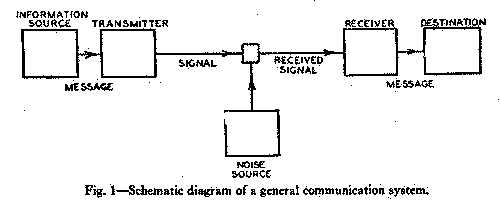
McLuhan was reacting against information science’s view of a medium as that through which a signal (or message) passes.

shannon's communication diagram

Information science purposefully abstracted itself from every and any particular medium, aiming at theories that held whether you were talking about tin can telephones or an inter-planetary Web. McLuhan’s pushback was: But the particularities of a medium do count. They affect the message. In fact, the medium is the message!

I mean by “We are the medium” something I think we all understand, although the old way of thinking keeps intruding. “We are the medium” means that, quite literally, we are the ones through whom information, messages, news, ideas, videos, and links of every sort move — and they move through this “channel” because we decide to move them. Someone sends me a link to a funny video. I tweet about it. You see it. You send a Facebook message to your friends. One of them (presumably an ancient) emails it to more friends. The video moves through us. Without us, the transport medium —” the Internet — is a hyperlinked collection of inert bits. We are the medium.

Which makes McLuhan’s aphorism more true than ever. In tweeting about the video, I am also tweeting about myself: “This is the sort of thing I find funny. Don’t I have a great sense of humor? And I was clever enough to find it. And I care enough about you— and about my reputation — to send it out to you.” That’s 51 characters over the the Twitter limit, but it’s clearly embedded in my tweet.

Although there are a thousand ways “We are the medium” is wrong, I think what’s right about it matters:

  • Because we are the medium, one-way announcements, such as a tweet to thousands of followers, still has a conversational element. We may not be able to tweet back and expect an answer, but we we can pass it around, which is a conversational act.

  • Because we are the medium, news is no longer mere information. In forwarding the item about the Egyptian protestor or about the Navy dealing well with a gay widower, I am also saying something about myself. That’s why we are those that formerly were known as the audience: not just because we can engage in acts of journalism without a newspaper behind us, but because in becoming the medium through which news travels, some of us travels with every retweet.

  • Because we are the medium, fame on the Net is not simply being known by many because your image was transmitted many times. Rather, if you’re famous on the Internet, it’s because we put ourselves on the line by forwarding your image, your video, your idea, your remix. We are the medium that made you famous.

It is easy to slip back into the old paradigm in which there is a human sender, a message, a medium through which it travels, and a human recipient. It’s easy because that’s an accurate abstraction that is sometimes useful. It’s easy because the Internet is also used for traditional communication. But what is distinctive and revolutionary about the Internet is the failure of the old diagram to capture what so often is essential: We are not users of the medium, and we are not outside of the medium listening to its messages. Rather, we are the medium.

Tweet
Follow me

Categories: infohistory, journalism, media, too big to know Tagged with: communications • information • journalism • mcluhan • media • medium Date: January 31st, 2011 dw

42 Comments »

January 27, 2011

[2b2k] Guardian aggregates all its data

The Guardian has been publishing its data for the past couple of years. Now it is making all of it available in one spreadsheet:

Want to see all of the data we have reported? Here’s all the data we’ve covered over the last two years, that’s almost 600 spreadsheets linked from one spreadsheet

Not just transparnecy, but convenience! Well done, Guardian!

Tweet
Follow me

Categories: journalism, media, too big to know Tagged with: 2b2k • big data • journallism Date: January 27th, 2011 dw

1 Comment »

January 26, 2011

McLuhan in his own voice

As a gift on the centenary of Marshall McLuhan’s birth, a site has gone up with videos of him explaining his famous sayings. Some of them still have my scratching my head, but other clips are just, well, startling. For example, this description of the future of books is from 1966.

Tweet
Follow me

Categories: libraries, media Tagged with: books • library • mcluhan Date: January 26th, 2011 dw

2 Comments »

December 13, 2010

Dan Gillmor’s Mediactive now active

Dan Gillmor has posted his new book. Mediactive is a handbook for anyone who consumes news, produces news, does both, or cares about either.

Dan’s published it under a Creative Commons license on his site, so you can read it for free and share it with friends. It’s also available in print from Lulu and Amazon. Dan views the book as just one more step in a long-term, continuing engagement with the topic.

Dan is one of the good guys of the Net. I’m off to Lulu to buy myself a copy!


Howard Weaver noted in the comment to a previous post of mine that he’s posted a scan of a typewritten 1976 memo [pdf] he wrote when he was at Alaska’s alternative newspaper, urging it to become more engaged. Prescient doesn’t begin to express it.

Tweet
Follow me

Categories: education, media, too big to know Tagged with: dan gillmor • media Date: December 13th, 2010 dw

1 Comment »

December 8, 2010

Standing with the Net

Life is complex, but sometimes it comes down to taking sides.

I don’t mean about Wikileaks. As Micah Sifry [twitter: mlsif] has tweeted, “I don’t know if I’m pro-Wikileaks, but I know I’m anti-anti-Wikileaks.”

Me, too. Especially when the full power of government and commerce is unleashed against it. Wikileaks embodies transitional ambiguity in several intersecting, crucial social processes normally handled unambiguously by traditional institutions. So, ambivalence is a proper response, and, arguably the only proper response. (For contrast, see the right-wing American Enterprise Institute’s reaction, by Mark Thiessen.)

I know I’m anti-anti-Wikileaks not because I know I like Wikileaks (although I do lean that way). It’s not Wikileaks that has summoned the wrath of the incumbents. It’s the Internet. The incumbents have now woken up to the Net’s nature, and are deploying every weapon they can find against it, including siccing Interpol on Julian Assange for incidents of what were reportedly consensual sex. (You’ve probably already read Naomi Wolf’s scathing, hilarious response.) [Later that day: Wolf’s casual assertions are likely wrong. The charges are more serious than what I said.] As Milton Mueller writes at the Internet Governance Project:

Whatever one’s opinion about the wisdom, responsibility and ethical justification of the revelations, it has shown that there is a new countervailing force in the world that the militarists and diplomats don’t know how to control yet. This is, on the whole, a good thing. It is true that the disclosure power Wikileaks invoked can be abused. It can do real damage. But in relative terms, it is far more benign that the power it is being used against in this case and its legitimacy resides more in public opinion than anything else. The hysteria generated by foreign policy hawks polarizes the world around the internet and its capabilities and shows that, all too often, those who claim to be defenders of freedom are its worst enemies.

Denizens of the Net are choosing sides. To my dismay, Amazon and eBay’s PayPal have decided that they are on the Net but not of the Net. When it comes down to it, they have decided they don’t really care for the Internet all that much, except as a low-friction cash register. How we would have rejoiced if Amazon and eBay had stood up to those who want to stop the flow of information that they don’t like. Instead they folded.

Amazon’s capitulation is especially disappointing. It has so benefited from its enlightened ideas about trust and openness. Yet, because karma does occasionally get itself out of bed in the morning, they will pay: What business is going to trust its data to Amazon’s cloud, knowing that one phone call from Senator McScrooge is enough to get Amazon to inspect or destroy its data?

I have my leanings, but I am ambivalent about everything in the past fifteen year’s messy cultural, societal transition. But my ambivalence shows up in how to navigate on the unambivalent ground on which I stand. I stand with the Net.

Tweet
Follow me

Categories: censorship, media, policy Tagged with: wikileaks Date: December 8th, 2010 dw

19 Comments »

December 5, 2010

Truth is not enough

I haven’t posted anything about Wikileaks because it’s not as if there’s been a shortage of commentary. Also, I am deeply conflicted about it, for predictable reasons: I’m happy to see some nasty government programs exposed, but I also believe governments and the people who work for them need to have conversations that are frank, honest, private, and even regrettable.

I here just want to comment on a particular theory of truth that many are using to justify Wikileaks. This ideas says that “the truth” is a neutral and accurate depiction of how the world is. One is thus always justified in stating the truth.

That definition may be true, or it may be true as stipulated, but it’s not useful. In fact, it’s the opposite of useful because it misses truth’s value. Someone who babbles an endless series of true statements is insane. Kierkegaard talked about this as “objective madness.” He imagines a patient walking home from a stay in an insane asylum trying to convince people he’s sane by repeating over and over something true: “The world is round. The world is round.” The same ex-patient would be just as insane if he varied his list of true things as he strolls down the street: “The world is round. Books have weight. Wheels roll. My toenails are growing.”

Truth can be noise. Truth can be used to distract us. Truth can be wicked violence. It is not enough, therefore, to justify your blurtings by saying, “But it’s the truth!” Truth’s value comes from its role in the complex social fabric — network — within which we live. That network contains many other human values, purposes, and fallibilities. The truth matters because it helps us act in our world, together.

So, I don’t think Wikileaks’ actions can be justified simply by saying, “But the site is just saying the truth!” It’s far more complex than that. What effect will this exposure have? How might it have been a more effective exposure? What do we gain and what to we lose. With this round of Wikileaks, we both gain and lose, imo.

Here, by the way, I think Assange’s interests diverge from many of us who believe in the power of transparency. I find persuasive Zungzungu’s argument, based on a 2006 writings attributed to Assange [pdf], that Wikileaks is not about letting sunlight into the room so much as about throwing grit in the machine: It is aiming at rendering “authoritarian conspiracies” ineffective. I am glad that the site has exposed some of my government’s wickedness; I am unhappy that it is going to render it less effective in the good that it does. And I am unhapy with my government’s response to the leak.


Here are links to some Berkman posts about Wikileaks. And here’s a discussion initiated by Jay Rosen about Assange’s non-answer to a question like the one this post raises.

Tweet
Follow me

Categories: censorship, journalism, media, open access, too big to know Tagged with: transparency • wikileaks Date: December 5th, 2010 dw

17 Comments »

November 17, 2010

[defrag] Scott Porad on how we fileter 0,000 user submisses per day

Scott Porad from the Cheezburger Network, a network of humor and entertainment Web sites, including I can Has Cheezburger. Memebase, The Daily What, and Failblog.

NOTE: Live-blogging. Getting things wrong. Missing points. Omitting key information. Introducing artificial choppiness. Over-emphasizing small matters. Paraphrasing badly. Not running a spellpchecker. Mangling other people’s ideas and words. You are warned, people.

It’s mainly user-moderated. As an example, Scott takes us through the steps for the Cheezburger site.

First, the home tab where you can submit content. The LOL builder makes it easy for users to add captions to images. They get 300,000-500,000 submissions to their network every month, but they only publish 1-2 percent. How do they cull? There’s no secret sauce, no magic algorithms. It’s a four-step human process.

Step 1: All submissions are screened by an editor, looking for image quality (not taken on a cellphone at night, etc.), appropriateness (no nudity, violence, racism), germaneness (a dog photo submitted to the cat site?), and keeping photos of humans out. Most of what gets submitted is junk, and gets screened out.

Step 2: Using the second tab, users vote or add a submission to their favorites. They also look at which content has been shared on social networks.

Step 3: User screening for offensiveness and copyright violations.

Step 4: Editorial curation.

They tried outsourcing it, but there’s too much specific to our culture, and requires too much editorial judgment.

Scott shows us his the favorite photos in his own account profile. ([Some very funny ones.]

Tweet
Follow me

Categories: cluetrain, entertainment, liveblog, media Tagged with: cheezburger • crowdsourcing • defrag • humor • scottporad Date: November 17th, 2010 dw

Be the first to comment »

« Previous Page | Next Page »


Creative Commons License
This work is licensed under a Creative Commons Attribution-NonCommercial-ShareAlike 3.0 Unported License.
TL;DR: Share this post freely, but attribute it to me (name (David Weinberger) and link to it), and don't use it commercially without my permission.

Joho the Blog uses WordPress blogging software.
Thank you, WordPress!