


logo
EverydayChaos
Everyday Chaos
Too Big to Know
Too Big to Know
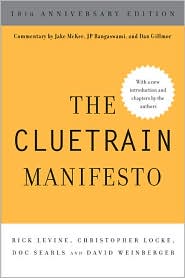
Cluetrain 10th Anniversary edition
Cluetrain 10th Anniversary
Everything Is Miscellaneous
Small Pieces cover
Small Pieces Loosely Joined
Cluetrain cover
Cluetrain Manifesto
My face
Speaker info
Who am I? (Blog Disclosure Form) Copy this link as RSS address Atom Feed

December 8, 2010

A blog not to trust

Just a note: if you’re going to Barcelona and come across blogs that favorably review the BCNinternet guide site, you should be aware that the site pays bloggers to write reviews and link to them. I know because they asked me to, and then confirmed it in an email.

Hmm, I wonder if this post counts as a review…

Tweet
Follow me

Categories: cluetrain, marketing Tagged with: barcelona • marketing • pay-for-play Date: December 8th, 2010 dw

Be the first to comment »

November 17, 2010

[defrag] Maggie Fox on privacy

Maggie Fox [twitter:maggiefox] says we think about privacy wrong.

NOTE: Live-blogging. Getting things wrong. Missing points. Omitting key information. Introducing artificial choppiness. Over-emphasizing small matters. Paraphrasing badly. Not running a spellpchecker. Mangling other people’s ideas and words. You are warned, people.

We can feel violated when what we thought was private goes into unwanted hands. “Violated” is a strong word, and originally meant someone crossing physical space, coming into your house. Our laws of privacy are all about physical place. “We suck at context. We think here and now is all there is.” Privacy is not universal, she says. The notion that you have a private space that no one else can come into is a Western concept. In fact, ours is an American concept. There is no Russian word for privacy. George Lowenstein’s study showed the cultural basis of privacy. He found that when guarantees of confidentiality were given and people were asked to disclosed things, disclosure dropped by 50%. And the more informal the disclosure statement on a site was, the more they disclosed. People don’t think about privacy unless they’re told to think about it.

Privacy is a new concept, relative to human history. It is not global. Rooted in 18th centure property law. And it’s very squishy (= contextual). And now we’re digital. But most people really aren’t all that interested in privacy. We leave breadcrumbs all the time. “In the digital revolution, that data is incredibly valuable, but not to Big Brother.” “If you’re a spy, you shouldn’t be on Twitter.” Worrying about that is a red herring.

We ought to be much more worried about advertisers’ use of data. Their business model is ending, Maggie says. They want to transition from trying to get all the eyeballs to getting the right eyeballs. There is a market for your data. Your privacy is no longer a place. It is a commodity — something people want to buy. You should worry more about Facebook than Big Brother.

So we need to approach privacy differently. Right now, we treat privacy as something that makes you feel weird when someone violates it, e.g., when your Mom refers to your FB page. But, the marketers aren’t just making you feel weird. They’re taking something from you: your data.

Your data has value, and you ought to extract that value. Advertising recognizes that with profit-sharing, discount, loyalty programs: you can trak me in exchange for something I want.

The big sites like Amazon have value because of the data we’ve given them. Our aggregated data is the information age’s natural resource.

We need to think about privacy differently, Maggie concludes.

Q: [esther dyson] What will a company that create a service that does represent the user?
A: Great question. I don’t have the answer.

Tweet
Follow me

Categories: cluetrain, liveblog, marketing Tagged with: marketing • privacy Date: November 17th, 2010 dw

Be the first to comment »

November 4, 2010

Customer satisfaction surveys that are totally unsatisfactory

I’ll skip explaining exactly why Citibank is impossible to deal with and how they are screwing up my credit by having created a fictitious account for me [see second comment for an update] and then sending it to a collection agency without ever having sent me a bill, and how multiple calls and escalations have not fixed this because Citibank’s various parts don’t communicate with one another, so getting it resolved with, say, the Customer Service folks remains invisible to the Personal Credit Destruction people.

So, last night, I spent another 20 minutes with Citi on the phone, talking with people who simply could not help me. They are fine folks doing their job as best they can, but they can’t see the computer files they need, and they can’t change the ones they can see. Citibank is broken.

Today I got a robocall from Citi asking me to complete a telephonic survey about my satisfaction. Hahahaha. But, in typical fashion, the questions pertain to the customer support person. How satisfied am I with her? Fine. She did what she could. But she couldn’t do anything because Citibank as a system sucks so bad. I’m not going to trash her because Citibank makes it structurally impossible for her to do her job.

If Citibank asked the right questions, it might find out just how broken it is.

Tweet
Follow me

Categories: cluetrain, marketing Tagged with: citi • citibank • cluetrain • marketing • vrm Date: November 4th, 2010 dw

6 Comments »

October 27, 2010

[2b2k] Possible tag line?

I’m liking this as a tag line for “Too Big to Know”:

Skulls don’t scale.
Networks do.

But I’ve gotten some reactions saying that “skull” sounds too “Spinal Tap”-ish. I like it because skulls are so bony, and thus you can see why they don’t scale. But I’m open to improvements….

Tweet
Follow me

Categories: marketing, too big to know Tagged with: 2b2k Date: October 27th, 2010 dw

6 Comments »

« Previous Page


Creative Commons License
This work is licensed under a Creative Commons Attribution-NonCommercial-ShareAlike 3.0 Unported License.
TL;DR: Share this post freely, but attribute it to me (name (David Weinberger) and link to it), and don't use it commercially without my permission.

Joho the Blog uses WordPress blogging software.
Thank you, WordPress!