logo
EverydayChaos
Everyday Chaos
Too Big to Know
Too Big to Know
Cluetrain 10th Anniversary edition
Cluetrain 10th Anniversary
Everything Is Miscellaneous
Small Pieces cover
Small Pieces Loosely Joined
Cluetrain cover
Cluetrain Manifesto
My face
Speaker info
Who am I? (Blog Disclosure Form) Copy this link as RSS address Atom Feed

May 17, 2011

[dpla] Amsterdam, Monday morning session

Jon Palfrey: The DPLA is ambitious and in the early stages. We are just getting our ideas and our team together. We are here to listen. And we aspire to connect across the ocean. In the U.S. we haven’t coordinate our metadata efforts well enough.


One of the core principals is interoperability across systems and nations. It also means interoperability at the human and institutional layers. “We should start with the presumption of a high level of interoperability.” We should start with that as a premise “in our dna.”

NOTE: Live-blogging. Getting things wrong. Missing points. Omitting key information. Introducing artificial choppiness. Over-emphasizing small matters. Paraphrasing badly. Not running a spellpchecker. Mangling other people’s ideas and words. You are warned, people.


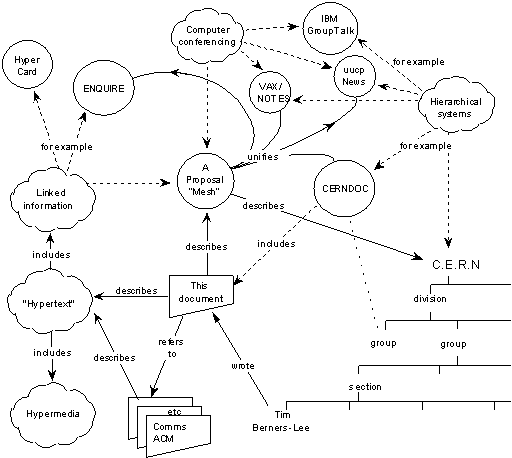
Dan Brickley is asked to give us an on-the-spot, impromptu history of linked data. He begins with a diagram from Tim Berners Lee w3c.org/history/1989 that showed the utility of a cloud of linked documents and things. [It is the typed links of Enquire blown out to a web of info.] At an early Web conf in 1994 TBL suggested a dynamic of linked documents and of linked things. One could then ask questions of this network: What systems depend on this device? Where is the doc being used? RDF (1997) lets you answer such questions. It grew out of PICS, an early attempt to classify and rate Web objects. Research funding arrived around 2000. TBL introduced the semantic web. Conferences and journals emerged, frustrating hackers who thought RDF was about solving problems. The Semantic Web people seemed to like complex “knowledge representation” systems. The RDF folks were more like “Just put the data on the Web.”


For example, FOAF (friend of a friend) identified people by pointing to various aspects of the person. TBL in 2005 critiqued that, saying tht should instead point to URI’s. So, to refer to a person, you’d put int a URL to info that talk about them. Librarians were used to using URL’s as pointers, not information. TBL further said that the URI should point to more URI’s, e.g., the URL for the school that the person went to. TBLs 4 rules: You URIs for names for things. 2. Make sure http can fetch them. 3. Make sure what you fetch is machine-frineldy. 4. Make sure the links use URIs. This spreads the work of describing a resource around the Web.


Linked Data often takes a database-centric view of the world; building useful databases out of swarms of linked data.


Q: [me] What about ontologies?
A: When RDF began, an RDF scema defined the pieces and their relationships. OWL and ontologies let you make some additional useful restrictions. Linked data people tend to care about particularities. So, how do you get interoperability? You can do it. But the machine stuff isn;t subtle enough to be able to solve all these complex problems.

Europeana

Paul Keller says that copyright is supposed to protect works, but not the data they express. Cultural heritage orgs generally don’t have copyright on their material, but they insist on copyrighting the metadata they’ve generated. Paul is encouraging them to release their metadata into the public domain. The orgs are all about minimizing risk. Paul thinks the risks are not the point. They ought to just go ahead an establish themselvs as the preservers and sources of historical content. But the boards tend to be conservatve and risk-adverse.


Q: US law allows copyright of the arrangement of public domain content. And do any of the collecting societies assert copyright?
A: The OCLC operates the same way in Europe. There’s a proposed agreement that would authorize the aggregators to provide their aggregators under a CC0 public domain license.


Q: Some organizations that limit images to low-resolution to avoid copyright issues. Can you do the same for data?
A: A high res description has lots of information about how it deroved tje infro.


Antoine Isaac (Vrje Universteit Amsterdam) has worked on the data model for Europeana .EDE (Europeana Semantic Elements) are like a Dublin Core for objects: a lowest common denominator. They are looking at a richer model, Europeana Data Model. Problems: Ingesting refs to digitized material, ingesting descriptive metadata from man institutions, build generic services to enhance access top objects.


Fine-grained data: Merging multiple records can lead to self-contradiction. Have to remember who data came from which source. Must support objects that are composed of other objects. Support for contextual resources (e.g., descriptions of persons, objects, etc.) including concepts, at various levels of detail.


Europeana is aiming at interoperability through links (connecting resources), through semantics (complex data semantically interoperable with simpler objects), and through re-use of vocabularies (e.g., OAI-ORE, Dubliin Core, SKOS, etc.) They create a proxy object for the actual object, so they don’t have to mix with the data that the provider is providing. (Antoin stresses that the work on the data model has been highly collaborative.)


Q: Do we end up with what we have in looking up flight info? Or can we have single search?
A: Most important we’re working on the back end, not yet working on the front end.
The Lin


Q: Will you provide resolution services, providing all the identiiers that might go with an object?
A: Yes.


Q: Stefan Gradmann also points to the TBL diagram with typed linked. Linked Data extends this in type (RDF) and scope. RDF triples (subject-predicate-object). He refers to TBL’s four rules. Stefan says we may be at the point of having too many triples. The LinkingOpenData group wants to build a data commons. (see Tom Heath and Chris Bizer.) It is currently discussing how to switch from volume aggregation to quality. Quality is about “matching, mapping, and referring things to each other.”


The LOD project is different. It’s a large-scale integration project, running through Aug 2014. It’s building technology around the cloud of linked open data. It includes the Comprehensive Knowledge Archive Network (CKAM), DBpedia extraction from Wikipedia.


Would linked data work if it were not open? Technically, it’s feasible. But it’s very expensive, since you have to authorize the de-referencing of URIs. Or you could do it behind a proxy, so you use the work of others but do not contribute. Europeana is going for opennness, under CCO: http://bit.ly/fe637P You cannot control how open data is used, you can’t make money from it, and you need attractive services to built on top of it, including commercial services. Europeana does not exclude commercial reuse of linked open data. Finally, we need to be able to articulate what the value of this linked data is.


Q: How do we keep links from rotting?
A: The Web doesn’t understand versioning. One option is to use the ORE resource maps, versioning aggregations.


Q: Some curators do not want to make sketchy metadata public.
A: The metadata ought to state that the metadata is sketchy, and ask the user to improve it. We need to track the meta-metadata.


Stefan: We only provide top-level classifications and encourage providers to add the more fine-grained.


Q: How do we establish the links among the bubbles? Most are linked to DBpedia, not to one another?
A: You can link on schema or instance level. The work doesn’t have to be done solely by Europeana.


Q: The World Intellectual Property Organization is meeting in the fall. A library federation is proposing an ambitious international policy on copyright. Perhaps there should be a declaration of a right to open metadata.
A: There are database rights in Europe, but generally not outside of it. CCO would normalize the situation. We think you don’t have to require attribution and provenance because norms will handle that, and requiring it would slow development.

Q: You are not specifying below a high level of classification. Does that then fragment the data?
A: We allow our partners to come together with shared profiles. And, yes, we get some fragmentation. Or, we get diversity that corresponds to diversity in the real world. We can share contextualization policies: which are our primary goals when contextualizing goals, e.g., we use VIAF rather than FOAF when contextualizing a person. Sort of a folksonomic process: a contributor will see that others have used a particular vocabulary.


Q: Persistence. How about if you didn’t have a central portal and made the data available to individual partners. E.g., I’m surprised that Europeana’s data is not available through a data dump.
A: The license rights prevent us from providing the data dump. One interesting direction: move forward from the identifiers the institutions already have. Institutions usually have persistent identifiers, even though they’re particular to that institution. It’d be good to leverage them.
A: Europeana started before linked open data was prominent. Initially it was an attempt to build a very big silo. Now we try to link up with the LoD cloud. Perhaps we should be thinking of it as a cloud of distributed collections linked together by linked data.


Q: We provide bibliographic data to Europeana. I don’t see attribution as a barrier. We’d like to some attribution of our contribution. As Europeana bundles it, how does that get maintained?
A: Europeana is structurally required to provide attribution of all the contributors in the chain.


Q: Attribution even share-alike can be very attractive for people providing data into the commons. Linux, Open Street Map, and Wikipedia all have share-alike.
A: The immediate question is non-commercial allowed or not.


Q: Suppose a library wanted to make its metadata openly available?
A: SECAN.

Tweet
Follow me

Categories: culture, libraries Tagged with: dpla • library Date: May 17th, 2011 dw

1 Comment »

May 11, 2011

James Bridle – first Library Innovation Lab podcast

James Bridle is the interviewee in the first in a series of podcasts I’m doing for the Harvard Library Innovation Lab.

I met James at a conference in Israel a few weeks ago, and had the great pleasure of getting to hang out with him. He’s a British book-lover and provocateur, who expresses his deep insights through his wicked sense of humor.

Thanks to Daniel Dennis “Magnificent” Jones [twitter:blanket] for producing the series, doing the intros, choosing the music, writing the page…

Tweet
Follow me

Categories: culture, libraries Tagged with: books • library • library innovation lab • lil • podcast Date: May 11th, 2011 dw

7 Comments »

April 25, 2011

The touch of metadata

Here’s a surprisingly touching video from Jon Voss, touting the power of metadata:

I say “surprisingly touching” because it is about metadata, after all. Linked Open Data, to be exact. Or maybe it’s just me.

Tweet
Follow me

Categories: everythingIsMiscellaneous, libraries Tagged with: libraries • linked open data • metadata Date: April 25th, 2011 dw

Be the first to comment »

April 21, 2011

How books were made

Jeff Goldenson, my colleague at the Harvard Library Innovation Lab found this fabulous 1947 short documentary on how books used to be made. (He posted it at the LiL blog.)


What a production! It’s hard to believe (or, for some of us, to remember) how hard it used to be to print books.

(Jeff found the video at Y-Combinator.)

Tweet
Follow me

Categories: culture, libraries, open access, too big to know Tagged with: books Date: April 21st, 2011 dw

1 Comment »

March 28, 2011

ePublishing business models

I’m at an education conference put on by CET in Tel Aviv. This is the second day of the conference. The opening session is on business models for supporting the webification of the educational system.

NOTE: Live-blogging. Getting things wrong. Missing points. Omitting key information. Introducing artificial choppiness. Over-emphasizing small matters. Paraphrasing badly. Not running a spellpchecker. Mangling other people’s ideas and words. You are warned, people.

Eli Hurvitz (former deputy director of the Rothschild Foundation, the funder of CET) is the moderator. The speakers are Michael Jon Jensen (Dir of Strategic Web Communications, National Academies Press), Eric Frank (co-founder of Flat World Knowledge) and Sheizaf Rafaelli (Dir. of the Sagy Center for Internet Research at Haifa Univ.)

Michael Jensen says he began with computers in 1980, thinking that books would be online within 5 yrs. He spent three yearsat Project Muse (1995-8), but left because they were spending half their money on keeping people away from their content. He went to the National Academies Press (part of the National Academy of Science). The National Academies does about 200 reports a year, the result of studies by about 20 experts focused on some question. While there are many wonderful things about crowd-sourcing, he says, “I’m in favor of expertise. Facts and opinions on the Web are cheap…but expertise, expert perspective and sound analysis are costly.” E.g., that humans are responsible for climate change is not in doubt, should not be presented as if it were in doubt, and should not be crowd-sourced, he says.

The National Academy has 4,800 books online, all available to be read on line for free. (This includes an algorithmic skimmer that extacts the most important two-sentence chunk from every page.) [Now that should be crowd-sourced!] Since 2005, 65% are free for download in PDF. They get 1.4M visitors/month, each reading 7 page on average. But only 0.2% buy anything.

The National Academy Press’ goal is access and sustainability. In 2001, they did an experiment: When people were buying a book, they were offered a download of a PDF for 80% of the price, then 60%, then 40%, then for free. 42% took the free PDF. But it would have been too expensive to make all PDF’s free. The 65% that are now free PDFs are the “long tail” of books. “We are going to be in transition for the next 20 yrs.” Book sales have gone from 450,00/yr in 2002 to 175,000 in 2010. But, as they have given away more, they are disseminating about 850,000 units per year. “That means we’re fulfilling our publishing mission.” 260,000 people have opted in for getting notified of new books.

Michael goes through the available business options. NAP’s offerings are too broad for subscriptions. They will continue selling products. Authors fund some of the dissemination. And booksellers provide some revenue. There are different models for long-form content vs. articles vs. news vs. databases. Further, NAP has to provide multiple and new forms of content.

General lessons: Understand your mission. Make sure your strategy supports your mission. But digital strategies are a series of tactics. Design fot the future. and “The highest resolution is never enough…Never dumb down.” “The print-based mindset will work for the next few years, but is a long-term dead end.” “‘Free’ of some kind is required.” Understand your readers, and develop relationships with them. Go where the audiences are. “Continue experimenting.” There is no single best model. “We are living in content hyperabundance, and must compete with everything else in the world.”


Eric Frank of Flat World Knowledge (“the largest commercial publisher of” open source textbooks) says that old business models are holding us back from achieving what’s possible with the Net. He points to a “value gap” in the marketplace. Many college textbooks are $200. The pain is not evenly distributed. Half of college students are in 2 yr colleges, where the cost of textbooks can be close to their tuition costs. The Net is disrupting the text book market already, e.g.,through the online sale of used books, or text book rental models, or “piracy.” So, publishers are selling fewer units per year, and are raising pricves to protect their revenues. There’s a “vicious downward spiral,” making everyone more and more unhappy.

Flat World Knowledge has two business models. First, it puts textbooks through an editorial process, and publishes them under open licenses. They vet their authors, and peer review the books. They publish their books under a Creative Commons license (attribution, non-commercial, share-alike); they retain the copyright, but allow users to reuse, revise, remix, and redistribute them. They provide a customization platform that looks quite slick: re-order the table of content, add content, edit the content. It then generates multiple formats, including html, pdf, ePub, .mobi, digital Braille, .mp3. Students can choose the format that works best for them. The Web-based and versions for students with disabilities are free. They sell softwcover books ($35 fofr b&w, $70 for color) and the other formats. They also sell study guides, online quizzes, and flashcards. 44% read for free online. 66% purchase something: 33% print, 3% audiobooks, 17% print it yourself, 3% ebooks.

Second business model: They license all of their intellectual property to an institution that buys a site license at $20/student, who then get access to the material in every format. Paper publishers’ unit sales tend to zero out over just a few semesters as students turn to other ways of getting the book. Free World Knowledge’s unit sales tend to be steady. They pay authors 20% royalty (as opposed to a standard 13%), which results in higher cumulative revenues for the authors.

They currently have 112 authors (they launched in 2007 and published their first book in Spring 2009). 36 titles published; 42 in pipeline. Their costs are about a third of the industry and declining. Their time to market is about half of the traditionals (18 months vs. 40 months). 1,600 faculty have formally adopted their books, in 44 countries. Sales are growing at 320%. Their conversion rate of free to paid is currently at 61% and growing. They’ve raised $30M in venture capital. Bertelsmann has put in $15M. Random House today invested.

He ends by citing Kevin Kelly: The Net is a giant copy machine. When copies are super-abundant, and worthless. So, you need to seel stuff that can’t be copied. Kevin lists 8 things that can’t be copied: immediacy, personalization, interpretation (study aids), authenticity (what the prof wants you to read), accessibility, embodiment (print copy), patronage (people want to pay creators), findability. Future for FWK: p2p tutoring, user-generated marketplace, self-assessment embedded within the books, data sales. “Knowledge is the black gold of the 21st century.”

[Sheizaf Rafaelli’s talk was excellent — primarily about what happens when books lose bindings — but he spoke very quickly, and the talk itself did not lend itself to livebloggery, in part because I was hearing it in translation, which required more listening and less typing. Sorry. His slides are here. ]

Tweet
Follow me

Categories: business, education, experts, libraries, liveblog, open access, too big to know Tagged with: copyright • e-books • ebooks • publishing Date: March 28th, 2011 dw

5 Comments »

March 26, 2011

Doing Google Books right

Having written in opposition to the Google Books Settlement (1 2 3), I was pleased with Judge Chin’s decision overall. The GBS (which, a couple of generations ago would have unambiguously referred to George Bernard Shaw) was worked out by Google, the publishers, and the Authors Guild without schools, libraries, or readers at the table. The problems with it were legion, although over time it had gotten somewhat less obnoxious.


Yet, I find myself slightly disappointed. We so desperately need what Google was building, even though it shouldn’t have been Google (or any single private company) that is building it. In particular, the GBS offered a way forward on the “orphaned works” problem: works that are still in copyright but the owners of the copyright can’t be found and often are probably long dead. So, you come across some obscure 1932 piece of music that hasn’t been recorded since 1933. You can’t find the person who wrote it because, let’s face it, his bone sack has been mouldering since Milton Berle got his own TV show, and the publishers of the score went out of business before FDR started the Lend-Lease program. You want to include 10 seconds of it in your YouTube ode to the silk worm. You can’t because some dead guy and his defunct company can’t be exhumed to nod permission. Multiply this times millions, and you’ve got an orphaned works problem that has locked up millions of books and songs in a way that only a teensy dose of common sense could undo. The GBS applied that common sense — royalties would be escrowed for some period in case the rights owner staggered forth from the grave to claim them.. Of course the GBS then divvied up the unclaimed profits in non-common-sensical ways. But at least it broke the log jam.


Now it seems it’ll be up to Congress to address the orphaned works problem. But given Congress’ maniacal death-grip on copyright, it seems unlikely that common sense will have any effect and our culture will continue to be locked up for seventy years beyond the grave in order to protect the 0.0001 percent of publishers’ catalogs that continue to sell after fourteen years. (All numbers entirely made up for your reading pleasure.)


As Bob Darnton points out, this is one of the issues that a Digital Public Library of America could address.


James Grimmelmann has an excellent and thorough explanation of the settlement, and a prediction for its future.

Tweet
Follow me

Categories: copyright, libraries Tagged with: copyleft • copyright • dpla • gbs • google books • libraries Date: March 26th, 2011 dw

7 Comments »

March 19, 2011

[2b2k] Melting points: a model for open data?

Jean-Claude Bradley at Useful Chemistry has announced (a few weeks ago) that the international chemical company Alfa Aesar has agreed to open source its melting point data. This is important not just because Alfa Aesar is one of the most important sources of that information. It also provides a model that could work outside of chemistry and science.

The data will be useful to the Open Notebook Science solubility project, and because Alfa has agreed to Open Data access, it can be useful far beyond that. In return, the Open Notebook folks cleaned up Alfa’s data, putting it into a clean database format, providing unique IDs (ChemSpiderIDs), and linking back to the Alfa Aesar catalog page.

Open Notebook then merged the cleaned-up data set with several others. The result was a set of 13,436 Open Data melting point values.

They then created a Web tool for exploring the merged dataset.

Why stop with melting points? Why stop with chemistry? Open data for, say, books could lead readers to libraries, publishers, bookstores, courses, other readers…

Tweet
Follow me

Categories: libraries, too big to know Tagged with: 2b2k • chemistry • copyright • libraries • open data Date: March 19th, 2011 dw

5 Comments »

March 7, 2011

Imperial College in showdown with closed-access journals

Felix Online, the online news of Imperial College in the UK, reports (in an article by Kadhim Shubber) that Deborah Shorley, Director of the Imperial College London Library, is threatening to end the library’s subscriptions to journals published by Elsevier and Wiley Blackwell, two of the major publishers in the UK. Rather than giving into the bundling of journals with 6% annual subscription prices (well above inflation, and in the face of a growth in profits at Elsevier from £1B to £1.6B from 2005 to 2009), she is demanding a 15% reduction in fees, as well as other concessions.

Says the article: “…if an agreement or an alternative delivery plan is not in place by January 2nd next year, researchers at Imperial and elsewhere will lose access to thousands of journals. But Deborah Shorley is determined to take it to the edge if necessary: ‘I will not blink.'”

As the article mentions, in 2010, after a 400% fee increase, the University of California threatened to boycott the Nature Publishing Group, including not engaging in peer review for NPG’s journals. (NPG claims that the rise in fees was due to the reduction of a discount from 88% to 50%. UC disputes this.) In August of 2010, NPG and UC made nice and announced “an agreement to work together to address the current licensing challenges as well as the larger issues of sustainability in the scholarly communication process.” [more and more]

Wow, we’re in a painful transition period. Open access will win.

Tweet
Follow me

Categories: copyright, libraries, open access Tagged with: 2b2k • copyright • libraries • open access Date: March 7th, 2011 dw

2 Comments »

March 2, 2011

Questions from and for the Digital Public Library of America workshop

I got to attend the Digital Public Library of America‘s first workshop yesterday. It was an amazing experience that left me with the best kind of headache: Too much to think about! Too many possibilities for goodness!

Mainly because the Chatham House Rule was in effect, I tweeted instead of live-blogged; it’s hard to do a transcript-style live-blog when you’re not allowed to attribute words to people. (The tweet stream was quite lively.) Fortunately, John Palfrey, the head of the steering committee, did some high-value live-blogging, which you can find here: 1 2 3 4.

The DPLA is more of an intention than a plan. The DPLA is important because the intention is for something fundamentally liberating, the people involved have been thinking about and working on related projects for years, and the institutions carry a great deal of weight. So, if something is going to happen that requires widespread institutional support, this is the group with the best chance. The year of workshops that began yesterday aims at helping to figure out how the intention could become something real.

So, what is the intention? Something like: To bring the benefits of public libraries to every American. And there is, of course, no consensus even about a statement that broad. For example, the session opened with a discussion of public versus research libraries (with the “versus” thrown into immediate question). And, Terry Fisher at the very end of the day suggested that the DPLA ought to stand for a principle: Knowledge should be free and universally accessible. Throughout the course of the day, many other visions and pragmatic possibilities were raised by the sixty attendees. [Note: I’ve just violated the Chatham Rule by naming Terry, but I’m trusting he won’t mind. Also, I very likely got his principle wrong. It’s what I do.]

I came out of it invigorated and depressed at the same time. Invigorated: An amazing set of people, very significant national institutions ready to pitch in, an alignment on the value of access to the works of knowledge and culture. Depressed: The !@#$%-ing copyright laws are so draconian and, well, stupid, that it is hard to see how to take advantage of the new ways of connecting to ideas and to one another. As one well-known Internet archivist said, we know how to make works of the 19th and 21st centuries accessible, but the 20th century is pretty much lost: Anything created after 1923 will be in copyright about as long as there’s a Sun to read by, and the gigantic mass of works that are out of print, but the authors are dead or otherwise unreachable, is locked away as firmly as an employee restroom at a Disney theme park.

So, here are some of the issues we discussed yesterday that I found came home with me. Fortunately, most are not intractable, but all are difficult to resolve and, some, to implement:

Should the DPLA aggregate content or be a directory? Much of the discussion yesterday focused on the DPLA as an aggregation of e-works. Maybe. But maybe it should be more of a directory. That’s the approach taken by the European online library, Europeana. But being a directory is not as glamorous or useful. And it doesn’t use the combined heft of the participating institutions to drive more favorable licensing terms or legislative changes since it itself is not doing any licensing.

Who is the user? How generic? Does the DPLA have to provide excellent tools for scholars and researchers, too? (See the next question.)

Site or ecology? At one extreme, the DPLA could be nothing but a site where you find e-content. At the other extreme, it wouldn’t even have a site but would be an API-based development platform so that others can build sites that are tuned to specific uses and users. I think the room agrees that it has to do both, although people care differently about the functions. It will have to provide a convenient way for users to find ebooks, but I hope that it will have an incredibly robust and detailed API so that someone who wants to build a community-based browse-and-talk environment for scholars of the Late 19th Century French Crueller can. And if I personally had to decide between the DPLA being a site or metadata + protocols + APIs, I’d go with the righthand disjunct in a flash.

Should the DPLA aim at legislative changes? My sense of the room is that while everyone would like to see copyright heavily amended, DPLA needs to have a strategy for launching while working within existing law.

Should the DPLA only provide access to materials users can access for free? That meets much of what we expect from public libraries (although many local libraries do charge a little for DVDs), but it fails Terry Fisher’s principle. (I don’t mean to imply that everyone there agreed with Terry, btw.)

What should the DPLA do to launch quickly and well? The sense of the room was that it’s important that DPLA not get stuck in committee for years, but should launch something quickly. Unfortunately, the easiest stuff to launch with are public domain works, many of which are already widely available. There were some suggestions for other sources of public domain works, such as government documents. But, then the DPLA would look like a specialty library, instead of the first place people turn to when they want an e-book or other such content.

How to pay for it? There was little talk of business models yesterday, but it was a short day for a big topic. There were occasional suggestions, such as just outright buying e-books (rather than licensing them), in part to meet the library’s traditional role of preserving works as well as providing access to them.

How important is expert curation? There seemed to be a genuine divide — pretty much undiscussed, possibly because it’s a divisive topic — about the value of curation. A few people suggested quite firmly that expert curation is a core value provided by libraries: you go to the library because you know you can trust what is in it. I personally don’t see that scaling, think there are other ways of meeting the same need, and worry that the promise is itself illusory. This could turn out to be a killer issue. Who determines what gets into the DPLA (if the concept of there being an inside to the DPLA even turns out to make sense)?

Is the environment stable enough to build a DPLA? Much of the conversation during the workshop assumed that book and journal publishers are going to continue as the mediating centers of the knowledge industry. But, as with music publishers, much of the value of publishers has left the building and now lives on the Net. So, the DPLA may be structuring itself around a model that is just waiting to be disrupted. Which brings me to the final question I left wondering about:

How disruptive should the DPLA be? No one’s suggesting that the DPLA be a rootin’ tootin’ bay of pirates, ripping works out of the hands of copyright holders and setting them free, all while singing ribald sea shanties. But how disruptive can it be? On the one hand, the DPLA could be a portal to e-works that are safely out of copyright or licensed. That would be useful. But, if the DPLA were to take Terry’s principle as its mission — knowledge ought to be free and universally accessible — the DPLA would worry less about whether it’s doing online what libraries do offline, and would instead start from scratch asking: Given the astounding set of people and institutions assembled around this opportunity, what can we do together to make knowledge as free and universally accessible as possible? Maybe a library is not the best transformative model.

Of course, given the greed-based, anti-knowledge, culture-killing copyright laws, the fact may be that the DPLA simply cannot be very disruptive. Which brings me right back to my depression. And yet, exhilaration.

Go figure.

The DPLA wiki is here.

Tweet
Follow me

Categories: berkman, everythingIsMiscellaneous, experts, libraries, too big to know Tagged with: 2b2k • berkman • copyright • dpla • libraries • metadata Date: March 2nd, 2011 dw

4 Comments »

March 1, 2011

Digital Public Library of America

I’m at the first workshop of the Digital Public Library of America, which is studying how we might build such a thing. Fascinating meeting so far. But it’s under Chatham House rules, which means that there’s no attribution of ideas and quotes. So, I’m tweeting it without attributions. Hashtag: #dpla. John Palfrey is liveblogging it.

Tweet
Follow me

Categories: libraries, open access, too big to know Tagged with: dpla • library • open access Date: March 1st, 2011 dw

1 Comment »

« Previous Page | Next Page »


Creative Commons License
This work is licensed under a Creative Commons Attribution-NonCommercial-ShareAlike 3.0 Unported License.
TL;DR: Share this post freely, but attribute it to me (name (David Weinberger) and link to it), and don't use it commercially without my permission.

Joho the Blog uses WordPress blogging software.
Thank you, WordPress!