


April 25, 2014
[nextweb] The Open Source Bank of Brewster
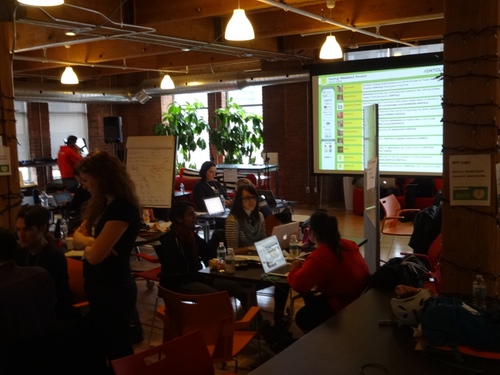
I’m at the Next Web conference in Amsterdam. A large cavern is full of entrepreneurs and Web marketing folks, mainly young. (From my end of the bell curve, most crowds are young.) 2,500 attendees. The pening music is overwhelming loud; I can feel the bass as extra beat in my heart, which from my end of the bell curve is not a good feeling. But the message is of Web empowerment, so I’ll stop my whinging.
Boris Veldhuijzen van Zanten recaps the conference’s 30-hour hackathon. 28 apps. One plays music the tempo of which is based upon how fast you’re driving.
First up is Brewster Kahle [twitter: brewster_kahle], founder of the Internet Archive. [I am a huge Brewster fan, of course.]
Brewster 2011
|
NOTE: Live-blogging. Getting things wrong. Missing points. Omitting key information. Introducing artificial choppiness. Over-emphasizing small matters. Paraphrasing badly. Not running a spellpchecker. Mangling other people’s ideas and words. You are warned, people. |
Brewster begins by saying that the tech world is in a position to redefine how the economy works.
We are now in position to talk about all of things. We can talk about all species, or all books, etc. Can we make universal access to all knowledge? “That’s the Internet dream I signed on for.” A lot of material isn’t on the Internet yet. Internet Archive is a non-profit “but it’s probably the most successful business I’ve run.” IA has all programs for the Apple II, the Atarai, Commodore, etc. IA has 1.5M physical books. “Libraries are starting to throw away books at a velocity.” They’re aiming for 10M books. They have about 1.5M moving images online. “A lot of the issues are working through the rights issues and keeping everyone calm.” 2M auio recordings, mainly live music collections, not CD’s that have been sold. Since 2000 they’ve been recording live tv, 24×7, multiple channels, international. 3m hours of television. They’re making US TV news searcable. “We want to enable everyone to be a Jon Sewart research department.” 3.7M ebooks — 1,500/day. When they digitize a copy that is under copyright, they lend it to one person at a time. “And everyone’s stayed calm.” Brewster thinks 20th century wbooks will never be widely available. And 400B pages available through the Wayback Macine.
So for knowledge, “We’re getting there.”
“We have an opportunity to build on earlier ideas in the software area to build societies that work better.” E.g., the 0.1% in the US sees its wealth grows but it’s flat for everyone else. Our political and economic systems aren’t working for most people. So, we have to “invent around it.” We have “over-propertized” (via Pam Samuelson). National parks pull back from this. The Nature Conservancy is a private effort to protect lande from over-propertization. The NC has more acres than the National Park system.
Brewster wants to show us how to build on free and open software. Brewster worked with Richard Stallman on the LISP Machine. “People didn’t even sign code. That was considered arrogant.” In 1976 Congress made copyright opt out rather than opt in: everything written became copyrighted for life + 50. “These community projects suddenly became property.” MIT therefore sold the LISP Machine to Symbolics, forking the code. Stahlman tried to keep the open code feature-compatible, but it couldn’t be done. Instead, he created the Free Software GNU system. It was a community license, a distributed system that anyone could participate in just be declaring their code to be free software. “I don’t think has happened before. It’s building law structure based on licenses. It’s licenses rather than law.”
It was a huge win, but where do we go from there? Corporate fanaticism about patents, copyright, etc., locked down everything. Open Source doesn’t work well there. We ended up with high tech non-profits supporting the new sharing infrastructure. The first were about administrating free software: E.g., Free Software Foundation, Linux Foundation, LibreOffice, Apache. Then there were advocacy organizations, e.g., EFF. Now we’re seeing these high=tech non=profits going operational, e.g., Wikipedia ($50M), Mozilla ($300M), Internet Archive ($12M), PLoS ($45M). This model works. They give away their product, and they use a community structure under 501c(3) so that it can’t be bought.
This works. They’ve lasted for more than 20 years, wherars even successful tech companies get mashed and mangled if they last 20 years. So, can we build a free and open ecosystem that work better than the current one? Can we define new rules within it?
At Internet ARchive, the $12M goes largely to people. The people at IA spend most of their salaries on housing, up to 60%. Housing costs so much because of debt: 2/3s of the rent you pay goes to pay off the mortgage of the owner. So, how can we make debt-free housing? Then IA wouldn’t have to raise as much money. So, they’ve made a non-proift that owns an apartment building to provide affordable housing for non-profit workers. The housing has a community license so it the building can’t be sold again. “It pulls it out of the market, like stamping software as Open Source.”
Now he’s trying it for banking. About 40% of profits in corporations in the US goes to financial services. So, they built the Internet Credit Union, a non-profit credit union. They opened bitcoins and were immediately threatened by the government. The crdit union closed those accounts but the government is still auditing them every month. The Internet Credit Union is non-profit, member-run, it helps foundation housing, and its not acquirable.
In sum: We can use communities that last via licenes rater than the law.
Q&A
Boris: If you’re a startup, how do you apply this?
A: Many software companies push hard against the status quo. The days are gone when you can just write code and sell it. You have to hack the system. Think about doing non-profit structures. They’ll trust you more.