logo
EverydayChaos
Everyday Chaos
Too Big to Know
Too Big to Know
Cluetrain 10th Anniversary edition
Cluetrain 10th Anniversary
Everything Is Miscellaneous
Small Pieces cover
Small Pieces Loosely Joined
Cluetrain cover
Cluetrain Manifesto
My face
Speaker info
Who am I? (Blog Disclosure Form) Copy this link as RSS address Atom Feed

September 4, 2019

Two bloggers meet again
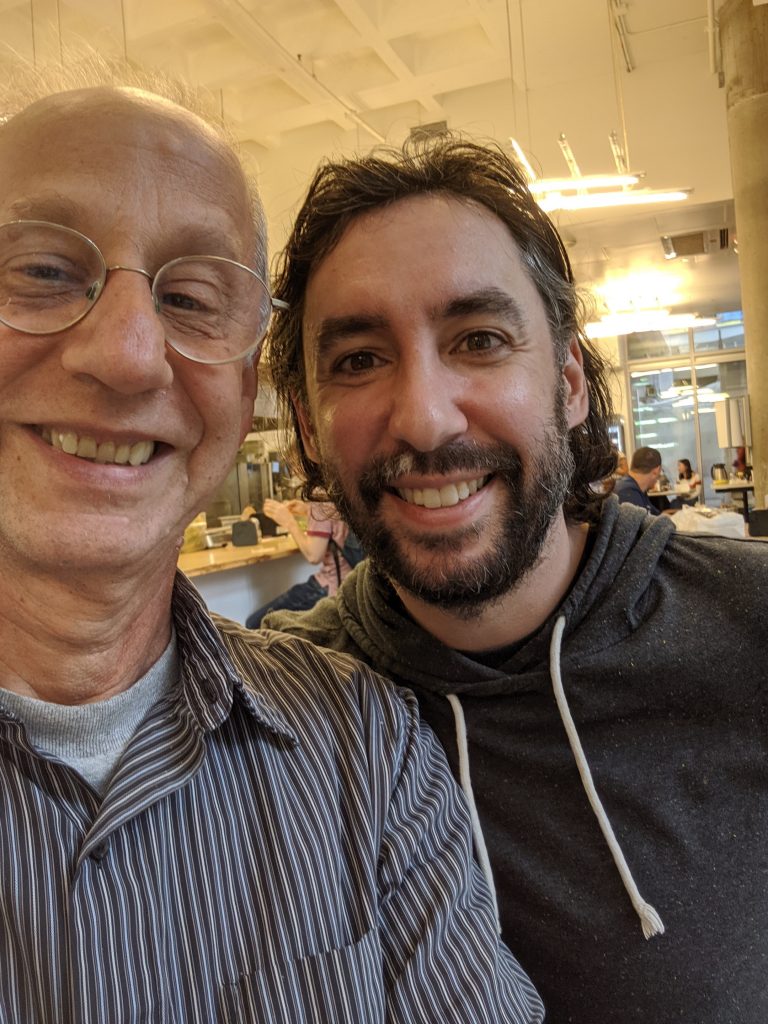
I met Brad Turcotte, who goes by the professional name Brad Sucks, back in the Age of the Blogosphere. He was, and is, an indie musician who embodies the spirit of the open Web. He’s also an awesome song writer, singer, producer, and one man band.

Weirdly, we have been friends since way back when – Why weirdly? Take a look at the photo – although we’ve only met in person twice, including today. Brad was in town, so we had a long beer and a longer conversation. What a pleasure. And, frankly, a privilege.

You should listen to his music because it’s good. You should support him at Patreon because that’s one of the services that actually helps artists. We should all be working to enable creative people like Brad to flourish; he’s what the Web was made for.

Tweet
Follow me

Categories: culture, free culture Tagged with: free culture • music • open web • web Date: September 4th, 2019 dw

Be the first to comment »

December 3, 2016

[liveblog] Kyle Drake: Making the Web Fun again

Kyle Drake, CEO of Neocities, is talking at the Web 1.0 conference. His topic is how to “bring back the spirit of geocities for the modern web.” The talk is on his “derpy” Web site

NOTE: Live-blogging. Getting things wrong. Missing points. Omitting key information. Introducing artificial choppiness. Over-emphasizing small matters. Paraphrasing badly. Not running a spellpchecker. Mangling other people’s ideas and words. You are warned, people.

“When you don’t create things, you become defined by your tastes rather than ability,” said Why the Lucky Stiff. “Remember when everybody created Web sites?” Kyle asks. (He points to a screen capture of Mark Zuckerberg’s homepage, which is still available at the Internet Archive.) In the spirit of fairness, he shows his own first home page. And then some very early 90’s-ish home pages that “highlight the dorkiness of the 90’s Web.”

“They looked bad. But so what? They were fun. They were creative. They were quirky. They were interesting, And what did we replace them with? With a Twitter textbox.” Those textboxes are minimal and the same for everyone. Everyone’s profiles at Facebook has the same categories available.”It seems strange to me that we call that new and Web pages old.”

We got rid of the old Web because it wasn’t profitable. “This isn’t progress. It’s a nightmare. So, how do we take the good things about the old Web and modernize it? How do we bring back the old idea of people creating things and expressing themselves?”

That’s why Kyle founded Neocities. 1. It brings back free home pages. 2. No ads. 3. Protects sites against being shut down. It’s open source, too. It currently hosts 100,000 sites.

“This is not nostalgia,” he says. Web sites do things that social networks can’t. A Web site gives you more control and the ability to be more of who you are, with the confidence that the site will persist. And the good news about persistence is that pages still render, often perfectly, even decades later. Also, the Internet Archive can back them up easily. It also makes it easy to create curated lists and collections.

He’s working with IPFS so that Neocities sites can be community hosted.

QA

Me: How does he sustain it financially?

A: You can be a supporter for $5/month

Tweet
Follow me

Categories: cluetrain, culture, free culture Tagged with: distributed web • indieweb Date: December 3rd, 2016 dw

Be the first to comment »

July 13, 2016

Making the place better

I was supposed to give an opening talk at the 9th annual Ethics & Publishing conference put on by George Washington Uinversity. Unfortunately, a family emergency kept me from going, so I sent a very homemade video of the presentation that I recorded at my desk with my monitor raised to head height.

The theme of my talk was a change in how we make the place better — “the place” being where we live — in the networked age. It’s part of what I’ve been thinking about as I prepare to write a book about the change in our paradigm of the future. So, these are thoughts-in-progress. And I know I could have stuck the landing better. In any case, here it is.

Tweet
Follow me

Categories: free culture, future, open access, philosophy Tagged with: ethics • publishing Date: July 13th, 2016 dw

2 Comments »

June 10, 2016

Building the Open Archive

If you’d like to upload open licensed content to the Internet Archive using your Android phone, install the OpenArchive app. You can do this using the Google Play Store

Jason Griffey and Dan Gillmor have posted about it from the Decentralized Web Summit that I am so sorry I had to miss.

Tweet
Follow me

Categories: free culture, open access Tagged with: decentralized Date: June 10th, 2016 dw

Be the first to comment »

December 13, 2015

From boosting the Net to remembering it

My role on the Net is going through a large swing: from explaining why the Internet is different, important, and (overall) good, to reminding us—especially college-age kids—how different and difficult so many things were before the Net existed.

For example, I gave an informal talk at Tufts last week and a few weeks ago at Emerson College. In both of them, and in the discussions afterwards, I did the Old Man thing of talking about how things were in the pre-Net days. For instance, it used to be that you’d read a newspaper article, have questions and want to know more, and there was no place you could go. You got whatever was in that rectangle of information and that’s all. Shocking! Outrageous!

The two roles are not unrelated: explaining what’s different about the Net and why we should overall be grateful and optimistic about the opportunities it has opened up. But what’s surprising to me is summed up by the comment by one of the Emerson students after the event was officially over: He thanked me for saying positive things about the Net since “All we ever hear is how dangerous it is.”

So, there’s still work to do. Hope over fear. Hope over fear.

Tweet
Follow me

Categories: cluetrain, culture, free culture Tagged with: cluetrain • gratitude • optimism Date: December 13th, 2015 dw

1 Comment »

June 22, 2015

Has the Internet been paved?

Atlantic.com has just posted an article of mine that re-examines the “Argument from Architecture” that has been at the bottom of much of what I’ve written over the past twenty years. That argument says, roughly, that the Internet’s architecture embodies particular values that are inevitably transmitted to its users. (Yes, the article discusses what “inevitably” means in this context.) But has the Net been so paved by Facebook, apps, commercialism, etc., that we don’t experience that architecture any more?

Tweet
Follow me

Categories: culture, free culture, internet, net neutrality, philosophy, social media Tagged with: free culture • selfie • technodeterminism Date: June 22nd, 2015 dw

3 Comments »

February 26, 2015

Literature and Medicine: The syllabus

The superb novelist and teacher Meredith Sue Willis, who is also my sister-in-law, is teaching a course at a local Veterans Administration hospital on literature and medicine. It’s taught to hospital staff after work in the hospital.

Here’s the syllabus, which Sue has put under a Creative Commons license (which is where all syllabi belong, amirite?). It looks like a great set of readings organized around important topics. Isn’t it awesome that we can get curated collections like these from which we can learn and explore?

In fact, it prompted me to start reading The Young Lions, which so far I’m glad I’m doing. Thanks, Sue!

(Ack. I forgot that Sue told me about this because she’s using in the course something I wrote. So I am inadvertently logrolling. But sincerely!)

Tweet
Follow me

Categories: culture, free culture, peace Tagged with: creative commons • literature • logrolling • meredith sue willis • syllabi • teaching Date: February 26th, 2015 dw

4 Comments »

February 19, 2015

The joy of the public domain

When Doc Searls and I published our New Clues, we put it into the public domain. Even two months later, it feels good. In fact, seeing it reprinted in its entirety on someone else’s site fills me with an irrational exuberance.

Normally we would have put it under a Creative Commons BY license that entitles anyone to reuse it in whole or in part so long as they attribute it to us. CC BY is great. It takes the “#1. Ask permission” step out of the process by which what you write can be absorbed by your culture. Or anyone’s culture.

The public domain is different. A CC-BY license keeps a work copyrighted, but permits use without first asking permission. Works in the public domain are not copyrighted. Ok, so it’s more complex than that, but that’s basically it. A work in the public domain is like a folk song: you can sing it, you can change the words, you can record it and charge for the recording, you can print the lyrics on the front of your ice cream containers. You can even claim that you wrote it, although that would be wrong of you.

In practical terms, putting New Clues into the public domain [here’s how] really doesn’t do much that CC BY doesn’t do. Yes, someone could reprint our public domain document without crediting Doc and me, but they could do that with CC BY also — we’d have the right to insist that they provide attribution, but Doc and I are likely to use moral suasion in either case, by which I mean that we’d write a polite email to the evil doer. So, pragmatically, there isn’t much difference.

So why does putting it into the public domain make me happier? I get as close to smiling as my stony visage permits when I see a site that’s copied and pasted the whole thing. It makes it feel that what Doc and I wrote was really about what it says and less about what the writing says about Doc and me. The focus is where it should be.

And it feels deeply good to know that we have created something that can spread as far and deeply into the culture — and thus into people’s lives — as our culture wants. The only barriers are those of interest. And we’re not going to try to tease you with a snippet, with a taste. Not interested? Fine. It’s still there for anyone who is.

I expressed this to Peter Suber, who is dedicated full time to expanding the sphere and influence of Open Access works. Peter pointed out that my reaction rests in part on the privileged position I occupy: I can do some writing for free, and because Doc and I are known a bit within the domain of people who blab about the Internet, there’s a disincentive for people who might want to pass off our words as our own. If we were, say, unknown high school students it’d be easier for someone to get away with crudely plagiarizing our work. True enough.

Even so, putting work into the public domain feels good. I recommend you try it.


Peter Hirtle points out that Creative Commons 0 isn’t exactly the same as public domain, although functionally it’s identical. The whole question of trying to eliminate all copyright interests in a work is vexed. Peter points here for details and evidence of the complexity of the issue. Thanks, Peter!

Tweet
Follow me

Categories: copyright, culture, free culture Tagged with: copyleft • copyright • copywrong • creative commons • new clues • open access Date: February 19th, 2015 dw

3 Comments »

February 2, 2015

Future of libraries, Kenya style

This video will remind you, if you happen to have forgotten, what libraries mean to much of the world:

Internet, mesh, people eager to learn, the same people eager to share. A future for libraries.

You can contribute here.

Tweet
Follow me

Categories: culture, free culture, free-making software, libraries, open access Tagged with: kenya • libraries • Nairobi • open access • open culture Date: February 2nd, 2015 dw

Be the first to comment »

January 20, 2015

Fargo: an open outliner

Dave Winer loves outlines. I do, too, but Dave loves them More. We know this because Dave’s created the Fargo outliner, and, in the way of software that makes us freer, he’s made it available to us to use for free, without ads or spyware, and supporting the standards and protocols that make our ideas interoperable.

Fargo is simple and straightfoward. You enter text. You indent lines to create structure. You can reorganize and rearrange as you would like. Type CMD-? or CTL-? for help.

Fargo is a deep product. It is backed by a CMS so you can use it as your primary tool for composing and publishing blog posts. (Dave knows a bit about blogging, after all.) It has workgroup tools. You can execute JavaScript code from it. It understands Markdown. You can use it to do presentations. You can create and edit attributes. You can include other files, so your outlines scale. You can includes feeds, so your outlines remain fresh.

Fargo is generative. It supports open standards, and it’s designed to make it easy to let what you’ve written become part of the open Web. It’s written in HTML5 and runs in all modern browsers. Your outlines have URLs so other pages can link to them. Fargo files are saved in the OPML standard so other apps can open them. The files are stored in your Dropbox folder , which puts them in the Cloud but also on your personal device; look in Dropbox/Apps/smallpicture/. You can choose to encrypt your files to protect them from spies. The Concord engine that powers Fargo is Open Source.

Out of the box, Fargo is a heads-down outliner for people who think about what they write in terms of its structure. (I do.) It thus is light on the presentation side: You can’t easily muck about with the styles it uses to present various levels, and there isn’t an embedded way to display graphics, although you can include files that are displayed when the outline is rendered. But because it is a simple product with great depth, you can always go further with it.

And now matter how far you go, you’ll never be locked in.

Tweet
Follow me

Categories: free culture, free-making software, interop, reviews Tagged with: dave winer • outliners • word processing Date: January 20th, 2015 dw

1 Comment »

« Previous Page | Next Page »


Creative Commons License
This work is licensed under a Creative Commons Attribution-NonCommercial-ShareAlike 3.0 Unported License.
TL;DR: Share this post freely, but attribute it to me (name (David Weinberger) and link to it), and don't use it commercially without my permission.

Joho the Blog uses WordPress blogging software.
Thank you, WordPress!