


logo
EverydayChaos
Everyday Chaos
Too Big to Know
Too Big to Know
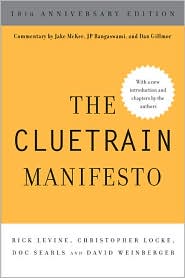
Cluetrain 10th Anniversary edition
Cluetrain 10th Anniversary
Everything Is Miscellaneous
Small Pieces cover
Small Pieces Loosely Joined
Cluetrain cover
Cluetrain Manifesto
My face
Speaker info
Who am I? (Blog Disclosure Form) Copy this link as RSS address Atom Feed

June 6, 2023

Apple’s Vision Pro intro video is the product

The Apple Vision Pro launch video is a timelessly great example of its kind. Indeed, With a $3,500 price tag for what is essentially a display,  the video is the actual product: it claims a new space for Apple.

At first glance, I was disappointed and skeptical: a cumbersome headset so I can watch a 2D virtual display? But it’s been so thoughtfully designed; they have, it seems, thought of everything. The video counters every objection that springs to mind. Do you want to show up in a Facetime with the dumb visor on? Oh, it erases it through the magic of AI! You want to be able to interact with real people in your physical space? Translucence to the rescue. So, good job, Apple!

I was impressed by the video under-selling its 3D capabilities. That took a lot of marketing restraint. But it would have distracted from what’s actually new: Apple’s intense focus on what makes this thing useful now with the software tools we have and with the way we work now, even though that won’t justify the price for hardly any of us.

At what price would I buy one? I won’t know until I try one, which I suppose is one mark of a genuinely innovative product. 


The Apple video in many ways reminds me of Bruce Tognazzini’s 1992 “StarFire” video that sketched a headset-free virtual workspace. It, however, was purely visionary with no product in sight. (Tog provides context for the video here.)


Tweet
Follow me

Categories: cluetrain, marketing, reviews, tech Tagged with: cluetrain • marketing • vr Date: June 6th, 2023 dw

3 Comments »

February 22, 2023

Section 230: The Internet, Categorization, and Rorty Rorty

Topic: The Supreme Court is hearing a case about whether section 230 exempts Google from responsibility for what it algorithmically recommends.

A thought from one of my favorite philosophers, Richard Rorty:

Photo of Richard Rorty

Rortiana, CC BY-SA 4.0 https://creativecommons.org/licenses/by-sa/4.0,
via Wikimedia Commons

“…revolutionary achievements in the arts, in the sciences, and the moral and political thought typically occur when somebody realizes that two or more of our vocabularies are interfering with each other, and proceeds to invent a new vocabulary to replace both… The gradual trial and error creation of a new, third, vocabulary… is not a discovery about how old vocabularies fit together… Such creations are not the result of successfully filling together pieces of a puzzle. They are not discoveries of a reality behind the appearances, of an undistorted view of the whole picture with which to replace myopic views of its parts. The proper analogy is with the invention of new tools to take the place of old tools.” — Richard Rorty,  Contingency, Irony, and Solidarity, 1989, p. 12

We’ve had to invent a new vocabulary to talk about these things: Is a website like a place or a magazine?  Are text messages like phone calls or telegrams? Are personal bloggers journalists [a question from 2004]?

The issue isn’t which Procrustean bed we want to force these new entries into, but what sort of world we want to live in with them. It’s about values, not principles or definitions. IMUOETC (“In my uncertain opinion expressed too confidently”)

A person being stretched to fit into Procrustes' bed. Tall people had their legs shortened by axe to get them to fit.

Procruste’s bed. And this is better than being too tall for it :(

A point all of this misses: “Yo, we’re talking about law here, which by its nature requires us to bring entities and events under established categories.”

Tweet
Follow me

Categories: cluetrain, culture, everyday chaos, everythingIsMiscellaneous, internet, law, philosophy Tagged with: 230 • digital culture • internet • law • media • social media • supreme court Date: February 22nd, 2023 dw

Be the first to comment »

October 29, 2022

Why I liked Twitter

I’ve been on Twitter for a long time. A very long time. In fact, I was introduced to it as a way for a bunch of friends to let one another know what bar they were about to go to. It seems to have strayed from that vision a bit.

I have not yet decided to leave it, although I’m starting to check in at Mastodon. Here’s what I use it for, in no particular order, and not without embarrassment:

  • Quick check on breaking news. It’s by no means comprehensive, and what trends is by no means always important. But I find some of it worth a click even as a distraction.
  • Quick commentary on issues of the day by people I follow because they’re good at that.
  • Issues worth knowing about raised by strangers who know about them.
  • Keeping up with fields I’m interested in by following people who I don’t know, as well as some I do.
  • Engaging with people I otherwise wouldn’t have kept up with.
  • There are people I know just barely in real life who I feel quite close to after many years on Twitter together. 
  • Engaging with a low bar of social inhibition/anxiety with people I don’t know, sometimes leading to friendships. 
  • An outlet for my stray thoughts and, well, jokes.
  • A medium by which I can publicize stuff I write.
  • A number I can cite to publishers as if people automatically read the stuff of mine I’m publicizing on Twitter.
  • The Twitter I’m on is often very funny.

Switching social platforms is hard.

Tweet
Follow me

Categories: cluetrain, free culture, social media Tagged with: social media • twitter Date: October 29th, 2022 dw

2 Comments »

December 22, 2021

Chris Locke, RIP

I do not like writing about the death of friends because it feels foolish to the point of arrogance to pretend to capture what we’ve lost. But I want to talk about Chris, so I will, without pretense of capturing anything at all…

I met Chris Locke, aka Rageboy (RB) aka Kat Herding, in the late 1990s. I was writing a newsletter (“Journal of the Hyperlinked Organization”). He was writing a newsletter (“Entropy Gradient Reversals”). Doc Searls was writing a newsletter (“Reality 2.0”); I can’t find the newsletter, so here’s his blog.  Chris thought Doc and I would get along, so he introduced us. The three of us, along with Rick Levine, ended up co-writing The Cluetrain Manifesto, which did well enough to let me give myself permission to call myself a writer. The book changed my life, and much of its success was due to its voice which came straight from Chris. 

Chris was a prodigiously talented writer. Here’s a sample of Chris flapping his wings; it may not be the best way of introducing his writing style, but I honestly don’t know what would be. Doc and I figure that he wrote the sample a few months after he was diagnosed with emphysema.

He loved the Internet deeply because it seemed to be an epochal opportunity to break the oppressiveness of industrial capitalism. This in turn mattered to him because he yearned for the release of the creativity and goodness and connection that he was sure every pair of manacled hands was reaching for. (Yes, he and the rest of the Internet hippies like me were wrong about that in important ways. Long discussion for another day.)

Chris was a complicated person. An autodidact. Publicly abrasive and fearless, and sometimes reckless. Privately and personally kind and modest. Undisciplined in some of his writing — a strength as well as a weakness — but highly disciplined in important aspects of his private life. As a self-termed gonzo writer, he likely would have liked to have been Hunter S. Thompson if Thompson hadn’t already taken the job.

Chris was wonderful to hang out with in person, but the Internet friends that gathered around him were a truly intimate social group, supporting him through his long illness, especially it seems to me the women. He and I fell out of touch, to my shame and regret. Nevertheless, his insights about the positive social nature of the Internet were not entirely wrong, at least for him. And his fierce, unrelenting yawp against the dark industrial forces that grind up so many good souls is piercing, needed, and true.

Chris was a character, fully formed yet becoming, his flaws an integral part of his being. I love him, owe him, and miss him.

Twitter: @KatHerding  Facebook: @KatHerding

I just read Doc Searls’ superb post about Chris.

Please read Liz Locke’s comment below.

RageBoy on a silly postage stamp.
No recollection
why I made this
Tweet
Follow me

Categories: cluetrain, personal Tagged with: christopher locke • cluetrain • rageboy Date: December 22nd, 2021 dw

10 Comments »

April 25, 2020

As Einstein once said, messages make markets

My favorite Einstein quote is the one that says, it is the theory that determines the data.  ;-)

So writes someone to a mailing list I’m on. I couldn’t find a source for that, but it might derive from this Einstein quotation:

Whether you can observe a thing or not depends on the theory which you use. It is the theory which decides what can be observed.

 Unification of Fundamental Forces (1990) by Abdus Salam ISBN 0521371406, page 99, related by Heisenberg.

(By the way, my quick Internet “research” turned up no reliable sources for a related quotation often attributed to Marshall McLuhan: “I wouldn’t have seen it if I hadn’t believed it.” It sounds like him, though.)

But no matter. What I really want to talk about is how the Einstein quotation applies to marketing:

Messages create markets.

This is I think quite literally the case in the pre-personalization view of markets as corresponding to demographic slices. The particular demographics that are assumed to constitute a market are the ones that are believed to be susceptible to the same broadcast message. If white adolescents are thought to respond to “Be a Pepper”, then they are a market. If suburban dads are susceptible to “Come alive with Subaru!”, then they are a market. If short baseball fans are not susceptible to the same message, they are not a market.

Such markets have no reality other than their susceptibility to a message. If and when (= now) messages can be delivered to, and even designed for, based on particular traits, preferences, and behaviors of individuals,  “markets” ?cease to exist. Since personalization can more effectively play on human susceptibility to non-rational appeals, many of us, including me, are of course disturbed about this development. 

But there is another side of this as well.  As Doc Searls once said, markets are conversations. If customers and users now talk with one another about the things they want to buy and have bought, then markets once again have some actual reality. The fact that these conversations occur in and on networks makes these markets fluid but does not make them less real.

Tweet
Follow me

Categories: business, cluetrain, marketing Tagged with: cluetrain • einstein Date: April 25th, 2020 dw

Be the first to comment »

April 7, 2020

A message from Johan

Dear David,

On behalf of everyone at easyJet, I hope you and your loved ones are healthy and safe at this time.

I wanted to write to you to let you know what’s been happening at easyJet.

Dearest Johan,

I cannot express the relief that swept over me when I saw your message in my inbox. And how like you to worry about me and my family above all else. My dear, dear Johan.

It instantly reminded me of the time four years ago when I took my only trip on easyJet and the very kind flight attendant stood up in front of all the passengers and assured us in the very sweetest of words that everyone at easyJet cares most about our safety… and then proved it by showing us how to operate the safety belts provided to each and every one of us, for free.

I knew then that EZJet, under your stewardship, was a member of our family.

And our family is doing well, given the circumstances.

As luck would have it, the call for self-isolation came when we were visiting Jack and Lucy and their five little ones in Worchester. (Mindy, bless her heart, insists on calling it Wor-chest-er because, as she says — maybe once too often, to tell the truth — would you call someone named Chester “Er”?)

It’s great to get to spend so much time with the grandkids 24/7 and weekends don’t exist anymore. We feel like we’ve really gotten to know them, especially Lilly, the middle child. Seven can be a tough age when you’re an energetic little tyke with no real interests other than dominance, locked in a house with a mother whose patience wore thin about six hours into the whole ordeal. Not that Lucy is a bad mother. She’s wonderful a good amount of the time and Jack still seems to love her.

For the past five weeks Mindy and I have only gone out three times to bring in some items that Jack and Lucy have forgotten to pick up for us on their grocery runs. You would have laughed to see the look on the face of the clerk at the liquor store when Mindy walked in dressed for a blizzard, with a full roll of toilet paper wrapped around her face. By the time she got home with her haul — Jack won’t let us use their car because of an article he read on the Internet — she had soaked through most of the TP and it took forever to comb it out of her hair. At least she combed her hair — it took three of us — for the first time in three weeks. When one door closes, a window opens, as they say. Everything has its positive side.

Although we’re struggling to find one in the passing of Mindy’s beloved Uncle Luke from the virus. Did you know that he landed at Normandy when he was just 17? Sorry to spring this on you, but I knew you’d want to know.

We have comforted ourselves by recalling that easyJet flight. We remember the conversations we had about whether the low cost of the flight was worth the trip to an airport an hour and a half away, which meant getting up at 2AM for a 5:30AM flight. And then Mindy and I laugh remembering learning all the things the ticket price didn’t cover. Not even a choice of seats! It was a wondrous journey of discovery for which we will always be grateful, dearest Johan.

The flight itself was a once-in-al-lifetime adventure. You took us literally miles above our beautiful blue pearl, as someone on TV once said. (I think it was Kermit the Frog but Mindy says it was a human impersonating him.) Anyway, you gave us the gift of flight, Johan, and we shall treasure it forever. Compared to that, Mindy’s lost suitcase is just earth-bound baggage. Literally, actually.

But enough about us, Johan. We appreciate all of the travails you yourself are suffering and tell us about in such a strong, calm voice: the long hold times that must frustrate your phone support people terribly, the suspension of flights that keep you from soaring like the eagle that is you spirit animal. Eagles don’t give us free snacks or carry our baggage without ever dropping a piece or two!

Please give our love and best wishes to every member of the easyJet family. We don’t know how you fit them all into your flat — that’s English for “apartment” — but we are sure that spirits are high, and we hope that you managed to grab enough snacks and those little bottles of liquor to keep everyone going as long as their credit cards keep working.

God bless you, sweet Johan. We miss you!

Your passengers forever,

Hal and Mindy

Tweet
Follow me

Categories: cluetrain, humor, marketing Tagged with: coronavirus • covid-19 • humor • marketing Date: April 7th, 2020 dw

2 Comments »

March 14, 2018

Big honor to Cluetrain

The Chartered Institute of Public Relations today gave the Cluetrain Manifesto its Presidents Medal. The announcement is here.

This is a huge honor and a big deal. CIPR is the largest professional association for PR folks in Europe.

Former recipients include — get ready for this —

  • Sir Tim Berners Lee

  • Archbishop Desmond Tutu

  • Princess Anne

  • Prince Philip

Yup, those are now my peeps.

Background: The Cluetrain site went up in 1999 — yes, almost 20 yrs ago — and we turned it into a book in 2000. (The “we” is Doc Searls, Rick Levine, Christopher Locke, and me.) It was an attempt to explain to media and businesses why people like us were so enthusiastic about this new Web thing: it is a place where we get to talk about what mattered to us and to do so in our own voice. That is, it’s a social space, which, surprisingly, was news to much of the media and many businesses. The best-known line from it is Doc’s: “Markets are conversations.”

For the occasion, they asked me to video a talk which is here and is 45 mins long. On the other hand, they wrote up an extensive summary, which should save you north of 42 mins. ( Why me? Pretty random: I was the Cluetrain point person for this.)

Cluetrain got important things wrong, but it also got important things right. CIPR has honored Cluetrain, I believe, as a way of honoring what is right and good about the Web. Still.

Tweet
Follow me

Categories: cluetrain Tagged with: cluetrain Date: March 14th, 2018 dw

1 Comment »

April 12, 2017

The CluePlane Manifesto

(An unauthorized, unapproved homage to The Cluetrain Manifesto).
bi-plane

A powerful global reaccommodation has begun. Corporations are rediscovering themselves in their muscular masculinity. For we are the makers, the takers, and above all else, we are the winners. Customers, employees, the needy, the vulnerable are, by definition, the losers. Each one of them would gladly trade their seat for one of the tufted leather chairs in our CEO’s office. Instead, make sure your pathetic seatbacks are returned to their upright position, your trays are stowed, and you’re buckled in. For this is your pilot speaking, and we’re ready to fly the friendly skies of “PUT YOUR HANDS WHERE I CAN SEE THEM, MOTHERFUCKER!”

  1. Markets are reaccommodations.

  2. There’s the crew and there’s the screwed. Deal with it.

  3. When jack-booted thugs rough up paying passengers and drag them from your plane, it’s time for the CEO to step up and declare that there’s two sides to every story.

  4. There’s no customer need that cannot be met by a bag of off-brand peanuts.

  5. Customers of course have rights. But only once they have lawyers.

  6. Think of it like this: Boarding a airplane is like opening a shrink-wrapped product, an act that involuntarily voids all your rights. Except boarding a plane means also giving up the shreds of human dignity we didn’t already strip from you during the nudie scan, the TSA ritual ball or tit squeeze, the routine totally un-profiled examination of the darker-hued among us, the lack of sufficient seats in the boarding area, the unexplained delays, and the segregation into social strata announced over the PA. Also, I think we may have missed a spot in your rectum.

  7. Costs have gone up while fuel prices and basic services have gone down, yet more and more people are flying. Therefore, passengers must love us more than ever. You can’t argue with math!

  8. Virtually no other industry uses overbooking as a routine best practice because they don’t love their customers are much as we do.

  9. “First they came for my free crappy meal, and I said nothing. Then they came for my carry-ons, and I said nothing. Then they just said ‘Fuck it’ and came for the guy sitting next to me and dragged him off the plane by the ankles. And I said something, and I video-ed it and I posted it.” Sorry, I couldn’t hear you. I’ve got a corporate reputation to maintain.

  10. Every act of corporate brutality can be fixed by combining the power of euphemism with the audacity of neologism, catalyzed by a really expensive blue suit.

  11. It’s great to know that we’re making our employees so proud! Right, gang? Gang?

  12. Hey, it’s us against them, where “them” are the customers, right, gang? Oh, c’mon, gang, quit kidding around!

  13. You know who’s the victim here? The shareholders. How about some sympathy for them, eh?

  14. Y’know, it’d be a lot easier for us to fly empty planes and not have to deal with you all. You’re welcome. Ingrates.

  15. Hey, catch! Here’s your guitar. Sorry-not-sorry for the crushing.

  16. Have a bag of last year’s peanuts, on us.


Notes

1. No official affilliation with Cluetrain.

2. Thanks to Frank Scavo (@fscavo) and Alan Lepofsky (@alanlepo) for the prod and the idea.

3. Also posted at Medium

4. Photo posted to Pixabay by JayClark1. CC0 – Public Domain.

Tweet
Follow me

Categories: cluetrain, humor, marketing Tagged with: airplanes • marketing • united Date: April 12th, 2017 dw

3 Comments »

February 18, 2017

The Keynesian Marketplace of Ideas

The awesome Tim Hwang (disclosure: I am a complete fanboy) has posted an essay
arguing that we should take something like a Keynesian approach to the “marketplace of ideas” that we were promised with the Internet. I think there’s something really helpful about this, but that ultimately the metaphor gets in the way of itself.

The really helpful piece:

…our mental model of the marketplace of ideas has stayed roughly fixed even as the markets themselves have changed dramatically.

…I wonder if we might take a more Keynesian approach to the marketplace of ideas: holding that free economies of ideas are frequently efficient, and functional. But, like economic marketplaces, they are susceptible to persistent recessions and bad, self-reinforcing equilibria that require systemic intervention at critical junctures.

This gives us a way to think about intervening when necessary, rather than continually bemoaning the failure of idea markets or, worse, fleeing from them entirely.

The analogy leads Tim to two major suggestions:

…major, present day idea marketplaces like Facebook are not laissez-faire. They feature deep, constant interventionism on the part of the platform to mediate and shape idea market outcomes through automation and algorithm. Digital Keynesians would resist these designs: marketplaces of ideas are typically functional without heavy mediation and platform involvement, and doing so creates perverse distortions. Roll back algorithmic content curation, roll back friend suggestions, and so on.

Second, we should develop a

clearer definition of the circumstances under which platforms and governments would intervene to right the ship more extensively during a crisis in the marketplace.

There’s no arguing with the desirability of the second suggestion. In fact, we can ask why we haven’t developed these criteria and box of tools already.

“ a way to think about intervening, rather than bemoaning the failure of idea markets”The answer I think is in Tim’s observation that “marketplaces of ideas are typically functional without heavy mediation and platform involvement.” I think that misses the mark both in old-fashioned and new-fangled marketplaces of ideas. All of them assume a particular embodiment of those ideas, and thus those ideas are always mediated by the affordances of their media — one-to-many newspapers, a Republic of Letters that moves at the speed of wind, even backyard fences over which neighbors chat — and by norms and regulations (or architecture, law, markets, and norms, as Larry Lessig says). Facebook and Twitter cannot exist except as interventions. What else can you call Facebook’s decisions about which options to offer about who gets to see your posts, and Twitter’s insistence on a 140 character limit? It seems artificial to me to insist on a difference between those interventions and the algorithmic filtering that Facebook does in order to address its scale issues (as well as to make a buck or two).

As a result, in the Age of the Internet, we have something closer to a marketplace of idea marketplaces “we have something closer to a marketplace of idea marketplaces” that span a spectrum of how laissez their faire is.[note.] (I know that’s wrong) These marketplaces usually can’t “trade” across their boundaries except in quite primitive ways, such as pasting a tweet link into Facebook. And they don’t agree about the most basic analogic elements of an economy: who gets to participate and under what circumstances, what counts as currency, what counts as a transaction, how to measure the equivalence of an exchange, the role of intermediaries, the mechanisms of trust and the recourses for when trust is broken.

So, Twitter, Facebook, and the comments section of Medium are all mediated marketplaces and thus cannot adopt Tim’s first suggestion — that they cease intervening — because they are their policies and mechanisms of intervention.

That’s why I appreciate that towards the end Tim wonders, “Should we accept a transactional market frame in the first place?” Even though I think the disanalogies are strong, I will repeat Tim’s main point because I think it is indeed a very useful framing:

…free economies of ideas are frequently efficient, and functional. But, like economic marketplaces, they are susceptible to persistent recessions and bad, self-reinforcing equilibria that require systemic intervention at critical junctures.

I like this because it places responsibility — and agency — on those providing a marketplace of ideas. If your conversational space isn’t working, it’s your fault. Fix it.

And, yes, it’d be so worth the effort for us to better understand how.

Tweet
Follow me

Categories: cluetrain Tagged with: conversation • facebook • markets • twitter Date: February 18th, 2017 dw

2 Comments »

December 3, 2016

[liveblog] Kyle Drake: Making the Web Fun again

Kyle Drake, CEO of Neocities, is talking at the Web 1.0 conference. His topic is how to “bring back the spirit of geocities for the modern web.” The talk is on his “derpy” Web site

NOTE: Live-blogging. Getting things wrong. Missing points. Omitting key information. Introducing artificial choppiness. Over-emphasizing small matters. Paraphrasing badly. Not running a spellpchecker. Mangling other people’s ideas and words. You are warned, people.

“When you don’t create things, you become defined by your tastes rather than ability,” said Why the Lucky Stiff. “Remember when everybody created Web sites?” Kyle asks. (He points to a screen capture of Mark Zuckerberg’s homepage, which is still available at the Internet Archive.) In the spirit of fairness, he shows his own first home page. And then some very early 90’s-ish home pages that “highlight the dorkiness of the 90’s Web.”

“They looked bad. But so what? They were fun. They were creative. They were quirky. They were interesting, And what did we replace them with? With a Twitter textbox.” Those textboxes are minimal and the same for everyone. Everyone’s profiles at Facebook has the same categories available.”It seems strange to me that we call that new and Web pages old.”

We got rid of the old Web because it wasn’t profitable. “This isn’t progress. It’s a nightmare. So, how do we take the good things about the old Web and modernize it? How do we bring back the old idea of people creating things and expressing themselves?”

That’s why Kyle founded Neocities. 1. It brings back free home pages. 2. No ads. 3. Protects sites against being shut down. It’s open source, too. It currently hosts 100,000 sites.

“This is not nostalgia,” he says. Web sites do things that social networks can’t. A Web site gives you more control and the ability to be more of who you are, with the confidence that the site will persist. And the good news about persistence is that pages still render, often perfectly, even decades later. Also, the Internet Archive can back them up easily. It also makes it easy to create curated lists and collections.

He’s working with IPFS so that Neocities sites can be community hosted.

QA

Me: How does he sustain it financially?

A: You can be a supporter for $5/month

Tweet
Follow me

Categories: cluetrain, culture, free culture Tagged with: distributed web • indieweb Date: December 3rd, 2016 dw

Be the first to comment »

Next Page »


Creative Commons License
This work is licensed under a Creative Commons Attribution-NonCommercial-ShareAlike 3.0 Unported License.
TL;DR: Share this post freely, but attribute it to me (name (David Weinberger) and link to it), and don't use it commercially without my permission.

Joho the Blog uses WordPress blogging software.
Thank you, WordPress!