


logo
EverydayChaos
Everyday Chaos
Too Big to Know
Too Big to Know
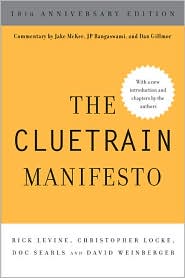
Cluetrain 10th Anniversary edition
Cluetrain 10th Anniversary
Everything Is Miscellaneous
Small Pieces cover
Small Pieces Loosely Joined
Cluetrain cover
Cluetrain Manifesto
My face
Speaker info
Who am I? (Blog Disclosure Form) Copy this link as RSS address Atom Feed

January 30, 2009

Pew Excellence in Journalism now watching blogs

Pew’s Research Center for Excellence in Journalism has now added a weekly new media report on what the ol’ blogosphere is blathering on about. That’s you and me, sister. Or what most people indexed by Technorati and Icerocket are talking about, anyway. For example, we seem to have focused a lot on Obama’s inauguration. (Wasn’t that three months ago? Time doesn’t fly when the Republicans are insisting on their old partisan ways.)

And here’s a hasty conclusion from the first week’s report: We bloggers really need to be reading Global Voices in order to get our gazes up from our American innie navels.

[Tags: pew blogging new_media citizen_journalism ]

Tweet
Follow me

Categories: blogs Tagged with: blogging • blogs • bridgeblog • media • pew Date: January 30th, 2009 dw

Be the first to comment »

January 13, 2009

Inaugural legal guide for citizen media

Berkman’s Citizen Media Law Project has published a guide for bloggers, twitterers, and other citizen media folks on the rights and restrictions of those documenting the inauguration.

[Tags: citizen_media journalism blogging inauguration berkman ]

Tweet
Follow me

Categories: blogs Tagged with: berkman • blogging • blogs • inauguration • journalism • media Date: January 13th, 2009 dw

Be the first to comment »

January 10, 2009

Here’s something you don’t hear every day

Feeling enabled by magcloud — a you-do-the-content-and-we’ll-do-the-rest service — Shannon Clark is thinking of starting a magazine. An actual magazine, with articles and pages and possibly staples. It’ll be on things he finds interesting and aims at being high-quality stuff with a relatively long shelf life.

This is the sort of thing that shouldn’t work, and then on rare occasions does.

[Tags: magazines media shannon_clark magcloud ]

Tweet
Follow me

Categories: blogs Tagged with: blogs • everythingIsMiscellaneous • magazines • magcloud • media Date: January 10th, 2009 dw

Be the first to comment »

January 5, 2009

Alternative voices

Habib Battah has an op-ed in Al Jazeera about the disparity between the American media coverage of the Israeli invasion and the Arab world’s. And there’s always Global Voices if you want to hear what bloggers in the region are saying.

[Tags: israel gaza palestine media news ]

Tweet
Follow me

Categories: blogs Tagged with: blogs • bridgeblog • gaza • israel • media • news • palestine Date: January 5th, 2009 dw

1 Comment »

January 4, 2009

Getting past the self-reflexive beginning

A tweet from Jeff Jarvis:

My son says his problem with Twitter is too much Twittering about Twitter. Judging by today, he’s right. And I just added to it.

That used to be the case with blogging when it first started. Every other post (including mine) was about blogging. Blog blog blog blog.

If you want to get out ahead of the curve when the next new social writing phenomenon happens, be the one who never writes about it.

(BTW, I’m dweinberger at Twitter.)

[Tags: tic_tac_toe christmas ]

Tweet
Follow me

Categories: blogs Tagged with: blogs • christmas • digital culture • social networks Date: January 4th, 2009 dw

4 Comments »

December 19, 2008

Support GlobalVoices

GlobalVoices needs your help. Need convincing? Check out GV’s bloggage about the Mumbai attack. Or, perhaps more important, check GV any day. The world speaks at GV. Worth a listen. Worth some support. [Disclosure: I’m a volunteer adviser.]

[Tags: berkman globalvoices gv global_voices blogs bridgeblogs ]

Tweet
Follow me

Categories: blogs Tagged with: berkman • blogs • bridgeblog • bridgeblogs • globalvoices • gv • peace Date: December 19th, 2008 dw

Be the first to comment »

December 18, 2008

Media Re:Public from Berkman

The Berkman Center’s Media Re:Public project assessing the state of the media (old school and citizen/participatory) is now out. (The papers are here.)

The report points to six issues, which I’m paraphrasing rather crudely:

1. Traditional media are scaling back their reporting because they’re going broke.

2. Their webby equivalents are not replacing all their functions.

3. Online news sources are not uniformly reliable, and not everyone knows that.

4. Not everyone is online anyway.

5. Some of the functions not being replaced online are really important, but we don’t yet have good business models for them.

6. We don’t have good data about what’s really going on.

This status report tries to bring some empiricism to the cheerleading (guilt as charged). It also pairs up nicely with a 2005 report about a Berkman conference that brought bloggers and mainstream journalists together for 1.5 days of frank discussions.

[Tags: berkman media citizen_journalism blogging news newspapers participatory_journalism persephone_miel ]

Tweet
Follow me

Categories: blogs Tagged with: berkman • blogging • blogs • digital culture • everythingIsMiscellaneous • media • news • newspapers Date: December 18th, 2008 dw

Be the first to comment »

November 27, 2008

Control doesn’t scale

I sometimes put up a Powerpoint (well, Keynote) slide that says “Control doesn’t scale.”The assumption that large projects only succeed if they’re centrally controls led and managed turns out to have been true because we limited the scope of what we we considered realistic. You can build a Britannica using a centrally controlled system, but you could not build a Wikipedia that way.

But I know that there are some important counter-examples, so I’ll frequently add, “Except at an huge cost in expense and freedom,” for we know all too well that some regimes have managed to maintain intense control over massive populations for generations.

Today there’s an interview in the Sydney Morning Herald with Isaac Mao, pioneering Chinese blogger and Berkman fellow, in which he says the Chinese authorities are unable to keep up with increasing volume of social communications the 108M bloggers, millions in social networks, and people texting and twittering away.

So, maybe control doesn’t scale after all.

[Tags: isaac_mao control china berkman ]

Tweet
Follow me

Categories: blogs Tagged with: berkman • blogs • bridgeblog • china • control • digital culture • everythingIsMiscellaneous • globalvoices • peace • social networks Date: November 27th, 2008 dw

6 Comments »

November 25, 2008

[berkman] Antony Loewenstein on blogging in rerpressive regimes

Antony Loewenstein is giving a Berkman Center lunchtime talk on “The Blogging Revolution: Going Online in Repressive Regimes.” He begins by reading a short paper. [Note: I’m live-blogging. Getting it wrong, Missing stuff. And this comes out far choppier than the actual discussion.]

In the paper he says that bloggers are at risk of being silenced in repressive regimes In Antony’s home, Australia, the PM is proposing filtering child porn and “excessively violent” sites. There has also been talk of blocking euthanasia and pro-anorexia sites. Wha next? Block Hamas sites? (Antony does not consider Hamas to be a terrorist group.) Despite all this, Australia isn’t one of the more repressive regimes when it comes to the Net. Antony’s book looks at bloggers’ attitudes toward their governments. E,.g., bloggers in the Middle East generally are angry at their governments for repressing the rise of Islamic government. There is a widespread desire to make incremental change without government involvement. Bloggers everywhere are unpacking issues governments would rather hide from view. “Blogging is not in itself revolutionary but the act of expressing yourself online can be.” Many of the bloggers he met with were aware of their international audience and hoped that would bring pressure on their regimes. They are also angry at global companies such as Microsoft, Yahoo, and Google in enabling the restrictions on the Net. “International laws and norms must be applied.” We need ethical labeling on media, as we have Fair Trade labels. And it’s not just other countries that we need to worry about it. Sen. Lieberman pressured YouTube to remove videos from supposedly Islamic fundamentalist terrorists. Blogging lets people write and publish without a Western filter.”

Q: [ethanz] In your book, you look at how the rest of the world gets filtered by the Western media. You say that the blogosphere lets people see the world unfiltered. But, people aren’t queueing up to read international blogs. There isn’t enough demand for it. What’s an ideal relationship among the people raising their voices — probably not in English — and the people around the world who could change policy and structure?
A: The bloggers I met with have very popular sites within their own country. Part of my job as a journalist is to talk with other journalists and tell them they ought to be paying more attention to these voices. It doesn’t mean that they will, but it’s likely these people will have an effect. During the Olympics, over Tibet, bloggers on both sides were shouting across each other. For one thing, language is a key problem. On the positive side, newspapers ran what Arab bloggers thought about the election.
Q: [ethanz] But wouldn’t the old man-on-the-street interviews be more representative than a handful of bloggers?
A: We need both. You, Ethan, may be underestimating the effect bloggers are having on journalists.

Q: [me] Do you have examples of blogging affecting repression?
A: Egypt. Bloggers filmed torture and rape. It was distributed via mobiles. Eventually the government was forced to respond. Police torture still goes on, but now people talk about it. Also, in Iran there are far more discussions of issues such as women’s rights, religious affiliations, the Iraq War. I don’t want to overplay that, but that is going on.

Q: The effect of Al Jazeera?
A: Major. Satellite is having more effect in many ways than the Net. It reaches more people.

Q: Yes, Western media ultimately turns everything into what’s about “us.” Western media define Arabs in light of the geopolitical struggle. The press reduces my identity to whether I’m pro or against Hamas. What is a positive message we can get out about working the system to get them to report on the real cases happening on the ground?
A: The Western media sense is that the Israelis are good and the Arabs are bad. Almost all Western journalists are based in Israel. That biases them. Not every story about the Middle East has to be focused through the terrorism prism.

Q: [jillian] What about Syria? Why didn’t you write more about that?
A: I don’t the Syrian blogosphere as having as much impact on that country as the Iranian and Egyptian blogosphere does on those countries.

Q: I was born in Poland and saw the Solidarity movement go from tiny to 1/3 of the population supporting it, in just a couple of months. It was so successful not because the NY Times supported it (which it did). I haven’t seen similar movements come about through the Net or cell phones. Why is it that even though we have all of this beautiful technology, we haven’t seen anything like Solidarity happening?
A: Blogging communities generally don’t have massive mainstream support. Many of the bloggers are not dissidents. E.g., Iranian bloggers are frequently pro-regime. Blogging plays one role among many. Bloggers on their own won’t bring down a regime. Frequently the reforms are old school. It’s not easier to get people on the streets to protest. No one I spoke to is looking for a violent revolution.

My understanding is that with the advent of the Net in Islamic states, people are finding new channels to discuss their questions about Islam, instead of going to the religious authorities or your family. This is eroding the authority of traditional religious authorities. Have bloggers in Islamic states mentioned this to you?
A: Even those who criticize the state still want an Islamic state.

You say a great deal of speech comes out of the Moslem Brotherhood that represents the people better than the Egyptian government does. What should those bloggers be doing to have a bigger influence nationally and internationally?
A: There’s a struggle within the Brotherhood between moderates and hard-liners. The old guard doesn’t like showing these internal struggles. It’s not about the Brotherhood changing their message to make the West happy. To bring about greater engagement means putting a Western-friendly face on.

[From the IRC comes a strong recommendation for this post by Roland Soong about Chinese blogging.]

Q: Technology backbones?
A: Facebook and Twitter are being localized. YouTube.

Q: Should YouTube block particular videos that offend, say, the Thais. Or should they just pull out of Thailand? If they block the particulars, is that collusion?
A: I think it’s inappropriate to do this without transparency. I’d rather have them block a few sites than block all of them, but what happens next?

[I had to leave at this point …] [Tags: berkman_antony_loewenstein blogging democracy ]

Tweet
Follow me

Categories: blogs Tagged with: blogging • blogs • bridgeblog • culture • democracy • digital culture • digital rights • peace Date: November 25th, 2008 dw

1 Comment »

November 24, 2008

Chinese won’t let blogger travel

Rebecca MacKinnon reports that the Chinese government has refused to let citizen journalist blogger Zhou Shuguang (known as Zola) travel outside the country. This is not the first time he’s faced the Chinese authorities. This time, he twittered it as it was happening.

Rebecca posts: “I just communicated with Zola online. I asked him how he’s feeling – he said he’s tired but he feels ok, isn’t stressed.” She is concerned, however, as we all should be.

[Tags: zola blogging Zhou_Shuguang china ]

Tweet
Follow me

Categories: blogs Tagged with: blogging • blogs • china • digital rights • peace • zola Date: November 24th, 2008 dw

Be the first to comment »

« Previous Page | Next Page »


Creative Commons License
This work is licensed under a Creative Commons Attribution-NonCommercial-ShareAlike 3.0 Unported License.
TL;DR: Share this post freely, but attribute it to me (name (David Weinberger) and link to it), and don't use it commercially without my permission.

Joho the Blog uses WordPress blogging software.
Thank you, WordPress!