





May 4, 2007
James Governor: Brevity Rocks. Love Twitter.
EOM.
[Tags: james_governor monkchips brevity everything_is_miscellaneous ]
Categories: blogs Tagged with: blogs • digital culture • everythingIsMiscellaneous • media


 Atom Feed
May 4, 2007
EOM.
[Tags: james_governor monkchips brevity everything_is_miscellaneous ]
May 3, 2007
Our new local paper, BostonNow, is taking blogs very seriously. See this post for the explanation. The paper is also tagalicious and comment-wild. Could be the start of something good for the city… [Tags: bostonnow media citizen_journalism blogs everything_is_miscellaneous hyperlocal ]
April 19, 2007
The Boston Globe has a good article by Marcella Bombardieri about colleges using students to blog to give prospective students a sense of what life is like there. About 25% of colleges do this. Some pay, some don’t. Some see the blogs before they’re posted, some don’t. All say they have a high tolerance for negative or embarrassing posts.
Wouldn’t a prospective student do better to find students who are just blogging, rather than ones who are sponsored by the school admissions department? On the other hand, have you tried to find, say, MIT blogs at Technorati? Let me give you a hint: The “related tags” listed for “mit” are “technology, und, der, zu, den, das, von, ein and auch.” Who tags anything “zu” or “von,” the equivalent of tagging an English-language post as “to” or “of.”
(Disclosure: I’m on Technorati’s board of advisors.) [Tags: college conversational_marketing marketing cluetrain blogs everything_is_miscellaneous]
April 17, 2007
The French have developed a “code of conduct” for bloggers—a project begun in Feb. 2006 but with longer roots—that has been adopted by 200 blogs and two major political parties. It mixes netiquette (don’t use all caps), best practices (“When replying to a comment, it can be useful to quote from the original text in order to be understood”) and ethical rules (“Comments of a racist, anti-Semitic, pornographic, revisionist or sexist nature will not be accepted…”).
From my point of view, it is one possible set of guidelines. We should have lots and lots of them so that — when appropriate — bloggers can make explicit the norms already implicit on their sites.
This evening at 9pm in France, there’s going to be a Second Life discussion about the code with the person responsible for the Net campaign of Ségolène Royal. Details here. (I’ll be on a plane, so I’ll have to miss it, which is just as well given my ludicrously bad French.)
(I blogged about blogging codes here and about my own guidelines in the comments to this post.)
[Tags: blogosphere blogs codes morals cyberbullying ]
April 15, 2007
From a press release about a study called Traffic Characteristics and Communication Patterns in the blogosphere [LATER: Try this pdf file if that link doesn’t work.] by researchers at Boston University and Federal University of Minas Gerais, Brazil:
The study concludes that the intensity of traffic directed to a blog through search engines (which use traditional page-rank algorithms) does not seem to correlate with the “real” popularity of the blog, and suggests that social-network-based navigation may be playing an increasingly important role in web navigation in general, and blogosphere navigation in particular. On that count the authors note that in blogspace, the popularity of a blog is more a reflection of its owner’s social attributes (e.g., celebrity status, reputation, and public image) than a reflection of the number and rank of other blogs or web pages that point to it. This highlights the need for the development of page-rank algorithms that take into consideration the social attributes of blogosphere actors (as opposed to solely on the topology of the underlying blogspace), possibly using inference techniques.
Professors Azer Bestavros (BU), Virgilio Almeida, Jussara Almeida and the graduate students Fernando Duarte and Bernado Matos (UFMG) used an extensive set of real traces to characterize the access patterns to a popular blogosphere. The traces consist of over 32 million blog requests and about 278 thousand comment requests. These requests were made by over 4 million visitors over a period of four weeks.
I haven’t read the study — I’m about to get on a plane from Helsinki, where, by the way, I had a wonderful time but slept like a dog on a rocking chair (assuming dogs don’t sleep well on rocking chairs) — and the summary raises lots of questions that I’m sure the study itself addresses. Anyway, it sounds like an interesting study. Hence, this premature post. [Tags: blogs ]
April 11, 2007
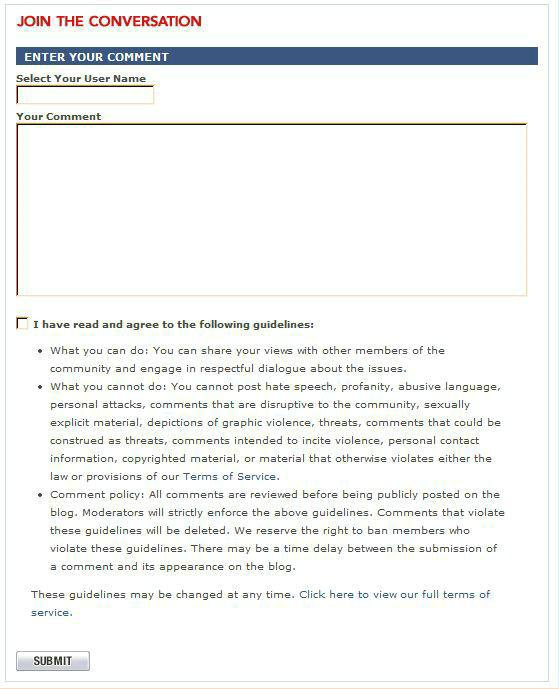
HillaryClinton.com’s rules for commenters [Tags: politics hillary_clinton ]
We’ve all got a real problem. On some sites comments are so nasty that they are driving people off the Web. Even if the comments on your own site are always respectful and sweet-natured, the verbal violence on other sites is your problem. Our problem. It’s not as bad as some in the media portray it, but when Kathy Sierra gets over a thousand messages, mainly from women, saying they’ve been stalked or bullied, it’s an issue we can’t ignore.
Unfortunately, there is no easy solution. A Blogger Code of Conduct goes down the wrong path. Codes only can play a role if they’re plural. Very plural.
Lisa Stone puts it all well when she explains why a “one-stop-shopping” code can’t work for all:
Images that are appropriate for a blog devoted to the war in Iraq would never work on a parenting site, for example. They shouldn’t have to play by the same rules. And we all know how I feel about the First Amendment. :)
So, here’s a longer way around to the same point. (More of Lisa here.)
The first and least debatable Blogger Code of Conduct is the body of law that sets limits on what we can say in public. Death threats, libel, and giving away state secrets are all out. But when we try to get more specific than “No death threats! No nuclear secrets!” what do we really all agree about? A Code of Swimming Pool Conduct that says “Swim safely!” is of little use. The only code worth posting poolside says things like “No diving. No swimming without a buddy. ” But what’s the equivalent for blogging, that is, for talking together in public? A single code of conduct would need to drive down into specifics about which bloggers disagree.
Further, no single code could cover all the different ways we want to talk. Conversation shapes itself to its topic, venue, goal and personal relationships. For example, if I’m arguing with a like-minded friend about politics, my social group’s norm allows me to be more interruptive and use more curse words than if I’m talking with an acquaintance from the other side of the fence. Our norms tell us exactly how much bad language we can use with our family, at work, at the sports stadium, and when meeting our future in-laws for the first time. We know how loud we can talk whether it’s sermon time at the synagogue or South of the Border Night at the bar. There is no possibility of coming up with a single code of conduct because there are too many circumstances in which we conduct ourselves. We are left, ultimately, with our judgment.
Behind the drive for a single code of conduct is often the idea that there is one particular type of conversation at the pinnacle of all conversations: The rational discourse in which two people who disagree work toward the truth. Civility is important there. I’m thrilled to be at an institution — the Berkman Center — where those sorts of conversations happen every day. But those are not the only sorts of conversations we should, could, would, will or do have. Some conversations should be raucous. Some should get people red in the face. Some should have us leaving muttering under our breath. Polite, respectful civil conversations are not the only ones worth having because conversation is about much more than the mutual discovery of truth. Conversation is how we’re social, and thus is as rich, ambiguous, implicit, and multipurpose as we ourselves are. Yes, as Tim O’Reilly says, “Free speech is enhanced by civility.” Definitely. We need more civility. But free speech is also enhanced by healthy doses of incivility. In our drive to limit harmful speech, we need to be careful to preserve risky speech.
Of course, that’s assuming a particular model of civility. If, instead, by “civil” one means only that the conversation should be respectful, then I agree that many more conversations need to be civil. But: (a) Respect is not always the highest value of a conversation. (b) What constitutes disrespectful or injurious speech depends upon the target, the speaker and the context (again, ruling out posts that cross the boundaries of the law and our shared sense of decency). (c) A code of conduct that says that, for example, we should be “respectful” will founder on the details of implementation since there are so many norms about what constitutes respectful discourse — sitting in a quiet room with our hands on the table and our heads cocked attentively being only one scenario. Without the implementation details, the code is as useful as the “Swim safely” poster at the pool.
But then we come back to the problem: People violated – threatened, bullied and stalked – by thugs wielding keyboards. When those comments cross the legal boundaries, there may be legal recourse, although usually that’s not practical. It is a problem with no easy or short-term solution. When the comments are posted on the victim’s own site, there are tools for dealing with them, although none works perfectly. A blogger can moderate the comments, perhaps add a reputation system, or even forbid anonymity. A code of conduct is one more tool in the box. Such a code makes explicit the rules already implicitly governing a comment space. As we come across blogs more and more randomly, it often doesn’t hurt to be told that a site won’t tolerate bad language or wants commenters to stay on topic, if those are the local norms. Bloggers can of course state that already — there’s an infinite supply of sentences — and many do, but coming up with standard ways of expressing the rules would encourage their expression.(That’s what I was suggesting 1.5 wks ago, and it’s what I like in Tim’s idea.) Transparency generally is good.Posting rules of the pool that make explicit the existing implicit norms can be a worthwhile tool…although pasting a long list of precise rules can indeed inhibit free swim.
As for encouraging civility: Absolutely. I like civility. Truly. I encourage it on this blog’s comment pages, and I even try to model it on occasion. But I also like a good fart and a high five now and then.
[Tags: blogs civility kathy_sierra bullying cyberbullying convesation free_speech lisa_stone tim_oreilly everything_is_miscellaneous berkman]
Heather Havenstein of ComputerWorld interviews Lisa Stone on this very topic…
April 4, 2007
I’d like to respond to the CNN piece about cyberbullying, but I have the flu and am unable to think longer than a sentence in advance. You can see the piece here. And here is my worry-wart post about my participation in it. Briefly my take is: It didn’t do the flat-out, ominous chords scare-mongering, but it nevertheless was perilously close to self-parody. [Tags: cnn media kathy_sierra chris_locke rageboy cyberbullying blogs ]
By the way, I should note that CNN got my attribution wrong. They say I’m a professor at Harvard. In fact, I’m a Fellow at Harvard. To be precise, I’m a Research Fellow at Harvard Law’s Berkman Center for Internet & Society. (The ampersand is an official part of the name.) And I was very clear about this attribution when CNN asked. There are major differences between professors and fellows, affecting everything from teaching to pay-scales to voting to having to wear a silly cap and picking up dry-cleaning for professors. (I’ve written about being a fellow here.)
April 1, 2007
I very much like Tim O’Reilly’s post about a bloggers code of conduct.
It’s certainly possible to quibble with the specifics of Tim’s post, although personally I think he’s right on the mark. But more important, his post is among many legitimizing taking responsibility for the comments we allow on our blogs (Tim’s point #1). It’s a call not for a single code of conduct to govern all sites, but for codes of conduct.
We’ve always been responsible for comments: There’s always been a line we wouldn’t allow commenters to cross, or if there’s been no line, we’ve been responsible for that as well. But we need to be OK with setting out explicit guidelines. Conversations always work within norms, although they rarely need to be explicitly expressed: You know not to do a lot of insult humor at a board meeting and you know not to argue with the mourners at a funeral no matter how overstated the eulogy. Likewise, if you’ve been reading a blog for a while, you probably have a sense of what’s ok and what isn’t. But people leave comments on blogs they’ve read once. They come in with their own sense of what’s allowed. Fine. Good. But we should make explicit to them what our norms are.
Tim joins many in pointing to the BlogHer Community Guidelines. Count me in. I’m adding them to my comment form this morning. I’ll probably work on some minor personalizations over the next few days. (Passover approaches, and I’m under the weather, so it may take me a little longer.)
PS: There’s been a discussion along the same lines over at StopCyberBullying [Tags: cyberbullying blogging tim_oreilly blogher]
Drew, who was fired for having a blog (although his employer has claimed otherwise), has prevailed in his struggle to get unemployment benefits.
His baby is still cute. [Tags: Drew_townson blogging mercenary_audio]

Joho the Blog uses WordPress blogging software.
Thank you, WordPress!