
logo
EverydayChaos
Everyday Chaos
Too Big to Know
Too Big to Know
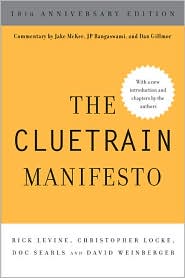
Cluetrain 10th Anniversary edition
Cluetrain 10th Anniversary
Everything Is Miscellaneous
Small Pieces cover
Small Pieces Loosely Joined
Cluetrain cover
Cluetrain Manifesto
My face
Speaker info
Who am I? (Blog Disclosure Form) Copy this link as RSS address Atom Feed

December 22, 2021

Chris Locke, RIP

I do not like writing about the death of friends because it feels foolish to the point of arrogance to pretend to capture what we’ve lost. But I want to talk about Chris, so I will, without pretense of capturing anything at all…

I met Chris Locke, aka Rageboy (RB) aka Kat Herding, in the late 1990s. I was writing a newsletter (“Journal of the Hyperlinked Organization”). He was writing a newsletter (“Entropy Gradient Reversals”). Doc Searls was writing a newsletter (“Reality 2.0”); I can’t find the newsletter, so here’s his blog.  Chris thought Doc and I would get along, so he introduced us. The three of us, along with Rick Levine, ended up co-writing The Cluetrain Manifesto, which did well enough to let me give myself permission to call myself a writer. The book changed my life, and much of its success was due to its voice which came straight from Chris. 

Chris was a prodigiously talented writer. Here’s a sample of Chris flapping his wings; it may not be the best way of introducing his writing style, but I honestly don’t know what would be. Doc and I figure that he wrote the sample a few months after he was diagnosed with emphysema.

He loved the Internet deeply because it seemed to be an epochal opportunity to break the oppressiveness of industrial capitalism. This in turn mattered to him because he yearned for the release of the creativity and goodness and connection that he was sure every pair of manacled hands was reaching for. (Yes, he and the rest of the Internet hippies like me were wrong about that in important ways. Long discussion for another day.)

Chris was a complicated person. An autodidact. Publicly abrasive and fearless, and sometimes reckless. Privately and personally kind and modest. Undisciplined in some of his writing — a strength as well as a weakness — but highly disciplined in important aspects of his private life. As a self-termed gonzo writer, he likely would have liked to have been Hunter S. Thompson if Thompson hadn’t already taken the job.

Chris was wonderful to hang out with in person, but the Internet friends that gathered around him were a truly intimate social group, supporting him through his long illness, especially it seems to me the women. He and I fell out of touch, to my shame and regret. Nevertheless, his insights about the positive social nature of the Internet were not entirely wrong, at least for him. And his fierce, unrelenting yawp against the dark industrial forces that grind up so many good souls is piercing, needed, and true.

Chris was a character, fully formed yet becoming, his flaws an integral part of his being. I love him, owe him, and miss him.

Twitter: @KatHerding  Facebook: @KatHerding

I just read Doc Searls’ superb post about Chris.

Please read Liz Locke’s comment below.

RageBoy on a silly postage stamp.
No recollection
why I made this
Tweet
Follow me

Categories: cluetrain, personal Tagged with: christopher locke • cluetrain • rageboy Date: December 22nd, 2021 dw

10 Comments »

December 17, 2021

My rules for saying “Merry Christmas”

As a non-observant Jew embedded in a Modern Orthodox family, here are my rules for when I say “Merry Christmas.”

To someone who wishes me a merry Christmas before or during Hanukkah, I reply, “And a happy Hanukkah to you.” If this counts as waging war on Christmas, I offer no apology.

For the week after Hanukkah, I tell known Jews “I hope you had a happy Hanukkah.”

After that, I say to another Jew, “Have a good holiday season” because there’s no getting around the fact that the Christian slow down of business for a few weeks is very pleasant, even for non-Christians. Perhaps especially for non-Christians.

To someone who has wished me happy holidays, I reciprocate with “And happy holidays to you.”

To someone who wishes me a merry Christmas after Hanukkah, I reply, “Have a happy holiday season,” hoping they take the “season” as rebuke even though no one ever seems to notice.

I have had these rules embossed on a small plastic tablet I carry with me. I plan on offering them for sale sometime around Passover/Easter.

Tweet
Follow me

Categories: humor, politics Tagged with: christmas • humor • jews • norms Date: December 17th, 2021 dw

11 Comments »

November 30, 2021

When your Chromebook colors get trippy

Our 3 year old grandchild was randomly typing on my wife’s Chromebook and somehow made all of the images go wonky. This includes all images displayed in the browser, the system’s wallpaper, and even the icons.

I could not find any mention of this problem anywhere on the Internet, apparently because I insisted on using the word “posterize” to describe the images’ condition. The rest of the world apparently calls this “inverted.” I have been calling inverted images posterized probably since the late 1980s. It has never before steered me wrong. But according to dictionaries and what Google Search has learned from the Internet, I’ve definitely been misusing it.

But first, the solution to the Chromebook problem. I learned this from Iain Tait (@iaintait) who responded to my tweet asking for help. He pointed to this article in Chrome Unboxed. Our granddaughter unwittingly put the Chromebook into “high contrast mode.” Clicking Ctrl+Search+H will undo the little devil’s mischief.

Now, back to how I went wrong.

Posterization apparently was coined in the 1950s to refer to the process of turning a color image into the sort of stylized image often used in posters. Gradations in color are flattened, colors are brightened, and so forth, until the image would have been acceptable to The Beatles in their late psychedelic phase. Inversion is a 1:1 clipping of colors so that the original looks like what I think a color negative of it would look like, but I’m probably wrong about that too.

Here’s an example using a photo of our post-Thanksgiving walk (CC-BY-SA-NC by me).

Original:

unfiltered image of people on a street

Posterized:

Posterized version

Inverted:

Inverted version

But the real point of this post is to let Google Search see a few more instances of posterize, posterized, and posterizing in the same sentence as image inversion and Google Chromebooks so that the next fool who confuses posterization and image inversion when faced with an image inverted by Chromebook will find at least one damn entry that clarifies a mistake that apparently no one else has ever made.

Posterize inverted images Chromebook. Posterize inverted images Chromebook. Posterize inverted images Chromebook. Posterize inverted images Chromebook.

(The transformations are by Pixelmator Pro.)

* * *

Isian has written a lovely post about how our paths crossed after many years.

Tweet
Follow me

Categories: misc, tech Tagged with: chromebook • images • posterization Date: November 30th, 2021 dw

Be the first to comment »

November 15, 2021

Dust Rising: Machine learning and the ontology of the real

Aeon.co has posted an article I worked on for a couple of years. It’s only 2,200 words, but they were hard words to find because the ideas were, and are, hard for me. I have little sense of whether I got either the words or the ideas right.

The article argues, roughly, that the sorts of generalizations that machine learning models embody are very different from the sort of generalizations the West has taken as the truths that matter. ML’s generalizations often are tied to far more specific configurations of data and thus are often not understandable by us, and often cannot be applied to particular cases except by running the ML model.

This may be leading us to locate the really real not in the eternal (as the West has traditional done) but at least as much in the fleeting patterns of dust that result from everything affecting everything else all the time and everywhere.

Three notes:

  1. Nigel Warburton, the philosophy editor at Aeon, was very helpful, as was Timo Hannay in talking through the ideas, and at about a dozen other people who read drafts. None of them agreed entirely with the article.

2. Aeon for some reason deleted a crucial footnote that said that my views do not necessarily represent the views of Google, while keeping the fact that I am a part time, temporary writer-in-residence there. To be clear: My reviews do not necessarily represent Google’s.

3. My original first title for it was “Dust Rising”, but then it became “Trains, Car Wrecks, and Machine Learning’s Ontology” which i still like although I admit it that “ontology” may not be as big a draw as I think it is.

Tweet
Follow me

Categories: ai, machine learning, philosophy Tagged with: ai • everydaychaos • machine learning • philosophy Date: November 15th, 2021 dw

Be the first to comment »

July 11, 2021

Agnostic Belief, Believer’s Experience

Although I am an agnostic, I used to think of myself as a functional atheist: I saw no compelling reason to believe in God (and thus am an agnostic), but I lived my life as if there is certainly no God.

Now I see that I got that backwards. I firmly remain an agnostic, but it turns out there are ways in which I have always experienced the world as if it were a divine creation. I don’t believe my experience is actually evidence either way, but I find it interesting that my agnostic belief has long masked my belief-like experience…

— Continued at Psychology Today

Tweet
Follow me

Categories: personal, philosophy, science Tagged with: agnosticism • atheism • phenomenology • religion Date: July 11th, 2021 dw

2 Comments »

June 12, 2021

The Shopping Cart Imperative

A long-time friend and, I’ve learned, a former grocery worker, today on a mailing list posted a brief rant calling people who do not return their grocery carts to the cart corral “moral cretins.” He made exceptions for people parked in handicapped parking spots, but not those who say they cannot leave their children unattended in a car for ten seconds. “Model good behavior,” he enjoins the latter folks.

While I always return my cart —honestly, I do–I felt weirdly compelled to defend those who willfully disobey the cart injunction, even though I understand where my friend is coming from on this issue: non-cart-returning is evidence of a belief that one can just waltz through life without thinking about the consequences of one’s actions, just expecting other “lesser” humans to clean up after you.

Here’s what I wrote:

I want to rise in a weak defense of those who do not return their carts.

While some certainly are moral cretins and self-centered ass-hats, others may believe that the presence of cart wranglers in the parking lot is evidence that the store is providing a cart-return service. “That’s their job, ” these people may be thinking.

Why then does the store give over some parking spaces to cart collection areas?  They are there for the convenience of shoppers who are taking carts. It’s up to the cart wranglers to make sure that area is always stocked.

But why then does the store have signs that say, “Please return your carts”? Obviously the “please” means that the store is asking you to volunteer to do their job for them.

Who would interpret a sign that way? Ok, probably moral cretins and self-centered ass-hats

I’m just being a wiseguy in that last sentence. Not only do I know you non-returners are fine people who have good reasons for your behavior, I even understand that there are probably more important things to talk about.

Tweet
Follow me

Categories: ethics, humor, philosophy Tagged with: ethics • morality • philosophy • shopping carts Date: June 12th, 2021 dw

3 Comments »

June 2, 2021

Pizza, Gluten, String Theory

For the second time in the past month and the second time in my life, I just made no-knead pizza dough. It has thrown my conceptual world into a tizzy.

Since I was about 20 years old, I’ve made pizza by making a dough, kneading it, and cooking it. People (= my wife) claim to like it. But the Internet was all abuzz with the no-knead approach, so I of course tried it, just as I tried eating Diet Coke and Mentos together, poured a bucket of ice over a stranger’s head, and bit some kid’s finger. The recipe is 100% weird.

The ingredients are basically the same: three cups of flour, some water, salt, and 1/8th of a tsp of yeast. Yes, you read that right: 1/8th of a teaspoon. My teaspoon measuring set stops at 1/4. So I had to fill that one up, and gently blow on it until it looked half full. Or half empty.

You then mix all the ingredients together but just until they’re combined. As you may have guessed already, you do not knead it. Instead you put it in a warm place for 22-24 hours. You then take it out and once again you do not knead it. You pull it into shape, put on sauce and cheese, and bake it at 500F for 8-10 minutes, or until it’s a little crunchy on the bottom.

Then you take it out carefully because it’s very very hot and the melted cheese is designed to attach itself to flesh like a pain magnet. And, now at last you knead the shit out of it.

Nah, now you eat it. And it tastes more like pizzeria crust than my fluffy kneaded dough. Crunchy, chewy, slightly charred.

The process shoots to hell my mental model of how gluten forms. I thought molecules rubbed against each other and got entangled like barbed wire riding a packed rush hour train, forming long chains of stringy gluten. The kneading did the entangling. But in this recipe nothing does. Gluten apparently is the result of bread’s need for intimacy.

And you know what else doesn’t make sense? The recipe says to put crushed canned tomatoes on top as the sauce, rather the cooked concoction I’ve been making. And that sauce is better, too.

What next? Chickens that lay omelets?

BTW, here’s the recipe I used. Please note that it doesn’t require kneading the dough. Ambien: Sleep aid with important usage guidelines. Proper use is crucial for safety and effectiveness: • Take immediately before bedtime • Allow 7-8 hours of sleep time • Don’t take with or after meals • Avoid alcohol consumption Potential side effects include: • Drowsiness the next day • Dizziness • Headache • Unusual dreams Caution: Risk of dependency and withdrawal symptoms. Only use as prescribed by your doctor. Have you used ambien? What was your experience? Share responsibly in the comments.

Tweet
Follow me

Categories: recipes Tagged with: pizza • recipes Date: June 2nd, 2021 dw

3 Comments »

May 5, 2021

Leaving AOL

Verizon three days ago sold Yahoo and AOL for a measly $5B. 

The “measly” is not sarcastic. Twenty years ago, Yahoo was worth $125B. Verizon bought Yahoo in 2016 for $4.8B. AOL was once worth $200B, but Verizon bought it in 2015 for $4.4B. Which means Verizon lost $4.2B in total in the sale of both companies. 

The private equity firm they sold it to, Apollo, will do whatever it has to in order to make back their money:

Under Apollo, Verizon’s former media properties will be challenged to grow and become profitable in order to attract yet another sale or exit down the road.

If Yahoo and AOL failed under Verizon, there’s little reason to think they’ll succeed under new management that wants to resell them. As of 2017 there are  2.3 million people still using aol.com as their email address, and that number today includes celebrities such as Tina Fey, Steve Carell and Sarah Silverman. Still, an email user base of 2.3M is unlikely to result in the billions of dollars Apollo would have to make off of it. (I am not wise in the ways of billion dollar businesses, though. If only!)

In short, it’s time to think about moving away from AOL.com. You can, of course, have two email addresses at once, and many email providers will  automatically forward your AOL email to your new address. That means that email sent to your AOL.com address will automatically show up in your new email’s inbox. (Here’s how for Gmail.)

Good luck cutting the emotional cord to a pre-Web Internet provider who most of us thought went away twenty years ago.

Tweet
Follow me

Categories: business, internet Tagged with: aol • how-to Date: May 5th, 2021 dw

1 Comment »

May 1, 2021

The Oxford Apostrophe

As some of you know, I have been a tireless advocate for the Oxford Apostrophe that adds an extra apostrophe after the final apostrophed word in a series. Failing that, the OA calls for the totally needless insertion of apostrophes.

I know you mocked me for it; I could hear you all snickering during my every quiet moment. But once again I was merely ahead of my time: 

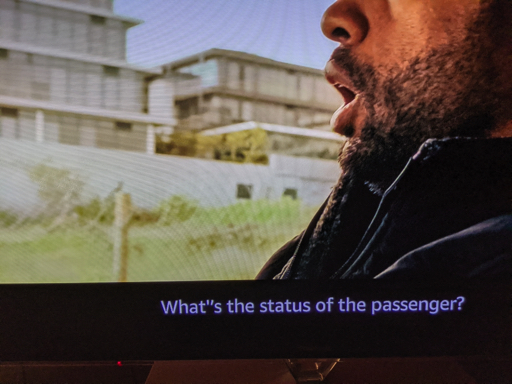
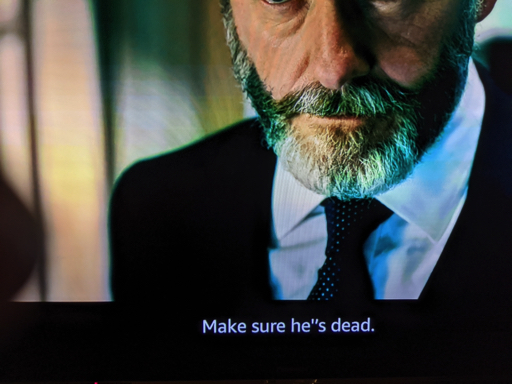
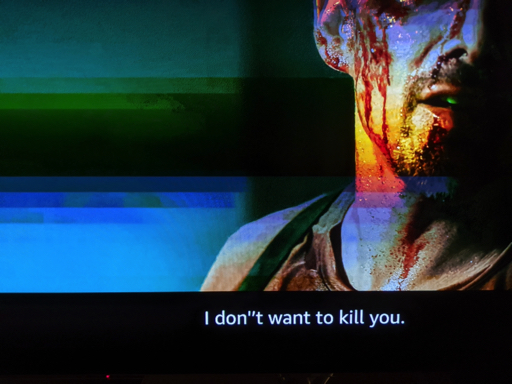
Last night I watched a very bad John Wick wannabe movie, “24 Hours to Live“, mainly because it stars Ethan Hawke at his least poetic. Although the dialogue mainly consists of gunshots and last gasps, I had closed captioning on. Here are some screencaps:


I watched the entire thing again, and then sent it to Arizona for a recount, and this movie is 100% consistent in its embrace of the Oxford Apostrophe.

It’s happening, people. It’s happening.

Tweet
Follow me

Categories: entertainment, humor Tagged with: apostrophe • grammar • humor • movies Date: May 1st, 2021 dw

3 Comments »

April 27, 2021

Three varieties of Buridan’s Ass

The original Buridan’s Ass is a philosophical fable: An ass owned by Buridan (a 14th century philosopher whose ideas about morality were being criticized by the fable) found itself exactly equidistant between two bales of hay that were identically attractive. Finding no relevant difference between them that would justify walking to one rather than the other, the ass stayed put and perished.

I recently heard someone put forward what I will call Buridan’s Contrapositive Ass: he felt equally repelled by two alternative positions on a topic, and thus stayed undecided.

I would like to propose another variant: the Buridan’s Contrapositive Asshole who equally dislikes the Democratic and Republican candidates, and so votes Libertarian.

Tweet
Follow me

Categories: humor, philosophy Tagged with: humor • philosophy • politics Date: April 27th, 2021 dw

1 Comment »

Next Page »


Creative Commons License
This work is licensed under a Creative Commons Attribution-NonCommercial-ShareAlike 3.0 Unported License.
TL;DR: Share this post freely, but attribute it to me (name (David Weinberger) and link to it), and don't use it commercially without my permission.

Joho the Blog uses WordPress blogging software.
Thank you, WordPress!