




logo
EverydayChaos
Everyday Chaos
Too Big to Know
Too Big to Know
Cluetrain 10th Anniversary edition
Cluetrain 10th Anniversary
Everything Is Miscellaneous
Small Pieces cover
Small Pieces Loosely Joined
Cluetrain cover
Cluetrain Manifesto
My face
Speaker info
Who am I? (Blog Disclosure Form) Copy this link as RSS address Atom Feed

June 8, 2011

Six degress of philosophy

In what is certainly the coolest proof that philosophy is the Queen of the Sciences, and also the Duke and all of the in-laws, xefer shows the relation of any Wikipedia topic to its “Philosophy” article. (Hat tip to Hal Roberts.)
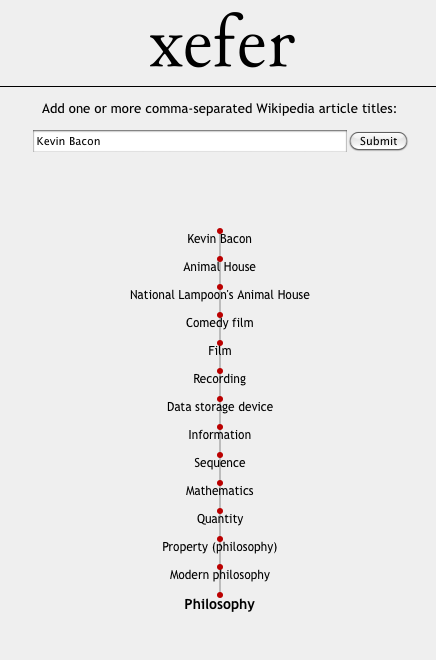
Kevin Bacon to Philosophy

Tweet
Follow me

Categories: humor, philosophy Tagged with: kevin bacon • philosophy • wikipedia Date: June 8th, 2011 dw

1 Comment »

MacKenzie Smith on open licenses for metadata

MacKenzie Smith of MIT and Creative Commons talks about the new 4-star rating system for open licenses for metadata from cultural institutions:

The draft is up on the LOD-LAM site.

Here are some comments on the system from open access guru Peter Suber.

Tweet
Follow me

Categories: copyright, culture, open access Tagged with: archives • copyright • libraries • lod-lam • lodlam • metadata • museums • open access • peter suber Date: June 8th, 2011 dw

5 Comments »

E.T.: A very old trailer

Here’s the 1982 trailer for ET:

MovieLine posted the trailer to support the wisdom of Super 8’s decision not to give away too much ahead of time. But, wow, does the ET trailer seem dated! It feels like it has about half as many scenes as a typical modern trailer. Contemporary trailers are much more coherent, not in the sense of making sense (which they usually don’t), but in the sense of feeling like a whole experience, usually ending with an ear-ripping blast or, after you’ve thought it ended, a shocking image or wry remark. I hate contemporary trailers because they are assaultive and disrespect the movies they spoil, but the ET trailer seems excepionally poorly made.

Maybe they figured (correctly) that they really just had to tell us that it’s the next Spielberg film, and that ET was unlikely to bite children in half.

Tweet
Follow me

Categories: entertainment Tagged with: entertainment • movies • spielberg • spoilers Date: June 8th, 2011 dw

1 Comment »

June 6, 2011

Peter Suber on the 4-star openness rating

One of the outcomes of the the LOD-LAM conference was a draft of an idea for a 4-star classification of openness of metadata from cultural institutions. The classification is nicely counter-intuitive, which is to say that it’s useful.

I asked Peter Suber, the Open Access guru, what he thought of it. He replied in an email:

First, I support the open knowledge definition and I support a star system to make it easy to refer to different degrees of openness.

* I’m not sure where this particular proposal comes from. But I recommend working with the Open Knowledge Foundation, which developed the open knowledge definition. The more key players who accept the resulting star system, the more widely it will be used.

* This draft overlooks some complexity in the 3-star entry and the 2-star entry. Currently it suggests that attribution through linking is always more open than attribution by other means (say, by naming without linking). But this is untrue. Sometimes one is more difficult than the other. In a given case, the easier one is more open by lowering the barrier to distribution.

If you or your software had both names and links for every datasource you wanted to attribute, then attribution by linking and attribution by naming would be about equal in difficulty and openness. But if you had names without links, then obtaining the links would be an extra burden that would delay or impede distribution.

The disparity in openness grows as the number of datasources increases. On this point, see the Protocol for Implementing Open Access Data (by John Wilbanks for Science Commons, December 2007).

Relevant excerpt: “[T]here is a problem of cascading attribution if attribution is required as part of a license approach. In a world of database integration and federation, attribution can easily cascade into a burden for scientists….Would a scientist need to attribute 40,000 data depositors in the event of a query across 40,000 data sets?” In the original context, Wilbanks uses this (cogently) as an argument for the public domain, or for shedding an attribution requirement. But in the present context, it complicates the ranking system. If you *did* have to attribute a result to 40,000 data sources, and if you had names but not links for many of those sources, then attribution by naming would be *much* easier than attribution by linking.

Solution? I wouldn’t use stars to distinguish methods of attribution. Make CC-BY (or the equivalent) the first entry after the public domain, and let it cover any and all methods of attribution. But then include an annotation explaining that some methods attribution increase the difficulty of distribution, and that increasing the difficulty will decrease openness. Unfortunately, however, we can’t generalize about which methods of attribution raise and lower this barrier, because it depends on what metadata the attributing scholar may already possess or have ready to hand.

* The overall implication is that anything less open than CC-BY-SA deserves zero stars. On the one hand, I don’t mind that, since I’d like to discourage anything less open than CC-BY-SA. On the other, while CC-BY-NC and CC-BY-ND are less open than CC-BY-SA, they’re more open than all-rights-reserved. If we wanted to recognize that in the star system, we’d need at least one more star to recognize more species.

I responded with a question: “WRT to your naming vs. linking comments: I assumed the idea was that it’s attribution-by-link vs. attribution-by-some-arbitrary-requirement. So, if I require you to attribute by sticking in a particular phrase or mark, I’m making it harder for you to just scoop up and republish my data: Your aggregating sw has to understand my rule, and you have to follow potentially 40,000 different rules if you’re aggregating from 40,000 different databases.

Peter responded:

You’re right that “if I require you to attribute by sticking in a particular phrase or mark, I’m making it harder for you to just scoop up and republish my data.” However, if I already have the phrases or marks, but not the URLs, then requiring me to attribute by linking would be the same sort of barrier. My point is that the easier path depends on which kinds of metadata we already have, or which kinds are easier for us to get. It’s not the case that one path is always easier than another.

But it might be the case that one path (attribution by linking) is *usually* easier than another. That raises a nice question: should that shifting, statistical difference be recognized with an extra star? I wouldn’t mind, provided we acknowledged the exceptions in an annotation.

Tweet
Follow me

Categories: everythingIsMiscellaneous, libraries, open access, too big to know Tagged with: lod-lam • lodlam • metadata • open access Date: June 6th, 2011 dw

1 Comment »

June 5, 2011

How to digitize a million books

Brewster Kahle gives a tour of one of the Internet Archive‘s book scanning facilities. This one is part of the Archive’s San Francisco headquarters:

Recorded during a tour of the facilities, as part of the LOD-LAM conference.

Tweet
Follow me

Categories: libraries Tagged with: books • brewster kahle • internet archive • libraries • lod-lam • lodlam • open library • scan • scanning Date: June 5th, 2011 dw

1 Comment »

June 3, 2011

Berkman Buzz

This week’s Berkman Buzz:

  • Media Cloud maps the US popular blogosphere:
    link

  • Ethan Zuckerman [twitter:ethanz] reflects on the quantified self:
    link

  • The Library Lab interviews open access advocate Peter Suber:
    link

  • Dan Gillmor [twitter:dangillmor] discusses hacking, PBS, and Tupac Shakur:
    link

  • Creative Commons [twitter:creativecommons] announces that YouTube will now support CC BY videos:
    link

  • Weekly Global Voices [twitter:globalvoices] : “Bolivia: Tweeting with Senator Centa Rek”:
    link

Tweet
Follow me

Categories: berkman Tagged with: berkman buzz Date: June 3rd, 2011 dw

Be the first to comment »

Happy birthday, Larry!

One of the heroes of the Internet turns 50, and the people who love him (and there are a lot of us) thank him on this perfectly appropriate video:

Larry Lessig 50th Birthday Lip Sync Tribute from Daniel Jones on Vimeo.

Tweet
Follow me

Categories: copyright, culture Tagged with: birthday • free culture • larry lessig • lessig • mashups Date: June 3rd, 2011 dw

Be the first to comment »

Open Access and libraries

I’ve posted the next in my series of library podcasts at the Library Innovation Lab blog. This one is with Peter Suber, the hub of the Open Access movement.

Tweet
Follow me

Categories: libraries, open access Tagged with: open access • peter suber Date: June 3rd, 2011 dw

Be the first to comment »

Brester Kahle reads from a prescient 1936 book

Brewster Kahle, founder of the Internet Archive, reads from an oddly prescient 1936 about preserving the current media types:

Tweet
Follow me

Categories: culture Tagged with: brewster kahle Date: June 3rd, 2011 dw

Be the first to comment »

June 2, 2011

OCLC to release 1 million book records

At the LODLAM conference, Roy Tennant said that OCLC will be releasing the bibliographic info about the top million most popular books. It will be released in a linked data format, under an Open Database license. This is a very useful move, although we need to know what the license is. We can hope that it does not require attribution, and does not come with any further license restrictions. But Roy was talking in the course of a timed two-minute talk, so he didn’t have a lot of time for details.

This is at least a good step and maybe more than that.

Tweet
Follow me

Categories: everythingIsMiscellaneous, libraries, open access, too big to know Tagged with: library • metadata • oclc • open access Date: June 2nd, 2011 dw

2 Comments »

« Previous Page | Next Page »


Creative Commons License
This work is licensed under a Creative Commons Attribution-NonCommercial-ShareAlike 3.0 Unported License.
TL;DR: Share this post freely, but attribute it to me (name (David Weinberger) and link to it), and don't use it commercially without my permission.

Joho the Blog uses WordPress blogging software.
Thank you, WordPress!