



logo
EverydayChaos
Everyday Chaos
Too Big to Know
Too Big to Know
Cluetrain 10th Anniversary edition
Cluetrain 10th Anniversary
Everything Is Miscellaneous
Small Pieces cover
Small Pieces Loosely Joined
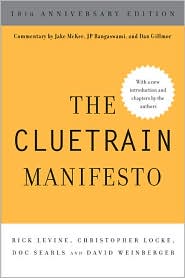
Cluetrain cover
Cluetrain Manifesto
My face
Speaker info
Who am I? (Blog Disclosure Form) Copy this link as RSS address Atom Feed

August 12, 2009

Apple: Totalitarian art

Jason Calacanis has an excellent post making the case against Apple, from an Apple fan’s point of view. I’m basically with him.

Doc Searls has long said that the key to understanding Steve Jobs — and thus to understanding Apple — is that Job’s an artist. We understand when an artist wants to maintain complete, obsessive control over his creations, especially when they are as beautiful as some Apple products are. But it’s not just artistry at work at Apple. Apple tends towards totalitarianism.

You can see why in its computer architectures: Its products work because they’re relatively closed systems that run tightly controlled hardware, unlike Microsoft’s operating system that has to be able to work on just about every piece of hardware that comes along. And Apple’s stuff generally works beautifully. (I switched from Windows to the Mac about three years ago.) But the hardwired connection between the iPod and iTunes — only recently loosened — is there not to benefit users, but to meet the DRM needs of recording companies and to tether users to Apple. The hardwired connection between the iPhone and the App Store represents a disturbing direction for the industry, in which Apple acts in loco parentis to protect users from their own software decisions, and (apparently) to exclude products they believe hurt the business interests of their partners. The App Store’s success makes it particularly threatening; it’s easy to imagine Apple’s rumored tablet adopting the same strategy, then other companies following suit.

It’s not an unmixed picture, of course. The removal of the egregious DRM from iTunes is a step forward, and seems to have been a step Apple eagerly took, and the movement of the Mac’s OS onto Unix added admirable transparency. Plus, Apple makes some beautiful stuff that works beautifully.

I just wish that going forward, I felt more confident that Apple is on our side, not just as customers but as digital citizens.

[Tags: apple drm copyright copyleft computers microsoft jonathan_zittrain generativity ]

Tweet
Follow me

Categories: Uncategorized Tagged with: apple • computers • copyleft • copyright • digital culture • digital rights • drm • generativity • jonathan_zittrain • microsoft Date: August 12th, 2009 dw

6 Comments »

August 11, 2009

The universality of names

There’s a terrific article by Carol Kaesuk Yoon in the NY Times about research that shows that humans around the world tend to cluster the natural world in highly similar ways, even using similar-ish names.

[Tags: everything_is_miscellaneous taxonomy ]

Tweet
Follow me

Categories: Uncategorized Tagged with: everythingIsMiscellaneous • everything_is_miscellaneous • folksonomy • taxonomy Date: August 11th, 2009 dw

1 Comment »

August 10, 2009

Dave Winer serves coffee to four logicians

From Dave Winer:

Four logicians are having breakfast. Waitress asks — Will you all be having coffee? The first logician says “I don’t know.” Second says “I don’t know.” Third says “I don’t know.” Fourth says “No.” The waitress returns with their coffees. Who gets coffee?

It does have a solution. The solution is not a cheat or wordplay or a sort of “lightbulb” joke anything extraneous to the puzzle. For example, it’s not “None of them, because logicians drink tea” or “None, because the first three were saying, “I don’t. No.” or “None, because coffee isn’t axiomatic.”

[HINT:]: Think about how each of the logicians would answer the question if she were going to order coffee or not order coffee.

I’ll put the answer in the first comment. [Actually, I changed my mind. I’ll post the answer in a comment if no one else comments.]

[Tags: puzzles logic dave_winer ]

Tweet
Follow me

Categories: Uncategorized Tagged with: dave_winer • logic • puzzles Date: August 10th, 2009 dw

21 Comments »

August 9, 2009

Twitterelevancy

With it’s new Fresh view, Delicious builds on the TweetNews idea of using links in Tweets (and other measures) as a way to find what’s newest and most interesting. As the blog post about it says:

Underneath the hood, Fresh factors several features into the ranking like related bookmark and tweet counts, “eats our own dogfood”  by leveraging BOSS to filter for high quality results, as well as stitches tweets to related articles even if the tweets do not provide matching URLs (as ~81% of tweets do not contain URLs). Try clicking the ‘x Related Tweets’ link for any given story to see the Twitter conversation appear instantly inline.

It’s a welcome reslicing, not a whole new beast, but it seems useful.

[Tags: delivious everything_is_miscellaneous twitter news ]

Tweet
Follow me

Categories: Uncategorized Tagged with: delivious • everythingIsMiscellaneous • everything_is_miscellaneous • metadata • news • social networks • tagging • twitter Date: August 9th, 2009 dw

1 Comment »

August 8, 2009

Daily (Intermittent) Open Ended Puzzle [DOEP]: Optimal speed

Thirty years ago, we were told that we should drive 55mph (or, in Europe, 42 euros per hectare) on the highway because that was the “optimal” highway speed when it came to squeezing miles out of gallons.

What is the current optimal highway speed?

And, for extra credit, what is the optimal speed on or off the highway? If I want to get maximum miles per gallon but don’t care how fast I go, how fast should I drive? Two caveats: Yes, I know this will be different for different cars in different conditions. And, no, zero mph is not an acceptable answer, no matter how true it is.

[Tags: puzzle mileage mpg cars fuel_efficiency ]

Tweet
Follow me

Categories: Uncategorized Tagged with: cars • fuel_efficiency • mileage • mpg • puzzle • puzzles Date: August 8th, 2009 dw

6 Comments »

Shakespeare for girls, and young language

Two more points from Kenneth Coleman’s lecture on teaching Shakespeare, at Shakespeare & Co.

First, he says that the four most-taught Shakespearean plays are all tragedies. The tragedies are — he says — about how men screw up the world. And in the four most-taught ones, the women generally kill themselves or are otherwise disempowered. We should be teaching the comedies, he says, because they’re about how women make the world livable.

Second, he objects to calling Shakespeare’s language “old English.” Actually, it’s young English, full of play, lacking rules, inventing itself.

Two excellent points.

[Tags: shakespeare women language ]

Tweet
Follow me

Categories: Uncategorized Tagged with: culture • language • shakespeare • women Date: August 8th, 2009 dw

10 Comments »

August 7, 2009

Tags again

Jeez, it would save me a lot of time if Keynote (or Powerpoint, if you insist) let me tag slides and objects in slides (especially images). I spend way too much time looking for that slide of a “smart room” or the one that shows business vs. end-user use of Web 2.0, or that photo of an old broadcast tower. (Later that day: Maybe I should add, having just rewritten the Wikipedia entry on Interleaf, that back in the early 1990s, Interleaf gave us exactly that capability.)

Instead, I have two hacks, both a pain in the butt. First, I keep a humungous file of slides I think I’ll want to use again. Second, I’ve started putting tags into the speaker notes by putting the tags in brackets. But I use the speaker notes to speak from, so larding them up with tags is sub-optimal.

And especially if you save Keynote files in the pre-2009 multi-file formats, then it’d be a snap for third parties to build tools that extract the tags and manage them. (I have a fussy home-made utility that extracts the text from the speaker notes and builds an editable file of them. If you want it, let me know.)

Tags are easy! Tags are useful! Let tags be tags!

[Tags: tags everything_is_miscellaneous keynote powerpoint metadata whines ]

Tweet
Follow me

Categories: Uncategorized Tagged with: everythingIsMiscellaneous • everything_is_miscellaneous • keynote • metadata • powerpoint • tagging • tags • whines Date: August 7th, 2009 dw

2 Comments »

August 6, 2009

Go see Twelfth Night

My family has gone to Shakespeare & Co. productions every summer for almost 30 years. We have taken the kids since they were nursing. Over the years, I’ve blogged about various plays we’ve seen, usually very positively. Shakespeare & Co. do lively stagings, with clear diction and no desire to have us sit still while watching A Classic. They are always entertaining and frequently moving.

We saw Twelfth Night this afternoon. It is the funniest production I think I’ve seen them do. If you are in or near western Massachusetts, I urge you to go. You will LYAO.

It was directed by Jonathan Croy, who we’ve enjoyed as an actor since seeing him as Bottom in A Midsummer’s Night Dream a few decades ago. He had us crying with laughter in the Pyramus and Thisbe play within a play, and we’ve seen him in just about everything he’s been in since. His direction of Twelfth Night is brilliant. Mainly it’s hilarious. But it was also at times quite moving. He finds every laugh, many bawdy, some hammy, and some perhaps not in the original — but Shakespeare would have approved, for, as always with Shakespeare & Co., this is not the broccoli Shakespeare you’re required to eat for your own good. This is delicious, hearty, deeply satisfying Shakespeare you can’t wait to get another helping of. This is Shakespeare after Shakespeare’s own heart.

Afterward, we went to a free lecture by Kevin Coleman, who heads the company’s educational program. His talk was informal, full of anecdotes. But by the end of the hour, he had made his point: Stop teaching Shakespeare in the schools. Instead, we should have students play Shakespeare. But not just put on performances after memorizing the lines.

He demonstrated one technique he uses. Students in pairs run up to a basketball hoop (he thinks Shakespeare should be taught on a playground, to convey the sense of play) dribbling an imaginary ball; one kid passes the ball and the other shoots a nothing-but-net shot, and then they high-five or otherwise exult. Next, he gives one kid in each pair a single line from a random Shakespeare play. They run up to the hoop. The one with the line speaks it loudly but flatly — “passing” it — and the other kid delivers the line to the audience. The combination of bodily movement and the fact that the line doesn’t have to be memorized gets the kids to find the heart of the line. This is way better than having kids read a play at home and then call on them to read a line from a page.

Kevin says that he then has them do entire scenes, each player being fed all the lines by a partner, without having read the play first. The players therefore can look at each other as they say the lines, rather than look at the script. They find the rhythm, the meaning, and the feeling. At Kevin’s lecture, we did the one line version, and the results were impressive. I could see it working for an entire play.

Kevin also argued against the “translation” process most teachers and Shakespeare books use, by which we ask students to re-express Shakespeare’s words in their own language. This seems like a way for students to appropriate the text, but it also strips out the beauty and resonance of the language. His example was the line when Romeo first sees Juliet: “What lady is that, which doth enrich the hand of yonder knight?” When, with good intentions, teachers ask students to re-express that line, it comes out something like “Who’s the girl?” or “What’s the name of the fox?” Sure, that’s what Romeo is asking, but the translation loses everything. Shakespeare’s language gets turned into “French fries,” Kevin says.

Anyway, go see Twelfth Night.

[Tags: shakespeare lenox berkshires twelfth_night ]

Tweet
Follow me

Categories: Uncategorized Tagged with: berkshires • culture • entertainment • lenox • shakespeare • twelfth_night Date: August 6th, 2009 dw

3 Comments »

August 5, 2009

Media Cloud unclouds media

The NY Times has a terrific article about Media Cloud, a Berkman Center project (hats off to Ethan Zuckerman, Yochai Benkler, Hal Roberts, among others) that will let researchers track the actual movement of ideas through the mediasphere and blogosphere.

Data about concepts! What a concept!

[Tags: berkman media blogs memes research media_cloud ]

Tweet
Follow me

Categories: blogs Tagged with: berkman • blogs • everythingIsMiscellaneous • media • memes • research Date: August 5th, 2009 dw

Be the first to comment »

August 4, 2009

Don’t Ask and Don’t Tell Facebook

The military is trying to devise policies to govern how our service people use social networking sites, according to a story by Julian Barnes in the LA Times. The article implies the Pentagon accepts that military folks are going to use these sites, and there may even be some good that will come from it, but the military is concerned about security. At the moment, the Marines have banned accessing Facebook, MySpace and Twitter from government computers, to make sure there’s bandwidth for more pressing military needs.

Not that anyone asked, but it seems to me that the military would do best by treating social networking site simply as another place service people will be gathering, just like in coffee shops, living rooms, and bars, and should therefore be training them in the use of social networking sites, with clear penalties for violating security guidelines. Which may be exactly what the military policy is heading toward.

[Tags: military social_networking_sites social_media sns ]

Tweet
Follow me

Categories: misc Tagged with: digital culture • military • sns • social networks • social_media • social_networking_sites Date: August 4th, 2009 dw

2 Comments »

« Previous Page | Next Page »


Creative Commons License
This work is licensed under a Creative Commons Attribution-NonCommercial-ShareAlike 3.0 Unported License.
TL;DR: Share this post freely, but attribute it to me (name (David Weinberger) and link to it), and don't use it commercially without my permission.

Joho the Blog uses WordPress blogging software.
Thank you, WordPress!