


logo
EverydayChaos
Everyday Chaos
Too Big to Know
Too Big to Know
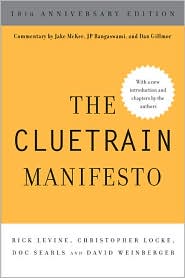
Cluetrain 10th Anniversary edition
Cluetrain 10th Anniversary
Everything Is Miscellaneous
Small Pieces cover
Small Pieces Loosely Joined
Cluetrain cover
Cluetrain Manifesto
My face
Speaker info
Who am I? (Blog Disclosure Form) Copy this link as RSS address Atom Feed

July 10, 2009

Internet freedom, but not equality

From the National Journal:

Sens. Arlen Specter, D-Pa., and Sam Brownback, R-Kan., secured $30 million in federal funding for the State Department’s efforts to promote Internet freedom as part of the agency’s fiscal year 2010 spending bill. The program must be approved by the full Senate and the House before it makes its way to President Obama’s desk. The money would promote widespread, secure Internet use by individuals residing in countries practicing repressive Internet monitoring, censorship and control. The outlay is “a low-cost method of allowing people, especially those living under repressive regimes, to access all-source, uncensored, unfiltered information,” the senators said in a Friday press release.

“Tearing down these Internet cyberwalls can match the effect of what happened when the Berlin Wall was torn down,” Specter said. “This funding seeks to enable freedom of thought, expression and the unimpeded flow of ideas and information, and I am pleased my colleagues have recognized the program’s importance.” Brownback added the battle being waged in the streets of Iran and China is also being fought on micro-blogging site Twitter, social network Facebook and other platforms. “This is a pivotal moment for people living in oppressive regimes. The best way to ensure their ability to communicate and share their story with each other and the world is to keep the Internet open,” he said.

The House passed a State spending bill Thursday that did not include Web freedom funding but Energy and Commerce Committee member Mary Bono Mack, R-Calif., earlier this week urged lawmakers to hold a hearing on the role of the Internet in giving a voice to those in repressive countries. Rep. Chris Smith, R-N.J., who in the 109th Congress chaired a high-profile Internet freedom hearing of the House subcommittee that oversees global human rights, has repeatedly introduced legislation that would prevent U.S. tech firms from working with nations that capture and convict citizens for engaging in democracy promotion and human rights advocacy online.

The NY Times reports on danah boyd’s kick-butt keynote at PDF09, in which she pointed to the class divisions in the Net:

Is the social-media revolution bringing us together? Or is it perpetuating divisions by race and class?

Many of us would like to believe the Internet is a force for unity, but danah boyd, a social-media researcher at Microsoft Research New England and a fellow at Harvard Law School’s Berkman Center for Internet and Society, thinks we’re deceiving ourselves.

Speaking last week at the Personal Democracy Forum, an annual conference that explores how technology is changing politics, Ms. boyd asked a packed audience of activists, political operatives, entrepreneurs and journalists to raise their hands if they use Facebook. Almost every hand in the place went up. Then she asked who uses MySpace, and barely a hand was seen.

How could that be? Sure, Facebook is growing much faster. But MySpace is far from dead. In May, Web-traffic tracker comScore reported that Facebook and MySpace are neck and neck in terms of U.S. visitors, with 70.28 million that month for Facebook, up 97% from a year ago, and 70.26 million for MySpace, down 5% from last year.

vMs. boyd got some answers from group of people she’s been hanging out with over the last four years: U.S. teens. During the 2006-2007 school year, her conversations with high-school students began showing a trend of white, upper-class and college-bound teens migrating to Facebook–much like the crowd in the conference hall has. Meanwhile, less-educated and non-white teens were on MySpace. Ms. boyd noted that old-style class arrogance was also in view; the Facebook kids were quicker to use condescending language toward the MySpace kids.

“What we’re seeing is a modern incarnation of white flight,” Ms. boyd said. “It should scare the hell out of us.”

More in the article, including research by Eszter Hargittai… [Tags: internet class social_class sociology politics e-democracy ]

Tweet
Follow me

Categories: Uncategorized Tagged with: class • digital culture • digital rights • e-democracy • egov • everythingIsMiscellaneous • internet • politics • sociology Date: July 10th, 2009 dw

1 Comment »

July 9, 2009

Brad Sucks latest album for free — and Brad still gets paid!

NOTE: The 50 copies are gone. Took about an hour.

I’m trying an experiment with a business model I like to call a reverse referral fee. Here’s how it works…

You click on a link that lets you download a copy of Brad Sucks’ latest album, Out of It. The album of wonderful music is yours for free in every sense. (Share it! Please!) But, I’m going to pay Brad for each copy downloaded, at a bulk rate he and I have agreed on.

This offer is good for the first fifty people who download it. After that, you can buy a copy on your own. Of course, Brad also makes his music available for free (in every sense), but don’t you want to support a truly webby, big-hearted musician who’s giving us his talent free of copyright, studios, and DRM? Doncha?

So, if you want to be one of the fifty, click here for your free-to-you-but-not-to-me copy of Brad Sucks’ Out of It.

[Tags: bradsucks music drm copyright copyleft business_models everything_is_miscellaneous ]free ]

Tweet
Follow me

Categories: Uncategorized Tagged with: bradsucks • business_models • copyleft • copyright • digital culture • drm • entertainment • everythingIsMiscellaneous • everything_is_miscellaneous • free • marketing • media • music Date: July 9th, 2009 dw

14 Comments »

Real photographs

A few years ago, I sat next to an AP photographer on a press bus as he deftly photoshopped an image he’d just taken. I asked him if he was allowed to do that, and he said the rule was that he could do anything with Photoshop that he could have done in a darkroom.

I thought of him when I saw the NY Times’ embarrassed retraction of a photo essay it had published. It turns out that the photographer had “digitally manipulated” the photos without telling his editor. Unfortunately, the NYT removed all of the photos, rather than keeping them up with the metadata that the digital manipulation had gone beyond editorial guidelines, and without telling us what those guidelines are. For all photos are manipulated. The photographer frames them, decides on what to focus on and how much of the photo should be in focus, etc., and then completes the manipulation in the darkroom, whether it’s analog or digital. To think otherwise is to fall prey to the fallacy of photographic realism that Susan Sontag warned us against.

Wouldn’t it be interesting to see what the NYT’s guidelines are and then hold a contest to see who can create the most deceptive photo while staying within those guidelines?

Scott Rosenberg, a founder of Salon and the author of a terrific new history of blogging (Say Everything), provides us with reflections on what could be one of the entries, based on stories he did for the San Francisco Examiner and Wired about the photographer Pedro Meyer. Really interesting. (Embarassingly, Scott cites me at the very end.)

[Tags: photography realism journalism media everything_is_miscellaneous ]

Tweet
Follow me

Categories: Uncategorized Tagged with: everythingIsMiscellaneous • everything_is_miscellaneous • journalism • media • metadata • photography • realism Date: July 9th, 2009 dw

6 Comments »

Putting the “us” into customers

Newegg, my favorite online store for electronics (well, if eBay doesn’t have what I’m looking for), runs informal online polls. The current one [note: this link will be wrong whenever Newegg posts its next poll]:

What kind of Product information is most important to you when making a purchasing decision?

* Images
* Product Specifications
* Manufacturer Content: manuals, installation guides
* Product Overview & Highlights
* Buying Guide
* Other Customer Reviews
* Additional Content Regarding the Product
* I love your current product page

Of the 4,100 people who voted, 40% say the product specs are the most important info, followed by 30% who say customer reviews are. The rest of the results are in single digits, except for the 15% who responded that they love the current page.

Granted this is an unmonitored, game-able online poll. In fact, I gamed it a bit by voting for customer reviews, even though the product specs are usually my first criterion: If I need a male-male USB cable, I don’t care how good the reviews are for a female-female USB cable. On the other hand, if the specs say that one monitor has a lower refresh rate than another, but customer reviews say that the lower refresh rate isn’t apparent when playing games, the customer reviews will be the decisive factor for me. And I do love Newegg’s current product page. So, faced with having to pick just one, I decided to encourage Newegg to continue featuring customer reviews.

(By the way, did I ever mention that the Tenth Anniversary edition of Cluetrain came out a couple of weeks ago, with new chapters by each of the authors and with comments from some Highly Respected Individuals?

[Tags: marketing cluetrain ]

Tweet
Follow me

Categories: Uncategorized Tagged with: business • cluetrain • marketing Date: July 9th, 2009 dw

2 Comments »

July 8, 2009

Running thoughts

I run. Yes, I know the idea is ridiculous, but not half as ridiculous as the actual sight of me “running.” The only indication that I am running and not, say, just leaning forward slightly is that that posture could under no circumstances produce that amount of sweat. Showering for me is not going from dry to wet; it’s merely the replacement of sea water with fresh.

Well, enough about my sweat. Here are some random thoughts from the hard sidewalks of Brookline and Brighton.

0-10 minutes: Jill Sobule is really good. Why don’t I listen to her more? I especially like the songs where she reveals something unexpected about the person she’s singing about. That’s the essence of the narrative art. Also, why is that new song about kissing a girl bigger than Jill’s was?

10-12 minutes: Jeez, Hegel was right about how history works. Everywhere you look at what the Net is doing to us, old forms are being contradicted, but also raised up, and then overcome by something new that includes it while going beyond it. E.g., experts are better able to do what they do, but put them into a network with other experts — and non-experts — and you get the whole expertise taken to a new level. Likewise, the massness of the Web nevertheless is raising up a new type of local-ness, including that in some public, mass-y places there will be nooks with the Norman Rockwell expectation that people will know your name. Or avatar, anyway.

12-20 minutes: Since at the current pace, the number of registered Web domains will hit infinity in the year 2013, what will be the most efficient search algorithm to look up any one of them? Even if they were alphabetized, could you do the old thing of dividing the list in half to see if the target term is in part one or part two, and then dividing it again and again? With an infinite list, wouldn’t that on average take, um, forever? In fact, how would you even know where the middle was to do the first divide? Well, I suppose you could assign them numbers and then divide them into even and odd numbers. But you’re still talking about infinities here. Jeez, I wish I’d taken math after high school.

20-43 minutes: What is the name of the part of the leg between the ankle and the calf — the back part of the leg, not the shins — because whatever it is, it’s on fire. Undercalf? Backshin? The limpmaster? The quadralimpcets? The supra-ankle-scorcholater? Ow ow ow ow ow ow ow ow ow ow ow ow ow ow ow ow ow wow that’s a lot of sweat ow ow ow ow ow ow ow ow.

[Tags: music hegel running infinity ]

Tweet
Follow me

Categories: misc Tagged with: digital culture • hegel • infinity • misc • music • running Date: July 8th, 2009 dw

2 Comments »

July 7, 2009

Eszter cries “Grinch!” on MJ lottery

Eszter Hargittai uses the lottery for tickets to view Michael Jackson’s corpse to illustrate her point about the existence, persistence, and importance of the digital divide.

[Tags: eszter_hargittai michael_jackson digital_divide ]

Tweet
Follow me

Categories: Uncategorized Tagged with: digital rights • digital_divide • eszter_hargittai • michael_jackson • policy Date: July 7th, 2009 dw

Be the first to comment »

Free book on search interfaces

Berkeley’s Marti Hearst, who was way ahead of everyone else in faceted classification (e.g.,flamenco) , has written a a definitive book on user interfaces to search engines. And it’s up on the Web for free, if that’s the way you roll. Thanks, Marti!

[Tags: search google user_interfaces everything_is_miscellaneous ]

Tweet
Follow me

Categories: misc Tagged with: everything_is_miscellaneous • google • misc • search • user_interfaces Date: July 7th, 2009 dw

4 Comments »

Plato: u suk kthxbi

Emil Sotirov in a comment points to this photo, in Wikipedia’s Wax Tablet article:

ancient greek wax table looks like a laptop

[Tags: wax_tablets greek humor ]

Tweet
Follow me

Categories: Uncategorized Tagged with: greek • humor • wax_tablets Date: July 7th, 2009 dw

1 Comment »

July 6, 2009

News, process, webs and networks

Terry Heaton has yet another excellent entry in his continuing series on the media r/evolution. This one is on the news as a process — never done, never entirely right.

I’ve been thinking for the past few days about the news as a network. I’ve been finding that the network view of institutions is helpful because it lets you think about the ways in which the odd properties of The Network, and especially the Web, may be getting applied to those institutions — how those properties fit and don’t fit, and what that means for how those institutions can and should interact with the Net. In fact, at the moment I’m thinking about that as the organizing principle of a talk I’m giving at the Open Gov Innovations conference in a couple of weeks.

Terry’s process view of the news is helpful because it reminds us that a news story is messily spread over time, with many hands touching, and thus contradicts the ol’ writing-boom-published timeline of yore. Nah, the news is always in process. Dave Winer’s river of news is another useful metaphor, capturing the flow of news that we care about.

Metaphors are not exclusionary, so I also like the network idea. The river of news as it flows past us is part of a continuing process, which has shape and some persistence because it is a network. And I think the news is a network pretty much fractally: A hyperlinked news story is embedded in a network of links. Stories are slices through complex webs of ideas, with connections through the river of time and the semantic space of causality and influence. A collection of stories (what we used to call a “newspaper” or a “nightly news show”) is a web of related pieces — related by chronology but also by cross-commentary and references. Reporters rely on networks of people. Readers read within networks of people and ideas. The events themselves that the news “covers” are so deeply enmeshed in networks of history and culture that the very notion of a “story” is now suspect.

There are at least three problems with networks of news. 1. Networks can be lazy; they are so sprawling and full of goodies that there’s some type of focused work they may not get around to. 2. Networks lower the barriers to social gravity, so that we can be irresistibly attracted to people who are like us. (Ok, so opposite magnetic poles attract, and thus my metaphor has failed. Damn!) 3. We know how to turn hard objects into money, whereas it’s way harder to figure out how to make networks of news economically sustainable.

But the networking of news feels to many of us like the news assuming a more natural, authentic shape, freed from the rectangle of paper into which it has been force fitted for so long.

[Tags: news journalism media jeff_jarvis michael_arrington nytimes ]

Tweet
Follow me

Categories: Uncategorized Tagged with: everythingIsMiscellaneous • jeff_jarvis • journalism • media • michael_arrington • news • nytimes Date: July 6th, 2009 dw

4 Comments »

July 5, 2009

News is a network

Jeff Jarvis has a terrific, provocative post about the narcissism of newspapers in which he discusses a number of myths. The discussion afterwards is also really inte)resting. Here’s the comment I posted there (with a minor edit or two, all of which can really be reduced to the title of this post:

Terrific post and discussion. Thanks, Jeff.

May I add one more, related, myth to your collection, Jeff? Here goes: That it’s possible to cover the day’s events.

This is just a different way of putting your formulation “One man’s [sic] noise is another man’s news.” But I think it’s worth calling out since the promise of sufficiency is a big part of traditional newspapers’ promise of value to us: “Read us once in the morning, and after going through our pages, you will know everything you need to know.” (Do radio stations still make the ridicule-worthy “Give us 8 minutes and we’ll give you the world?” claim.) Yeah, no newspaper would ever maintain that claim seriously if challenged — they know better than their readers (or at least they used to) what they’re leaving out — but it’s at the base of the idea that reading a paper is a civic duty. The paper doesn’t give us everything but it gives us enough that reading one every day makes us well-informed citizens.

The notion that newspapers give you your daily requirement of global news — which works out to wondering, along with Howard, if there is such a thing as “news” — seems to me to be as vulnerable as the old idea of objectivity. Like objectivity: (1) It’s presented as one of the basic reasons to read a newspaper; (2) it hides the fact that it’s based on cultural values; and (3) it doesn’t scale well in the age of the Net.

Ultimately, this myth is enabled – as so many of the myths of news and knowledge are — by paper. Take away the paper and the newspaper doesn’t become a paperless newspaper. It becomes a network. That’s what’s happening now, IMO. From object to network … and networks are far far harder to “monetize” (giving myself a yech here) than objects.

(By the way, this is what I was trying to ask in the question I horribly botched at PDF. Sigh.)

[Tags: newspapers journalism everything_is_miscellaneous objectivity ]

Tweet
Follow me

Categories: Uncategorized Tagged with: everythingIsMiscellaneous • everything_is_miscellaneous • journalism • media • newspapers • objectivity Date: July 5th, 2009 dw

4 Comments »

« Previous Page | Next Page »


Creative Commons License
This work is licensed under a Creative Commons Attribution-NonCommercial-ShareAlike 3.0 Unported License.
TL;DR: Share this post freely, but attribute it to me (name (David Weinberger) and link to it), and don't use it commercially without my permission.

Joho the Blog uses WordPress blogging software.
Thank you, WordPress!