

logo
EverydayChaos
Everyday Chaos
Too Big to Know
Too Big to Know
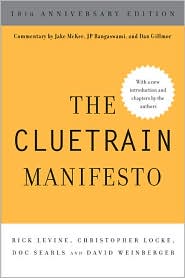
Cluetrain 10th Anniversary edition
Cluetrain 10th Anniversary
Everything Is Miscellaneous
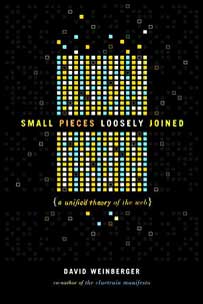
Small Pieces cover
Small Pieces Loosely Joined
Cluetrain cover
Cluetrain Manifesto
My face
Speaker info
Who am I? (Blog Disclosure Form) Copy this link as RSS address Atom Feed

April 9, 2009

Happy Birthday to You isn’t copyrighted???

In a comment to a distressing post about YouTube automatically taking down any video that contains any copyrighted material, even if it’s covered by Fair Use, a commenter posts a seemingly learned post explaining why “Happy Birthday” may indeed not be under copyright.

And to think of all the years I spent singing “For She’s a Jolly Good Birthday” instead!

[Tags: copyright youtube dmca happy_birthday copyleft ]

Tweet
Follow me

Categories: Uncategorized Tagged with: copyleft • copyright • digital rights • dmca • youtube Date: April 9th, 2009 dw

1 Comment »

The future of the Boston Globe

The New York Times owns the Boston Globe and is asking the unions to come up with $20M in savings. According to a report on WBUR this morning, the Times isn’t even giving the unions enough time to go through their own legal processes for making such decisions. So, here are some possible outcomes:

The Globe folds.

The Globe is bought, presumably by someone with a drug problem.

The Globe becomes an insert in the New York Times. The insert covers not just local news but maintains some of the Globe’s identity, personality, and personalities. (Also, the comics.) If I were the NYT, I’d be running spreadsheets to see if folding the Globe into the NYT (quite literally) would increase local circulation and ads enough to make it worth the considerable operating expenses.

And, as an auxiliary idea, I wonder if people would be willing to pay for online access to the Globe if it did two things: 1. Continue to provide free access to individual articles, for we need to be able to link to them both to keep the Globe relevant and to grow our culture. 2. Enhance the current Globe site so that it has more of the unitary newspaper feel. That is, let us have more of a sense that we’re reading an object that has a start and a finish, so that we’re tempted to sit down with it once a day and go through it. Let us turn pages until we’re done. (Of course, the pages would be full of links.) Provide us with all the electronic reading tools we could ever want, but tempt us to treat it as a whole through which we take a walk every day. And charge us $100/ year for the privilege. Since we’d be able to get at any of the individual articles for free, the Globe would be charging us for the online equivalent of curling up with the paper in the morning.

I acknowledge that that may be the stupidest idea since unsliced bread, and perhaps it is merely an old fogey desire. But, heck, it’s not like I’m writing for a responsible newspaper!

[Tags: newspapers media boston boston_globe everything_is_miscellaneous ]

Tweet
Follow me

Categories: Uncategorized Tagged with: boston • everythingIsMiscellaneous • media • newspapers Date: April 9th, 2009 dw

2 Comments »

April 8, 2009

PhilosophyTalk goes miscellaneous

On Sunday, I was the guest on PhilosophyTalk, an NPR show that you can listen to via PRX.org (free membership required). We talk about how and why we dice up the world the way we do.

[Tags: everything_is_miscellaneous philosophy radio ]

Tweet
Follow me

Categories: Uncategorized Tagged with: everythingIsMiscellaneous • philosophy • radio Date: April 8th, 2009 dw

Be the first to comment »

April 7, 2009

[berkman] Tim Hwang

Tim Hwang (twitter: timhwang), one of the founders of ROFLcon, is giving a talk at the Berkman Center. The talk is titled “The LOLCat-hedral and the Bizarre: A Memescape Manifesto.” [Note: I’m living blogging which means I’m missing lots, getting things wrong, not correcting mispellpings, and generally making the world worse.]

ROFLcon is an attempt to get everyone who’s ever been famous together in a room. E.g., the Tron Guy, Tim says. He also works with Yochai Benkler who is working on the nature of collaboration. He also works with freeculture.org. He’s also shooting a documentary about the Goatse photo; he is going to find the Goatse guy and those who have been affected by his hideous photo. [Note: Don’t Google the image unless you want to see a guy holding open his own ass. The link in the previous sentence is to a photo-less Wikipedia article.]

He says that as you look at Internet memes and fads, it looks like a random collection of odd things. But this intuition is wrong. “There’s a reason certain memes emerge and when they do.” There should be a relationship of these memes across time and among memes at the same time. Tim calls this the “memescape,” which is a way of saying that the emergence of these memes is not entirely random.

The 4chan paradox: Memes form where people can communicate and share content. E.g., Facebook. It’s a big thing. There we can share ideas, events, comments, chat, etc. etc. “It has every single doohickey you could want.” Now look at 4chan.org. It has many few social tools. You’d think that more memes would emerge on FB. In fact, 4chan is a bigger meme generator. E.g., LOLcats came out of 4chan, as did Rick Rolling and chocolate rain. Memes do come out of FB (e.g., 25 things and the Beautiful truck), but there aren’t sustained communities around these memes. LOLcats on the other hand has a community site (icanhascheezburger.com). LOLcats respond to one another: Ceiling Cat calls forth the Basement Cat. The meme contains its own memes and becomes a self-referential universe. And it spills past its boundaries, unlike Beautiful truck. E.g., the LOLspeak translation of the Bible, LOLbama.com, etc.

Why? It could be just an accident that memes arise more on 4chan than FB. Or there might be a relationship among memes. In Jonathan Zittrain’s “The Future of the Internet,” he says the PC won out because it was open and generative. Generativity means that tech that’s open to third parties allows for explosive innovation. Tim suggests that generativity applies to social systems as well as to hardware. FB is closed in that it tells you what the basic areas are, the info is siloed among friends, and there’s so much there that it’s hard to master. In contrast, 4chan is simple and just a blank space into which you can put any type of content, and the content is open to everyone (not siloed).

The future? Over the next couple of years we’ll see Net culture infiltrate into the mainstream. The global recession will help the Internet culture boom. Net culture is made of supply (people creating content, back and forth) and demand (money, interest, participation). Unemployment gives people time to create memes. He points to a 2007 study that shows that YouTube usage peaks right after lunch before people come back to work. Shirky‘s “cognitive surplus” really means a lot of people with time on their hands (Tim says).

Demand: Do I contract with a real celebrity or with a Net celebrity? E.g., Rick Astley showing up on a Thanksgiving Parade float. More is going mainstream. E.g., Christian Lander has a book called “Stuff White People Like” that is a bestseller.

There are also people. If you’re out of work, you can spend all day online being entertained for free. You can buy cheap goods through Etsy.com. He points to some data that seems to correlate unemployment with Net creativity, although he says that it would need much more research.

The decisions made in code and hardware influence the social space. This suggests some projects that could be undertaken. 1. Environmental advisories: Look at the consequences of behaviors, especially when lots of people do them. E.g., symmetrical info streams: If I see your data, you see m. ineIf people are friending back indiscriminately, what happens when this scales up? Does that dilute FB? 2. Bug tracking. Internet culture is hackable. E.g., Digg. The top 100 users have contributed 50-60% of the stories on the front page. Might be interesting to track these sorts of “bugs.” Could you use this to create an EPA for the social Web, that reports on its health?

Q: [chris seghoian] Most of 4chan is porn. It works because it’s anonymous. The postings there would get you banned from Facebook. 4chan is the primordial soup of the Internet. I’d argue that it’s the freedom to be horrible that enables the memes to grow.
Tim: I agree.

Q: Digg was distorted by companies trying to get their stories promoted.
Tim: That’s an argument for an EPA for the Web. I’d like to make this sort of distortion public.

Q: [ethanz] I like the environment metaphor. But what’s optimal? The EPA says that lead in drinking water is a bad thing. How does the Web EPA figure out what is desirable? And you’d be trying to model something that is changing so rapidly. I don’t believe in your correlation of stock market and creativity, but I think you’re right that it correlates to economics; you might do better with case studies. But the environment is all about homeostasis, whereas the Net has no homeostasis.
Tim: Yes. But thinking of memes as a system rather than as random jolts online might be valuable.

Q: [jason] Is the audience expanding? Or are those who are involved getting more active?
Tim: The population is expanding. And the audience is growing.

Q: [me] So many of the memes are distortions of mainstream culture. Chuck Norris, LOLcats, Marmaduke Explained…
Tim: Yes. Some are more distinctly their own, e.g. XKCD.com references mainstream but is its own. It’s still a game that it has yet to be resolved.
Ethanz: People are now coming out of this fan culture with their own culture. This is the nascent new crop of natives. They’re mastering their craft.

Q: [judith donath] With LOLcats, if you didn’t keep up, you lose track. E,.g., if you didn’t know Ceiling Cat, you wouldn’t get the Basement Cat joke. There’s already this tension between being non-obvious (so they are a boundary between those who are in and out) and being obvious enough. LOLcats changed rapidly to keep that boundary at the right space.

Q: [chris s.] You mentioned good memes. But there are also griefers who post flashing jpegs at epileptic forums, Anonymous actions against Scientology, the Sarah Palin hacker…
Tim: There’s a universe of evil of memes that parallel the good memes. Even in the days of BBS, there were communities online that did bad stuff. Benkler talks about the Net aggregating fringe things and making them a big thing at the center.

[lokman] How do the economics affect the culture?
Tim: Clay Shirky points to the Power Law distribution of blogs. True for Net culture. The celebs who think of themselves as big celebs had the most trouble at ROFLcon. The Numa Numa guy won’t show up for less than a few thousand dollars. Will Net culture maintain its character?

Q: [jason] How do you decide when something becomes a meme?
Tim: We battle with this. We take “meme” really broadly.

Q: [eszter hargattai] How does this energy and time could be turned to other activities? E.g., let’s have people learn more about Africa?
Tim: There’s a code of honor on 4chan: You should do things for the luls, i.e., for the fun of it. I haven’t seen good models for channeling the energy towards something socially productive. Still, you might be able to use the mechanisms/lessons to produce something more useful.

Q: [elsa] Net culture lends itself not only to LOLcats but also to more political and global news. But, do you have thoughts about the generational issue. Our gen was the first to grow up with the Net. Is there a shift in cultures?
Tim: Are we only talking about the geek universe? There’s a whole universe not captured by this. So, when you zoom out, it’s hard to tell if Net culture only applies to a relatively small pocket.

Q: Why do some micromemes become popular?
Tim: Most social media experts are either talking about one case they know about or they’re completely anecdotal. There isn’t enough quantifiable work being done.
Ethanz: MediaCloud is trying to figure out what political memes come out of the blogosphere. Could you do research that would enable you to spot, say, 4chan memes that are about to take off?
Tim: A recent paper said that some pairs of memes are in a predator-pray relationship.

Q: [joel] PennyArcade was just two guys in Seattle and is now a business. The professionalization is interesting. Can we reverse engineer what might become a hit? [Tags: ]

Tweet
Follow me

Categories: Uncategorized Tagged with: digital culture Date: April 7th, 2009 dw

6 Comments »

Australia to build 100mbps broadband infrastructure

From the Australian government’s press release:

New National Broadband Network

The Rudd [Australian federal] Government today announced the establishment of a new company to build and operate a new super fast National Broadband Network.

This new super fast National Broadband Network, built in partnership with private sector, will be the single largest nation building infrastructure project in Australian history.

This new National Broadband Network will:

* Connect 90 percent of all Australian homes, schools and workplaces with broadband services with speeds up to 100 megabits per second—100 times faster than those currently used by many households and businesses

* Connect all other premises in Australia with next generation wireless and satellite technologies that will deliver broadband speeds of 12 megabits per second

* Directly support up to 25,000 local jobs every year, on average, over the 8 year life of the project.

[Slightly later:] Here are responses by Benoit Felten and Paul Budde.

[Tags: broadband australia ]

Tweet
Follow me

Categories: Uncategorized Tagged with: australia • broadband • policy Date: April 7th, 2009 dw

2 Comments »

April 6, 2009

Ethanz at his best

Ethan Zuckerman has a fantastic post about Paul Simon’s South African collaboration. It’s a long, complex story that Ethan tells with his usual clarity and gusto, but it’s not about Paul Simon so much as about the nature of paths between cultures. The simple is complex because cultures emerge from (and shape) history, and history is everything there is plus some more on top of that.

Few can combine his simultaneous grasp of details, his breadth, and his ability to synthesize context. There’s also his vast heart. Read the post. Only Ethan could have written it.

[Tags: ethan_zuckerman paul_simon bridgeblogs blogs south_africa culture ]

Tweet
Follow me

Categories: blogs Tagged with: bridgeblog • bridgeblogs • culture • digital culture • globalvoices • peace Date: April 6th, 2009 dw

Be the first to comment »

Open networks work

At Freedom to Connect, I was unable to blog Benoit Felten‘s excellent and very popular talk because there was too much in it, and there were some terms I didn’t understand. But I did like the following quotation from Ad Scheepbouwer, CEO of the Dutch telecom, KPN:

In hindsight, KPN made a mistake back in 1996. We were not too enthusiastic to be forced to allow competitors on our old wireline network. That turned out not to be very wise. If you allow all your competitors on your network, all services will run on your network, and that results in the lowest cost possible per service. Which in turn attracts more customers for those services, so your network grows much faster. An open network is not charity from us, in the long run it simply works best for everybody.

Benoit went on to talk about whether the US situation is sufficiently like that of the Netherlands to warrant learning a lesson from KPN. You can see a version of his talk here: 1 2 3 4.

[Tags: benoit_felten broadband net_neutrality fcc ]

Tweet
Follow me

Categories: Uncategorized Tagged with: broadband • digital rights • fcc • net neutrality • policy Date: April 6th, 2009 dw

Be the first to comment »

No press pass? No First Amendment for you, my friend.

From Terry Heaton:

The freedom of the press clause in our beloved First Amendment is about to undergo perhaps its most serious challenges, because “the press” isn’t as neatly defined as it once was. A fascinating case in Phoenix is headed for court, and it ought to give any practicing journalist pause.

According to The Arizona Republic, blogger Jeff Pataky’s home was raided by ten Phoenix police officers armed with a warrant last month. He was out of town, and his girlfriend was handcuffed for three hours while police conducted the raid. They seized computers, files and anything associated with Pataky’s website — are you ready for this? — Bad Phoenix Cops.

Pataky apparently has an axe to grind with Phoenix police but says his site contains tips and inside information that comes from “good” cops in Phoenix. Now that the department has all of Pataky’s equipment and files, it’s pretty easy to see where this is going.

…

…And here’s the thing: anybody with an ounce of ink in their blood knows that Pataky deserves First Amendment protection, but they’re unlikely to say it publicly, because “the (professional) press” thinks of itself as a special class of people and have railed for years against the likes of Pataky….

More at Terry’s site…

Tweet
Follow me

Categories: blogs Tagged with: blogs • digital rights • media Date: April 6th, 2009 dw

Be the first to comment »

April 5, 2009

Public data becoming public! Viva Vivek!

The U.S. has announced that it will be making data public routinely at data.gov starting May. Vivek Kundra, our federal CIO gets the credit, since he did the same thing for DC.

[Tags: egovernment egov everything_is_miscellaneous vivek_kundra ]

Tweet
Follow me

Categories: Uncategorized Tagged with: egov • egovernment • everythingIsMiscellaneous Date: April 5th, 2009 dw

3 Comments »

Songs of Liberation

As I clean my home office for Passover, ere’s a quick refresher on the holiday’s symbols:

The pointer came from my brother Andy, who, in a non-unrelated-email also pointed me to an ACLU petition to get a special prosecutor to look into W’s torture policy.

[Tags: passover pesach liberation torture ]

Tweet
Follow me

Categories: Uncategorized Tagged with: culture • liberation • passover • pesach • politics • torture Date: April 5th, 2009 dw

2 Comments »

« Previous Page | Next Page »


Creative Commons License
This work is licensed under a Creative Commons Attribution-NonCommercial-ShareAlike 3.0 Unported License.
TL;DR: Share this post freely, but attribute it to me (name (David Weinberger) and link to it), and don't use it commercially without my permission.

Joho the Blog uses WordPress blogging software.
Thank you, WordPress!