


logo
EverydayChaos
Everyday Chaos
Too Big to Know
Too Big to Know
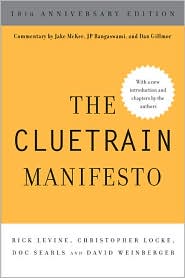
Cluetrain 10th Anniversary edition
Cluetrain 10th Anniversary
Everything Is Miscellaneous
Small Pieces cover
Small Pieces Loosely Joined
Cluetrain cover
Cluetrain Manifesto
My face
Speaker info
Who am I? (Blog Disclosure Form) Copy this link as RSS address Atom Feed

April 17, 2009

[ugc3] Scott McDonald

NOTE: Live-blogging. Getting things wrong. Missing points. Omitting key information. Introducing artificial choppiness. Over-emphasizing small matters. Paraphrasing badly. Not running a spellpchecker. Mangling other people’s ideas and words. You are warned, people.

Scott McDonald of Conde Nast gives the lunchtime talk. He reminds us of how big CN is: magazines, websites, events, digital apps.

His numbers show that lots of people are creating content.

UGC issues for “traditional” [the quotes are on Scott’s slide] media: Brand compatitiblity (vs. “snark/coarsening”. Commoditization of content (all gets treated the same). Value as “listening post” (media can hear their readers). DRM when everyone is an aggregator. Monetization.

Advertisers are reluctant to jump in, Scott says. They worry about brand. UGC video is cheap and plentifu. but it’s not selling. The CPMs are deeply discounted. Ad revenues are not going to UGC and marketing execs are pessimistic about this; only 22% think UGC is a “high-growth opportunity.” 73% of advertisers say they definitely will not run ads on UGC.

So, what are the other models? You can incorporate UGC on a site as a “retention device.” [CNN’s turn-the-channel “iReports”?] Authentication fees on microblogging sites? E.g., Twitter charges DominosPizza to assure that it in fact represents Dominos Pizza. How about sponsorships on crowdsourcing sites such as Digg? E.g., at Reddit, maybe a sponsor could be an “amplifier” that announces that each thumbs up counts 5x. [Wha??? Wouldn’t that destroy Reddit’s credibility?] Finally, there’s cross-platform marketing. Only 10% of visitors to a mag’s site are subscribers. So, cannibalization isn’t a worry. But how do you make money on the web site? Ads only work for very big sites. But,” online subscriptions sales are sweet.” People who subscribe that way have higher value than subscribers through other means: They’ve sought out the mag, they pay with a credit card, they are more likely to take an automatic renewal contract, they get added to the email list, etc.

He points to Conde Nast examples of UGC. Contests for designs, NYer caption contest, GQ tips on good grooming. [These are as much UGC as a man-in-the-street interview.]

He points to Reddit, a CN site. He acknowledges the bad language on the page. It produces no subscription revenues. They’re starting to have sponsored posts that still can be voted up or down.

Q: Are people dropping subscriptions because they can get the content for free online?
Scott: In general, no. The conditions for reading mags are special, e.g., reading one on the subway to create zone of privacy. [A good e-reader will destroy this.] For news mags, that’s more of an issue.

[Tags: ugc ugc3 conde_nast media mainstream_media advertising marketing ]

Tweet
Follow me

Categories: Uncategorized Tagged with: advertising • business • cluetrain • conference coverage • culture • digital culture • marketing • media • ugc • ugc3 Date: April 17th, 2009 dw

Be the first to comment »

Appellate court: No fair peeking at RIAA hearing

The appellate court has decided, on narrow grounds, that the judge in the Tennenbaum RIAA case was wrong to allow an upcoming hearing to be webast. ZDNet has a helpful article.

[Tags: riaa tennenbaum charles_nesson copyright copyleft ]

Tweet
Follow me

Categories: Uncategorized Tagged with: copyleft • copyright • digital rights • riaa • tennenbaum Date: April 17th, 2009 dw

2 Comments »

[ugc3] Understanding evolving online behavior

NOTE: Live-blogging. Getting things wrong. Missing points. Omitting key information. Over-emphasizing small points. Paraphrasing badly. Not running a spellpchecker. Mangling other people’s ideas and words. You are hereby warned.

John Horrigan of Pew Internet and American Life, gives a “non-Koolaid” presentation. He says that about 12% of Internet users have a blog. The percentage of people doing some form of content sharing is not increasing much at all. The demographics says that 18-24 do the most sharing, and then it goes down in pretty much a straight line. The change over time is not distributed evenly across age groups. Younger adults are turning away from the 6 core UGC behaviors, the 24-35s are increasing. The rest: not much change.

But people are increasingly going to social networkingIf UGC is migrating to rules-based environments, is it a good bargain? On the one hand, good governance can build sustainable mechanisms. OTOH, bad governance is a risk, so you want an open Internet.

Q: A decrease in activity among younger folk? Because they were so heavily involved initially?
John: They’re going to social networking sites instead of maintaining their own sites. But UGC is still an important activity to them.

Q: The changing behaviors as people age and how that will effect UGC?
John: Impossible to answer because we don’t know how the tech will change.


Mainak Mazumdar of The Nieslen Company begins by looking at blogging topics. It’s quite diverse he says. Next: size. Wikipedia has many more topics than Britannica. Also, social networking is very big: Member communities are #4 on most visited lists, after search, portals, and software manufacturers. #5 is email. Social media is big everywhere. (Biggest: 80% of Brazil. 67% in US.) The US is showing comparatively slower growth in “active reach of member communities.” Time spent in CGM has been increasing. So is the time spent on social networking. 35-49 years are the fastest growing audience for social networking sites. Teen consumption of SNS is going down, because they’re going more and more mobile. Mobile will be huge. TV will be big. People are watching more TV. Big media companies are doing well. “Becoming a mother is a dramatic inflectin point and drives women to the Web in search of advice and a desire to connect with others in her shoes” (from the slide).

Is the Net a game-changer for research companies? He compares it to scanner data in the 90s and online surveys in 1990s. In 2000s, perhaps [perhaps??] social networking will once again change the game. Reasons to think the Net is a game-changer overall [i.e., exceptionalism] : Pervasive, sticky, generational.

Q: Is TV watching growing on all screens or just on the living room screen?
Mainak: Time spent watching TV content on a TV.

Q: Maybe SNS have surpassed email because email was used to listserves to serve the social function.
Mainak: We’re talking about how long you spend in Outlook + Web mail. We install monitors that report on how long you spend in each application.

Russ Neuman: Be careful of projecting out from the current tech. It can be disrupted easily.

Q: Older people are entering SNSs. I call them “parents.” To what extent will that change what started out as a youth movement? Is the move to mobile a move out of the SNS as they become mom and dad’s spots? [Oprah is on twitter.]
A: Yes. Some younger teens are going straight to mobile and circumventing the Internet.


Eszter Hargittai talks about the role of skill in Internet use. Yes, young people use digital media and spend a lot of time online, but it’s true that they engage in lots of online activities or that they’re particularly savvy about the Net and Web tools. So, the idea of “digital natives” is often misguided.

She’s particularly interested in the skills people have and need. Her methodology: Paper and pencil surveys to avoid biasing towards those comfortable with using Web tools. 1,060 first year students at U of Illinois. Most of the data comes from 2007, although she has some pre-pub data from 2009. The question is: What explains variation in skill? Gender, education and income predict skill. “The Web offers lots of opportunities but those who can take advantage of them are those who are already privileged.”

This has an effect on how we intervene to equalize matters. You can’t change socio-economic status. And it turns out that motivation doesn’t seem to make much of an effect. You can only be motivated to do something that you already know is a possibility. She shows new data, not ready for blogging, that show that very small percentages of users have actually created content, voted on reviews, edited Wikipedia pages, etc. The number of teenagers who have heard of Twitter is quite low. [Sorry for the lack of numbers. I’m not sure I’m supposed to be reporting even these trends.]

Mainstream media remain strong. Eszter points to the media story about Facebook users having lower grades. Eszter looked at the study and finds it to be of poor quality. Yet it got huge mainstream play. Eszter tweeted about it. She blogged about it. The tweet led to a co-authored paper. Even so, the mainstream probably won’t care, and most of the tweets are still simply retweeting the bad data. The Net is a huge opportunity, but it’s not evenly distributed.

Q: A study found that people online are lonely. It was picked up by the media. The researcher revised to say that it’s the other way around. It wasn’t picked up. The media pick up on the dystopic.

Q: Your data reflects my experience with my students. They don’t blog, they don’t tweet. There’s a class component to this.
Eszter: We measure socio-economic status. Why does it correlate? We’re exploring this. We now ask about parental support of technology use, rules at home about tech use, etc. So far we’re finding (tentatively!) that lower-educated parents tend to have more rules for their kids.

Q: What happens when there’s universal wireline connection?
Eszter: As the tech changes, the skill sets change. The privileged stay ahead, according to my 8 years of studies.

Q: What skills should we be teaching?
A: Complicated. Crucial issue: The evaluation of the credibility of sources. There’s an extreme amount of trust in search engines. That’s one place we need to do more work. And librarians are highly relevant here.

Q: How do people use the Net to learn informally, e.g., WebMD?
Eszter: There are lots of ways and types to do this. But, first you need to know what’s on the Web. You need good search skills, good credibility-evaluation skills.


Cliff Lampe talks about how Mich State U students use Facebook. He presents a study just completed yesterday, so the data isn’t yet perfect. 97% of his sample are FB users (although Cliff expresses some discomfort with this number). Mean average of 441 friends; median = 381. Ninety percent of these they consider to be “actual” friends. 73% only accept friend requests from people they know in real life. Most spend just a little time (under 30mins) at FB per day. About half lets their friends (but not everyone in their network) to see everything in their profile. Almost everyone puts a photo of themselves up. Vast majority have a photo album. About a third think their parents are looking at their page. Overall they think they’re posting for their college and high school friends.

He talks about Everything2.com, a user-generated encyclopedia/compendium that is 11 years old. Why have people exited? Research shows they left because other sites came along that do the same thing better. Also, changes in life circumstances. Also, conflict with administration of the site. There’s a corporitization of some of the UGC sites. He also has looked into why new users don’t stick: They don’t glom onto the norms of the site.

Q: Are reasons for exiting a negative network effect? More than 150 and the network deteriorates?
Cliff: We see that in Usenet. But not so much at Facebook where you’re just dealing with your friends.

Q: Any sites that have tried to drive away new users?
Cliff: Metafilter has a bit of that. Slashdot has a “earn your bullshit” tagline.

Q: Are your students alone or with others when they are online? Are they aware of the technology?
Cliff: The rise of the netbook has had an effect. Most of my students experience social media as a group activity. But a lot of them are not that savvy. They generally don’t know how Wikipedia operates. [Tags: sns social_networking facebook exceptionalism tv wikipedia environment ]

Tweet
Follow me

Categories: blogs Tagged with: blogs • business • conference coverage • digital culture • education • entertainment • environment • everythingIsMiscellaneous • exceptionalism • expertise • facebook • knowledge • libraries • marketing • media • sns • tv • wikipedia Date: April 17th, 2009 dw

2 Comments »

[ugc3] The Evolution of UGC

Dan Hunter of NY Law School begins with an informal talk called “UGC: From Threat He disagrees with Eli Noam that the end game will be commercialization. [Ah, the exceptionalist battle is joined!] He thinks about UGC as amateur media, focusing on the motivation of the users. His question: Is there a role for commercial providers, outside of providing the infrastructure? The content will increasingly be provided by people whose motivations are non-commercial. (He shows Wolf Loves Pork at YouTube.com. Very cool.)

It’s important to not think this is about traditional media forms, he says. It includes virtual worlds, collaborative games. People are living out their lives in these environments. UGC is not something separate from our lives. It is our environment.

Amateur work is crowding out the commercial, he says. E.g., YouTube, music, user reviews at Amazon etc. Most of the money is in the infrastructure, not the content: Blizzard providing World of Warcraft, Google, etc.

Q: Google lost $500M this year on YouTube.
Dan: If you’re suggesting there’s no money in infrastructure…We can’t yet know if that’s a blip, a market indicator, etc.

Q: Two examples that support your case: 1. Orpheus Orchestra has no conductor. 2. YouTube orchestra is collaborative.
Dan: Sites like Wikipedia can be quite bureaucratic. There’s a range of examples, some totally spontaneous.

Q: Wolf Eats Pig actually ends the other way around, which is a bad moral and is very worrisome for Japanese society.


Next, David Card of Forrester Research presents research. [I’m not going to try to capture the numbers.]

Social networking is becoming ubiquitous, but the “creative stuff” is still a minority behavior and is not growing at the same pace as social networking, watching videos, or writing reviews. Budgets for social marketing are still pretty low because the value of it is unproven. [His data actually show that few people can prove profitability from social marketing but a majority think it is valuable]

Social network business models: It will be like air (cf. Charline Li). Or it’s a walled garden. Or it’s a media model. The portal model faces threates from Google and social networking sites. AT SNS’s people view photos and videos, keep up with friends, etc. They’re not consuming much professional content there. Marketers should “tap entertainment media, then build out social marketing promise.” Facebook’s “Beacon” idea was powerful but ineptly handled. [Beacon: When buy something, it asks if you want to share that news with your FB friends.] Money is more likely to come from the audience than from authors; the real social marketing potential is untapped.

Q: Opportunity: Harvesting social networking data for customer relationship management. [Doc Searls: This one’s for you! :)]
David: Lots of people do this. P&G. Fox. They bring in the audience to get feedback. “If you get them into real product development, that’s a nirvana.” Although you have to be careful that you’re not handing design to a niche market of your most enthusiastic customers.
Q: Keeping track of the metadata about the types of info makes this huge market of info usable.
David: Do you mean Amazon ought to make its customer available to others?
Q: No.

Q: The virtual is piercing the physical, ending up in offline retail.
A: Interesting.

Q: What guidance for employees active in these spaces, so they feel free to express their ideas but also potentially censorship?
David: Forrester analysts have personal blogs as well as company blogs. Neither are reviewed. We have policies that say you should think about what you’re saying. But if it’s too heavy handed so that employees look like shills, they won’t get a very big audience. You have to play by the rules of the medium — uncensored, rapid response (e.g., WholeFoods responds instantly, even if it’s an intern in a closet sometwhere) — authenticity, etc. It’s a delicate line.


Robert Cohen talks about business adoption of virtual worlds. He points to the broad use of interactive sites by children 7-12, suggesting that we’re seeing a deep change. There are over 100M subscribers to the Barbi site and 100s of millions of Habbo users. This may portend a generational change.

He points to three waves: Content-centric, Surface [he’s using a Microsoft chart], and immersive. He’s interviewed 50 vendors about how virtual worlds will be used. It has the potential to affect the way business operates (he says). First, it enhances training and teamwork. Then, more interactive corporations. Over the next tend years we’ll see collaborative corporations (among suppliers and product developers) and “modern guild system firms” (“highly technologically competent firms that come together to collaborate on projects”). He points to oil companies using virtual worlds to model environments for training, exploration.

Q: The press is reporting that SecondLife has stumbled in growth and development. And how can we get from Barbi style product focus to a platform approach?
Bob: There’s controversy about this. BTW, Mitch Kapor is working on putting your photo on your avatar and making the movement more realistic. SecondLife also has bought a company that does business operations. But IBM has shown a way to connect virtual worlds through a firewall. But SecondLife is trying. There’s a lot going on i n Europe.

[Posting without rereading so I can go to the break. Sorry.] [Tags: ugc ugc3.0 user_generated_content exceptionalism virtual_worlds second_life social_networks everything_is_miscellaneous ]

Tweet
Follow me

Categories: Uncategorized Tagged with: business • conference coverage • digital culture • everythingIsMiscellaneous • exceptionalism • expertise • marketing • media • ugc Date: April 17th, 2009 dw

1 Comment »

[ugc3] W. Russell Neuman

Russ Neuman begins with a Firesign ref: Everything you know is wrong. If you project from current media to its future, you’ll be wrong. We always have been (he says). E.g., our early vision of the telephone viewed it as a broadcast medium that would lend itself to demagoguery. [NOTE: Live-blogging. Typing too fast. Believe nothing that you read. Thank you.]

He shows an attempted typology of UGC with 24 categories. It will probably make the same mistakes as our early understanding of the phone. Western Union, which declined to buy the patents, didn’t understand it as a long-distance device.

[Tags: ugc everything_is_miscellaneous web2.0 telephone media ]

Tweet
Follow me

Categories: Uncategorized Tagged with: conference coverage • digital culture • media • telephone • ugc Date: April 17th, 2009 dw

Be the first to comment »

[ugc3] Eli Noam – intro

I’m at Columbia U’s conference/seminar on “UGC 3.0” (user-generated content). It’s a mix of academics and businesspeople, which I find appealing. (I don’t find the phrase or slant of “ugc” appealing, however. It often focuses on the stuff rather than on the social participation.) There are about 60 100 people here, sitting in a long conference room. [NOTE: Live blogging. Getting things wrong. Missing stuff. Not doing sepll checking.]

My guess/prediction is that throughout the day, the businesspeople will express enthusiasm for UGC while the academics will tend to splash cold data on it.

Eli Noam begins by wondering if UGC’s importance is going to persist. He points to the fading of other grassroots technologiess that started out with a lot of hype and promise: ham radio, CB radio, homebrew microcomputers. This happens (he says) because as the network size increases and fixed costs drop, and average benefit increase (due to Metcalfe’s law). The point is how you get to the self-sustaining cross-over point when you start at 0. You can regulate the price down, or have a business subsidize it, or you can use a community approach that increases the benefit and lowers the cost. [I’m not capturing his increasingly complex diagram. Sorry.] This tends to make commercialization profitability. So we cycle from community to complementary companies, then competition and then “oligopoly that in the next generation brings back community.”

So where will fiber take this spiral, he asks. First, it will widen choices. Long-tail content. UGC. Richer experience. Historically, the price per bit delivered to the consumer has dropped logarithmically (books to Net), and the richness of the experience (bits per second) has increased logarithmically. Media have gotten more visual because of this. But creating interactive, immersive content requires lots of capital for programmers, equipment, etc. [Yet it also incidentally creates lower-end user possibilities, e.g., machima.] That means, says Eli, that this gives large media companies the edge.

How does UGC fit into this? Mashups. But is it possible to create works of art collaboratively, he asks. [It’s certainly possible to create folk art.] Eli points out that schools of art have been somewhat collaborative; people at least influence one another. But art generally seems to need a hierarchy. The closest he can find to a collaborative model are ssome string quartets and rock bands, but even rock bands are dominated by one person (he says). The main examples he can think of are folk art. [aha.] Folk art isn’t leading edge. It’s quaint. So, is UGC just priming the pump for commercial entries, which is the model of the past. To predict otherwise, one would need a model, an historic analysis, data.

UGC will be prevalent in the low end, he says, and an explorer in the high end. But it will be difficult for UGC to remain in the lead. Commercial entities will (Eli says). To say otherwise is to engage in religious thinking.

[Tags: ugc web2.0 mashups ]

Tweet
Follow me

Categories: Uncategorized Tagged with: conference coverage • digital culture • everythingIsMiscellaneous • mashups • ugc Date: April 17th, 2009 dw

Be the first to comment »

April 16, 2009

WolframAlpha alpha

Seb Schmoller went to a webinar put on by Stephen Wolfram about the upcoming WolframAlpha search engine (well, answering engine) and came away impressed…

[Tags: wolfram wolframalpha google search ]

Tweet
Follow me

Categories: misc Tagged with: google • misc • search • wolfram • wolframalpha Date: April 16th, 2009 dw

2 Comments »

Pew study on Net and politics

Pew Internet has a new report out about the role of the Internet in the recent presidential campaign. It confirms that more than half of us went online for info, and many of us were quite active. In fact, here’s one nugget from the report:

Due to demographic differences between the two parties, McCain voters were actually more likely than Obama voters to go online in the first place. However, online Obama supporters were generally more engaged in the online political process than online McCain supporters. Among internet users, Obama voters were more likely to share online political content with others, sign up for updates about the election, donate money to a candidate online, set up political news alerts and sign up online for volunteer activities related to the campaign. Online Obama voters were also out in front when it came to posting their own original political content online–26% of wired Obama voters did this, compared with 15% of online McCain supporters.

Lots of fodder for thought in this survey…

[Tags: election campaign politics pew ]

Tweet
Follow me

Categories: Uncategorized Tagged with: campaign • election • pew • policy • politics Date: April 16th, 2009 dw

Be the first to comment »

April 15, 2009

The future of the book

I just came from a discussion of the future of the book at Harvard, although it was actually more like the propedeutic for that discussion. Quite fascinating though.

First spoke Ann Blair, a history professor at Harvard, who has a book on the history of information overload (particularly in the early modern period) coming out in the fall of 2010. She talked about how printed books were first received: Positively, the printing press was appreciated for the labor it saved (an early estimate said that four men in one day could create as many books with a printing press as ten could do with a quill in a year) and for driving down the cost of books. (You had to count on selling 300 copies before you’d break even, whereas hand-copied manuscripts were done on commission.) But people also complained because printed books were often shoddily done, and there were too many of them. Ann cited Pliny saying that here is no book so bad that some good cannot be made of it, balanced by Seneca who urged people to read a few books well. [Classic fox vs. hedgehog matchup.]

She then pointed to 16th-17th century references books, including dictionaries, collections of beautiful and elevating sentences (“florilegia”) [twitter, anyone?] and commonplace books. Printing made it possible to have very big books. One of the commonplaces started with 1.5M words, was revised to include 4.5M and had a sequel with 15M words. (Wikipedia had 511M words the last time Ann checked.) Conventions, therefore, arose for finding your way through all those words. Some techniques were typographical (Aristotle’s text in bigger letters, followed by commentaries, etc.) but indexes became more sophisticated. The 15M commonplace book had over 100 pages of entries on a single word, for example (“bellum,” “war”). The indices sometimes had mutliple levels of indentation.

Ann finished by showing an illustration of a 1689 piece of furniture the size of a closet, designed to organize knowledge. There were 3,000 hooks for headings, with multiple hooks for slips of paper under each heading.

I asked whether the availability of slips of paper encourage the de- and re-structuring of knowledge. Ann answered first by talking about the history of slips of paper — the printing press drove up the demand for paper and thus drove down its cost — and then said that it’s hard to gauge the effect on thought because writers were already collecting miscellanies, such as commonplace books.

Ann also explained that large alphabetical concordances had already been created before slips of paper by assigning a letter to each monk and having him go through the Bible looking for each word that begins with that letter.

Then John Palfrey gave a talk about how the world and books look to those born into the digital age. To these digital natives, said John, the world doesn’t divide into online and offline; it’s all converged. They assume digital access. (YouTube is the #2 search engine, JP said.) They expect to be co-creators. They also give away too much information and need to learn to do for themselves the gatekeeping that used to be done for them. The opportunities are huge, JP said, for creativity, reuse, and making knowledge together. JP expects libraries will continue to become social spaces where we learn and explore together, and he expects physical books to persevere because they are so well engineered for knowledge and extended argument. [Personally, I’m not convinced of that. I think books may turn out to be an accident of paper. Check back in 30 years to see who’s right.]

A fascinating afternoon. I wish it had gone on longer.

During the Q&A, Robert Darnton, Harvard’s head librarian, responded to a criticism of the new tools for navigating the university’s collection, by saying that it was still “in beta.” It’s open to all to suggest improvements, many of which have already been incorporated. For me, hearing Harvard’s chief librarian talk about a catalog being “in beta” says it all. (Darnton also talked about Harvard’s position on the Google Books settlement, about which he has been a prominent and eloquent critic.) [Tags: books history_of_books ann_blair john_palfrey robert_darnton libraries knowledge everything_is_miscellaneous google_books ]

Tweet
Follow me

Categories: Uncategorized Tagged with: books • culture • digital culture • everythingIsMiscellaneous • expertise • knowledge • libraries Date: April 15th, 2009 dw

5 Comments »

The CIA’s Intellipedia

We’ve posted the latest Radio Berkman podcast, this time an interview with Don Burke and Sean Dennehy, two of the folks behind Intellipedia, a wikipedia for U.S. intelligence services.

[Tags: wikipedia intellipedia cia intelligence everything_is_miscellaneous ]

Tweet
Follow me

Categories: Uncategorized Tagged with: cia • digital culture • egov • everythingIsMiscellaneous • intelligence • intellipedia • social networks • wikipedia Date: April 15th, 2009 dw

1 Comment »

« Previous Page | Next Page »


Creative Commons License
This work is licensed under a Creative Commons Attribution-NonCommercial-ShareAlike 3.0 Unported License.
TL;DR: Share this post freely, but attribute it to me (name (David Weinberger) and link to it), and don't use it commercially without my permission.

Joho the Blog uses WordPress blogging software.
Thank you, WordPress!