

logo
EverydayChaos
Everyday Chaos
Too Big to Know
Too Big to Know
Cluetrain 10th Anniversary edition
Cluetrain 10th Anniversary
Everything Is Miscellaneous
Small Pieces cover
Small Pieces Loosely Joined
Cluetrain cover
Cluetrain Manifesto
My face
Speaker info
Who am I? (Blog Disclosure Form) Copy this link as RSS address Atom Feed

December 4, 2008

TinEye’s reverse image search

I’m very proud that a photo that I snapped with my cellphone on a London sidewalk (and that I posted in this blog) is the fourth hit you get when you do a Google image search for “comb over”.

amazing comb over

Now TinEye lets me feed in the photo’s URL and see the other places where it’s been used. You can even give upload the photo itself. TinEye spiders the Web, creating a hash for the images it finds, and then compares the search “term” to the hash. Of course this can be used to track down Violators, but it could also be useful to get more information about an image. The site’s “cool searches” page has some examples of searches that are, well, somewhat cool and that give a sense of the search engine’s tolerance for variations. (Thanks to Michael O’Conner Clarke for the link.)

[Tags: search images combovers ]

Tweet
Follow me

Categories: Uncategorized Tagged with: combovers • everythingIsMiscellaneous • images • search • tech Date: December 4th, 2008 dw

4 Comments »

Keeping national broadband useful, usable, and a hotbed of innovation

John Horrigan of Pew Internet & American Life project wonders what their online research says about possible national broadband policies, if we were ever to have one. The essay begins this way:

…America’s middling standing in world rankings on broadband adoption has served as a call to arms for the new administration to develop a national broadband strategy…

The body of research from the Pew Internet Project, dating to 2000, indicates that online Americans might have one more suggestion: Make sure the internet remains a place where users define what it means to be digitally connected.

John points to many-to-many collaboration as the new wave, and refers us to research showing that while 42% of cell phone users use them for something other than making a call, that number is even higher for minority groups. So, a national broadband policy should not only keep the bands open for innovation, but it should cover wireless devices and other devices. And, suggests John, as e-gov services are rolled out, they ought to be held to a very high standard for usability.

“Only connect“? Nah. Connect everyone, with whatever devices they want, and with the freedom to go where they want and invent what they want.

[Tags: broadband generativity net_neutrality pew john_horrigan ]

Tweet
Follow me

Categories: Uncategorized Tagged with: broadband • digital culture • digital rights • egov • generativity • net neutrality • pew Date: December 4th, 2008 dw

1 Comment »

December 3, 2008

Creative Commons gov

Change.gov, the transition site, has moved its content to a Creative Commons 3.0 Attribution license. So, anyone can use it so long as they attribute it back to its source. Very cool.

Open content is, of course, a creativity magnet. Already, apps have sprung up that let you get Change.gov content on your iPhone and as a widget elsewhere.

A government whose first instinct is toward openness! What a difference a mere 69 million votes can make!

Next: Putting government under revision control, as Tim O’Reilly advocates.

[Tags: obama e-gov transparency creative_commons tim_oreilly ]

Tweet
Follow me

Categories: Uncategorized Tagged with: e-gov • egov • everythingIsMiscellaneous • obama • transparency Date: December 3rd, 2008 dw

1 Comment »

DMCA exemption season

Once every three years, the copyright office considers proposed exemptions to the DMCA’s forbidding of attempts to circumvent Digital Rights Management (DRM) protections. Yesterday at 5pm was the deadline for this cycle’s bids.

And there have been some really interesting ones.

Some Berkman folks have asked for the right to Hack the Dead, although they don’t put it like that. If you have software that checks on line to make sure you are authorized to use it, and if the company has now gone out of business, you can no longer use stuff you paid for. So, the Berkman team has proposed that in those circumstances, hackers should be allowed to hack your content free of the dead grip of the defunct business. Chris Soghoian, one of the petitioners, explains it well.

Chris also explains some of the other 18 requests for exemption, including an EFF (did you remember to join?) request to allow users to jailbreak their iPhones so they can run software that Apple has not approved, and a request to allow academics to hack DRM’ed DVD’s to make compilations that are legit under the Fair Use exemption.

Unfortunately, it’s likely that the copyright office will emerge from its three year slumbers, see its own shadow, and put its head straight back up its own rectum. [Tags: berkman crm dmca copyright copyleft eff chris_soghoian ]

Tweet
Follow me

Categories: Uncategorized Tagged with: berkman • copyleft • copyright • crm • digital rights • dmca • eff • policy Date: December 3rd, 2008 dw

1 Comment »

December 2, 2008

Charlie Nesson takes on the RIAA: The podcast

In the latest Radio Berkman podcast, Prof. Charles Nesson and Joel Tennenbaum explain their countersuit against the RIAA, claiming that the RIAA should be forbidden on Constitutional grounds from suing people for sharing music files. Charlie’s analogy is to Congress passing a law that charges $750-$150,000 for each mile we go over the speed limit, and then allows a private company to fund itself by enforcing the law, and allows them to take bribes (“settlements”). He says the RIAA is using the federal courts as a collection agency. If the law is a criminal statute, which Charlie argues it in effect is, then private parties should not be able to pursue civil suits to enforce it.

If Charlie and Joel win, it would shut down the RIAA’s hyper-aggressive tactics. And, although Charlie does not say this, it seems to me that it might open up some interesting class action suits from those who have had to pay up.[Tags: podcasts radio_berkman charlie_nesson charles_nesson joel_tennenbaum riaa copyright copyleft ]

Tweet
Follow me

Categories: Uncategorized Tagged with: copyleft • copyright • digital rights • podcasts • policy • riaa Date: December 2nd, 2008 dw

1 Comment »

[Berkman] Chris Dede on Immersive interfaces and education

Chris Dede is giving a Berkman lunchtime talk on using the new immersive environments. [Note: I’m live-blogging, which means IO’m not checking for errors, and that I’m missing stuff, getting things wrong, paraphrasing, etc.]

Why immersion? “Immersion is the subjective impression that one is participating in a comprehensive, realistic experience.” Immersion can help learning by providing multiple perspectives, situated learning, and shifts in identity. Chris is interested in how we can make meaning out of complexity, using immersive interfaces in middle schools.

He sketches three types of immersive interfaces:

1. Augmented reality. You’re in the real world — you’re not an avatar — with a device that lets you overlay the real with the virtual. Entertainment and education can be anywhere. He shows a bit of his middle school math curriculum called “Alien Contact,” which uses mobile phones. Aliens have landed outside the school. The students explore the area (the real physical area), interviewing virtual characters and using mathematical and literacy skills. Students see different pieces of evidence based on their roles (FBI agent, linguist, computer expert, chemist), and have to collaborate to see the entire picture.

2. Alice-in-Wonderland, like SecondLife. Chris’ project has its own MUVE (multi-user virtual environment). This is partial immersion because you’re sitting in front of a monitor. He shows a clip about RiverCity. It’s a 3D simulation of a 1880 town battling infectious diseases. The students have to figure out what’s going on, learning the scientific method.

Situated learning — e.g., a medical internship — i s another example. You learn by doing and by watching people who know what they’re doing. Chris is using a virtuated environment to created a distributed-learning community.

3. Full immersion. Head-mounted displays. E.g., NewtonWorld, where you can see how balls interact, varying mass, velocity, etc. Similarly for MaxwellWorld.

He opens up the discussion.

Q: Would this work with university students? More sophisticated students?
A: A virtual ecosystem can be easy enough for a middle school student, but you can also imagine one complex enough for a university or graduate student.
Q: Complex environments are hard to create.
A: The good news is that the tools are being created by the entertainment industry. We then re-fit them our purposes. E.g., the authoring shell for the game Oblivion is very powerful. Within 5 years we’ll probably be able to build mixtures of emergent behaviors and scripted behaviors that are really compelling.

Q: Why did you make RiverCity historically situated. Doesn’t that make less obviously relevant to the kids.
A: We needed our kids to be experts. Even the least sophisticated kid today knows more about medicine than the most sophisticated person in the 1800s. [I love this idea.] Also, I wanted to show you could teach multiple things at the same time: science, history, English…

Q: [jz] Harvard Libraries have an outpost in SecondLife but not in Wikipedia. There seems to be something about participating in virtual places. Do you think of Wikipedia as an immersive environment? What would it mean to make it so? And would it improve it?
A: Wikipedia doesn’t work for sensory immersion, actional immersion (being able to fly, e.g.), but it might for symbolic immersion (what you get late at night if you’re reading a horror novel), depending on what you’re reading about or co-creating. A better example might be a Harry Potter fan fiction site. You can imagine putting the Wikipedia for HP inside a virtual HP world — your HP avatar could write an entry in the inner Wikipedia. And would it be better? Lectures are generally better in the real world. But it’d take a lot of discussion to answer your question fully….

Q: Some manuscripts can only be experience in a group via a virtual environment.
A: Yes. You could set up a virtual museum exhibit that brings together works, and that might let you explore the artist’s world. Or, for Van Gogh, what the world looked like a schizophrenic.

Q: How can you keep up with the commercial environments so that the educational ones don’t look old fashioned?
A: It depends on what factors matter. In terms of fidelity, many studies show that you need high fidelity in the parts where the experience requires it — e.g., teaching how to read X-rays — but you can have low fidelity for the parts not directly related to what you’re teaching. If it’s engaging, users don’t care about the low fidelity. None of the 15,000 students who have used RiverCity have complained that it’s too cartoon like, even though it’s not even remotely as photo realistic as the games they play.

Q: Metrics?
A: All of these projects measure gains carefully. They’re research projects. Typically the research shows that if it’s well designed, you get gains in learning…which is what research shows for just about educational technique.

Q: [me] First, I love the idea that in RiverCity, students are treated as experts. How much of this would you do in a day? How much of this is the film strip break in the day?
A: It varies developmentally. For young children, I’d do very little. You learn over and under by crawling, not by having your avatar do it. As they get older, maybe 15-20% of the day? It depends on the topic, the age of the students, etc…For my courses, I’d use the virtual environment at the beginning to let them see the scope of the landscape. In the middle, they’d do a formative experience inside the virtual environment: Here’s what I understand so far. At the end, you’d do a summative experience.

Q: [ethanz] Have people done side by side studies of these environments and other creative interventions, including teachers putting in an enormous of creativity into changing a lesson plan. Your examples tell us about engaged teachers more than about virtual environments, perhaps.
A: It’s a question very relevant to policy. One of the considerations: RiverCity’s cost for 30 kids is about the same as for 3,000 kids. But even the most skilled teacher could give students the sense of going back in time. Where the world is not doing much more than lecturing, you’re right to be skeptical. How are we testing this claim? We have control conditions for RiverCity and Alien Contact. The control conditions are paper-based games. We found a strong difference in engagement. In RC, we found a big difference in learning; in AC we’re breaking even in learing, but it’s a first gen project.

Q: I teach law. You are expected to immerse students into being just, fair and convincing. That’s entirely inter-human. To what extent could this virtual, artificial interface enable the inter-human relation, or perhaps hinder it.
A: Immersive interfaces aren’t equally powerful for all subjects. I don’t know the answer to your question, but one of the thigns we can do in RC is have two people can be in the same room and have different experiences. E.g., you could build a pre-Civil War environment. Two avatars walk down the street together. They see the same things, but one is a slave and one is a slave-holder. That leads to an interesting conversation.

Q: [charlie nesson] Can you establish a transfer of skills from games to real world skills?
A: I’m skeptical about claims of far transfer. The evidence there is weak. I’m quite more convinced about near transfer. So, saying that you’re good at World of Warcraft and thus you’d be good as a lawyer isn’t going to get you too far. It might mean that you can make fast decisions, but WoW aggression probably doesn’t correlate with aggression in the courtroom. The first is a near transfer, and the second is a far transfer.
Q: Has there been a lot of research on this?
A: Not that I’ve found. Closest you get to this is the military that has evidence that military skills transfer to civilian life, and many of those skills are gained by simulation. [Tags: education teaching simulations secondlife chris_dede games learning avatars ]

Tweet
Follow me

Categories: Uncategorized Tagged with: avatars • conference coverage • education • games • learning • secondlife • simulations • teaching Date: December 2nd, 2008 dw

Be the first to comment »

Pushing Fifty

From my friend JF Smith:

Pushing fifty cartoon

[Tags: cartoon fifty birthday jf_smith ]

Tweet
Follow me

Categories: Uncategorized Tagged with: birthday • cartoon • fifty • humor Date: December 2nd, 2008 dw

4 Comments »

December 1, 2008

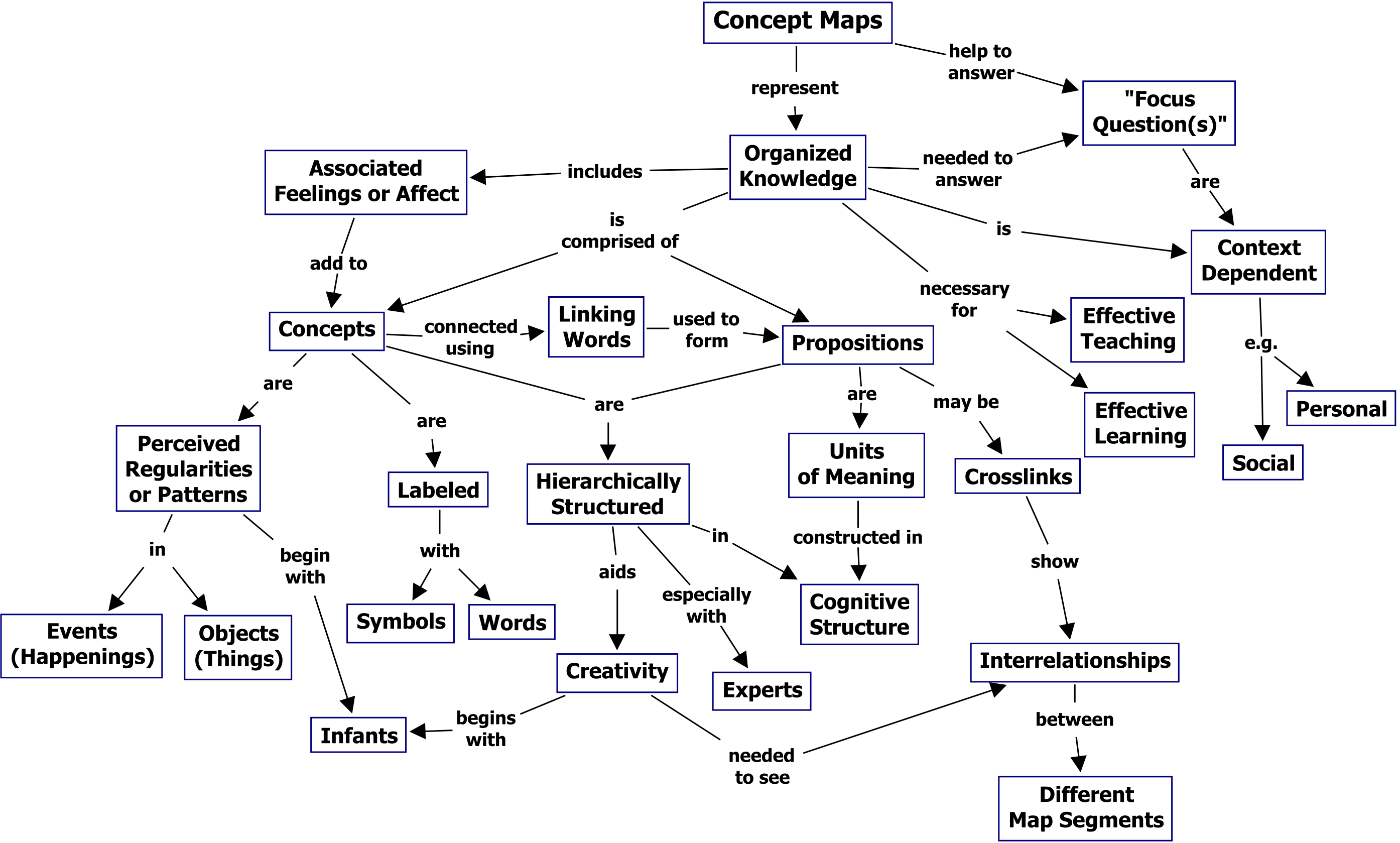
Meta-concept maps

Howard Rheingold has noticed a concept map of concepts.

All that it’s missing is a “You are here” marker.

[Tags: everything_is_miscellaneous howard_rheingold concept_maps ]

Tweet
Follow me

Categories: Uncategorized Tagged with: everythingIsMiscellaneous • metadata Date: December 1st, 2008 dw

2 Comments »

Is uTorrent disrupting the Net?

Richard Bennett reports that one of the leading BitTorrent clients, uTorrent, has decided to use UDP rather than TCP as the protocol for moving torrents through the Net. Especially since uTorrent is owned by BitTorrent, Inc., and thus is the paradigmatic BitTorrent client, this has stirred up a lively debate about whether this is a good thing for the Net, and whether it is proof that Net neutrality is counterproductive, necessary, or irrelevant.

I am in way over my head here, so please correct me if I get this wrong, but as I understand it, UDP is generally used for data that is time-sensitive and that isn’t rendered useless by some data loss, such as VoIP and online gaming. Unlike TCP, UDP doesn’t have a self-governing mechanism that manages traffic when it gets crowded; UDP lets a server just keep sending bits regardless of the current state of the network. uTorrent (which had previously been using UDP only for lightweight metadata) has started using UDP for the data itself — the files that people are torrenting — to get around the TCP throttling mechanisms some of the ISPs use, raising the fear that all that UDP data will congest the tubes.

Richard Bennett says this shows that Net neutrality will choke the Net. uTorrent talks about it here. I found a forum at BroadbandReports that provided multiple and useful perspectives.

As for me, I don’t know what to think. I am open for instruction.

Later that day: BitTorrent replies that Richard’s article is “utter nonsense.” Explained here. Slashdotted here. BitTorrent says that they’re implementing controls in their client software that will notice congestion and throttle back. Again, I’m in no position to judge.

[Tags: utorrent bittorrent net_neutrality ]

Tweet
Follow me

Categories: Uncategorized Tagged with: bittorrent • net neutrality • utorrent Date: December 1st, 2008 dw

7 Comments »

How the FCC transition works

Harold Feld steps through the various scenarios of how the FCC will go through its transition next year. You’d think it’d be a straightforward process. Hah! Harold lays it all out. Does Martin step down? How many new commissioners will Obama get to appoint? If the Republican commissioners were replaced by 19th century French Impressionists and the Democrats were replaced by unicorns, who would win the touch football match? Harold considers every possibility …

[Tags: fcc harold_feld ]

Tweet
Follow me

Categories: Uncategorized Tagged with: fcc • policy • politics Date: December 1st, 2008 dw

Be the first to comment »

« Previous Page


Creative Commons License
This work is licensed under a Creative Commons Attribution-NonCommercial-ShareAlike 3.0 Unported License.
TL;DR: Share this post freely, but attribute it to me (name (David Weinberger) and link to it), and don't use it commercially without my permission.

Joho the Blog uses WordPress blogging software.
Thank you, WordPress!