



logo
EverydayChaos
Everyday Chaos
Too Big to Know
Too Big to Know
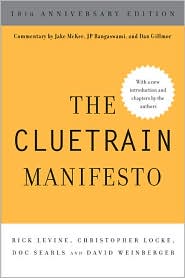
Cluetrain 10th Anniversary edition
Cluetrain 10th Anniversary
Everything Is Miscellaneous
Small Pieces cover
Small Pieces Loosely Joined
Cluetrain cover
Cluetrain Manifesto
My face
Speaker info
Who am I? (Blog Disclosure Form) Copy this link as RSS address Atom Feed

November 14, 2008

A joke from the inbox

Unaltered from an email going around:

One sunny day in 2009 an old man approaches the White House from across Pennsylvania Avenue where he’s been sitting on a park bench. He speaks to the U.S. Marine standing guard: “I would like to go in and meet with President Bush.” The Marine looks at the man: “Sir, Mr. Bush no longer is president, and no longer resides here.” The old man says, “Okay,” and walks away.

The following day, the same man approaches the White House, says to the same Marine, “I would like to go in and meet with President Bush.” The Marine again tells the man, “Sir, as I said yesterday, Mr. Bush is no longer president and no longer resides here.” The man thanks him and, again, just walks away.

The third day, the same man approaches the White House and speaks to the very same U. S. Marine saying “I would like to go in and meet with President Bush.” The Marine, somewhat irritated at this point, looks hard at the man and says, “Sir, this is the third day in a row you have been here asking to speak to Mr. Bush. I’ve already told you that Mr. Bush is no longer President and no longer resides here. Don’t you understand?”

The old man looks at the Marine: “Oh, I understand, all right. I just love hearing you say it.”

The Marine snaps to attention, salutes, and says, “See you tomorrow, sir.”

[Tags: jokes bush obama ]

Tweet
Follow me

Categories: Uncategorized Tagged with: bush • jokes • obama • politics Date: November 14th, 2008 dw

4 Comments »

November 13, 2008

Obama running in Ghana

Ethanz has a backgrounder (or get-up-to-dater) on the elections in Ghana that closes with the unexpected presence of Obama on (well, near) the ticket.

[Tags: obama ghana africa ethan_zuckerman ]

Tweet
Follow me

Categories: Uncategorized Tagged with: africa • bridgeblog • ghana • obama • politics Date: November 13th, 2008 dw

Be the first to comment »

Celebrities block themselves from Argentinian search results

From a post by Firuzeh Shokooh Valle and Christopher Soghoian at the Open Net Initiative site:

Since 2006, Internet users in Argentina have been blocked from searching for information about some of country’s most notable individuals. Over 100 people have successfully secured temporary restraining orders that direct Google and Yahoo! Argentina to scrub the results of search queries. The list of censorship-seeking celebrities includes judges, public officials, models and actors, as well as the world-cup soccer star and national team head coach Diego Maradona.

Wow. Argentinian celebrities either have a different view of celebrity or of the Web, or both.

The post (which contains much more detail) notes that Yahoo was not notifying searchers that their search results were being blocked, a violation of the Global Net Initiative ethical guidelines that Yahoo, Google, and others recently promulgated. But, Chris Soghoian in an email notes that yesterday Yahoo fixed the transparency problem.

[Tags: berkman oni open_net_initiative argentina celebrities censorship filtering google yahoo global_net_initiative gni ]

Tweet
Follow me

Categories: Uncategorized Tagged with: argentina • berkman • celebrities • censorship • digital culture • digital rights • entertainment • filtering • gni • google • oni • privacy • yahoo Date: November 13th, 2008 dw

1 Comment »

November 12, 2008

Net neutrality point and counterpoint

The Cato Institute has published Tim Lee’s paper arguing for a neutral Net but against Net neutrality regulation. Stephen Schultze, of the Berkman Center, has posted a careful and thoughtful rebuttal.

[Tags: berkman net_neutrality cato tim_lee stephen_schultze fcc ]

Tweet
Follow me

Categories: Uncategorized Tagged with: berkman • cato • fcc • net neutrality Date: November 12th, 2008 dw

1 Comment »

Google flu interview – Request for Help

I’m going to be on the radio news show Here and Now tomorrow to talk about Google.org’s ability to track outbreaks of flu by charting search terms (“flu symptoms”), time, and presumed IP location. I plan on talking about it as an example of the power of having enormous amounts of data, and of putting to use information generated for some other purpose.

Any ideas about how else this sort of technique could be used or is being used? (Amazon’s personalization is a different sort of example.) Any concerns (other than the how-not-to-do-it example from AOL)? [Tags: google flu crowd_sourcing wisdom_of_the_crowd privacy ]

Tweet
Follow me

Categories: Uncategorized Tagged with: digital culture • flu • folksonomy • google • marketing • metadata • privacy • web 2.0 Date: November 12th, 2008 dw

11 Comments »

Obama v. Bush: Google counts

“George Bush”: 25M hits at Google (with the quotation marks)
“George W. Bush”: 48M
“Barack Obama”: 105M
“Obama”: 248M
“Bush”: 344M

Wow, that seems screwy! The combined total for “George Bush” and “George W. Bush,” after 9 years of coverage (campaign and presidency), and including two George Bushes, is only about 75% of the number of hits for Barack Obama before he’s taken office?

Either we’re really excited about Barack Obama or something’s gone wrong in my Google searches. Or, more likely, both.

[Tags: google obama ]

Tweet
Follow me

Categories: Uncategorized Tagged with: everythingIsMiscellaneous • google • obama • politics Date: November 12th, 2008 dw

2 Comments »

Everyone’s position on linguistic correctness

AKMA points to two snippets from Stephen Fry on grammatical purity. The second snippet is classic Laurie and Fry.

AKMA expresses his usual admirable inclusiveness: He thinks grammatical correctness is worth striving for, but also acknowledges that language can usefully overflow its bounds. I’m with him. I was disappointed to hear Obama use the phrase “between her and meI,” and at his recent press conference to use “between” instead of “among” when referring to relationships of three or more. But I’m not a stickler. Why, I’ve recently become willing to blatantly split an infinitive or two.

When it comes to the sanctity of the rules of language, doesn’t everyone have the same position? While we think people ought to follow the grammatical rules that matter, we graciously condescend to permit others to make fools of themselves in public, unless they break rules the violation of which force a “Tut tut” from our lips. The difference is only over which particular rules we think are worth following, ignoring, or tut-tutting.

Or, to complete Henry Higgins’ thought: “Oh, why cahn’t the English … learn … to … speak … like me.” Pardon me: “…as I do.”

[Tags: akma grammar stephen_fry language ]

Tweet
Follow me

Categories: misc Tagged with: akma • culture • education • grammar • language • misc Date: November 12th, 2008 dw

8 Comments »

Meme alert: Reputational democracy

Simon Willis of Cisco’s Public Sector group and I were talking last week. I was saying that if the new administration were to create a civic social networking site, casual decisions by software designers could deeply affect democracy. For example, if the designers were to use a reputation system as a way of enabling the millions of conversations to scale, civic leaders might emerge for topics based upon a reputation system that is sensitive to small changes in software functionality — rate people on a scale of 1-10 or just with a thumbs up or thumbs down? Weight the ratings based on the rater’s own reputation?

Simon replied that this would be an interesting case of reputational democracy.

I sort of love this term. And it only gets three hits (1 2 3) at Google.

You heard it here first! Well, fourth.

[Tags: reputational_democracy memes simon_willis ]

Tweet
Follow me

Categories: Uncategorized Tagged with: egov • memes Date: November 12th, 2008 dw

9 Comments »

November 11, 2008

[berkman] Open Source at Microsoft

Bryan Kirschner (Dir of Open Source Strategy) and Mario Madden (Open Source Licensing Counsel) at Microsoft are giving a Berkman Tuesday lunch talk on Open Source and Microsoft. [NOTE: I am live-blogging, typing too fast, missing things, getting things wrong, etc.]

They start with three framing positions: 1. Open source has changed the info-communications landscape. It’s “neither a fad nor a magic bullet” [missed the attribution] 2. It brings an opportunity for Microsoft, open source developers, and ICT customers. 3. It’s not any harder or easier to realize this potential, compared to other opportunities (e.g., cloud computing).

In 2004, Msft submitted two licenses to the Open Source Initiative. Now there are 500. There are at least 80,000 Open Source apps that run on Windows. Microsoft is virtualizing Linux on Windows and vice versa, and Silverlight is becoming Moonlight (= a Linux version).

Why is Msft doing this?

1. Motivation. What motivates OS developers? (From Karim Lakhani, who is in the room.) They’re motivated by creativity and learning, economic opportunity, and solving a problem.

2. Commercialization. Some of OS is money-driven, while some is community-driven. “At the end of the day, it’s about value-for-cost and solving a customer’s problem.”

There’s a “world of choice” these days. You use the best tool for the job. Mix and match. E.g., they want Windows to be a great platform for OS apps, including for PHP. So, Windows is working with Zen (commercial PHP company) and the PHP community. If your company wants single-sign-on; Msft has Active Directory that does that, including for php aps. Then, if you want to use cloud computing (Windows Azure), you can use it and it works with Active Directory. Then you could have OpenID and Ruby apps running on Linux. Then you might want to use virtualization to rapidly move apps across hardware, and you could then use OpenPegasus to do cross-platform systems management, contributing back to the Pegasus project. “At the application layer, it really makes sense to strive for openness.”

There’s a human relationship and emotions in the OS community, Bryan says. It’s inspirational. Microsoft wants to comingle, cooperate and co-exist.

Q: You touted collaboration with Novell. Many are not happy with that deal. Some people at Novell quit. The Linux kernel community would be a tougher community. They haven’t been happy about joining forces with you. Do you have any plans to bury the hatchet? E.g., Linus Torvalds is unhappy with Msft’s stance on patents…
A: I wouldn’t hold up Novell as a great example. Our customers, especially our large customers, like it a lot, though. It makes commercial sense, although it doesn’t necessarily make everyone feel happy.
A: [mario] The legal team’s job is to help the team navigate the shoals. We did the best we could in the Novell deal.
A: [bryan] We have an active partnership with Samba. Both sides are happy about this.

Q: I’m a European lawyer. Microsoft’s reaction to the European Court’s decision showed no sign of openness? How do you address the abuse that was found and the open attitude you’re expressing today?
A: [bryan] I’m not a lawyer. The question for me is how do you meet the needs of your customers? The overwhelming body of evidence leads you to openness. We will continue to develop .Net. But it’s not zero sum. We also have support php. The Windows media team wrote a plugin so Windows Media Player would work on Firefox. There have been 6 million downloads, so that’s great.
A: [karim] There’s a lag between court decisions and how the company thinks about it.
Q: My point was that you might have saved 500M euros if you had been more open…

Q: Once sw is fully developed, you’re half done. It still needs quality assurance. How do you assure open source software is of high quality? And how do you know it wasn’t stolen from an open source app?
A: [mario] When code is brought in, it’s up to the engineering groups to do the QA. Legally, OS software is just third party code. We brought in 500M lines of code last year. We scan it. A lot of it was Open Source.
A: [karim] Two studies have compared the quality of code from Open Source vs. commercial and found no difference, except perhaps OS is slightly higher quality because the QA is continuous.
A: [bryan] We’re a platinum sponsor of the Apache Foundation. They have overhead. It makes it easier to deal with them if they’re not under terrible financial stress.
A: [mario] When it comes to OS, we’re driven by business purposes. Can we decrease development costs?

Q: [me] What’s the business case that you see for contributing to OS, as well as enabling Windows to work well with OS? How much are you contributing?
A: [bryan] We contribute in three ways. 1. Product strategy. E.g., contribute to php to make it work better with SQL Server. 2. Does it actually make sense for your product to take an OS or hybrid strategy? E.g., Class server is curriculum management system. It competes with OS. It didn’t make sense to compete, so now it’s an OS product. 3. Having more developers creating more code is a good thing. It’s pie-expanding. E.g., we have XNA libraries for developing games. There are hundreds of XNA projects that are open source now.
Q: [me] Are 500 contributions a lot? Compared to the number of patents? Products?
A: We’ll measure success when every product group considers open source.
Q: [karim] IBM says they have 1,000 developers working on Linux, etc. Do you have any number you can point to that’s similar?
A: No.

Q: Has OS affected how stuff gets done inside?
A: Inside the company, we are not the Borg. Every product group has a lot of autonomy. Agile groups. You also have some 3-year-product-plan projects. Increasingly you’ll see a more blended model.
A: [mario] We have 30,000 developers. It’s hard to know, on the IP, what everyone is doing.
A: [bryan] You’ll see a company-wide statement from the company that we understand the world is heterogeneous, we respect the contributions open source has made, and we’re committed to greater openness. I’ll quote Heidegger: Fear is not knowing what to do. The Windows-Linux oppositional framework in 1998 took the public imagination. We formally responded with a site in 2007, so no one will accuse us of acting precipitously :)

Q: When will Steve Ballmer start putting out the OS msg? He has a reputation for being confrontational.
A: [bryan] He’s a strong, opinionated leader. But you’ve already seen Steve talk about the benefits of supporting open source. Inside Msft, the open source group always talks in terms of what makes sense for business.

Q: This has implications for DC policy positions. I.e., very strict IP enforcement.
A: [mario] We may disagree about strict IP; we support patent reform, for example. But we see our business as about IP. We’ll always support IP and IP rights.

Q: Chances are we’ll find out that the new Redmond Congressperson will be a former Microsoft manager. Since Msft employees have funded about a third of her campaign, when your lobbyists are calling her up, will you be asking to support Open Source?
A: [mario] Fascinating question, and I’m sure not going to comment :)
A: [bryan] We don’t want anyone fighting Open Source. We don’t think it makes business sense.

Q: [karim] If we’re back to big iron — Google is a server farm company — how do we think about the role of open source?
A: [bryan] It changes the dynamics. Clouds and server farms open up a lot more space.

[me[ What about OOXML vs. ODF? Why did you push OOXML as a doc format after we already had adopted ODF? Is that typical of what you mean by openness?
A: [bryan] Open doc formats are really important. I don’t see doc standards as a zero sum game. So being able to understand the doc through a published set of docs doesn’t seem exclusive to me.

Karim concludes the session by pointing out how contentious this topic would have been just five years. “The presence of Mario and Bryan here is a sign of success.” [Tags: berkman microsoft open_source ]

Tweet
Follow me

Categories: Uncategorized Tagged with: berkman • digital culture • digital rights • everythingIsMiscellaneous • microsoft • tech Date: November 11th, 2008 dw

5 Comments »

The Broadcasting Treaty that won’t stay dead

The Electronic Frontier Foundation (did you remember to join?) has blogged about the WIPO Broadcasting Treaty that won’t seem to stay dead. (Great backgrounder and eval by Nate Anderson at Ars Technica.)

The new treaty would mean that to record or reuse a broadcast of a TV show, you would have to get rights not only from the company that created the show, but also from the broadcaster whose signal you recorded. The Europeans have supported this since they backed the Rome Convention in 1961; the proposed treaty would globally standardize this new layer of rights/restrictions.

The EFF has argued that if passed, it would mean that it would be illegal to record even a Creative Commons licensed broadcast; the creator of the work may be fine with it, but the broadcaster might not be. There are no “fair use” exceptions in the proposed Treaty, although it allows signatories to carve out exceptions based on their own copyright laws; the EFF claims that this would create confusion that would chill innovation and speech, as different countries implement different exceptions.

The US delegation has taken up again its call for “broadcast” to include transmissions over the Net.

The new push for the treaty, according to an update by Nate at Ars Technica, is likely to fail because there seems to be an irreconcilable split among countries that want to add this new layer of rights and those that would solve the problem of people stealing and reselling broadcasts simply by using existing laws to prosecute the people who do it.

Yay.

[Tags: wipo broadcasting copyright copyleft media eff ]

Tweet
Follow me

Categories: Uncategorized Tagged with: broadcasting • copyleft • copyright • digital rights • eff • media • policy • wipo Date: November 11th, 2008 dw

Be the first to comment »

« Previous Page | Next Page »


Creative Commons License
This work is licensed under a Creative Commons Attribution-NonCommercial-ShareAlike 3.0 Unported License.
TL;DR: Share this post freely, but attribute it to me (name (David Weinberger) and link to it), and don't use it commercially without my permission.

Joho the Blog uses WordPress blogging software.
Thank you, WordPress!