


logo
EverydayChaos
Everyday Chaos
Too Big to Know
Too Big to Know
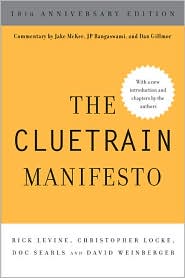
Cluetrain 10th Anniversary edition
Cluetrain 10th Anniversary
Everything Is Miscellaneous
Small Pieces cover
Small Pieces Loosely Joined
Cluetrain cover
Cluetrain Manifesto
My face
Speaker info
Who am I? (Blog Disclosure Form) Copy this link as RSS address Atom Feed

September 12, 2008

Echo chambers: The meme that will not die

Last night, I went to the JFK Library to see a panel on the Internet and the campaign, with Matt Bai of The New York Times, Garrett Graff of Washingtonian Magazine (and Howard Dean’s first political webmaster), and Joe Trippi, who ran Dean’s campaign.

It was an interesting session not just because of the caliber of the people, but because the sight it gave of what’s been settled and what we’re still arguing about. These three astute observers — two of them straight-ahead Obama supporters, and one maintaining professional neutrality, but, c’mon, you think Bai’s going to vote for McCain?? — agree that the Internet is transformative of politics and ultimately of democracy. It’s worth pausing to remember that four years ago, we were still arguing about that. They also agree that this is overall for the good, albeit with various important doubts and reservations.

They also agree that the Internet is loosening party affiliation to the extent that in the next four or eight years we’re likely to see a viable independent presidential candidate.

But the three did not agree with one another and sometimes with themselves about whether the Net is making us more partisan (“echo chambers”) or better informed. Is it manipulated by pols throwing out chum that predictably attracts the mindless sharks or, as Trippi replied, is that more characteristic of cable news than the Net? The fact that we are so uncertain about this might indicate that it’s just too soon to tell, but I suspect it indicates that there’s something malformed in the question.

For example, last night one of the audience members expressed concern that the Net is naught but a series of echo chambers. Bai earlier had maintained that he worries that the Net is not about persuasion but about confirmation: you only read that which confirms your views. Ellen Hume of MIT’s civic media project worried from the floor that we’ve lost a unified, authoritative press, feared enough by politicians that when they’re caught in a lie (“I said thanks but no thanks”) they’ll actually stop repeating it.

These are all good points. And yet the question of whether the Net is making us better voters or not remains unsettled, including, I suspect, in the minds of each of those speaking last night. Ultimately, I think it’s unsettled not simply because we lack evidence or because the Internet revolution isn’t over yet. There are more difficult reasons this issue remains an Internet cultural Rohrschach test

1. We don’t yet know how to make intuitive sense of the open connective nature of the Net. We don’t fault our real-world discussions with friends because they’re not arguments that are based on persuasion that work themselves down to first principles. We’ve chosen our rw friends in part because of the sympathy of our views and the sympathy of our discussion styles, yet we don’t count those friendshipsas echo chambers. Online, we can engage with people before we’ve become friends with them. We thus sometimes bond based on agreement (“echo chambers”) or on disagreement strong enough us to get us to respond (“flame fests”).

2. We don’t know how to handle the new publicness of the Net. We can hear — and blog about — every nasty conversation held. Imagine you could listen in on every barroom quarrel and every fratboy gabfest. Well, now you can. We now know just how awful we are.

2a. To put the previous point differently: We make the mistake of treating the Net as if it were a medium. But it’s more like a world than a medium. Everything humans can do and say is done and said there. Want to find hate-based OCD? Got it! Want to emphasize the way in which bloggers bring skeptical intelligence to stories promulgated by the worst of the MSM? Can do! Because the Net is an open world, no examples are typical .

3. We therefore don’t really have anything to compare the Web to. Before the Web and off the Web, how much of our time was spent in persuasive rather than confirming discussions? How diverse was the nightly news compared to the “average” encounters with news on the Net? How much disagreement was allowed in watercooler discussions before people just crumpled their cups and walked away, and what is the online equivalent of watercoolers anyway?

Perhaps the persistence of the question is due to our shock at being shown who we really are. When all you can see of yourself is what the sanitized mass media show you and what you can see around you in your physical environs, the differences the Net makes visible unsettle us profoundly.


The Financial Times has a good article on the Internet’s effect on the US campaign.

It quotes me (and — what are the odds? — it begins by quoting an Obama supporter named Stacey Weinberger, who is no relation), but I want to rise on a point of personal privilege, i.e., egocentric nitpicking. The article introduces me as “Mr Dean’s internet adviser.” Later in the article, it more accurately refers to me as “a Dean adviser,” which is much closer to the truth. Jeez. I hate being perceived as a taking credit I don’t deserve, and I definitely was not the campaign’s internet adviser, as if I were the one who figured out how to do all that Internet stuff. Ha! I twice told the interviewer that Trippi and Zephyr Teachout et al. had come up with their groundbreaking Internet strategy before I ever got there, and that the title Trippi kindly gave me (“Senior Internet Adviser”) was far more grandiose than my actual role. If there’s one thing that bothers me more than getting undeserved credit, it’s being perceived as taking undeserved credit.

[Tags: politics internet joe_trippi matt_bai garrett_graff howard_dean ]

Tweet
Follow me

Categories: Uncategorized Tagged with: digital culture • internet • politics Date: September 12th, 2008 dw

7 Comments »

September 11, 2008

The opposite of noise

Silence is the opposite of noise.

Music is the opposite of noise.

Peace-and-quiet is the opposite of noise.

Signal is the opposite of noise.

Attention is the opposite of noise.

[Tags: noise ]

Tweet
Follow me

Categories: Uncategorized Tagged with: infohistory • noise Date: September 11th, 2008 dw

7 Comments »

September 10, 2008

Rowling wins copyright suit, but a little good news for Fair Use

JK Rowling has won her suit against the publisher of a Harry Potter lexicon. David Ardia, of the Berkman Center’s Citizen Media Law Project finds some good news for Fair Use in the decision.

I liked Tim Wu’s explanation last January of why Rowling should lose the case, and was disappointed in the decision.

[Tags: berkman harry_potter jk_rowling david_ardia fair_use copyright ]

Tweet
Follow me

Categories: Uncategorized Tagged with: berkman • copyright • digital rights Date: September 10th, 2008 dw

1 Comment »

Strayed Talk Express

A 2.5 minute reminder of McCain’s politically-motivated switches on values issues. At least one is a mere stumble, but the others seem to me to be changes in principles for political expediency.

[Tags: mccain obama politics ]


Andrew Sullivan has given up on McCain as a person of integrity. I have to agree that McCain has made a series of appalling decisions about his campaign, choosing to run in a way that worsens our democracy. It’s disappointing, and depressing.

Tweet
Follow me

Categories: Uncategorized Tagged with: mccain • obama • politics Date: September 10th, 2008 dw

3 Comments »

September 9, 2008

Tim Wu on McCain and Obama’s plans for the Internet

Tim Wu brings his customary clarity and vision to the McCain and Obama’s tech policies. Rather than sticking with the “McCain’s never used Google, oh, and he’s old, too,” Tim tries to get at the differences guiding them. Chief among them: McCain sees the Internet as just another bit of the telecom panoply, while Obama thinks it’s special. But read the whole thing to get past my over-simplification…

[Tags: tech_policy obama mccain tim_wu fcc net_neutrality ]

Tweet
Follow me

Categories: Uncategorized Tagged with: fcc • mccain • net neutrality • obama • policy • politics Date: September 9th, 2008 dw

2 Comments »

September 8, 2008

New Brad Sucks CD is out

I’m downloading the new Brad Sucks collection…

[Tags: music brad_sucks bradsucks copyright riaa riaa_sucks ]

Tweet
Follow me

Categories: Uncategorized Tagged with: bradsucks • copyright • digital culture • digital rights • entertainment • music • riaa Date: September 8th, 2008 dw

4 Comments »

Report on One Laptop Per Child from Nicaragua

Waveplace is bringing the One Laptop Per Child laptops (AKA “The $100 Laptop”) to poor parts of the world. Here’s a terrific post about teaching kids how to use the EToys program that’s included. For context, there’s this. And you want photos? Yes, you do. Here are some fantastic pictures. (And here’s one of my favorite photos of all time. BTW, the little girl is a double amputee.)

[Tags: olpc xo nicaragua waveplace ]

Tweet
Follow me

Categories: Uncategorized Tagged with: bridgeblog • digital culture • education • nicaragua • olpc • peace • waveplace • xo Date: September 8th, 2008 dw

4 Comments »

Canadian election gets down and redolent of loam

The tag line at the Canadian Conservative Party’s Web site, attacking the liberal candidate Stéphane Dion — as you know, the PM just called for an election — seems oddly 19th century:

“Canada cannot afford risky experiments at a time of uncertainty”

It’s as if Obama were to say, “My opponent’s steadiness of purpose is challenged by recent announcements seemingly at odds with this character,” or if McCain were to say, “To what end shall our nation proceed if driven by hands untested by trial?”

The Conservative site does feature “MyCampaign,” a “virtual campaign office,” that lets you write letters to editors, recruit friends, call talk radio, and engage in other acts of personal broadcasting. As far as I can see, there’s no actual social networking available.


The Liberal party site does some Ajax-y launch-on-hover things, and has a prominent link to Facebook where Dion has 12,000 supporters. The page was updated on Dec. 14, June 19, and Aug. 19. The Liberal’s YouTube page leads with a video of a slow clap for nature, posted two months ago.

The NDP’s Facebook page has 13,000 supporters and a campaign video uploaded yesterday, although the updates have been about monthly. And the NDP has been twittering. Well, to be exact, they’ve tweeted three times, but once was six minutes ago. They have 169 followers, but are following 151, creating an amazing following-to-follower relationship that they can only hope will not be sustainable in the long run.

(And, yes, although I’m being snarky about the Canadian Web sites’ campaign rhetoric, I do prefer it to America’s.) [Tags: politics canada e-democracy e-politics stephen_harper stephane_dion jack_layton tories liberals ndp ]

Tweet
Follow me

Categories: Uncategorized Tagged with: canada • e-democracy • e-politics • liberals • ndp • politics • tories • web 2.0 Date: September 8th, 2008 dw

6 Comments »

September 7, 2008

Hacking the Trivial: Governor of Poker game

During the nine-hour plane ride from Amsterdam (after the 1.5 hr flight from Vienna) to Dallas, I figured out how to increase the amount of money you have in the game the Governor of Poker by flipping a bit in the save game file.

I did this because I’ve had a little trouble with the game. It’s a cute Texas hold’em game in which you progress through Texas based on your winnings. Quite possibly because of the oddities of my system, the game several times acted as if it had lost the save file. So, now I copy the save file after every game. But I also was annoyed at having lost the three or four days of “work” acquiring a lump o’ cash. (Please note that in this game, you play against the computer for purely fictitious money. Also, it’s a Windows game I’m running under VMware on my Mac.) So, I spent time on the plane figuring out which bytes in the save file encode the amount of money you have in the game.

So, here are some rough instructions on how to do this. Or, quite likely, totally screw up the game.

The save file is “GovernorOfPoker.sol,” which will be in something like: C:\Documents and Settings\[username]\Desktop\E4VWWMXNC:\Documents and Settings\{username}\Application Data\Macromedia\Flash Player\#SharedObjects\TS2J3QVB\localhost. Make a copy of it and put it somewhere safe.

Did you remember to make a copy? You’re about to edit the save file, and a single wrong byte can trash it.

Get yourself a hex editor. PSPad is free and works well. Open up the save file in it. (Did you remember to make a copy first?)

Look for the word “money” towards the end of the file. The byte you want is 3 bytes after the end of that word. In the version I have, the key byte is #7959.[LATER: The file size changes as you play the game, so there’s no predicting which byte is at issue. Instead, go to the end of the file and look backwards for “money” or “m.o.n.e.y”, depending on how your hex editor displays it.] Change it to “A” and you’ll have something like $3,000 available. Change it to “F” and you’ll have over $100,000. But I haven’t experimented enough to know exactly what the rules are. There’s clearly another byte or two involved in recording the amount. So, you have have to do some experimenting.

Also, did you make a copy?

By the way, on the plane I also watched “Vantage Point,” which just gets more convoluted and less believable with each iteration, plus an hilarious episode of “Frasier” in which Daphne asks Niles to pretend to be her husband to discourage an old flame. [Tags: games governor_of_poker make_a_copy ]

Tweet
Follow me

Categories: Uncategorized Tagged with: entertainment • games • tech Date: September 7th, 2008 dw

77 Comments »

Not that there’s anything wrong with that.

Paul McDougall at InformationWeek explains what’s wrong with Microsoft’s $300M Seinfeld reruns.

[Tags: marketing cluetrain microsoft seinfeld advertising ]

Tweet
Follow me

Categories: Uncategorized Tagged with: advertising • cluetrain • marketing • microsoft • seinfeld Date: September 7th, 2008 dw

Be the first to comment »

« Previous Page | Next Page »


Creative Commons License
This work is licensed under a Creative Commons Attribution-NonCommercial-ShareAlike 3.0 Unported License.
TL;DR: Share this post freely, but attribute it to me (name (David Weinberger) and link to it), and don't use it commercially without my permission.

Joho the Blog uses WordPress blogging software.
Thank you, WordPress!