

logo
EverydayChaos
Everyday Chaos
Too Big to Know
Too Big to Know
Cluetrain 10th Anniversary edition
Cluetrain 10th Anniversary
Everything Is Miscellaneous
Small Pieces cover
Small Pieces Loosely Joined
Cluetrain cover
Cluetrain Manifesto
My face
Speaker info
Who am I? (Blog Disclosure Form) Copy this link as RSS address Atom Feed

June 14, 2008

Gay rights and differential hermeneutics

In the June issue of Harper’s, Gary Keizer has an article called “Turning away from Jesus: Gay rights and the war for the Episcopal Church” that I kept trying not to like, I think because he’s too right and too good. But the article won me over. Alas, Harper only posts miniature, unreadable images of the pages, so you’ll have to do something primitive like trudge to your local library to read it.

Gary paints a picture of a church traditionally less interested in enforcing doctrinal homogeneity than in ministering to those in need. He personally favors the ordination of gay clergy, but the article focuses a level up from that: How can a church handle disagreement and difference? And he explicitly applies those lessons beyond the church to the country and the world.

It made me think of AKMA‘s idea of differential hermeneutics, a theory of interpretation (which is to say, of understanding) that assumes we’re never going to agree. He opposes this to what he calls “integral hermeneutics,” which aims at resolving issues, and thus showing that one person’s interpretation is right and another’s is wrong. And, yes, AKMA is fully aware of the issues that arise from his position. (I blogged about this here.)

I am convinced that Gary and AKMA are raising exactly the right questions, and are answering them the only way that lets us live together in peace, which is not to say in harmony or quietude. And I find what they say based upon their similar religious convictions to be quite in line with what I understand the Jewish attitude toward interpretation to be: The arguing continues all the way into the next life. If you’re so lucky. [Tags: episcopalians gay_rights gary_keizer akma peace judaism everything_is_miscellaneous ]
Tweet
Follow me

Categories: Uncategorized Tagged with: akma • culture • episcopalians • everythingIsMiscellaneous • judaism • marketing • peace • philosophy Date: June 14th, 2008 dw

4 Comments »

Kevin Marks’ T-Shirt idea

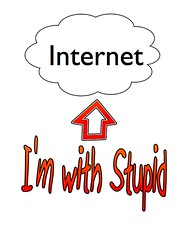
Kevin Marks on a mailing list raised an idea for a t-shirt:

I'm with stupid, pointing at the Internet

This is a reference to David Isenberg‘s “Rise of the Stupid Network” idea. So, if you wear it, you’ll know that anyone who laughs at it is a team member.

[Tags: kevin_marks david_isenberg t-shirts ]

Tweet
Follow me

Categories: Uncategorized Tagged with: humor • t-shirts Date: June 14th, 2008 dw

1 Comment »

June 13, 2008

Open up Google Docs?

I’ve found myself using Google Docs more and more. It’s about a Bronze Age word processor at this point, but it makes collaborating easy, I like being able to get at my work from anywhere (even when offline), and the continuous backup and versioning is comforting.

But, not only is Docs way under-featured and butt ugly, Google is fixing it up really slowly.

What would Google have to do to enable The Community to enhance it?

We presumably (i.e., I don’t know what I’m talking about) could write an enhanced system that uses Google Docs for storage, but that slaps a new UI on it and adds features. In fact, maybe this is something that Adobe’s beautiful Air-based word processor, Buzzword, should be (or is?) looking at.

Even better: Google could make Google Docs as amenable to add-ons as Firefox is. Of course, I have no idea how hard that would be, and what the possibilities of terminally screwing up your docs might be.

At the very least, while Google Docs is getting better at allowing us to redefine existing HTML elements, to create new classes, and even to create new elements (albeit without giving us a UI to use these classes or elements, other than entering into HTML editing mode), letting us attach CSS style sheets seems like an obvious and non-destructive improvement.

But, IDKWITA (I don’t know what I’m talking about … and why isn’t that a standard Web acronym?), so there may be obvious technical issues mooting all of the above. But I’m sure that won’t mute you from telling me what I’m missing.

Please. [Tags: google google_docs word_processors openness css ]


Marco Barulli at Clipperz (a password manager) blogs about what it would take to get more freedom and privacy from the providers of Web apps. He has a three-part solution…

Tweet
Follow me

Categories: Uncategorized Tagged with: css • digital culture • google • openness • whines Date: June 13th, 2008 dw

4 Comments »

Oil prices: The spreadsheet

Here’s a table of oil prices since 1984, day by day. You can also download it as a spreadsheet, and then you can graph it, in order to get a visual display of quantitative information that confirms that gas prices have pretty much gone up overall.

Alternatively, you could take your car in for a fill-up.

[Tags: oil gas economics ]

Tweet
Follow me

Categories: misc Tagged with: economics • gas • misc • oil Date: June 13th, 2008 dw

1 Comment »

June 12, 2008

Britt is neo-conversative

No, the title of this post isn’t a misspelling. Britt Blaser is announcing that Independence Year starts on this July 4. And in the course of it, he claims to be neo-conversative, i.e., engaged in a new conversation about politics. I love the phrase. I also like what Britt is up to. (I may in fact be involved in some advisory role somehow; Britt’s got a lot going on.)

[Tags: britt_blaser politics ]

Tweet
Follow me

Categories: Uncategorized Tagged with: britt_blaser • politics Date: June 12th, 2008 dw

Be the first to comment »

Alps ‘n’ Balcs

A couple of centuries ago, people traveling through the Alps used to pull the curtains on the windows on the carriages because the scene was just too terrible.

I wonder if the same sort of thinking explains why so few New York City hotels have balconies. Did the architects think the street scenes were ugly, scary, or uninteresting? Or was it because of something more mundane, such as weather or concerns about plummeting martini glasses?

Oh well. Too bad. I’d love to be sitting on a balcony now, watching the sun redden the Empire State Building.

[Tags: nyc architecture ]

Tweet
Follow me

Categories: misc Tagged with: architecture • misc • nyc Date: June 12th, 2008 dw

4 Comments »

June 11, 2008

Are drugs too miscellaneous?

I think this public service announcement makes it pretty obvious which drugs are good and which are bad. Ones shot in black and white are bad, while brightly colored ones are good. [source] [Tags: propaganda everything_is_miscellaneous ]

Tweet
Follow me

Categories: Uncategorized Tagged with: propaganda • uncat Date: June 11th, 2008 dw

7 Comments »

Simple sabotage

At the Enterprise 2.0 conference (which I didn’t attend), Don Burke and Sean Dennehey from the CIA gave a talk on Intellipedia, the CIA’s internal wikipedia. As part of their talk, they cited a manual, including, I’m told, this from page 28:

(1) Insist on doing everything through “channels.” Never permit short-cuts to be taken in order to expedite decisions.
(2) Make “speeches.” Talk as frequently as possible and at great length. Illustrate your “points” by long anecdotes and accounts of per­sonal experiences. Never hesitate to make a few appropriate “patriotic” comments.
(3) When possible, refer all matters to committees, for “further study and considera­tion.” Attempt to make the committees as large as possible — never less than five.
(4) Bring up irrelevant issues as frequently as possible.
(5) Haggle over precise wordings of com­munications, minutes, resolutions.
(6) Refer back to matters decided upon at the last meeting and attempt to re-open the question of the advisability of that decision.
(7) Advocate “caution.” Be “reasonable” and urge your fellow-conferees to be “reason­able” and avoid haste which might result in embarrassments or difficulties later on.
(8) Be worried about the propriety of any decision — raise the question of whether such action as is contemplated lies within the juris­ diction of the group or whether it might conflict with the policy of some higher echelon.

Their point was that these instructions come from a 1944 manual on how to sabotage a business.

The session’s Web page points to the entire, amazing, declassified manual of simple sabotage. [Tags: cia sabotage enterprise_2.0 intellipedia wikipedia ]

Tweet
Follow me

Categories: Uncategorized Tagged with: business • cia • everythingIsMiscellaneous • intellipedia • peace • sabotage • web 2.0 • wikipedia Date: June 11th, 2008 dw

33 Comments »

June 10, 2008

Britannica tweaks the wiki

Britannica has announced that it’s going to enable some measure of reader participation in the extending of the online version of their encyclopedia. You can see the beta of the new site here.

The detailed overview of the planned site says:

two things we believe distinguish this effort from other projects of online collaboration are (1) the active involvement of the expert contributors with whom we already have relationships; and (2) the fact that all contributions to Encyclopaedia Britannica’s core content will continue to be checked and vetted by our expert editorial staff before they’re published.

Excellent! We needs lots of variations on the theme of collaboration. Editing and expertise add value. They slow things down and reduce the ability to scale, but Wikipedia’s process makes it possible to read an article that’s been altered, if only for a minutes, by some devilish hand. It all depends on what you’re trying to do, and collectively we’re trying to do everything. So, this is good news from Britannica. It’ll be fascinating to watch.

To pick a nit, I’m not as convinced by Britannica’s insistence on objectivity as a value, however. The blog post says “we believe that the creation and documentation of knowledge is a collaborative process but not a democratic one.” It lists three positive consequences of this. The third is “objectivity, and it requires experts.” In a reference that makes you wish they’d at least once use the word “Wikipedia,” the post continues: “In contrast to our approach, democratic systems settle for something bland and less informative, what is sometimes termed a ‘neutral point of view.'” I think it would be reasonable for Britannica to tell us that an expert-based, edited system is likely to yield articles that are more comprehensive, more uniform in quality, more accurate and more reliable. But haven’t we gotten past thinking that expertise yields objectivity?

Anyway, I think it’s amazing that the Britannica, in its 240th year, is taking this step. Britannica will be better for it, and so will we. [Tags: britannica wikipedia knowledge everything_is_miscellaneous ]

Tweet
Follow me

Categories: Uncategorized Tagged with: britannica • culture • digital culture • education • everythingIsMiscellaneous • folksonomy • knowledge • media • wikipedia Date: June 10th, 2008 dw

6 Comments »

Berkman lunch: Anne Balsamo on Designing Culture

Anne Balsamo from U of Southern California and the Annenberg School is giving a Berkman lunchtime talk, called “Designing Culture: The Technological Imagination at Work.” [Live blogging, paraphrasing. And Anne is talking about deep themes. So, these notes will be especially inadequate, as well as getting things wrong, missing stuff, etc.]

Her book touches on technological imagination (how we engage the materiality of the world), technological innovation, and the reworking of culture. She’s particularly interested in the importance of training the technological imagination. Her book discusses designers who explicitly consider culture throughout the design process. The book speculates about what it would take to train imaginations to create new cultural possibilities as they are at designing new technologies. This is the responsibility of educators as well as of engineers, etc.

Chapter 1 does some framing. Chapter 2 is called “Gendering the technological imagination,” extending the topic of her previous book. “Technology was always gendered. We just didn’t recognize it as such.” It draws on feminist theories of reproduction as the basis of all technologies as reproductive. Chapter 3 (“The Performance of Innovation”) draws on her time at PARC designing a museum exhibit on the future of reading. It focused on how we perform innovations, rather than discover them. Chapter 4 (“Public interactives and technological literacies”) reflects on the literacy a designer must always take into consideration when designing interactive pieces, and how interactives draw upon existing literacies and require new ones for the future. It then looks to the ethics of designing public interactives. Chapter 5 (“Working the Paradigm Shift”) is on the labor of creating this shift. It draws on Henry Jenkins and calls on people to do the hard work of shifting the paradigm. People have to learn how to engage deeply under the hood, as well as the policy work. Chapter 6 is a coda (“The Work of the Book in a Digital Age”) about why she’s writing a book in the age of the digital. The book is transmedia and includes a multimedia documentary (“Women of the World Talk Back”) she co-authored about 15 yrs ago, a Web site, and some other pieces. She also is working on a new thesaurus that maps technology as a cultural ensemble.

She talks about working the paradigm shift. We have failed to bridge C.P. Snow’s two cultures. We need to do so through practices. New participants (esp. women) and new commitments. We need to learn to be learners, not to be the smartest person in the world. And we need more collaborative teams and new spaces where people can work together on technological things. We need places that aren’t owned territorially but are places where people can come together from multiple disciplines.

She is working on a new MacArthur project. Scholarship will be distributed and networked, Macarthur understands. Part of her new grant is understanding the technology to enable this to happen. Learning is happening in distributed fashion, not in any one place. She is looking at how museums and libraries will function as part of this distributed learning environment. She’s starting with the portfolio of reading devices developed at PARC for the museum exhibit. She is looking at digital learning objects, mixed reality learning environments (body-based, gesture-based), and thinking with objects (DIY … but, Ann asks, as the digital divide mainatins, will the poor get access only to the virtual while the affluent learn how to solder, weld, saw…).

Libraries and museusm are important for presreving culture and bring it into new understandings.

She leaves us with the question: What about the future of libraries and museums?

Discussion begins, but I’m not going to try to capture all of it. Here are some random points:

Ann says that we need to be smart about our metadata, recognizing that there is always a narrative there. If we don’t think about this, the semantic web will be stupid.

Ann thinks books will continue to be printed. But libraries may be about more than lending books and CDs/DVDs. They could lend tools, toys… [Great vision!] A library is also a stage where people can perform and participate in their culture. [Tags: berkman ann_balsamo libraries museums culture technology everything_is_miscellaneous ]

Tweet
Follow me

Categories: Uncategorized Tagged with: berkman • culture • digital culture • knowledge • libraries • museums • technology Date: June 10th, 2008 dw

Be the first to comment »

« Previous Page | Next Page »


Creative Commons License
This work is licensed under a Creative Commons Attribution-NonCommercial-ShareAlike 3.0 Unported License.
TL;DR: Share this post freely, but attribute it to me (name (David Weinberger) and link to it), and don't use it commercially without my permission.

Joho the Blog uses WordPress blogging software.
Thank you, WordPress!