


logo
EverydayChaos
Everyday Chaos
Too Big to Know
Too Big to Know
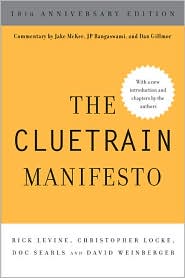
Cluetrain 10th Anniversary edition
Cluetrain 10th Anniversary
Everything Is Miscellaneous
Small Pieces cover
Small Pieces Loosely Joined
Cluetrain cover
Cluetrain Manifesto
My face
Speaker info
Who am I? (Blog Disclosure Form) Copy this link as RSS address Atom Feed

May 15, 2008

[b@10] Jonathan Zittrain

[

After Dean Kagan (correctly) identifies JZ with the Berkman Center, JZ begins by talking about the importance of the fact that the Net at its start was unconstrained by a need to make money. They therefore didn’t have to count how many people were on it or how much they were using it. So, they made it so anyone could get on just be hooking in. Anyone can build on it. It explains the hourglass shape of the Net: Diverse media, diverse tasks, all going through Internet protocol. [Live blogging: JZ is a great speaker, and my scribbled notes don’t come close to capturing the flow, much less the texture, of his talk.][Note: I’m posting this without re-reading or spellechecking so I can go join the hallway chat.]

IP reflects the constraint and lack of constraint. Ethernet, for example, relies on social conventions to keep the hardware following the protocol. Same with email. The natural way to create email would have been to set up an authenticated database. Instead, email assumes a distributed email address and assumes people won’t spoof addresses. Solutions to problems generally are postponed until the problems arise. He points to the informal, unpretentiousness of the IETF as typical of the founding attitude of the Net.

JZ points to the “generative” power of having programmable computers attached to an open network.

The heart of his argument: The social conventions may not be enough to prevent the “turning of the barge” of the Net. We are losing the fight. Our PC’s assume that codes running there are good and desired, whereas PC’s (and Macs) frequently run programs we don’t understand or want. Vint Cerf has said that perhaps 250M machines around the world are running code waiting for commands to do something evil, e.g., botnets. “This is an absurd situation. We would not allow our cars to be used for joyriding.”

E.g., Pakistan YouTube by exploiting a network weakness: An ISP altered its routing tables so that other routers thought it was one hop from YouTube, so YouTube traffic went that way.

“The Internet is a collective hallucination that works so long as we don’t stare at it too carefully.”

He puts up a 2×2: hierarchy <> polyarchy, and bottom-up<>top-down. (Polyarchy means lots of people can try out lots of things.) JZ says bottom-up = generative and top-down = sterile. He puts the Internet in the bottom-up, polyarchy quadrant. “This area works great until it doesn’t.”

So, then what do you about it? Have the government fix it? A Patriot Act for cyberspace, as Lessig fears? Sometimes the government does intervene, JZ says. E.g., it adjudicates domain name disputes. But he shows the ITU’s architecture for fixing the Internet: an enormously complex chart that is the opposite of the simple Internet hourglass. The changes is to quality of service (not best effort) and fully compliant with all regulatory requirements. That’s the future Internet being designed for us. Likewise, PCs are being locked down. He points to the Mac that says Macs are better because all the pieces come from a single vendor. Even with the coming of the iPhone SDK, all apps have to go through the Apple Store, subject to Apple’s regulations, as announced by Jobs: Nothing illegal, malicious, privacy violative, porn, bandwidth hog or “unforeseen.” JZ thinks that this type of lockdown, which is coming, is the worst of both worlds. Locked down appliances and gated communities.

He points to FaceBook being used as an alternative email, but with pretty hideous terms.

So what do we do? Perhaps the lower left quadrant: bottom-up hierarchy: Bottom up solutions with enough adherents that it has the heft of a hierarchy. We need social buy-in. E.g., Wikipedia has technology that makes the price of mistakes not to high and that lets people talk and come to agreement. That’s the kind of buy-in we want for stopbadware.com at the Berkman Center. But this also requires that we import some practices from the regulatory sphere, e.g., an appeals process to get people off the stopbadware list. We need ways of expressing our social preferences with the condience that they will be respected. But, he says, some of these social techniques can be subverted. And we don’t always agree on norms. When we don’t find solutions in that quadrant, we find ourselves turning to government.


Q: Scottt Bradnor: JZ is sort of right, but hyperbolic.

Q: David Reed: I sort of agree. There were a lot of skeptics when the American democracy was founded. The problems we’re suffering through are not the iconic ones. They’re more subtle. They’re about power shifts and whether commercial entities are really helping us. I’m not convinced the problems are insurmountable. [Tags: ]

Tweet
Follow me

Categories: Uncategorized Tagged with: conference coverage Date: May 15th, 2008 dw

2 Comments »

[b@10] Intros

Terry Fisher talks about the Berkman’s scope. He initiates a cheering section to try induce Jonathan Zittrain to accept Harvard Law’s offer of a professorship. [JZ! JZ! Z!]

Charlie Nesson talks about the values of the Center: “Open code, open acJcess, open talk, open education.” He asks us to build “the university” across all distances. “We are the future of the Internet,” he says.

[Tags: berkman terry_fisher charlie_nesson jonathan zittrain ]

Tweet
Follow me

Categories: Uncategorized Tagged with: berkman • conference coverage Date: May 15th, 2008 dw

Be the first to comment »

[b@10] Berkman Center becomes a Harvard center

Dean Kagan has just announced that the Berkman Center, which had been part of Harvard Law, is now an interdisciplinary center, part of Harvard University overall.

This is not only quite an honor. It also will embed the Center even more directly in the full range of Harvard’s discourse.

[Tags: berkman berkmanat10 ]

Tweet
Follow me

Categories: Uncategorized Tagged with: berkman • berkmanat10 • uncat Date: May 15th, 2008 dw

1 Comment »

[b@10] Berkman@10

The tenth anniversary celebration of the Berkman Center is starting. It’s a two day conference about the future of the Internet. It’s sold out.

The backchannel is at irc://irc.freenode.net/berkman. I assume it’s being webcast but I don’t know where. (I came into the conf room without a program.) The tag is “berkmanat10.” For more, check here. Also, STeve Garfield is streaming it live here.

[Tags: b@10 berkmanat10 ]

Tweet
Follow me

Categories: Uncategorized Tagged with: berkmanat10 • conference coverage Date: May 15th, 2008 dw

Be the first to comment »

May 14, 2008

Zenzuu: The social network with a one-track mind

So, I was chatting with the driver of the limo my hosts in Las Vegas kindly supplied for me. When I said that I write about technology, he told me about his startup. It’s a social network that he’s confident will knock FaceBook and MySpace off the map. So, when I got back home tonight, I took a look. The Zenzuu explanatory page consists of a 6-minute video right off of late-night cable.

The pitch is that if you check into Zenzuu 30 times per month, they’ll give you 80% of the ad revs. And if you sign other people up, you’ll get a cut of their ad revs. All of which is fine, and reminds us of the absurd amounts of money we users generate for the social networks we use. But Zenzuu is so focused on the revenues that the video doesn’t mention a single feature of the site.

The fact that all the ads on the site are for Zenzuu itself pushes it over the edge into self-parody.

By the way, would you surprised to learn that Zenzuu’s privacy policy seems to suck, although I’m not sure because it’s in a font designed by and for squirrels.[Tags: social_networking_sites facebook myspace zenzuu ]

Tweet
Follow me

Categories: Uncategorized Tagged with: facebook • marketing • myspace • social networks • social_networking_sites • zenzuu Date: May 14th, 2008 dw

96 Comments »

May 13, 2008

Bluetooth celebrity encounters

I’m in Las Vegas, and my Blackberry just tried to do a bluetooth pairing with “Brenda Lee.”

Do we now have a whole new — and easily spoofed — type of Celebrity Encounter? And how many degrees from Kevin Bacon does that make me?

[Tags: bluetooth celebrities ]

Tweet
Follow me

Categories: misc Tagged with: bluetooth • celebrities • misc Date: May 13th, 2008 dw

Be the first to comment »

Publius is publicus!

The Berkman Center’s Publius Project is now live. There you’ll find essays on the Internet’s “constitutional moments,” even though most of those moments do not involve a written constitution … which makes the topic all the more interesting. (My contribution, on tacit governance, is here.)

[Tags: publius governance ]

Tweet
Follow me

Categories: Uncategorized Tagged with: governance • publius • uncat Date: May 13th, 2008 dw

Be the first to comment »

Conversational business

Charlene Li, co-author of Groundswell and Forrester person, pointed to some good sites in her keynote at Community 2.0. The Starbucks suggestion box is nicely done, but I especially like the way Tivo participates in the independent forum, TivoCommunity.com

By the way, the Community 2.0 conference was an interesting gathering of people interested in various aspects of the various ways businesses build and are embedded in communities. [Tags: cluetrain marketing charlene_li groundswell ]

Tweet
Follow me

Categories: Uncategorized Tagged with: charlene_li • cluetrain • groundswell • marketing Date: May 13th, 2008 dw

2 Comments »

May 12, 2008

Ethanz is recovering from his eye surgery

He’s doing well, although the recovery is going slower than he’d like.

Men well, ethanz.

[Tags: ethan_zuckerman ]

Tweet
Follow me

Categories: misc Tagged with: ethan_zuckerman • misc Date: May 12th, 2008 dw

1 Comment »

The Publius Papers: The Net’s constitutional moments

The Berkman Center has announced the launch of the Publius Papers, a collection of short essays (op-ed length) about the various ways constitutional moments the Internet is going through, from formal declarations to norms and nuances. The essays are in conversation with one another, by a whole bunch of authors. The exact site will be announced tomorrow on the Berkman main page. And it’s with a great deal of trepidation that I say that the first essays is mine, on why the government that governs tacitly governs best, with responses by Esther Dyson and Kevin Werbach. Ulp.

[Tags: publius esther_dyson kevin_werbach ]

Tweet
Follow me

Categories: Uncategorized Tagged with: digital culture • esther_dyson • kevin_werbach • publius Date: May 12th, 2008 dw

Be the first to comment »

« Previous Page | Next Page »


Creative Commons License
This work is licensed under a Creative Commons Attribution-NonCommercial-ShareAlike 3.0 Unported License.
TL;DR: Share this post freely, but attribute it to me (name (David Weinberger) and link to it), and don't use it commercially without my permission.

Joho the Blog uses WordPress blogging software.
Thank you, WordPress!