


logo
EverydayChaos
Everyday Chaos
Too Big to Know
Too Big to Know
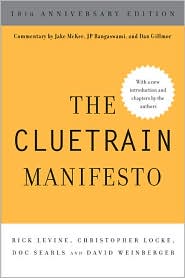
Cluetrain 10th Anniversary edition
Cluetrain 10th Anniversary
Everything Is Miscellaneous
Small Pieces cover
Small Pieces Loosely Joined
Cluetrain cover
Cluetrain Manifesto
My face
Speaker info
Who am I? (Blog Disclosure Form) Copy this link as RSS address Atom Feed

April 14, 2008

The Two-Thirds Life Crisis

I am coming to grips with the sticker shock of hitting my 40th birthday. Unfortunately, I’m 57.

This inconvenient truth is born home by Doc Searls‘ recent “incident.” [More from Doc here, here, here, and here.) I am one of the absurd number of people who count Doc as a close friend. I happened to be in the conference room when the pain in his chest got too strong to ignore. He called the Harvard health folks who said it might be a good time to stagger on over. So, I walked him there. It’s the least the second oldest person in the room could do. Not to mention, that way I found out as soon as possible what was going on with him, which turned out to be a pulmonary embolism (a blood clot that had traveled to his lungs), which was treated quickly and well.

Boston is a good city to get sick in.

Doc’s doing well, thank heavens. He blogged a couple of days after the incident that he’s resolved to start taking better care of himself. Good. We want Doc around for many decades, purely for selfish reasons.

Doc is in the midst of what I guess we should called a Two-Thirds Life Crisis because it comes some time after the Midlife Crisis. I’ve been through my own, having eaten my way into Type 2 diabetes a couple of years ago. I resolved to start taking better care of myself, and, fortunately, you can no longer use my blood to top off your pancakes in the morning. I’m actually in better shape than before. (Irony alert: I’ll probably drop dead this afternoon, just to give y’all something to blog about.)

Anyway, here, is a handy comparison chart:


The Male Midlife Crisis

The Male Two-Thirds Life Crisis

Occurs in your 40’s

Occurs in your late 50’s or early 60’s

Brought on by hearing your songs played on the oldies station

Brought on by hearing your cardiologist going “tut tut,” and then realizing that your cardiologist is 15 years younger than you.

Can’t believe you’re not twenty years younger

Can’t believe you’ve only got twenty years left

Purchase sports car in desperate attempt to appear young

After catching yourself in a mirror, you give away your baseball cap and shorts because you realize you’re too old for camp

Work on abs

Work on cholesterol

Ready to prove to the ladies that you’re still in your sexual prime

Continue lifelong redefinition of “sexual prime.”

Learn (= pretend) to like hip hop

Learn your parents were right about Duke Ellington

50 seems really old.

50 seems really old.

[Tags: midlife doc_searls aging old_farts ]

Tweet
Follow me

Categories: Uncategorized Tagged with: aging • culture • humor • midlife • personal Date: April 14th, 2008 dw

12 Comments »

Emergent politics: Was Steven Johnson right?

As the 2004 Dean campaign crashed, Steven Johnson wrote one of the more provocative and insightful analyses of why it failed despite all the enthusiasm behind it. In the piece, Steve refines the notion of “emergence” he had popularized in his terrific book of the same name: There’s emergence that clusters and emergence that copes. Clustering is exemplified by slime mold, which creates a crowd without any top-down control. Coping is exemplified by termite nests which result from a bottom-up regulatory regime which is able to adapt. The Dean campaign, under this analysis, clustered people and money but was unable to cope when things started to go badly.

Steve ends the piece this way:

I suspect that such a system may well be fundamentally incompatible with the necessary structure of a national political campaign, at least for the foreseeable future. Emergent systems that excel at coping do so out of truly local information; they take their random walks through their neighborhoods and record patterns in what they find. National campaigns, on the other hand, work at a macro scale, and they are necessarily wedded to the broadcast amplifications of the national media. Whatever local disturbances or opportunities they discover are quickly uploaded to the world of network TV and satellite feeds, where they undergo all sorts of distortions. And national campaigns, by definition, have to have leaders, at least in the form of the politicians themselves…

Is there an emergent politics capable of a more subtle form of self-regulation? If there is, I think it will first take shape, not as a political campaign, but as a more local, day-to-day affair: more polis than politics.

Was Steve right? (Just to be clear: I’m not asking about Steve, of whom I am a giggling fanboy, but about the state of politics.) [Tags: politics steven_johnson emergence everything_is_miscellaneous ]

Tweet
Follow me

Categories: Uncategorized Tagged with: emergence • politics • uncat Date: April 14th, 2008 dw

5 Comments »

Drop.io for quickly sharing stuff

I haven’t tried Drop.io yet, but I like the faq. It makes it easier to share stuff than by FTP’ing it, and it adds a little value to what you share when it can: It adds thumbnails to photos, etc. You can add to a “drop” via the Web, phone, email, or fax. You can set a drop so that it’s read-only or so that others can add or delete to it. The site isn’t indexed, so it’s as private as the people you tell about a drop care to keep it. Drop.io not only is free, it doesn’t require you to give your email address.

Ok, I just tried it and hit a glitch: Uploads freeze about 5% of the way in this morning. Could be them, could be the Net, either way, it’s got to be temporary…

[Tags: drop.io free_ftp_sites ]

Tweet
Follow me

Categories: Uncategorized Tagged with: everythingIsMiscellaneous • free_ftp_sites Date: April 14th, 2008 dw

2 Comments »

April 13, 2008

McCain’s Constitutional scholarship

John McCain explaining — in a disturbingly incoherent way — that this is a Christian nation (found via JedReport):


My favorite part: When he confuses what’s on our money with what’s in our Constitution.

And while I’m youtubing, here’s an oddly inappropriate response from Hillary Clinton to what seems to me to be a reasonable, albeit aggressive, question:


[Tags: mccain clinton hrc religion ]

Tweet
Follow me

Categories: Uncategorized Tagged with: clinton • hrc • mccain • politics • religion Date: April 13th, 2008 dw

2 Comments »

The Microsoft open document format, slashdotted

ISO’s taking over of Microsoft’s 8,000 page specification of the “open” standard based on Word’s document model has been slashdotted with typical, um, vigor.

[Tags: ooxml standards iso microsoft odf ]

Tweet
Follow me

Categories: Uncategorized Tagged with: everythingIsMiscellaneous • iso • metadata • microsoft • odf • ooxml • standards Date: April 13th, 2008 dw

Be the first to comment »

April 12, 2008

What I want to write about

For the past few months, I’ve been thinking about writing something that argues that the history of information is way more discontinuous than we’ve thought. Usually, we trace info and computers from Turing and Claude Shannon back through Hollerith’s punch cards, back to Babbage, and maybe back to the Jacquard loom, which used punch cards to control the patterns being woven. But I think this reads the modern idea of information back into machines that were not information-based at all. The loom cards look like punch cards, but they’re not really information, any more than a gear is. Or a comb is, for that matter.

When we discovered atomic theory, we were able to claim that historic objects were made of atoms all along. But I don’t think it’s the same with information theory. Reading info back into historical objects feels more like what happened when the universe started to look like clockwork.

This matters to me because I think we’re beginning to emerge from the Information Age. The paradigm is just starting to break. So it’s a good time to wonder how we ever managed to conceive of ourselves and our world as made out of information. How did we become information?

So, I’m not sure how to approach this, but I’ve been having a lot of fun reading about Babbage (including the new Difference Engine construction, as well as Doron Swade’s account of the first one), Hollerith, Turing, Shannon, and the rest of the cast of characters. I’ve also been poking around in some disciplines that reconceived of themselves as being about information, especially genetics. Some great stuff has been written about this. (E.g., “Who Wrote the Book of Life?: A History of the Genetic Code” by Lily Kay) Every conversation leads to another three books, and every book leads to another ten, so I’ve been reading fairly randomly and quite happily at this point. (No, I have not yet read “How We Became Posthuman: Virtual Bodies in Cybernetics, Literature, and Informatics,” by N. Katherine Hayles, but it sounds spot on.)

I’m greatly enjoying the poking and the prodding and the not understanding. [Tags: everything_is_miscellaneous information_theory babbage turing shannon jacquard_loom ]

Tweet
Follow me

Categories: Uncategorized Tagged with: babbage • infohistory • shannon • turing Date: April 12th, 2008 dw

18 Comments »

April 11, 2008

Notes on brief talk about libraries

A librarians’ group is meeting today at the Berkman Center to talk about the future of libraries. Gene Koo, Jake Shapiro, and Melanie
Dulong de Rosnay
, all of the Berkman.

I’m supposed to give a discussion-opener later this afternoon. Here are the notes of what I’m thinking of saying:

– Two themes
   – metadata over content
   – socializing of knowledge

– Knowledge as content
   – K was a quality of a belief
   – Became content esp. with books
      – Good fit because K was believed to be universal, single and eternal – permanence of books
         – Christian belief in a single universal truth
   – Books created:
      – topics as self-contained
      – experts as containers

– Web/Net
   – Primary characteristic: Abundance
      – Abundance of good is scarier than abundance of crap
      – Web invented to deal with abundance by giving us links…gives human-mediated shape to the endless sea
   – Links destroy container model
   – Web as social realm leads to socialization of K

– Socialization of K is all about metadata
   – e.g., this is worth reading, this is wrong, this connects to that
   – Paper-based metadata throws out info
      – Digital includes it all
      – Means that in general we get good enough info (but is that good enough?)
   – What does this mean for digital libraries?
      – Library is all metadata
      – distributed content
      – Place for expert and social knowing

Question: Digital libraries have nothing in common with libraries?

(Pardon the compressed form. These are my notes.) [Tags: libraries everything_is_miscellaneous ]

Tweet
Follow me

Categories: Uncategorized Tagged with: everythingIsMiscellaneous • libraries • metadata Date: April 11th, 2008 dw

6 Comments »

April 10, 2008

PRX gets a MacArthur nod

Congratulations to the folks at the Public Radio Exchange for receiving one of eight MacArthur Foundation awards for Creative and Effective Institutions. Couldn’t have happened to a nicer bunch of people! (More info at the Berkman site.) [Tags: prx berkman macarthur]

Tweet
Follow me

Categories: Uncategorized Tagged with: digital culture • media Date: April 10th, 2008 dw

1 Comment »

Norwegians take to the street to protest ISO standard

Here are photos of an actual IT protest demonstration in Norway. How often do you see that? (Answer: This is the second IT protest demonstration in Norway’s history.)

Steve Pepper, Chairman of the Norwegian ISO committee since 1995, gave a speech that explains why standard document formats are important and why the adoption of Microsoft’s specification — OOXML — as an ISO standard was a bad mistake. There’s also bloggage here, which links to a podcast I have not yet listened to.

Steve has stepped down as chair of the Standard Norway committee in protest of the overall committee’s process. Steve told me about what happened when we had dinner in Oslo last week. It sounds pretty gruesome.

Says Steve, 80% of the committee was apparently against changing Norway’s vote from No to Yes, but that wasn’t close enough to consensus, so everyone had to leave the room except for three administrators and four technical experts, the latter conveniently chosen to get the balance down to 50-50. When there still wasn’t consensus (surprise, surprise), the experts were dismissed and the Vice President of Standard Norway just decided the way he wanted.

Steve believes the 8,000 page spec (!) should not have been “fast-tracked,” and that ISO voted in favor of the Microsoft spec in part because it didn’t want to leave it in the hands of Ecma (a semi-competing standards body). Yet, OOXML is pretty much nothing but Word’s document model with a whole bunch of angle brackets added…overly complex and too tied to Word’s peculiar capabilities. Meanwhile, we have a truly open and well-worked out document standard in ODF. (Get yer copy of Open Office here — it’s free and it works real good.)

This matters a lot, for two basic reasons. First, the world runs on documents so we want to be able to interchange them without even having to think about which application made them. Having two standards vitiates much of the point of having a standard. Second, OOXML is so tied to Word that having it be an official ISO standard gives one vendor (guess which) a market advantage that truly open standards should take away: You should be able to pick the word processor you want based on its features and feel, without having to worry if using it will lock your documents out of the worldwide market of ideas and information.

Steve tells me that the battle to reverse the Norwegian decision is continuing, and he urges that irregularities in other countries be similarly investigated. [Tags: ooxml steve_pepper norway iso ecma microsoft standards]

Tweet
Follow me

Categories: Uncategorized Tagged with: digital rights • metadata • tech Date: April 10th, 2008 dw

2 Comments »

April 9, 2008

Managed by expectations, irked by messages

Francois Gossieaux reports on experiments described in Dan Ariely’s Predictably Irrational that show just how influential our expectations are: People who paid more for an energy drink were more refreshed by it and even solved more puzzles. Francois concludes: (1) “We are doomed,” and (2) “…who said that messaging was dead? The things you say about your product may indeed be more important that the product itself…”

Almost from the day the Cluetrain site went up, I regretted point #74: “We are immune to advertising. Just forget it.” We are so not immune. Branding works. We think of Volvos as safe and the Ford Fiesta as a car for young folks. We think of Coke as the original and Pepsi as the copy. We can characterize someone as a “wearer of Birkenstocks.” Branding and advertising in some important sense work.

Now, we certainly can undo some of the cognitive damage advertising and branding do. Market conversations in fact often are about the ways in which a product’s promises and sloganeering don’t live up to its reality. But that’s a lot different than saying we’re immune to advertising. We’re not.

I’d still urge companies to move their marketing away from messaging, however. Assuming the studies Francois cites are correct, our reactions to products do seem shaped by what we’re told about them. No surprise there, although it’s always depressing to find out what big dopes we humans are through no fault of our own. But, customers (= all of us) are going to increasingly resist and resent marketing that focuses narrowly on messaging — that is, on finding the simple idea they can pound into our heads over and over. Telling us your drink will make us refreshed or more alert may indeed make us more refreshed or alert, but treating us like freaking morons by droning the same words at us over and over will make your product less interesting to us. The real challenge marketers face in a world of online conversations is how to help us find what’s interesting about their products.

(By the way, although Francois an I have been friends and colleagues for many years, I just this morning realized that his last name uses each of the vowels just once.) [Tags: francois_gossieaux marketing branding advertising cluetrain ]

Tweet
Follow me

Categories: Uncategorized Tagged with: advertising • branding • business • cluetrain • marketing Date: April 9th, 2008 dw

16 Comments »

« Previous Page | Next Page »


Creative Commons License
This work is licensed under a Creative Commons Attribution-NonCommercial-ShareAlike 3.0 Unported License.
TL;DR: Share this post freely, but attribute it to me (name (David Weinberger) and link to it), and don't use it commercially without my permission.

Joho the Blog uses WordPress blogging software.
Thank you, WordPress!