


logo
EverydayChaos
Everyday Chaos
Too Big to Know
Too Big to Know
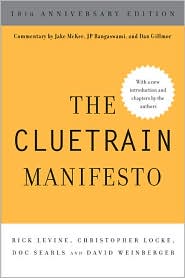
Cluetrain 10th Anniversary edition
Cluetrain 10th Anniversary
Everything Is Miscellaneous
Small Pieces cover
Small Pieces Loosely Joined
Cluetrain cover
Cluetrain Manifesto
My face
Speaker info
Who am I? (Blog Disclosure Form) Copy this link as RSS address Atom Feed

April 26, 2008

And another thing about fame…

I was talking with Kate Raynes-Goldie of the CBC at the end of the first day of ROFLcon yesterday [live-streamed here] and had a small realization about another difference between broadcast fame and Web fame. A little connection that immediately seemed too obvious to blog about. Nevertheless, here goes….

I said in my talk at the conference yesterday that we are making fame our own, rather than an alienating effect of the broadcast regime, because we make people famous on the Web by passing around links, and that — especially when you watch people watching YouTubes together — it’s a lot like how people tell jokes together: one video reminds someone of another, and there can be a type of pleasant one-upmanship as people try to top the current video with one that’s even better.

Not until I was talking with Kate did the further obviousness occur to me: One of the differences between broadcast and Web fame is that in making someone famous on the Web, we are putting a little bit of our social standing at risk. We’ve got a stake in it.

For example, during the wonderful, impromptu videofest blogged by (and, to a large degree, led by) the wonderful and impromptu Ethan Zuckerman, during Fellows Hour at the Berkman Center last week, everyone was pointing to the next great video to play. In the midst of this, I lost the thread and pointed to a video that, when projected to the group, was out of place and not even very interesting. People shuffled uncomfortably, trying to figure out why I would suggest such a clunker. I was embarrassed. (At least the video was short.)

That we have something at stake in what we recommend is, of course, well understood and completely obvious. But for me, only last night did I recognize that that’s one of the reasons the Web famous feel more like ours than the broadcast famous usually do. Not only do we make them famous, but we do so at some risk to ourselves.

It’s a type of sweat equity, or, in my case during video night at the Berkman, it was more like a type of flop sweat equity. [Tags: roflcon2008 fame ]

Tweet
Follow me

Categories: Uncategorized Tagged with: culture • digital culture • fame • roflcon2008 • social networks Date: April 26th, 2008 dw

1 Comment »

April 25, 2008

[roflcom] LOLcats panel

The LOLcats panel at ROFLcon, with six panelists and a moderator, is redeeming the format. It’s been hilarious. And sometimes more than that. “Ignore the haters,” says Cheez (ICanHasCheezburger), “because every moment you spend responding is a moment taken from those who love you.” Another advises not to try to control the meme.

Q: Why is it pronounced “loll” instead of spelled out L-O-L? Because it’s easier, they say. But an audience member — and it’s a raucous audience — says that it’s because you can make puns with “loll” but not with L-O-L, e.g., LOLicoaster.

Someone asks when the dialect went from based on toddlers to based on the retarded. (I told you it was raucous.) Cheez responds that it’s the first dialect that was written first, and spoken later. Thus, he says, we all hear it in our heads differently. So, if the questioner is now hearing a retarded person instead of a toddler…

One of them says that the LOLcat Bible is well underway. The moderator suggests a LOLcat Koran…

A question about origins brings replies pointing to l33t speak and to Yoda.

Is there LOLporn? The panel rolls its collective eyes. Oh yes. “The most common meme is ‘do not want,'” one says.

Has anyone tried to own the language? “There’s so much prior art,” says Cheez.

I haven’t gotten close to capturing this. It was hilarious, with a great panel and a great audience. There’s a real sense of commonality at this conference, and it’s in high spirits. [Tags: roflcon2008 lolcats ]

Tweet
Follow me

Categories: Uncategorized Tagged with: digital culture • lolcats • roflcon2008 Date: April 25th, 2008 dw

1 Comment »

April 24, 2008

Citizen Media legal guide

The Berkman Center’s Citizen Media Law Project has a site that’s rich with information, written in non-legalese, about your rights and liabilities as a blogger (and general citizen media person) in the U.S. There’s lots to browse there, and it’s all quite concise and helpful.

For example, the section on whether it’s legal to record a phone call you’re having with someone else says, in part:

Federal law permits recording telephone calls and in-person conversations with the consent of at least one of the parties. See 18 U.S.C. 2511(2)(d). This is called a “one-party consent” law. Under a one-party consent law, you can record a phone call or conversation so long as you are a party to the conversation. Furthermore, if you are not a party to the conversation, a “one-party consent” law will allow you to record the conversation or phone call so long as your source consents and has full knowledge that the communication will be recorded.

In addition to federal law, thirty-eight states and the District of Columbia have adopted “one-party consent” laws…

This is an excellent resource.

[Tags: citizen_media law cmlp journalism ]

Tweet
Follow me

Categories: blogs Tagged with: blogs • citizen_media • cmlp • digital rights • journalism • law • media Date: April 24th, 2008 dw

Be the first to comment »

Web fame – notes on my talk-to-be at ROFLcon

I’m talking tomorrow at ROFLcon, a conference about Web fame, celebrity and culture. I’m supposed to be talking in a general way about Web fame. Then I’m leading a panel composed of men (yup) who are Web famous: Kyle Macdonald (One Red Paperclip), Joe Mathelete (Joe Mathelete Explains Marmaduke), Ian Spector (Chuck Norris Facts), Andy Ochiltree (JibJab.com), Andrew Baron (Rocketboom), Alex Tew (The Million Dollar Homepage)

Here’s a sketch of what I’m thinking of saying:

Fame has been a property of the broadcast (= one-to-many) system. Fame is based on the math of many people knowing you, so many that you can’t know them. But it’s not just math, of course. It’s also economics. The broadcast economy has a fiduciary interest in building and maintaining the famous. They’re “bankable.”

Because of this scarcity and the fact that the one-to-manyness of the relationship means the knowing is one-way, the famous become a special class of person: mythic and not fully real. They are not like us, even ontologically. Fame is a type of alienation.

Outside of the broadcast system, fame looks different. This is a type of do-it-yourself fame, not only in that we often want human fingerprints on the shiny surfaces we’re watching, but also because we create fame through passing around links … occasionally for mean and nasty reasons. Kids sitting around watching YouTubes with one another are like kids telling jokes: That reminds me of this one; if you liked that one, you’ll love this one. And the content itself fuels public conversations in multiple media. This is P2P fame.

There’s a long tail of fame, although I suspect the elbow isn’t quite as sharp as in the classic Shirky power law curve for links to blogs. At the top of the head of the curve, fame operates much as it does in the broadcast media, although frequently there’s some postmodern irony involved. In the long tail, though, you can be famous to a few people. Sure, much of it’s crap, but the point about an age of abundance is that we get an abundance of crap and of goodness. We get fame in every variety, including anonymous fame, fame that mimics broadcast fame, fame that mocks, fame that does both, fame for what is stupid, brilliant, nonce, eternal, clever, ignorant, blunt, nuanced, amateur, professional, mean, noble … just like us. It’s more of everything.

viagra online

But most of all, it’s ours.

* * *

[ROFLcon will be live-streamed here. [Tags: roflcon2008 web_culture fame celebrity ]

Tweet
Follow me

Categories: misc Tagged with: celebrity • culture • digital culture • fame • media • roflcon2008 Date: April 24th, 2008 dw

21 Comments »

April 23, 2008

Tags vs. identity politics

Ike Piggott posts about the effect of tags ‘n’ such on identity politics. Nicely done. (And, if I may say be so self-centered he seems unknowingly to be channeling Everything Is Miscellaneous.)

[Tags: politics everything_is_miscellaneous ]

Tweet
Follow me

Categories: Uncategorized Tagged with: everythingIsMiscellaneous • everything_is_miscellaneous • folksonomy • politics • tagging Date: April 23rd, 2008 dw

1 Comment »

My life as a counter-indicator

Apparently, the traits I like in a candidate are the traits most of the country dislikes. I am therefore a counter-indicator. And also pretty depressed.

Pity me.

Of course, the truth of the matter is that the candidate I prefer (= am in love with) has in fact “closed the deal” with the majority of Democratic voters and delegates. So, maybe you shouldn’t pity me.

Yet.

[Tags: politics obama ]

Tweet
Follow me

Categories: Uncategorized Tagged with: obama • politics • whines Date: April 23rd, 2008 dw

2 Comments »

April 22, 2008

Web difference: 8.4 out of 10

In case you were wondering, we have scientifically determined that the Net is different on a scale of 8.4 out of 10.

Our methodology was unassailable. Each member of the Web Difference class had to state a number from 1-10 saying what difference the Net will make, where “Net” includes the Internet, the Web, and the computing devices it uses, and where the potential for change is included in the number.

Next question!

[Tags: web_difference webdiff ]

Tweet
Follow me

Categories: Uncategorized Tagged with: digital culture • webdiff • web_difference Date: April 22nd, 2008 dw

2 Comments »

April 21, 2008

What happened in Norway

Steve Pepper has started a blog, and one of his first posts explains — from his insider’s vantage point — how Standard Norway managed to approve OOXML as an ISO standard despite the overwhelming disapproval expressed by the committee members. It is not a pretty story.

The following post on Steve’s blog is about prostitution in Norway, starting with a conversation he had with a woman called Jenny. So, Steve’s blog is off to an appropriately eclectic start! [Tags: steve_pepper iso ooxml standards norway ]

Tweet
Follow me

Categories: Uncategorized Tagged with: digital rights • iso • net neutrality • norway • ooxml • standards • tech Date: April 21st, 2008 dw

2 Comments »

P2P search

YaCy is a peer-to-peer, open source Web search engine. You can use it to create a search portal, but the officially Very Cool thing about it is that you can peer it up with other Yacy installations, creating a distributed, p2p search engine.

[Tags: search p2p open_source everything_is_miscellaneous ]

Tweet
Follow me

Categories: Uncategorized Tagged with: everythingIsMiscellaneous • everything_is_miscellaneous • open_source • p2p • search • tech Date: April 21st, 2008 dw

1 Comment »

April 20, 2008

Open Science Directory

Can you guess what the Open Science Directory might be a directory of? Score 0 points if you guess “open science sources,” but subtract -10 if you guessed anything else…

[Tags: science open_access ]

Tweet
Follow me

Categories: Uncategorized Tagged with: digital culture • digital rights • open_access • science Date: April 20th, 2008 dw

2 Comments »

« Previous Page | Next Page »


Creative Commons License
This work is licensed under a Creative Commons Attribution-NonCommercial-ShareAlike 3.0 Unported License.
TL;DR: Share this post freely, but attribute it to me (name (David Weinberger) and link to it), and don't use it commercially without my permission.

Joho the Blog uses WordPress blogging software.
Thank you, WordPress!