


logo
EverydayChaos
Everyday Chaos
Too Big to Know
Too Big to Know
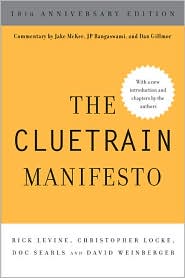
Cluetrain 10th Anniversary edition
Cluetrain 10th Anniversary
Everything Is Miscellaneous
Small Pieces cover
Small Pieces Loosely Joined
Cluetrain cover
Cluetrain Manifesto
My face
Speaker info
Who am I? (Blog Disclosure Form) Copy this link as RSS address Atom Feed

January 18, 2008

Control doesn’t scale

Control doesn’t scale. That seems to me to say it all. Or, it at least says some of it.

Now, here are some of the people who came up with that phrase, some well before I did:

David Friedman (economics)
Steve Manning (technical writing)
Jonathan Feldman (remote application controls)
Curtis Yanko (CruiseControl, a build management tool)
Steven Riley (MAC-based access control)
Uwe Doering (a packet filter for access control)

I hereby claim that phrase in the name of Her Highness, Queen Generality.

[Tags: control aphorisms ]

Tweet
Follow me

Categories: Uncategorized Tagged with: aphorisms • business • control • culture • leadership • politics Date: January 18th, 2008 dw

7 Comments »

January 17, 2008

All computers suck

I no longer have a working computer and I don’t know what to do about it.


I’m not going to bother whining about Vista, although to make the case for my despair I do have to state for the record that Vista has turned a working XP machine into a useless pile of software failures. I cannot count on any application completing its task. And I’m not referring to Vista’s propensity to interrupt me with security questions. E.g., I spent most of yesterday trying to move 20gb of music from Vista to my MP3 player, hoping that Vista would move all the files before crashing. It took many reboots. App after app freezes or crashes. And I can’t play a graphically intense game, even after downgrading to DX9, without a fresh reboot and no other apps running. Even then, it’s likely to freeze while I’m playing and almost certain to if I leave it alone overnight. And keep in mind that this is on a high-end machine with lots of RAM and hard drive, and a high-end graphics card. So, well, I guess I am going to bother whining about Vista.


Vista is worse than I’d expected (at least in my experience), but what really has me down is that my MacBook — which in most ways I love — continues to be unstable to the point of unusability. I had hoped that Leopard would end the frequent app crashes. So I did a fresh install. Things worked well for a a few weeks. Now it is crashing and freezing frequently. Last night during a presentation, Keynote totally froze, even thought I had done a fresh boot and had nothing else running, and I had to present with slides. (No, that was not an improvement.) This morning, I was interviewing JP Rangaswami for a podcast and Audacity froze and then crashed, wiping out the recording. I continue to get seemingly random app crashes of the kernel error sort. My system is unstable, which is worse than being broken.


I have run every diagnostic I can find, especially looking for bad RAM. I have done a scrape-and-clean reinstall. I literally don’t know what else to do.


I feel like I’m out of options. I don’t mind an occasional crash. But I now don’t have a working computer system — one I can rely on to, say, record a podcast or sync an MP3 player — and I’m actually pretty depressed about it. [Tags: mac leopard os_x vista whines technodepression ]

Tweet
Follow me

Categories: Uncategorized Tagged with: whines Date: January 17th, 2008 dw

32 Comments »

Time-Warner to try letting users decide

Time-Warner apparently is going to try an experiment in which users will get charged if they download (and upload?) more than the bandwidth they’re paying for. If you’re in a particular tier of service, you’ll be able to see a meter telling you when you’ve gone over your limit, and then you’ll be charged for the overage. That’s pretty much how cellphone billing works for most of us, and it only sucks reasonably — it’s a bit of a hassle and can result in surprisingly high bills, but does seem roughly fair.

So, it sounds like a step forward, and it’s a far preferable way to manage network congestion than having the cable company decide what content has priority. This approach does not, in my understanding, violate Net neutrality. It is, however, merely a very limited trial. If that.

If this heads towards an untiered pay-per-bit system, I’ll be concerned, however, because paying per bit discourages the exchange of ideas and creative works on the Net, and disproportionately affects the poor. (Tiering affects the poor, too, of course, which is an argument for socializing the Net. But, well, that’s a different can of Vermes.)

If only we could introduce some real competition into the system so connectivity becomes a commodity, as providers race to provide the most bits at the lowest price. In a truly competitive market, a whole bunch of business models, including ones not yet invented, could slug it out as users decide what’s best for them.

[Tags: net_neutrality time-warner ]


Ben Scott of Free Press says, in a press release thingy:

“Compared to that approach [unilaterally blocking traffic], Time Warner’s proposal is better — at least customers will know what they’re getting into. But metered prices may chill innovation in cutting-edge applications because consumers will have a disincentive to use them. Viewed in the context of our long-term national goals for a world-class broadband infrastructure, telling consumers they must choose between blocking and metered pricing is a worrying development.

Yup.

Tweet
Follow me

Categories: Uncategorized Tagged with: net neutrality • net_neutrality • time-warner Date: January 17th, 2008 dw

5 Comments »

Everything is Miscellaneous at Google Print

Everything Is Miscellaneous is indexed, searchable, and previewable at Google Books. Yay!

Interesting to see the metadata Google extracts and assembles, sometimes guessing wrong. (Vermes in my book is an animal category, not a place.)

Tweet
Follow me

Categories: Uncategorized Tagged with: everythingIsMiscellaneous • libraries • media Date: January 17th, 2008 dw

2 Comments »

Intro to citizen’s media

Global Voices has produced a great intro to citizen’s media, under the guidance of David Sasaki. It’s clear, friendly, and full of heart. And, needless to say, it’s not US-centric. It’s available in English, Spanish, and Bengali, with more on the way.

Well done, David and team. [Tags: gv global_voices citizen_media david_sasaki journalism ]

Tweet
Follow me

Categories: Uncategorized Tagged with: bridgeblog • digital culture • globalvoices • media • peace Date: January 17th, 2008 dw

1 Comment »

January 16, 2008

Library of Congress partners with Flickr…and you (= socialized metadata)

Very interesting posting from the venerable Library of Congress on its blog (which by itself is pretty cool). Here’s a snippet:

Out of some 14 million prints, photographs and other visual materials at the Library of Congress, more than 3,000 photos from two of our most popular collections are being made available on our new Flickr page, to include only images for which no copyright restrictions are known to exist.

The real magic comes when the power of the Flickr community takes over. We want people to tag, comment and make notes on the images, just like any other Flickr photo, which will benefit not only the community but also the collections themselves. For instance, many photos are missing key caption information such as where the photo was taken and who is pictured. If such information is collected via Flickr members, it can potentially enhance the quality of the bibliographic records for the images.

We’re also very excited that, as part of this pilot, Flickr has created a new publication model for publicly held photographic collections called “The Commons.” Flickr hopes—as do we—that the project will eventually capture the imagination and involvement of other public institutions, as well.

Except for my general nervousness about putting this stuff into a privately held, for-profit organization, I think this is quite cool. It has the advantage of putting the data where the people already are. As a footnote to the posting says, it takes a photo of a grain elevator as an example “because it helps illustrate that there are active Flickr user groups for even such diverse subjects as grain elevators.” As the Commons page says,

The key goals of this pilot project are to firstly give you a taste of the hidden treasures in the huge Library of Congress collection, and secondly to how your input of a tag or two can make the collection even richer.

You’re invited to help describe photographs in the Library of Congress’ collection on Flickr, by adding tags or leaving comments.

Gives me little goosebumps.

And, by the way, the photos are fantastic. [Tags: everything_is_miscellaneous library_of_congress tags flickr folksonomy taxonomy photographs metadata ]

Tweet
Follow me

Categories: misc Tagged with: culture • everythingIsMiscellaneous • folksonomy • libraries • metadata • taxonomy Date: January 16th, 2008 dw

14 Comments »

Losing my urge for Air

When I first heard that Apple had introduced a 3-lbs Mac, technolust heated my blood. But from my very first poking-arounds about it, my tremors of desire have quieted.

On the basis of preliminary reports, it sounds like Apple threw everything overboard in order to achieve a single design ukase: Thou shalt be the thinnest! No CD/DVD player, yet another freakish video out, no ethernet port, a battery that requires a trip to the factory to be replaced (and given that my MacBook battery is failing rapidly after 8 months…), a single USB port, no firewire port, no good way to plug in an external drive (assuming you have a mouse plugged into your USB port), no mic input, yet another unique power supply. Dongle city! And the Mac Air ain’t cheap.

Thinness is an aesthetic criterion, not a utilitarian one. Art triumphs over usefulness yet again, driven by Steve “One Button” Jobs.

Good. I can enjoy my MacBook unruffled by envy. Well, at least not much envy.

[Tags: apple mac macintosh_air mac_air macbook technolust ]

Tweet
Follow me

Categories: Uncategorized Tagged with: apple • mac • macbook • macintosh_air • mac_air • tech • technolust Date: January 16th, 2008 dw

17 Comments »

January 14, 2008

This has to be ancient, but…

One of my cousins sent this photo around to the family mailing list. It must be as old as the Internet — old enough to have lost its attribution — but what the heck.


The title of the photo is “Winner of this year’s ‘Not My Job Contest’“:


Not my job - white line swerves around a twig

[Tags: humor photos white_lines roads ]

Tweet
Follow me

Categories: Uncategorized Tagged with: cluetrain • humor • photos Date: January 14th, 2008 dw

3 Comments »

January 13, 2008

Copyrighting dance

I had a stimulating dinner conversation with someone who works for an institution that preserves the work of a well-known choreographer. (I’m being a bit cagey because I may not be representing this person’s views accurately.) The institution licenses productions very carefully and is stringent in insisting that every element of the productions be authentic, i.e., be as the work was originally produced.


Predictably, I wondered why the institution didn’t loosen up. The choreographer would have more influence because her (or his — caginess!) works would be more frequently performed. After all, if the Beethoven Institute insisted that all performances must be on original instruments, using exactly the same pacing, intonations, sonic dynamics, etc., as Beethoven intended, our culture would be far poorer because we’d hear much less Beethoven and many fewer creative interpretations of his works. In fact, Beethoven would have copyrighted himself right out of culture.


But, replied my dinner companion, it’s different with the work of a great choreographer. The work consists of the details of music, costume, lighting and gesture. The gap between composition and performance is smaller than with a musical score; in fact, there is no gap.


I am not convinced. Nor am I not unconvinced. I think I think that the magic of metadata could let us have our cake and dance it too: the association could authenticate those performances that met its criteria, while freely (liberally, if not for free) permitting non-canonical performances. I don’t know the status of Gilbert and Sullivan’s copyrights, but the D’Olyly Carte group performs a similar metadata function: There are many productions of Gilbert and Sullivan works — a couple of weeks ago, we saw a delightful Mikado that updated lyrics with references to Dick Cheney’s little list — but if you want to see an authentic version, you go to D’Oyly Carte.


But, much as a I like metadata, I’m not confident that I understand the dimensions of the issues in copyrighting something that seems to fall between a score and a performance. [Tags: copyright copyleft choreography dance arts mikado ]

Tweet
Follow me

Categories: Uncategorized Tagged with: culture • digital culture • digital rights • metadata Date: January 13th, 2008 dw

13 Comments »

January 12, 2008

David Isenberg and Harold Feld on who gets to discriminate among packets

When I blogged something positive about Net Neutrality, Seth Finkelstein wanted to know what the alternative was to letting the carriers decide which packets to block, if there is genuine Net traffic congestion.


David Isenberg and Harold Feld have each responded not only in comments to my post, but more fully on their own sites. I like David and Harold’s approaches better than my own hasty and, well, dumb response. (A while ago I’d posted an idea I heard somewhere that I like: The carriers could let users nominate particular sites for especially speedy interaction, limiting the number of times a user could switch in a month. So, if you want to play WoW but don’t care about downloading on-demand movies, you could choose some WoW sites for your express lane, but I could choose on-demand this month and next month decide I’d like really fast P2P video. Or whatever.)


(FWIW, David lists me among those who conflate copyright and congestion. I’m not sure how I gave David that impression. I understand that AT&T’s intention to filter copyrighted material is different from the carriers’ contention that network congestion requires them to filter packets.) [Tags: net_neutrality david_isenberg harold_feld seth_finkelstein att ]

Tweet
Follow me

Categories: Uncategorized Tagged with: digital rights • net neutrality Date: January 12th, 2008 dw

Be the first to comment »

« Previous Page | Next Page »


Creative Commons License
This work is licensed under a Creative Commons Attribution-NonCommercial-ShareAlike 3.0 Unported License.
TL;DR: Share this post freely, but attribute it to me (name (David Weinberger) and link to it), and don't use it commercially without my permission.

Joho the Blog uses WordPress blogging software.
Thank you, WordPress!