

logo
EverydayChaos
Everyday Chaos
Too Big to Know
Too Big to Know
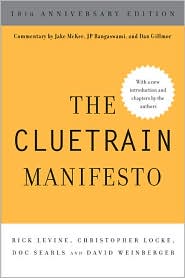
Cluetrain 10th Anniversary edition
Cluetrain 10th Anniversary
Everything Is Miscellaneous
Small Pieces cover
Small Pieces Loosely Joined
Cluetrain cover
Cluetrain Manifesto
My face
Speaker info
Who am I? (Blog Disclosure Form) Copy this link as RSS address Atom Feed

April 18, 2007

Archbishop of Canterbury on reading – and hearing – the Bible

Akma highly recommends Dr. Rowan Williams’ lecture on the interpretation of the Bible. If the endorsement of a non-observant Jew matters—and why should it?—I agree. The lecture is fascinating to me, although also quite foreign. I would love to hear the reaction of some learned and observant Jews.

For example, Dr. Williams says that the Bible was first heard in a community, not read in isolation. It should therefore be read (he says) “not as information, not as just instruction, but as a summons to assemble together as a certain sort of community, one that understands itself as called and created ‘out of nothing’.” I both recognize this as a deep summons and hear it as expressing foundational presuppositions different from mine and my people’s. Although non-Jews often don’t give this full credence, Jews are a people. You are a Jew by birth, not by belief. (It’s more complex than that, but what isn’t?) Thus, the community isn’t created “out of nothing.” And the community with which one hears the holy text is an historical one with which one is supposed to discuss the text. Reading the Torah, at least as I’ve watched my wife and others do it, is about conversing with the tradition of great commentators on it. I think that is a different type of community and different experience than Dr. Williams is discussing. And yet, of course, there are elements of Jewish community that are much like what he describes.

Anyway, I find myself useful provoked by the lecture. [Tags: rowan_williams bible hermeneutics akma judaism torah ]

Tweet
Follow me

Categories: Uncategorized Tagged with: culture • philosophy Date: April 18th, 2007 dw

4 Comments »

April 17, 2007

[berkman] Wendy Seltzer on ChillingEffects and copyright take-downs

Wendy Seltzer is a founder of ChillingEffects.org. She talks about her “run in” with the National Football League.

Wendy waits for the room to fill by running a very funny YouTube clip of the Daily Show segment about Viacom vs. YouTube. (The room is now packed.)

She was watching the Super Bowl and saw the notice: “This telecast is copyrighted by the NFL for the private use of our audience. Any other use of this telecast or of any pictures, descriptions, or accounts of the game without the NFL’s consent, is prohibited.” She took the clip off her MythTV and posted it to YouTube under the title “Super Bowl Highlights,” with a caption that said: “The NFL’s overreaching copyright claim.” That was on Feb. 8. Five says later, she got a notification from YouTube saying that they had taken the clip down because the NFL claimed it was infringing under the DMCA .

YouTube had received a list of 158 clips the NFL claimed was infringing. It’s likely that the NFL had a robot search for anything that was titled or tagged as NFL. Wendy asked to see the list and received it.

Wendy believes her clip was Fair Use of copyrighted material. That copyright doesn’t protect people from giving accounts of the game or describing the game. It doesn’t even prevent people from making some pictures from the telecast. Wendy’s clip was Fair Use because:

My use is for nonprofit educational purposes; the copyright in the telecast is thin; the portion of football that follows the copyright warning is a minute portion of the whole, with no significant action or commentary, useful to show people what it was the NFL claimed its copyright covered; and the effect on the market for or value of the work is non-existent.

At ChillingEffects, there is a counter-notification generator form that requires the claimant to get specific about why the piece is infringing. Wendy filled it in. This gives YouTube the ability to re-post the material without penalty; the poster now takes the heat if the complainant still complains. Wendy says this isn’t quite an even balance because YouTube’s terms of service protect it from complaints by users anyway, so while Viacom can sue YouTube for not taking a clip down, users can’t really sue YouTube if it doesn’t put the clips back up upon receipt of a counter-claim.

YouTube put Wendy’s clip back up.

Then, on March 18, YouTube once again removed it because the NFL again complained. Wendy says that the DMCA has no explicit mention of a second take-down notice. If a company doesn’t like a counter-notification, it can sue.

This time, it was clear that an individual from the NFL had actually watched the clip. But, Wendy thinks they were falling foul of 512f of the DMCA, which makes a person liable for damages (including lawyers’ fees) for knowingly misrepresenting that a clip is infringing. YouTube was required to pass along Wendy’s original counter-notification, so the NFL knew that Wendy was saying that the clip was for educational purposes.

Wendy sent back the same counter-notification. The Wall Street Journal blog and the Newark Star Ledger covered it, resulting in a letter from the NFL saying that Wendy clearly “doesn’t understand” the DMCA. They objected to the fact that Wendy included 20 seconds of game play around the ten-second copyright notice. But, the letter said, she has their permission to use just the copyright notice. (She included the 20 seconds as context. It does not show a complete play.)

Wendy wrote back, saying that she thinks the clip in its entirety is covered under Fair Use.

They replied with an email, saying that “there is a substantial difference of opinion us on this matter that cannot be reconciled.” So, the clip is still on line. But the NFL says it can offer no assurance they won’t complain again.

YouTube is built on the DMCA safe harbor (512c) that says that it doesn’t have to screen or filter content, or check the copyright of each piece posted. Instead, YouTube has to reply to claims of infringement. No one has alleged that YouTube has not responded. It’s followed the DMCA to the letter. Instead, Viacom et al. say that it’s “too hard” to send YouTube all these notices, so they want to shift the burden to YouTube. Even if YouTube could manage to do all that work, the next startup would find that too high a hurdle; it’d badly hurt innovation…a chilling effect. “I think they’re trying to renege on the deal that was struck with the DMCA.” Wendy would like to see the DMCA reformed “to address some of the burdens on speech” but not thrown out.

Q: (catherine bracy) Why do you think the NFL is “materially misrepresenting”?
A: They know that this is non-infringing. The second notification makes it harder to claim it was a good faith mistake.

Q: (bracy) Can I take a camera into the stadium, tape it, and put it onto YouTube?
A: The guards frisk you and say that your ticket is a contract that prevents you from using a camera. You could look on from a rooftop and tape it from there.

Q: Could you sell it?
A: There’s no copyright in the game itself, so yes. But if you tape a concert you can hear from your house, there’s copyright in the music itself. And “Super Bowl” is trademarked, which is why ads for, say, chips say things like “Stock up for the big game.”

The “knowingly misrepresents” phrase, Wendy says, was added by the entertainment industry to make it harder to sue complainants.

Q: (john palfrey) What’s their strongest case against your Fair Use claim?
A: Their strongest claim against the 20 seconds of football is that I haven’t transformed it or added educational material into the clip itself. They’ll say the announcers describing the plays is a creative work. And there are markets for licensing virtually everything, they’ll say. If they want phone companies to continue paying them to stream clips to cellphones, this is a market into which I’m intruding.

Q: What might your damages be under 512f?
A: It’s hard to quantify damages from speech. I didn’t lose money from students not attending class because I couldn’t talk about the clip, etc.

Q: (gene koo) How long can this take-down and put-back dance go on?
A: California recognizes that legal process can be used to squelch legitimate speech, so if this process continued, I might have a claim.

Q: (me) Someone posted an aggregation of Couric’s questions of the Edwards. It was taken down. Was that fair use? And if this had been done by Jon Stewart, would it be protected the same way it was for the amateur who posted it.
A: Yes, it sounds like fair use, and Stewart and the poster are protected by the same law. But there is no DMCA coverage for broadcast. I don’t know if Stewart licenses his clips or just asserts they’re fair use.

[Tags: berkman fair_use copyleft copyright nfl youtube dmca]

Tweet
Follow me

Categories: Uncategorized Tagged with: business • digital rights • entertainment • everythingIsMiscellaneous • media Date: April 17th, 2007 dw

6 Comments »

French code of conduct for bloggers

The French have developed a “code of conduct” for bloggers—a project begun in Feb. 2006 but with longer roots—that has been adopted by 200 blogs and two major political parties. It mixes netiquette (don’t use all caps), best practices (“When replying to a comment, it can be useful to quote from the original text in order to be understood”) and ethical rules (“Comments of a racist, anti-Semitic, pornographic, revisionist or sexist nature will not be accepted…”).

From my point of view, it is one possible set of guidelines. We should have lots and lots of them so that — when appropriate — bloggers can make explicit the norms already implicit on their sites.

This evening at 9pm in France, there’s going to be a Second Life discussion about the code with the person responsible for the Net campaign of Ségolène Royal. Details here. (I’ll be on a plane, so I’ll have to miss it, which is just as well given my ludicrously bad French.)

(I blogged about blogging codes here and about my own guidelines in the comments to this post.)

[Tags: blogosphere blogs codes morals cyberbullying ]

Tweet
Follow me

Categories: blogs Tagged with: blogs • digital culture Date: April 17th, 2007 dw

1 Comment »

April 16, 2007

Replacing Powerpoint with Flash?

Anyone have any recommendations for a Windows or Linux package that will let me create Flash presentations so I can stop using Powerpoint? Note that I am not trying to import Powerpoint into Flash. I want software that will make it easy-ish to create presentations in Flash, so that I can play them back at 1024×768, complete with snazzy path animation (a must) and special effects. A plain old Flash editor that has a template for presentations would be a start, but I’d like something with effects built in. I’m playing around with Swish (but can’t find a presentation template and so far don’t see how to run it as Flash instead of Shockwave, but I haven’t looked hard.)

My preferences: The editor either works in Linux or works in Linux via Wine or CrossOffice (or some other DLL-runner). And I don’t want to pay a million dollars for this, since it’s likely to be a failed experiment on my part. But if it works, I could switch to Linux on my laptop.

Any thoughts? [Tags: powerpoint flash linux presentation_software]

Tweet
Follow me

Categories: Uncategorized Tagged with: tech Date: April 16th, 2007 dw

11 Comments »

Podcorps Nation

The Conversations Network (a non-profit from the same folks who bring you IT Conversations) has just launched Podcorps, an all-volunteer team of “stringers” who will record the audio and sometimes the video of public events that matter to people.

Once you register, you can search for events near you that you can sign up to record. Or, if you know of an event you’d like covered, go stick it into the calendar. (The FAQ says that some stringers may want some help covering expenses, but this is intended to be an entirely non-profit enterprise.) The stringers can then publish the media where they want, although Podcorps expects most will post them at OurMedia.org and the Internet Archive where they are freely available to anyone.

I hope this takes off. More is better than less. (Disclosure: I’m on the board of the Conversations Network.) [Tags: podcasts politics events everything_is_miscellaneous ]

Tweet
Follow me

Categories: Uncategorized Tagged with: culture • everythingIsMiscellaneous • podcasts • politics Date: April 16th, 2007 dw

Be the first to comment »

April 15, 2007

How do you get to blogs

From a press release about a study called Traffic Characteristics and Communication Patterns in the blogosphere [LATER: Try this pdf file if that link doesn’t work.] by researchers at Boston University and Federal University of Minas Gerais, Brazil:

The study concludes that the intensity of traffic directed to a blog through search engines (which use traditional page-rank algorithms) does not seem to correlate with the “real” popularity of the blog, and suggests that social-network-based navigation may be playing an increasingly important role in web navigation in general, and blogosphere navigation in particular. On that count the authors note that in blogspace, the popularity of a blog is more a reflection of its owner’s social attributes (e.g., celebrity status, reputation, and public image) than a reflection of the number and rank of other blogs or web pages that point to it. This highlights the need for the development of page-rank algorithms that take into consideration the social attributes of blogosphere actors (as opposed to solely on the topology of the underlying blogspace), possibly using inference techniques.

Professors Azer Bestavros (BU), Virgilio Almeida, Jussara Almeida and the graduate students Fernando Duarte and Bernado Matos (UFMG) used an extensive set of real traces to characterize the access patterns to a popular blogosphere. The traces consist of over 32 million blog requests and about 278 thousand comment requests. These requests were made by over 4 million visitors over a period of four weeks.

I haven’t read the study — I’m about to get on a plane from Helsinki, where, by the way, I had a wonderful time but slept like a dog on a rocking chair (assuming dogs don’t sleep well on rocking chairs) — and the summary raises lots of questions that I’m sure the study itself addresses. Anyway, it sounds like an interesting study. Hence, this premature post. [Tags: blogs ]

Tweet
Follow me

Categories: blogs Tagged with: blogs Date: April 15th, 2007 dw

5 Comments »

April 14, 2007

Becoming Shakespeare

The Guardian has a terrific article by Jonathan Bate on how Shakespeare went from being considered one of the very best playwrights to the unique, exceptional genius of our language.

Among small points: Bates says it isn’t true that Shakespeare created more new words than anyone else in our history. That myth resulted from the Oxford English Dictionary’s frequent citation of Shakespeare as a source because “because of his ready availability when the dictionary was created at the end of the Victorian era.” [Tags: shakespeare]

Tweet
Follow me

Categories: Uncategorized Tagged with: culture Date: April 14th, 2007 dw

1 Comment »

Networked truth, part 2

I’m still sleep-dprived, but I’ve had a day to think about what I posted yesterday about truth being a property of networks.

It would have been clearer for me to say understanding is a property of networks. Then I wouldn’t have left the impression that I think facts are a matter of majority opinion. Facts are facts. That’s pretty much their essence. Understanding, however, is plural, at least in many domains — less so in the sciences, more so in the humanities.

On the other hand, our age should be embarrassed that we’ve reduced truth to mere facts.

[Tags: truth philosphy everything_is_miscellaneous]

Tweet
Follow me

Categories: Uncategorized Tagged with: digital culture • everythingIsMiscellaneous • philosophy Date: April 14th, 2007 dw

5 Comments »

April 13, 2007

Networked truth

It’s three in the morning in the US. I am in the Zurich airport, waiting for my flight to Helsinki. I am high on Dramamine. All of which will help explain why at the moment it seems plausible to me to say: Truth is a property of networks.

I can only guess at what I mean, starting with the obvious: Rather than thinking that truth is a relationship between the propositions we believe and the way the world is, such that the propositions represent the world, in the networked world the truth is argued for and connected via links. For all but the most mundane of truths, the network of conversations gives us more shades, nuances, and reasons to believe. Which leads me to think that if truth isn’t an emergent property of networks, then understanding is.

It is, of course, an unowned, self-contradictory, unsettled truth that is too big to be contained by any individual. It is outside of us and among us. It is gained not by trying to contain it but by traveling through it.

Of course, the fact that I’m traveling at the moment has no effect on my choice of metaphors.

And the fact that I’m dog tired has no effect on my decision to post this instead of letting it melt in the light. [Tags: truth philosophy networks wrong_in_public everything_is_miscellaneous ]

Tweet
Follow me

Categories: Uncategorized Tagged with: culture • everythingIsMiscellaneous • philosophy Date: April 13th, 2007 dw

8 Comments »

April 12, 2007

Co-teaching a course at Harvard Law

Harvard Law has approved a course I’ll be co-teaching with the Berkman Center’s John Palfrey during Spring 2008. Holy crap.

It’s called The Web Difference? Digital Media, Entertainment, and the Law. Here’s the description:

This course will examine the claim of Internet exceptionalism and the implications of this claim in the context of the law and society. Is the Web something substantially new that is changing the fundamentals of who we are and how we’re together? Or is it just the next in the communication media humans have invented? What are the problems to which these changes give rise? Which of these problems are ones that we’d like to address through reforms in the law, technology environment, markets, social norms, or other yet-to-be-discovered modes of influence? This course will cover the legal and policy issues to which changes in the news media and entertainment businesses, wrought by the web, give rise. Key doctrinal areas of inquiry include intellectual property, the First Amendment, defamation, and privacy. Students should be prepared to experiment with new technologies, including a course weblog, and to perform some coursework collaboratively. Course requirements include gro up coursework and a final paper, and no examination.

Oy. Not only haven’t I taught since 1986, the topics the course plans on covering are way beyond my reach. So, thank heaven for John Palfrey. I am totally thrilled to work with him. (I won’t go on to list JP’s virtues both because he’s modest and because he’s my boss at the Berkman Center. But you can just ask anyone.)

By the way, does anyone know what “gro up coursework” is? [Tags: harvard berkman exceptionalism john_palfrey teaching]

Tweet
Follow me

Categories: Uncategorized Tagged with: digital culture • education • everythingIsMiscellaneous • philosophy Date: April 12th, 2007 dw

8 Comments »

« Previous Page | Next Page »


Creative Commons License
This work is licensed under a Creative Commons Attribution-NonCommercial-ShareAlike 3.0 Unported License.
TL;DR: Share this post freely, but attribute it to me (name (David Weinberger) and link to it), and don't use it commercially without my permission.

Joho the Blog uses WordPress blogging software.
Thank you, WordPress!