


logo
EverydayChaos
Everyday Chaos
Too Big to Know
Too Big to Know
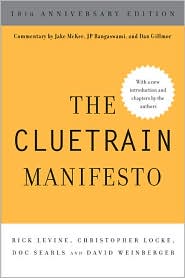
Cluetrain 10th Anniversary edition
Cluetrain 10th Anniversary
Everything Is Miscellaneous
Small Pieces cover
Small Pieces Loosely Joined
Cluetrain cover
Cluetrain Manifesto
My face
Speaker info
Who am I? (Blog Disclosure Form) Copy this link as RSS address Atom Feed

March 6, 2007

[f2c] Susan Crawford

Susan Crawford gives a talk about our inability to communicate outside this room

Imagine there’s an easy-to-assemble toll booth. We drive into the gray world of the Land of Low Expectations. We’re getting what the current providers give us.We can then go to the Land of Glittering Generalities that attempt to maintain the incumbents in power.

How do we get reason back? “Communications regulation should be about optimizing human communication.” We have to persuade people that economic growth comes from new ideas, that the Internet is the greatest source of new ideas we’ve ever seen and that the telecom policy has to put the Internet at its core. We should claim that the Internet is different. “People are very uncomfortable when we say that, but we have to say it.”

To help reason, we should be showing pictures. E.g., a chart of the market plummeting recently, and a chart of the weakness of the US economy. “If the rate economic growth in the US over the next 45 yrs were to increase by 0.5% per year, it could resolve all of the budget difficulties associated with the aging of the Baby Boom generation” with plenty left over. So, how do we continue growth in the US? “We need more meta-ideas about the generation of new ideas.”

Aha! The internet – a source of new ideas.” It’s group-forming attributes and the chance to fail quickly are vital, too.

Policy outcomes: Universal service. Divestiture, separating services from content [i.e., the people who supply bit transport should not provide content.]

We need to professionalize, with better comparative data to show the effect of the Net on economy, the effect of Net neutrality, etc. And we need serious leadership.

We’re running out of time. The future of the Internet hangs in the balance.

[SC for FCC!]

[Tags: fcc susan_crawford net_neutrality f2c ]

Tweet
Follow me

Categories: Uncategorized Tagged with: conference coverage • digital rights • media • politics • wifi Date: March 6th, 2007 dw

2 Comments »

[f2c] Alternative to Yochai

Peter Swire at Ohio State U and former privacy advisor to the Clinton Admin explains why he thinks Yochai Benkler gets it wrong. Benkler overstates the shift from market to non-market, and Peter will explain “why an economics-based alternative is pragmatically useful.”

Your laptop is an information factory. Consumers own the means of production, which sounds pretty economic, he says. He says he’s a big fan of Yochai, but not with the major thesis that says it is “social rather than proprietary and market relations that create all the big effects — freedom, equity, etc.” (p. 92). But the shift to non-market is not proven, and there are pragmatic reasons to employ an economics-based approach.

Is non-market overstated? It’s defined too broadly in the book, says Peter. And Yochai is observing the early adopters, but as the niche grows it may well go commercial. The amateurs give way to marketized professionals. The Internet itself has shifted from non-commercial to highly commercial.

He says that the production costs have gone well down, so we’ll get more production. There should be a market response, not that we’ll go to a non-market environment.

Why adopt economics as a second way of explaining what’s going on? It’s not clear that Yochai is right that the big change in tech will result in a shift to a nonmarket economy. That’s not what happened with the industrial revolution. It’s simpler (Occam’s Razor) to apply the usual economic view that a reduction in costs will lead to an expansion of production and a bigger market, says Peter.

Yochai responds: It’s important not to confuse markets with economics. My claim is exactly that people own the means of production. But the point that the supply curve shifts outward is not inconsistent with what I’m saying. It means the supply of zero-priced goods increases. You’re using the term “market” as a metaphor and a seucrity blankie. You need to include the pricing mechanism. My claim is that the price mechanism is of smaller importance in directing action. If you want to affect action you have to accept that there is a unique system that is outside of the price system. And that’s what I call nonmarket. To claim that I’m not using economics in this book is surprising.

Second (Yochai says), I thought to say that when you change the costs of the physical capital necessary to act in economically significant ways you get changed behaviorial patterns is not technological exceptionalism. It’s like saying the same thing about the steam engine. Costs matter, the combination of physical human etc. capital all matter. One cost component has declined to a point that a whole set of behaviors that were peripheral to the economy are becoming central.

It’s not that the market disappears. Rather, the addition of nonmarket actions adds a degree of freedom that can solve some of the problems of the purely market-based system (Yochai says).

Peter: The amateurs are likely to get professionalized.

Yochai: Could be. But what will the policies be?

Yochai says there’s a wiki at benkler.org to talk about this type of thing…

[Excellent.] [Tags: f2c yochai_benkler peter_swire economics ]

Tweet
Follow me

Categories: Uncategorized Tagged with: business • conference coverage • marketing Date: March 6th, 2007 dw

Be the first to comment »

[f2c] Commissioner Adelstein

FCC Commissioner Jonathan Adelstein begins by playing harmonica with Howard Levy. Really. [As always, the following paraphrases, abbrevites, omits, and gets wrong.]

[I’m sitting next to Susan Crawford who is blogging away. Hers will be the post to read on this.]

Then he touts the E-Rate program. But “we lack a coordinated vision for success…We need to provide for all of our neighbors. This has to be a greater national priority than it is now.” A national strategy should have benchmarks. Update the current FCC definition of “high speed” as 200kb [which is laughable — dialup is 56k]. Have standards for expressing what rates customers are getting. We need meaningful competition. “We can’t let the broadband market settle into a comfortable duopoly…” We should worry about consolidation. The Congress should use tax incentives to bring access to under-served areas, and more [can’t keep up]. We should invest in basic R&D. Be creative and flexible. We need to preserve the creative freedom of the Net. “You’re all reinventing democracy, how we share music…” We need to preserve the Net’s openness. The AT&T merger brought about an agreement about Net Neutrality that isn’t the end of the story but at least refutes the notion that NN can’t be defined.

Q:(frankston) The FCC and the Net are incompatible. The Net is what we can get by connecting our home networks from the edge. The FCC defines it in terms of services instead of in terms of bits.
A: We took a step with the AT&T merger….
Q: No, you treat it as a service. We don’t need the phone companies to run the Internet.
A: We need an infrastructure. There’s a balance here. We need to be realistic.

Q: (isenberg) The chat was wondering how much power you have.
A: I’m one of five commissioners.

Q: (brough) What about cognitive radio opening up spectrum?
A: I was going to talk about that but cut it for time. Maybe I made the wrong choice. Software-defined radio is one of the most exciting developments I’ve seen and maybe the most revolutionary in spectrum use. We need to find ways to enable them to reach their full fruition. Our engineers are examining the ways they can work. It’s a way of doing more with less because, as someone said, G-d isn’t making any more spectrum. Of course, we have to be concerned about harmful interference, but in general I’m very high on it.

Q: (JH Snider) Please elaborate on what you said about the carrot-stick approach. The FCC has been 99.99% carrot. In the past few years, the FCC has given away $50B in spectrum allocation. Look at what you did with the MMDS band. You gave it away to Sprint and they haven’t built anything. Eight years later they may actually build it out. Where’s the stick?
A: It’s so much easier to give away carrots. Politicians like to do that. It’s happened time and again in spectrum policy.

Q: (Elisha McDonald): Is the definition of Net Neutrality workable? How is it enforceable?
A: It’s a baseline and opens up the possibility of having a rational discussion without sloganeering. The Chairman testified that he will enforce it, and he’s told me that too. [Joe Plotnick from the chat: “They haven’t enforced ANY PRIOR merger conditions, as Kushnick has thoroughly documented.”] [Tags: fcc net_neutrality spectrum ]

Tweet
Follow me

Categories: Uncategorized Tagged with: conference coverage • digital culture • digital rights • politics • wifi Date: March 6th, 2007 dw

Be the first to comment »

Democratic workplaces

WorldBlu has announced 34 winners of its first award for Most Democratic Workplaces. (That’s a lowercase “democratic,” btw.)

Among the organizations that made WorldBlu Most Democratic Workplaces 2007 premier list were Great Harvest Bread Company, GE Aviation’s Durham Engine Facility, Honest Tea, 1-800-GOT-JUNK, Equal Exchange, Linden Lab (makers of the Second Facility Life virtual reality world), Zingerman’s Community of Businesses, SRC Holdings Corporation, Orpheus Chamber Orchestra, i-Free, and Threadless.

[Tags: work democracy ]

Tweet
Follow me

Categories: Uncategorized Tagged with: business Date: March 6th, 2007 dw

Be the first to comment »

USAToday takes the plunge

USA Today, a newspaper I like more than do most of the people I respect, is going conversational. I haven’t had a chance to poke around much — the f2c conference is all-consuming — but I like the way they’re talking, anyway. Digg-like recommendations. Feeds from other news sources. Selected blog posts. Comments. I hope they get it right. (Features list.) [Tags: news msm blogs journa journalism everything_is_miscellaneous]


NPR’s “Talk of the Nation” has added a blog: Blog of the Nation.

Tweet
Follow me

Categories: Uncategorized Tagged with: digital culture • everythingIsMiscellaneous • media Date: March 6th, 2007 dw

Be the first to comment »

[f2c] Journalism panel

jonathan Krim of WashingtonPost.com is leading a panel. On it are: The Dan (Gillmor), Mark Tapscott of The Washington Examiner, Bill Allison of The Sunlight Foundation.

Dan begins by saying that some types of stories, particularly ones that can be broken into small pieces, lend themselves to distributed journalism. He points to a story done by Talking Points Memo and to the possibility of opening up the WSJ’s current series on options back-dating. [From the chat, Jerry Michalski points to a Chicago crime map mashup. Steve Crandall points to a map of Iraqi casualties by US geography.]

Bill talks about citizen investigations of House corruption.

Mark says he’s “Dan Gillmor’s bastard child.” He read We the Media and was struck by Dan saying “My readers know more than I do.” At the Washington Examiner, he suggested making readers part of the staff. They set up the Washington Examiner Community Action

Jonathan asks whether distributed journalism undermines the notion that journalism is a craft. Does it undermine professionalism? Does it have a negative impact, in addition to the positive impacts?

Mark says that that’s the big question. “I call them collaborative networks rather than distributed.” “Distributed” has a whiff that it’s distributed from on high, he says. Bill says that it results in better journalism. Dan says that if more institutions used these techniques, it would make them more credible. Dan says he thinks it’ll be good for journalism, although it may not be good for the traditional institutions of journalism.

Q: (Steve Crocker): This is exciting. What’s the reaction going to be?
A: (Jonathan) The sea change will be tremendous at the corporate level, if these changes evolve as we hope.

A: (Dan). Privacy is likely to be the lever by which government shuts down access to data.

Q: Journalism has received the most friendly of challenges, compared to what we’ve said about other gatekeepers such as the telcos. at DailyKos, there’s some media bashing, but more often people will point to stories, or complain that journalists haven’t lived up to journalistic standards.

Q: (Yochai Benkler) What you’re experiencing is not unusual. College teachers worry about their kids reading Wikipedia. Many companies have been worried about using open source software. All sorts of authorities are worried. The mainstream media itself contributes to the undermining of science by treating everything as 50-50. There’s pushback now on this.

[Tags: f2c media msm journa journalism everything_is_miscellaneous]

Tweet
Follow me

Categories: Uncategorized Tagged with: conference coverage • everythingIsMiscellaneous • media Date: March 6th, 2007 dw

Be the first to comment »

March 5, 2007

[ef2c] OpenMoko – OpenSource phone

The aim is not to create a mobile phone that mimics a PC. The OpenMoko phone is a “totally open system.” Engineers can rewrite the rules and have access to all the building blocks. But he can’t sell it in the US because the cellular carriers “whitelist” phone IDs, so they only support the ones they want.

An audience member says that Part 68 means the FCC says that any device not detrimental to the public has to be allowed to connect.

There’s much discussion among many learned people using acronyms I never heard of. [Tags: f2c openmoko telephony open_source ]

Tweet
Follow me

Categories: Uncategorized Tagged with: conference coverage • digital rights Date: March 5th, 2007 dw

1 Comment »

[f2c] panel

At Freedom to Connect , James Salter is talking about the need to get the US connected right. He builds fiber networks. We’re at 19 in the world in bandwidth and falling. Fiber can carry 100 terrabytes a second. [Did I hear that right?] YouTube uses more bandwidth than the entire iunterent did 5 years ago. A utility in the southeast is wiring every house with fiber, for $1250 per home, complete.

Who’s doing fiber? Verizon, selectively. They’ve done a million or more homes, but it’s going mainly to the rich and the white. Gov’t ought to be an enabler of fiber.

John Waclawsky of Motorola says we’ve evolved from plain ol’ telephony that was simple and reliable to having many options. Connectivity is becoming ubiquitous. And complex. But it will get simpler. We will have a smart edge and a facilitating core, as opposed to a smart edge and a dumb core.

Sanjit Biswas of Meraki has what David Isenberg thinks is the “holy grail” of wifi mesh networking. It’s a $50 mesh router. It’s a spinout of MIT’s Roofnet. They want to create networks deployed by communities without involving a telco (except for one person’s access). They’ve been in beta for 6 months. Meraki’s market is the “next billion” Internet users. They have 15,000 people connected. It costs users $1-$2 month. Meraki is trying to engage local entrepreneus to create these networks. Today he announces they’re building a “huge experiment” in San Francisco, building a network of 1,000 repeaters with free DSL bandwidth – maybe 30 lines would serve the area. [I spoke with Sanjit afterwards and asked him why he won’t get sued by the telcos. He said that it’s an uncertain area, there are some IPs who are ok with it, they’re working mainly in low income areas where a law suit would look really bad, and that he’s focused more on areas outside of the US.] [Tags: wifi fiber mesh meraki san_francisco ]

Tweet
Follow me

Categories: Uncategorized Tagged with: conference coverage • digital rights • wifi Date: March 5th, 2007 dw

1 Comment »

[f2c] Yochai Benkler

Yochai Benkler, author of the single most important book about the Internet — The Wealth of Networks — is giving a “theme-setting” talk.

He points to the wide distribution of computer power and “insight, intuition and experience” across the population, as opposed to their concentration during the industrial revolution. The behaviors that have already been there but on the periphery — friendship, cooperation, decency — now move to the core. We see “commons-based prodiuction,” i.e., produciton without exclusion from the inputs and outputs. This decentralizes the authority to act. “The commons locates authority to act where capacity resides.”

It enables peer production and sharing: cooperation without control or the price system. It is based on social relations. (See “Sharing Nicely.”) He points to the success of open source software, and to a mapping of Mars craters by a collaborative process (“Martian clickworkers”). Also, of course, Wikipedia. He asks us to imagine when Wikipedia started that someone predicted that Nature would find it about equal to Britannica in its science articles in five years. He concludes: “We’re beginning to see a solution space, rather than a particular phnenomenon.” There’s a “load balancing of motivations over time” — people can contribute when they want and for whatever reasons they have.

“Building such platforms is hard.” “Coase’s Penguin” says peer production tasks require modularity, granularity and integration. (He says he’s been working on seeing how this works. He’s looking at experimental literaure on cooperation and reciprocity, game theory, evolutionary biology and anthropology. “There are more design levers than I initially thought.” Factors include: Self-selection, communication, humanization, trust construction, norm creation, transparency, monitoring/peer review/discipline and fairness. Introducing money can muck things up.

So long as large-scale needed to be concentrated, we were llimited to firms and governments, or we could work in decentralized form through the market. Now we’re seeing a non-market decentralization via social sharing and exchange…a parallel form of production. We go from recording industry to p2p, Microsoft to open source, Grollier to wikipedia, telecoms to Skype. And there are new “opportunity spaces,” from well behaved appliances to production tools. He points to the BBC citizen journalism effort, among other examples. [Yochai moves very quickly. . This is the double fudge Death by Chocolate form of knowledge overload.]

But, this is a threat to incumbent business models. So there’s a battle on. Yochai shifts to politics. “The core idea is that people now as a practical matter can do more for and by themselves.” And they can do more in loose assoiciation with others. When it comes to democracy, our epxerience “is purely with a mass mediated public sphere.” We’re beginning to learn what it means to have a networked public sphere. He recounts how concerns about e-voting machines from Diebold were raised by activitists, put out info, and how it spread.

The Internet democratizes. It’s boring by now, but important, he says. The first generation objections are generally unfounded: “The Daily Me” fragmentation hasn’t happened, and it doesn’t polarize the way claimed. For one thing, polarization is a matter of interpretation: Is 85% of links pointing to like-minded sites a sign of polarization or its opposite? And the power law misses the topology of the Net that hooks small sites to large sites as part of a community. Those large sites then can get the word out.

There’s a strong “see for yourself” ethic. We come to understand that everything we read is a provisional judgment, rather than training ourselves to seek authority as we did in the mass distribution system.

The Human Development Index depends on who and how produces information, Commons-based and peer production are beginning to help: open source, open academic publishing , free hs science texts in South Africa, BiOS and BioForge out of Australia.

The threat is being played out over institutional ecology. “Rules can make some actions easier or harder.” Incumbernts are trying to make distributed production harder, more expensive, subject to permission. And there’s a push back to be free and productive. Broadband duopoly vs. muni broadband. “Trusted computing systems” vs. general purpose devices. Software patents vs. free and open source. DMCA vs. sharing and open innovation. There’s been a tightening up of all the “toggles,” e.g., copyright. “Law has been systematically optimized for control-based business models…”

“But we’re beginning to practice new ways of being free and equal human beings.” This is subject to a persistent battle.

Now there’s a panel: Mark Cooper, Elliot Maxwell, KC Clafy and Gigi Sohn.

Elliot Maxwell talks about Yochai’s ideas applied to pharmaceuticals. Among other things, he points to the PLoS library of failed clinical trials.

KC Claffy (Cooperative Association for Internet Data Analysis). Things we cannot measure on the Internet: The topology from one point to another at any layer. Propagation of routing. Router won’t give us its entire state (it’s second best routes.) One way delay from two places on the Internet without customized instruments. Can’t get an hour of packets from the core. Accurate flow counts. Accurate bandwidth. How much spam, phishing. A commons infrastructure would allow all this. (See this presentation.)

GG Sohn from Public Knowledge first praises The Wealth of Networks. Then she says that her one complaint is that Yochai gives the government too much of a break.

Mark Cooper wants to chart a course between Yochai’s optimism and Lessig’s pessimism. Yochai points to the use of collaborative production in the material economy. But, in his politics he shrugs off the attacks under the claim that in the long run the superior mode of production will prevail. “I think he’s clueless about politics.” But, “we can build an alternative politics on Yochai’s epistemological and moral base.” We need more than the blogosphere. We have not yet shown we can transform the public sphere. The public sphere needs institutions that transform the routine activities of daily life. [Yes, but how we do this except by having good ideas an implementing them? E.g., come up with another Creative Commons.]

Q: (isenberg) Yochai, would you like to address whether loose goosey has a chance against righty tighty?
A: There’s a common thread between Gigi and Mark. In the long term we care about social practices rather than policies, laws and institutions, because those are subsystems we occupy and life practices are the outcome. Law matters, but the critical question is: Do we need an affirmative set of rules that will enable things, or is blocking bad law and rules enough? I used to work on reforming laws and was pessimistic, and now I’ve flipped. “I do think that what we’re seeing in the Net roots, in the blogosphere, in the global access to knowledge is that political organization is also shifting away rom the standing institutional model, toward more ad hoc networks that mix different kinds of players nad get updated over time…and that disconnect and reconnect, rather than relying on stable institutions…I see the future of political engagement being much flatter, ad hoc…” [Tags: f2c yochai_benkler economics peer_production ]

Tweet
Follow me

Categories: blogs Tagged with: blogs • business • conference coverage • media • philosophy Date: March 5th, 2007 dw

2 Comments »

[f2c] Gov. Douglas on covering Vermont

Tom Evslin is interviewing Jim Douglas, 1the governor of Vermont. He is turning Vermont into an e-state. Anywhere you open a laptop, you will be online. [Note: As always, I’m paraphrasing, missing stuff, getting things wrong…Also, no time to re-read before posting., Ulp.]

Gov. Douglas says he’s doing this for reasons of public safety, and to help the economy. It’s also important for travel and tourism. He says Americans recognize the importance of innovation, but elected political leaders have been “fairly slow to respond.” He asks: “How do we apply technology in ways that enable innovation?” They’re up to 87% broadband availability. The last 10% will be the hardest, but it’s vital, he says. “We can’t let anyone go unserved” as Vermont uses the Net for local services. The state will partner with private providers and invest in infrastructure (e.g., fiber optic). The last mile will be provided by private providers. [Bob Frankston in the on-screen chat objects that the state should worry about coverage more than about broadband, and that the private partnerships are mistake.]

Q: What kind of things have you thought of so your providers can stay up to date?
A: That’s vital. I’m not a techie. Let’s ask Tom Evslin, who’s on the tech advisory board…
A: (tom) The goal is 3M by 2010. The goal for 2013 is 20M symmetric [download and upload…yay!]

Q: What’s the role of spectrum in your broadband vision? Why aren’t the rural governors asking for spectrum reform? 95% of spectrum in VT is unused.

Q: who besides VT is working this way?
A: No one. [Chris Meyer, sitting next to me, points to the RI-WINS program for border-to-border coverage in Rhode Island.]

Q: Verizon has proposed selling its VT infrastructure to FairPoint, a tiny company.
A: We haven’t decided whether we’ll support this transaction.

Q: I’m with the American Library Ass’n. Libraries are the #1 provider of Net access in VT. What role did libraries play in your planning?
A: Libraries are important. We hope they’ll play an even bigger role. E.g., access the Oxford library.

Q: There are challenges connectings kids to the Internet in a school setting, largely because the adults are uncomfortable with it and worry that it’s out of control.
A: Parents should be parents. [paraphrase]

Q: How about if the municipality owns the backbone, with private financing. E.g., Burlington
A: There are lots of models that work.

Q: The key question is: Who’s going to own this? Will some business interest be able to put in a toll booth, and also decide when the tech gets upgraded in a given corridor? Gov’ts don’t biuld roads; they put out bids to build roads. How will the state decide when it’s time to upgrade?
A: I’m cautious fiscally.

[Micah Sifry, who is in the house, posts to the chat the Gov’s financial profile…] [Tags: f2c vermont wifi broadband net_neutrality ]

Tweet
Follow me

Categories: Uncategorized Tagged with: conference coverage • digital culture • digital rights • wifi Date: March 5th, 2007 dw

3 Comments »

« Previous Page | Next Page »


Creative Commons License
This work is licensed under a Creative Commons Attribution-NonCommercial-ShareAlike 3.0 Unported License.
TL;DR: Share this post freely, but attribute it to me (name (David Weinberger) and link to it), and don't use it commercially without my permission.

Joho the Blog uses WordPress blogging software.
Thank you, WordPress!