



logo
EverydayChaos
Everyday Chaos
Too Big to Know
Too Big to Know
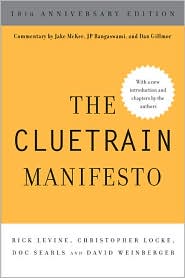
Cluetrain 10th Anniversary edition
Cluetrain 10th Anniversary
Everything Is Miscellaneous
Small Pieces cover
Small Pieces Loosely Joined
Cluetrain cover
Cluetrain Manifesto
My face
Speaker info
Who am I? (Blog Disclosure Form) Copy this link as RSS address Atom Feed

January 9, 2007

Freedom to Connect…now on sale!

Tickets to David Isenberg‘s Freedom to Connect conference, March 5-6 in DC, with Yochai Benkler as the keynoter, are on sale for $250 until Jan. 15. (Disclosure: I’m a speaker so I get in for free.) [Tags: david_isenberg f2c net_neutrality]

Tweet
Follow me

Categories: Uncategorized Tagged with: digital rights Date: January 9th, 2007 dw

Be the first to comment »

[berkman] Susan Crawford

Susan Crawford is giving a lunchtime talk on the Internet and the project of communications law. [As always, I’m paraphrasing and getting things wrong.]

When Susan was in DC practicing law, the FCC began assuming it had the right to regulate what it calls “IP-enabled services.” This over-extended the FCC’s reach, way beyond telecommunications.

There are two completely different visions of the Internet, Susan says. To the communications industry, it’s a distribution system premised on scarcity. From the Nethead point of view, the Net is an agreement about how to communicate.

She begins by making five points. [These are cribbed pretty much from her slide, with some additions.]

1. First generation communications law focused on infrastructure optimized for particular uses.

2. Now a single pool of digital data is replacing former communications modalities. Users are indifferent to the transport mechanism.

3. Economic growth is triggered by new ideas and diversity.

4. The Internet is an unparalleled idea-generation engine.

5. So, it’s time for a new conception of communications law. In particular, we should begin thinking about separating the transport layer from the rest. This would be a big change.

The Internet is blurring categories, she says. Convergence has already arrived. But the incumbents are fighting back. They’ve convinced the FCC that highspeed access is not a common carriage service. They want to maintain their old services as they move to the Net. So, for example, they define IPTV as a special service, not just one more set of bits moving through the Net. The Supreme Court has agreed with them. Now they’re selling bundled services, which is what they think of as “convergence.” And they’re convincing Congress that they need to monetize Internet access to make it worth it to them, she says.

But, the facts on the ground seem to show users have a different view. Users think of the Net as a single pipe that brings lots of different types of services, not as separate services. (The exception, she says, is telephone service, although I think VOIP will get users over that.) Netheads think of the bits-over-pipes service as a commodity, while the telcos think they’re providing services such as pay TV, telephony, etc.

This is becoming particular acute because of the consolidation of providers.

“Current theorists,” she says, focus on “new ideas as the source of growth.” We should be trying to increase the Internet’s ability to generate new ideas. And not just for new applications. The ideas that could emerge are unpredictable and could be profound and transformative.

“I am an Internet exceptionalist,” she says. The Net is different. It’s not “just like” a railroad or “just like” a cable system. For one thing, it is a complex system. Order emerges from the complex interactions of individuals. We can’t control what will emerge and we shouldn’t try to because it will reflect our interests.

What is the role of regulation? Communications law can have a dampening effect on communication and creativity because it enshrines gatekeepers and prioritizes security. We should try to convince the regulators of the potential of economic growth by not regulating. (But she is willing to use taxation to affect social goods such as providing universal access.)

We should prioritize diversity, avoid rigidity and randomness, facilitate feedback, and have the merits arguments drive policy (rather than “following the money”)…but it’d take another FDR for this sea change to occur.

Q: Isn’t there scarcity in building the last mile of networks? Not anyone can dig a hole to my house.
A: Yes, that is scarcity and that’s why I want the government involved in the build out.

Q: Isn’t spectrum scarce?
A: Smarter devices enables more signals. But in the “whitespaces” procedure at the FCC, considering what to do with newly-opened frequencies, the FCC seems to have changed its mind and now is saying we have to “protect” TV signals even though fewer of us than ever get our TV signals over the air.

Q: (me) I agree that the right solution is to structurally separate the transport layer, but even the Net Neutrality folks (like me) settle for a milder compromise, talking about non-discrimination. And if the layers were separated, the telcos wouldn’t even be the right ones to provide this commodity service because they’re structured to sell services (as Bob Frankston says). There seems no political will for doing the right thing.
A: Not yet. But it’s like the creation of the TVA under FDR.

Q: (Ethan) But who was the TVA displacing?
A: I resist the notion that because the incumbents are so entrenched now, our hackles won’t be raised when we get envious of Japan and Estonia. Someone has to be optimistic.

Q: (me) Who in public life supports this?
A: Sen. Ron Wyden’s office maybe, sort of. But there’s not a lot of support among those in public life. [Whoops, I got this wrong. See Susan’s correction in the comments. It apparently goes no further than a conversation she had with a Wyden staffer who was open to considering it. Something like that.]

Q: Might wireless wrest control away from the telcos?
A: Exactly.

Q: In the developing world, you end up compromising in order to provide some needed service while allowing competition in other areas.

Q: (Andy Orem) The growth of wimax will help.
A: Yup.

Q: (me) Why?
A: Wimax breaks down the walled garden. [We’ll use big-range wimax instead of the cellular network.]

Q: Anyone talking about extending the school day by requiring schools to provide online materials to be used at home [which would drive policies for universal access]?
A: Interesting.

[Tags: susan_crawford fcc telecommunications wifi wimax berkman]

Tweet
Follow me

Categories: Uncategorized Tagged with: digital rights Date: January 9th, 2007 dw

2 Comments »

Somalia bombing – more than meets the eye (and meets the media)

I just had the good fortune to be able to ask Ethan Zuckerman about the Somalia air strikes and got an amazing 15-minute controlled rant. Wish I’d taken notes. Anyway, despite the way it’s being reported, this is not a simple in-and-out revenge strike on bad guys. It is a move in a complex political struggle over the future of that area of the world. (Yes, I am naive enough to have thought otherwise.) For more, begin by searching on Ethan’s site for the category “africa,” and see this article and this one. [Tags: africa ethiopia somalia terrorism ethan_zuckerman]

Tweet
Follow me

Categories: Uncategorized Tagged with: globalvoices • peace • politics Date: January 9th, 2007 dw

2 Comments »

Thunderbird’s hanging folders

Lately, Thunderbird (1.5.0.9) has been hanging when I try to open particular folders. Eventually, it crashes. I think I know why, and I seem to have fixed it, but please note that I am an incompetent Thunderbird repairperson. I don’t know what I’m doing. Following in my footsteps is likely to bring you to wrack, if not to actual ruin.

Are we clear on the disclosure? Good.

So, I noticed that the hanging folders had .msf files that were zero-length. I believe the msf folders contain the metadata about the display of the contents of the folders. I believe they do not contain the actual messages. So, I deleted them and restarted Thunderbird, forcing Thunderbird to rebuild the metadata.

If you’re an XP user, you’ll find your msf files, and the rest of the contents associated with your Thunderbird profile, at C:\Documents and Settings\User_Name\Application Data\Thunderbird\Profiles\Jibber_Jabber\Mail\ (where User_Name=your user name and Jibber_Jabber=a random string Thunderbird generates).

It seems to have worked. And if you try it, it’s likely to cause your computer to fuse its solenoids or display only unsolvable Sudoku puzzles. [Tags: thunderbird msf ]

Tweet
Follow me

Categories: Uncategorized Tagged with: tech Date: January 9th, 2007 dw

3 Comments »

Wiki chapter and cover

Joseph Jaffe is asking us all to wikily create a chapter of his new book, “Join the Converation: How to engage marketing-weary consumers with the power of community, dialogue and partnership.” The chapter is on “Why are you so afraid of conversation?” He’s also inviting people to submit ideas for the cover design. (Personally, I think it’d be more fun to write the author’s acknowledgements or cover flap biography :) [Tags: marketing joseph_jaffe wiki]

Tweet
Follow me

Categories: Uncategorized Tagged with: everythingIsMiscellaneous • marketing Date: January 9th, 2007 dw

Be the first to comment »

January 8, 2007

Ethan on Second Life’s open sourcing

If you want to understand what Second Life’s open source announcement means, go directly to Ethanz’s blog… [Tags: second_life open_source ethan_zuckerman ]

Tweet
Follow me

Categories: Uncategorized Tagged with: everythingIsMiscellaneous • tech Date: January 8th, 2007 dw

Be the first to comment »

When the world is flat, German blogs get sued in China

Thomas Knüwer of Handelsblatt posts about a German blog, autoregional.de, that posted a link to a story in Der Spiegel about a German bus producer suing a Chinese company for stealing a bus design. Autoregional, which is produced by the SEO company Iven & Hillmann, cited the Spiegel article and added a single sentence: “This example shows how fast and ruthless Chinese are when it comes to copying.” So, now Iven & Hillmann are being sued for libel for hurting the Chinese company’s business. As Thomas points out, the offending sentence in the Autoregional post is less hurtful to the Chinese company’s business than the headline in Die Welt: “Chinese steal bus design…” He guesses that Autoregional is getting sued while Die Welt is not because Die Welt is big and Autoregional is little. [Tags: blogosphere libel germany autoregional copyright gv]

Tweet
Follow me

Categories: blogs Tagged with: blogs • digital rights • everythingIsMiscellaneous • globalvoices • marketing Date: January 8th, 2007 dw

1 Comment »

Surge math

(More troops) + (exit plan for those troops) = Surge

(More troops) – (exit plan for those troops) = Escalation [Tags: politics surge]

Tweet
Follow me

Categories: Uncategorized Tagged with: politics Date: January 8th, 2007 dw

1 Comment »

Daylife inside out

I’ve poked around with Daylife.com some more (my first impressions are here) and have found that the more I poked, the more I’ve liked. I think I know why some people have reacted negatively to it: Daylife is built inside out.

If you want to see what’s very cool about Daylife, skip the front page (the cover story) and the second page (the list of ten top stories) and go straight to a topic page. Let’s say the headline “Critics say surge is more of the same” on the list of top stories strikes your fancy. Click on it. Now you’re at a page about that story. It’s got a snippet from the story, a big pull quote, photos, and related news stories. It’s a busy page and it doesn’t do exactly what I’d like: Show me lots and lots of articles on the same topic. But we’re still not at a topic page. To get there, click on the photo labeled Nouri al-Maliki. Now we’re on a topic page, this one devoted to the prime minister of Iraq. It’s got a whole bunch of stuff to look at, attractively laid out, including snippets from the news wires; articles from today, from this week, from this month; a photo gallery; a quotation; a chart of mentions in blogs and the press; and a list of linked people, places and organizations. What’s not here: An explanation of who Nouri al-Maliki is, a biography, a link to an article about the structure of the Iraqi government, etc. Right now, DayLife is a news site that aims at giving context through links, but the context for news isn’t only more news. A lot of this could be fixed by sucking in (and of course linking out to) Wikipedia content.

But, keep clicking because DayLife gets more interesting the more you click. So, click on one of the linked people. (First, click on the “see the connection” link to see why that person is on al-Maliki’s page.) Let’s try Jalal Talabani. Now we’re on Talabani’s topic page. It’s laid out the same as al-Maliki’s, yet now, for the first time, you (well, I) get a sense of what DayLife is really up to. I can browse in any direction and be certain I’m going to get relevant stuff. The homogeneity of the topic pages means that you don’t have to learn many ropes to swing through the vines.

But there’s more. The topic pages default to the “overview” tab. Instead, click on the “Players” tab. This takes you to a much less finished page that lists people, organizations and places somehow related to Talabani. Simple, but a useful way to browse. (Nit: The pages the tabs lead to lose the tab widget; instead they have a link taking you back to the overview page. The tabs ought to stay in place. That’s why they’re tabs. Ok, DayLife prominently declares itself to be in beta.) That’s what makes DayLife’s pulse pound: Lots of ways to browse.

So, here are my suggestions to DayLife:

1. Right now, because the site takes you to the cover page, and from there to the top ten, it looks like a news aggregator. But it’s weak as an aggregator, at least so far. It doesn’t show you enough news, the news doesn’t update frequently enough, it doesn’t let the user customize it to her interests. For a quick gulp of what’s new, I’m not switching from Google News. Instead, DayLife should aim at enticing us to the topic pages. That’s where the real value is, imo. One way to get us there is to show us a big gulp of the news right off, and quickly get us to the topic pages by featuring their presence. And then get us to come back (well, sort of) by giving us topic feeds, or at least topic alerts.

2. Enhance the topic pages. They’re off to a good start, but they need more than news. We want to understand the news, and for that we need static background materials. And discussion pages so we can educate one another. (Nit: The topic pages about places could also use some maps.)

3. I’m surprised, given the site’s pedigree, how little user contribution is allowed. Not only is there no commenting or tagging, blogs seem to play a small role in the content presented on the site. I don’t understand that. (Conspiracy theory: Is DayLife looking to be acquired by the NY Times, whose topic pages DayLife handily beats in terms of intertwingularity?)

4. We need more of an ability to customize the site. Let us choose a front page that matches our interests; I still think that the best aggregators will let us filter our news through a social network. We should also be able to save topics to “my world” (in addition to the stories, searches, photos, people, places and organizations you can already save); saved searches would let us hack this if there were an advanced mode that let us mash up various types of searched-for objects. Etc.

As it stands, there’s a powerful engine of miscellany running under Daylife. It’s buried inside a front end that, while appealingly presented, doesn’t expose the site’s real utility and power. It should go inside-out, the way Clark Kent does when he’s at his best.

File this under “It’s easy for me to say.”

[Tags: daylife news media everything_is_miscellaneous it’s_easy_for_me_to_say]

Tweet
Follow me

Categories: Uncategorized Tagged with: everythingIsMiscellaneous • media • taxonomy Date: January 8th, 2007 dw

1 Comment »

Order of magnitude quiz: Boob jobs

In 2005, how many breast enhancement surgeries were performed in the U.S., excluding reconstructive ones? (Source: Boston Globe)

Getting this answer right means getting it within an order of magnitude.

The answer is in the first comment. [Tags: puzzles medicine surgery]

Tweet
Follow me

Categories: Uncategorized Tagged with: puzzles Date: January 8th, 2007 dw

9 Comments »

« Previous Page | Next Page »


Creative Commons License
This work is licensed under a Creative Commons Attribution-NonCommercial-ShareAlike 3.0 Unported License.
TL;DR: Share this post freely, but attribute it to me (name (David Weinberger) and link to it), and don't use it commercially without my permission.

Joho the Blog uses WordPress blogging software.
Thank you, WordPress!