


logo
EverydayChaos
Everyday Chaos
Too Big to Know
Too Big to Know
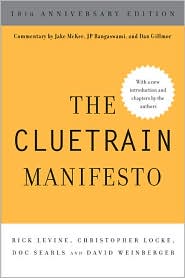
Cluetrain 10th Anniversary edition
Cluetrain 10th Anniversary
Everything Is Miscellaneous
Small Pieces cover
Small Pieces Loosely Joined
Cluetrain cover
Cluetrain Manifesto
My face
Speaker info
Who am I? (Blog Disclosure Form) Copy this link as RSS address Atom Feed

December 5, 2006

Ethanz on Cass Sunstein

Ethan Zuckerman has a brilliant review and consideration of Cass Sunstein’s Infotopia, a book I have not read but now look forward to even more. Sunstein’s previous book, Republic.com, gained notoriety for arguing that the Net tends to polarize opinions. (I am way over-simplifying.) Infotopia takes a closer look at the economy of knowledge on the Web. Sounds terrific. I wish I had been able to include it in what I say about Republic.com in Everything Is Miscellaneous…all part of the seven months of regret between when an author turns in a book and when it is available in print. [Tags: cassw_sunstein ethan_zuckerman infotopia everything_is_miscellaneous ]

Tweet
Follow me

Categories: Uncategorized Tagged with: digital culture • everythingIsMiscellaneous Date: December 5th, 2006 dw

1 Comment »

[berkman] StopBadware

Christina Olsen is giving a Tuesday lunch talk at the Berkman Center. She says that StopBadware.org is “neighborhood watch for the Internet,” finding sites you want to avoid. It’s based theoretically on Jonathan Zittrain‘s work on generativity. JZ favors open PCs and and open network, but the openness also means that bad actors can create badware that may create a backlash and a demand to lock down PCs or put gatekeepers in place. To avoid that, StopBadware.org addresses the badware problem. [[Disclosure: I’m an advisor to SiteAdvisor.com].

StopBadware has a set of guidelines that defines badware as an application that acts deceptively or irreversibly (e.g., an app that installs sw you don’t want and/or provides no way to uninstall it), or that “engages in potentially objectionable behavior” without first requiring the user to opt in with the full facts presented to her.

StopBadware creates reports based on data from its partners. There’s also a community that provides data. They are aiming at having a distributed app that draws on the “wisdom of the crowd.”

Google filters its search results and sends people to StopBadware.org for more info about dicy sites that turn up in search results.

In 2006, StopBadware developed 24 in-depths reports and 414 quick reports on badware hosting sites. They received 2,658 badware story submissions from the community. There are 618 people in the discussion group. in 2007, StopBadware wants to do 2 in-depth reports per week, and organize the community to generate more quick reports. They also want to bulid the tech community around the badware issue.

More specifically, StopBadware is hoping to:

Implement XML-based reports…more details, more semantics. “Continue the development of automated crawling and malware detection of submitted applications.”

Increase automation throughout the process. It should be easier to submit suspected badware and easier to appeal. More partnerships.

Localize reports for non-English speakers. Integrate with Firefox

The “wisdom of the crowds” app draws on the experience of the user community. It involves a downloadable piece of software that looks to see if a user’s website contains badware.

Christine raises to this group what the principles should be for the appeals process, and what are the criteria for being “happy” with a user experience.

Q: (a cowboy) People get more frustrated when computers work as they should then when they work as they shouldn’t. The subjective experience is much more powerful than the objective one.

Ethanz responds that the people who are likely to download the distributed app are a self-selected, technical group. (Someone jokes, “Wouldn’t it be great if there were a way to put the app on people’s desktops without them knowing…maybe if they just are downloading a Jessica Simpson screensaver…”)

A very interesting conversation follows, but I stopped typing… [Tags: stopbadware badware viruses malware berkman]

Tweet
Follow me

Categories: Uncategorized Tagged with: uncat Date: December 5th, 2006 dw

3 Comments »

Net neutrality is clear

Ack. Doc just pointed out to me that I’m cited in the second paragraph of the current Wikipedia article on Net neutrality. Here’s how the article begins:

Network neutrality is a general principle of Internet regulation which states that a network is neutral if it satisfies all application needs equally. For example, a perfectly neutral network would not give better service to some web sites than others, and it is argued that it would likewise not favor web-surfing or blogging over online gaming or Voice over IP. It is also guided by the assumption that the public good is maximized by limiting Internet innovation to the edges, where things are often easier to change, rather than the core of the network.

However, it has no completely precise, agreed-upon meaning. One prominent net neutrality advocate, Cluetrain Manifesto author David Weinberger, expresses frustration at his attempts to reach a precise understanding: …I recently spent a day—sponsored by an activist think tank—with a dozen people who understand Net tech deeply, going through exactly which of the 496 permutations would constitute a violation of Net neutrality. Caching packets within a particular application area but not according to source? Caching application-based non-cached application-based packets? Saying “Hi” to all passing packets, but adding, “Howya doin’?” to only the ones you like? Patting all packets on the back but refusing to buy some lunch? The whole thing makes my brain hurt.[1]

Here’s what I just posted to the article’sdiscussion page:

FWIW, I agree that the paragraph that cites me should be edited out. It is unencyclopedic. It also is used to make a point that it in fact does not support. The fact that it’s challenging to work out the precise application of NN in some instances doesn’t mean that the meaning of the principle itself is unclear. It’s tough to figure out exactly how to apply, say, affirmative action, gay rights, or the end-to-end principle, but it’d be highly misleading to start an article on them by saying the principles are unclear. It’s the nature of principles to require thought, argument and politics in their application. So, I hope someone removes that paragraph.

(Here‘s my original post.) [Tags: net_neutrality wikipedia politics]

Tweet
Follow me

Categories: Uncategorized Tagged with: digital rights • politics Date: December 5th, 2006 dw

6 Comments »

December 4, 2006

Egyptian Good Night and Good Luck

Global Voices runs (and translates) Mohammed Hisham’s post urging Egyptians to see George Clooney’s Good Night and Good Luck because, he says, it describes Egypt today. It’s apparently a movie with unfortunately wide application… [Tags: gv egypt]

Tweet
Follow me

Categories: Uncategorized Tagged with: politics Date: December 4th, 2006 dw

1 Comment »

December 3, 2006

[rootscamp] Four reasons why RootsCampDC was a really, really good event

1. Interesting discussions all over the place.

2. People working for progressive change for the sake of others, aware of the possibilities of the Internet not only for making them more effective, but for invigorating our democracy.

3. A community that has not come together quite this way before.

4. The possibility of real change in the real world for real people. [Tags: rootscamp rootscampdc politics]

Tweet
Follow me

Categories: Uncategorized Tagged with: conference coverage • politics Date: December 3rd, 2006 dw

1 Comment »

[rootscamp] Net neutrality

About twenty people are at this session, evenly split by gender. Sentiment in the room is definitely pro Net neutrality, although we probably don’t all agree about what exactly it is. Many in the room are activists on the issue, from the political side more than the technical side. Nancy Scola, the moderator, is interested in how the issue of Net neutrality might be used to energize progressives. I think everyone agrees that we’re not good enough at explaining that the issue is. [I’m paraphrasing and taking notes. I’m missing much and undoubtedly getting things wrong. Sorry.]

Noel from New York says it’s a civil rights issue. “We’ve moved into a digital age.” When we entered the industrial age, everyone got access to the benefits, from indoor plumbing to an expanded range of travel. We need to give everyone the benefits of the digital age, he say6s.

Someone from the DNC says that the civil rights framing is too abstract. When the telcos claim Net neutrality is a form of government regulation, the Hill gets that.

(I say that the response to the carriers’ claim that Net neutrality is the government regulating the Internet should be: “No. It’s about the government regulating you.”)

There’s discussion, kicked off by Matt Stoller‘s comment, about the need to provide Internet as a common good, rather than relying on private industry to provide it. Not everyone thinks this is a practical political approach. Many think that it’s important to see Net neutrality within a broader context.

Steve says that maybe we should make the claim that there’s a right to information. “You can’t have a democracy if you can’t find out what’s going on.”

A woman whose name tag I can’t see says that Democrats ought to have as a core belief that “you don’t outsource public goods.” (Nice phrase. She works on the Hill.)

Corinna says that it ought to be explained to Congress as being about the American dream, i.e., about what’s possible.

Matt says it’s fundamentally about morality.

Julie says that the right way to frame it is to say that something you have is about to be taken from you, rather than saying that we want something we don’t currently have. [Nice point.]

[Tags: rootscamp rootscampdc net_neutrality politics]

Tweet
Follow me

Categories: Uncategorized Tagged with: uncat Date: December 3rd, 2006 dw

2 Comments »

[rootscamp] Why Democratic women challengers disproportionately failed

Few women Democratic challengers won. This session is trying to figure out why. There are about 25 people in the session, more women than men. Marc Laitin of Wired for Change will present data he’s gathered. Then the group will put forward cases and hypotheses so that Marc can adjust his statistical model. The aim is to figure out why women did so badly, because, as Jackie Bray says, the solution can’t be to run more men.

Marc’s data show there was definitely a skew against women challengers. But is this what always goes on? There’s some historical analysis that shows, surprisingly, that being a female has not worked against candidates. If so, then something was going on this year. This year women raised more money than man. But women did even worse in close elections.

The discussion is often arcane (to me) about political factors I’ve never heard of. Some I do understand: Was security the dominant issue in these issues? Did the National Repulican Congressional Committee target these races? Was the advertising especially negative? Were conservative Democratic women recruited? Were women with particular types of credentials recruited? How many had held office before? What do the campaigns say were the causes of their loss? Are there commonalities among the voters? Did women fare worse with independents? Is there any correlatio wit the Republican women who lost? Anything about the primary? Many many more factors are raised…

I ask if statistical analysis is the right way to go given the relatively small sample and the number of possible influences. Marc (who has an admirably warm and serious demeanor) answers that there’s plenty of qualitative work to do, and it’s undoubtedly being done, but statistical analysis may surface information otherwise hidden.

Jackie ends by saying that the women’s loss is a part of the story we need to be telling.

Fascinating. [Tags: rootscamp rootscampdc politics women democrats]

Tweet
Follow me

Categories: Uncategorized Tagged with: conference coverage • politics Date: December 3rd, 2006 dw

5 Comments »

[rootscamp] RootsCamp and coalitions

I’m at the second day of a Bar-style RootsCamp in DC. (Bar camps are unconferences, initially inspired by FOO camp.) It looks about 200 people are here today at the space made available by the National Education Association. It’s generally (entirely?) a progressive group. Young. Well-mixed by geneder, not as well by race. Some political consultants but mainly (I think) organizers…hard-bitten optimists.

The big schedule board up in the hall is pretty much full with topics ranging from experiences using electronic tools to help labor organize to a discussion of why Democratic women candidates did not fare well.

I’m at a session about coalition building. People from America Votes are at the head table. America Votes is a coalition of 32 progressive organizations, including Emily’s List, Sierra Club, Planned Parenthood and MoveOn.org. Its inaugural year was 2004. But the organizers don’t want the session blogged so that the exchange can be frank. (Official notes wil lbe posted.) [Tags: rootscamp rootscampdc politics ]

Tweet
Follow me

Categories: Uncategorized Tagged with: conference coverage • politics Date: December 3rd, 2006 dw

Be the first to comment »

December 2, 2006

My brother’s honor, and takin’ the midnight train

I’m in NJ tonight for my brother’s award ceremony. He’s Rheumatologist of the Year, an award he earned by caring about his patients and not processing them like flounder. He’s also the most ethical person I’ve met and damn smart, too. He’s getting an honor he richly deserves. (Yay, Andy!)

Then I take the 3:20am train from Newark to DC for Day 2 of the RootsCamp unconference. If you’re there, I’ll be easy to find: I’ll be the incredibly cranky old man in the corner. [Tags: andrew_weinberger rootscamp]

Tweet
Follow me

Categories: misc Tagged with: misc Date: December 2nd, 2006 dw

Be the first to comment »

December 1, 2006

Web of Ideas: Being and Tags

On Monday, I’m trying out a talk I’ll be giving at the U of North Carolina a few days later. The talk is called, for now, in a doomed attempt to be slightly light-hearted about it, “Being and Tags. Here are the five sections (not counting the zero-based prologue):

0. Three orders of order
1. Tiny tags
2. Are taxonomies real?
3. Can tags be wrong?
4. The miscellany beneath
5. Tagging meaning

The section that particularly worries me is #2—Perhaps you’ve heard that there is no one true taxonomy?— mainly because I think it argues against a position no one really holds. But I can’t tell any more.

I’m also worried about the presentation style. I’m trying to be more precise than usual, so I’ve written out a talk, tightly integrated with Powerpoint—yes, Powerpoint, dammit!—with tons of animations. While I carefully prepare presentations, I never read them from a script. Except for this one.

The whole thing is headed for disaster.

Although the Monday night talk started out as one in my Web of Ideas discussion series, it’s been assimilated into the Harvard-Yale Cyber Scholars series. So, at 6pm you can here Yale’s Shyam Balganesh talking about “Social Costs of Property Rights in Broadcast.” I’m on at 7pm. We’re serving Indian food. It’s open to everyone. [map] [Tags: tags taxonomy everything_is_miscellaneous berkman philosophy aristotle]

Tweet
Follow me

Categories: Uncategorized Tagged with: everythingIsMiscellaneous • philosophy • taxonomy Date: December 1st, 2006 dw

4 Comments »

« Previous Page | Next Page »


Creative Commons License
This work is licensed under a Creative Commons Attribution-NonCommercial-ShareAlike 3.0 Unported License.
TL;DR: Share this post freely, but attribute it to me (name (David Weinberger) and link to it), and don't use it commercially without my permission.

Joho the Blog uses WordPress blogging software.
Thank you, WordPress!