

logo
EverydayChaos
Everyday Chaos
Too Big to Know
Too Big to Know
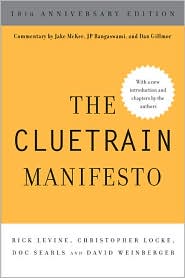
Cluetrain 10th Anniversary edition
Cluetrain 10th Anniversary
Everything Is Miscellaneous
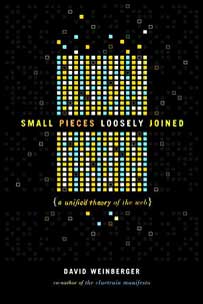
Small Pieces cover
Small Pieces Loosely Joined
Cluetrain cover
Cluetrain Manifesto
My face
Speaker info
Who am I? (Blog Disclosure Form) Copy this link as RSS address Atom Feed

October 10, 2006

[berkman] Dan Burk on Open Source science

Dan Burk from U of Minnesota Law School is talking about open source science. [As always, I’m paraphrasing at best.]

He notes some strands of open sourciness. 1. Open Source Genomics saw a clash of the scientific and hacking cultures. 2. Open Source patenting wonders if what worked for sw could work for biotech licensing. 3. Cyberinfrastructure (= e-science), i.e., use of networks to do collaborative science, enables transborder collaboration.

Dan looks at scientific norms as proposed by Merton: Communalism, universalism, independence, organized skepticism and originality. Not that science always achieves this ideals, he says. But if you follow these norms, you get scientific reward, including the respect of one’s peers. in the 1980s, Rebecca Isenberg, among others, pointed to the “intellectual property” system as providing another set of rewards: Money. But that can require secrecy and exclusion, which works against the reputational reward. Patents at least require disclosing what you’ve learned, as opposed to trade secrets. The Human Genome Project in the ’90s started patenting snippets of DNA. They agreed to “Bermuda” rules, making info public within 24 hours.

The new cyberinfrastructure that enables e-science is Internet- and grid-enabled. People share the info through collaboratories (virtual environments). But whose patent law applies to something discovered in a virtual world? The US assigns inventorship based on where you’re located, which is hard to apply. An agreement beforehand would help. Open Source licensing might be a model.

There are two justifications for Open Source coding: It’s practical because it flushes out bugs, and it’s moral. To keep it from being captured, licenses travel with the code with norms that are similar to the scientific norms: Communal, reputational rewards, no forking, leadership, and licensing strategies. Can bio-med sciences adopt this licensing scheme? A couple have tried: the Haplotype Mapping project uses OS-style licenses. The BIOS project makes physical tools (enzymes) and requires you to contribute back to the system any improvements of the tools you make, although you can patent what you make with the tools. The Science Commons uses OS-style licenses for literature.

Dan points to unsettled issues about patents that could be a problem for open science. There’s patent pooling, reverse “reach through” licenses and reverse “grant backs.” Are some of these licenses intended to discourage patents, which the US would consider a bad thing?

There are also cultural impediments, he says. “Science has a much more structured set of institutions than Open Source generally does.” There are universities, funding agencies and labs who have interests in what gets developed. There are also systemic differences: Peer review, publication, scientific societies.

Q: Say more about the patent misuse question
A: A patent gives someone exclusive rights in order to promote progress, to have an incentive, to recoup the investment. The assumption is that that’s good. It will spur science. If you license your patents in a bad way—charge for a license beyond the term of the patent, e.g.—your patent gets curbed. If an OS license says that you can’t patent anything you discover with it, you’re using your patent to discourage patents and it might count as a misuse. SCO said OS discourages the development of “intellectual property.” That argument didn’t go anywhere, but it’s still lurking there. Robin Feldman has a good paper on this. She thinks these licenses could be pro-competitive.

One of the strategies is to forbid patents of developments within the area of the original patent but allow patents for developments outside of that area.

Q: Is there a fundamental difference between the innovations that should be promoted by OS and those promoted by patents and the proprietary?

A: We don’t know but that may be the case. One of the things to worry about is whether open approaches are self-sustaining. The examples in Yochai Benkler’s The Wealth of Networks are of people funded by their business or university.

Q: (me) Assuming we’re going to have both OS and proprietary science, how do the ambiguities get resolved?
A: We’ve had both systems for a long time: Patents and reputational reward. Now they’ve intersected. Generally they accommodate each other. Biomed scientists are figuring out that if they want the reputational reward they have to do X, if they want the patent they have have to do Y. If you view OS as an extension of that (and remember, he says, that the hacker mentality comes out of universities, just as reputational science does), it seems to be working. OS has been around for a while and we really don’t have any cases, outside of a case in the Netherlands last year. OS licenses seem to be enforceable. We may not get decisions quickly. For one thing, business cares about making money, not so much about “intellectual property” for its own sake. There aren’t that many “IP” cases and it may be the same in this area. Also, typically you don’t get a lot of action in the “IP” area until there’s a lot of money at stake. So far, there isn’t. There will be, though. Patent litigation costs $5-10M, so something worthwhile has to be at stake.

Q: Joseph Stiglitz (sp) has shown that prizes work well as incentives.
A: It’s interesting but contested work. In some situations it may well work, in many it won’t, and we’ll have to figure out those situations are. This was Alexander Hamilton’s approach. He liked the French idea of having a system of prizes instead of patents.

Q: How is the scientific culture changing?
A: There seems to be a gender difference in how scientists group. The big divide is between academic and commercial researchers. To get scientists out of academic into commerce, employers have had to provide some of the openness they’re used to in the academy. But the more a commercial scientist wants to join an online group or a collaboratory, there’s more risk of trade secret leakage.

In conversation, Dan recommends a site about an upcoming conference on cyberinfrastructure.

[Tags: science open_science open_source dan_burk berkman patents]

Tweet
Follow me

Categories: Uncategorized Tagged with: uncat Date: October 10th, 2006 dw

3 Comments »

October 9, 2006

Google Map fun

google map of anytown, usa-searchbox
google map of anytown, usa
Anytown, USA

google map of nowhereville, usa-searchbox
google map of nowheresville
Nowheresville

Tweet
Follow me

Categories: misc Tagged with: misc Date: October 9th, 2006 dw

1 Comment »

Two new books

Charles Leadbeater—the author of an early book on the new economy, the “deviser” of Bridge Jones’ Diary, and an advisor to prime ministers—has posted a complete-but-not-final draft of his new book, We-think: why mass creativity is the next big thing. You can read the whole thing on line and comment on every line. (It’s got a cool commenting system attached.) I’ve thumbed through it, and it looks like it’s got tons of good examples of what the new collaboration looks like.

And The Guardian has run a great excerpt from Steven Levy’s upcoming book, The Perfect Thing: How the Ipod Shuffles Commerce, Culture And Coolness. Levy makes the question of the Ipod’s randomness not just interesting but fascinating. He’s a heck of a writer. [Tags: charles_leadbeater steven_levy everything_is_miscellaneous]

Tweet
Follow me

Categories: Uncategorized Tagged with: digital culture • everythingIsMiscellaneous Date: October 9th, 2006 dw

2 Comments »

John Lennon’s looks

I’ve never gotten over John Lennon. I still can’t listen to his music without choking up. As the media hype his birthday, I was struck this morning by the obvious fact that, in addition to everything else, he looked so cool. Image after image.

Is that the least of it? Yes, but an integral aspect of the most of it. [Tags: john_lennon beatles]

Tweet
Follow me

Categories: misc Tagged with: misc Date: October 9th, 2006 dw

3 Comments »

October 8, 2006

DOEP (Daily Open-Ended Puzzle) (intermittent): Marketing

My son and I were distressed to find out that non-tivo-ed tv is still showing ads. So as we watched the five minutes of The Monkees that we could endure—an infuriating and stupid ripoff of The Beatles’ movies—we were forced to see a 30 second ad that showed an attractive young woman sitting on a bench waiting for a bus. “Don’t you wish everything was soft?” the narrator asks as the bench turns into a comfy couch.

1. Can you guess what this ad advertises? No, this is not the open-ended part of the puzzle, although it does give a new meaning to “open-ended.” The answer is in the first comment.

2. Once you’ve checked the answer, if you were in charge of marketing that product, what would one of your television commercials look like? Keep in mind that it has to be suitable for showing on whatever lame-ass cable station shows Monkee re-runs, although I suppose you could pick some other program to sponsor.

3. For extra credit, how might you market it on the Internet, and how would that change what you say about it? [Tags: doep puzzle]

Tweet
Follow me

Categories: Uncategorized Tagged with: marketing • puzzles Date: October 8th, 2006 dw

3 Comments »

Foley timeline

Britt Blaser‘s group has put together a timeline of the Foley affair, which is both informative and a cool widget. [Tags: britt_blaser timeline foley politics misc__]

Tweet
Follow me

Categories: Uncategorized Tagged with: politics Date: October 8th, 2006 dw

Be the first to comment »

October 7, 2006

Me, me, tiresome me

I did a phone-in (well, Skype-in) interview/conversation about journalism ‘n’ stuff with Steve Sloan’s class at San Jose State University. Steve captured it and has posted it. It’s 33:28 minutes long.

And Arjo van der Gaag has posted four short (3 mins or less) videos of my talk about marketing at the MarktPlein conference in Maastricht (1 2 3 4).

Thanks to Steve and Arjo. (And thanks for the ride, Arjo.) [Tags: marketing]

Tweet
Follow me

Categories: Uncategorized Tagged with: marketing • media Date: October 7th, 2006 dw

1 Comment »

The end of the dream

Unfortunately, due to the accelerated pace of the Internet, my political opponents unearthed a fact about my past that looks more damning than it was, I denied it, new evidence showed that I was not being completely forthright, the story mushroomed, and as a result, this morning I reluctantly announce I am no longer a candidate for the presidency of this great land.

My campaign is over, but the dream lives on in the hearts of all of you, my supporters. Your hard work has touched my heart. I have learned so much about America in the long six minutes of my candidacy. I will never forget you.

God bless America. [Tags: politics humor]

Tweet
Follow me

Categories: Uncategorized Tagged with: humor • politics Date: October 7th, 2006 dw

5 Comments »

October 6, 2006

If I were president…

My platform:

Let’s lower our national expectations to something a little more reasonable.

Declare victory in Phase One of the war on terrorism (Operation Big Wounded Bear Swinging Its Arms) and begin Phase Two (Operation Being Smart About It).

End the current superstitious rituals at airport security that any fifteen year old could figure out how to get around. Instead, require every passenger to rub a lucky rabbit foot.

Pass SHANANA: Stop the Hilarious Absurdity: No Acronyms Naming Anything act.

Resuscitate humility.

Stop asking G-d to bless us after every speech. He doesn’t like needy people.

Put the “pro-life” back into “nuclear non-proliferation” by unilaterally scrapping all of our nuclear weapons.

New high priority task for the Army Corps of Engineers: Build drive-in movies. Everyone loves drive-ins.

New policy about gays in the military: “Don’t Ask, Don’t Care. Be Fabulous.”

Start a distributed Peace Corps. Step two: Figure out what that means.

All test drives of SUVs must contain a segment in which they drive under water. (Playing the taped message from Al Gore is optional.)

Tough new copyright law provides works with a full fifteen years of protection…one more than our Founding Parental Units intended.

Printed newspapers by law will have to backdate themselves one day.

Increase national curiosity.

Government offices will use open source software unless they’re being punished.

I’m tired of tough justice. Let’s get some tender-hearted judges on the bench.

Since we’re not trying to turn out standard kids, why do we educate them to pass standardized tests? New option: To get a high school diploma, either pass a standardized test or be a wiseass in public.

I’d be wrong in public. A lot. I’m good at that!

Any senior government official who does not blog has “[bureaucrat]” appended to her title.

Marijuana would be as legal as alcohol, but only until you’re 35. Frankly, after that it’s time to grow up.

Lawrence Lessig gets to work out with Susan Crawford which one heads the FCC and which goes on the Supreme Court.

Secretary of the Internet becomes the first wiki-based cabinet post.

Dick Cheney goes to jail, even if we have to plant something on him.

I will never ever clear brush on vacation. That is my solemn pledge to you, my fellow Americans. [Tags: politics humor]

Tweet
Follow me

Categories: Uncategorized Tagged with: humor • politics Date: October 6th, 2006 dw

11 Comments »

Man arrested for shooting Cheney in the face. Correction: For voicing an opinion

A man joined the crowd around Dick Cheney at a conference in Colorado and told him that he thinks Cheney’s Iraq policies are “reprehensible.” Secret Service officers handcuffed him and charged him with assaulting the vice president. This makes perfect sense since, under new definition of torture as “aggressive questioning,” the man was torturing Cheney.

In other news, President Bush assaulted the Constitutional separation of powers again today, signing a Congressional mandate that FEMA heads be minimally qualified for the job by adding a big “…NOT!” to it in the form of yet another “signing statement.” [Tags: cheney george_bush free_speech signing_statements fema]

Tweet
Follow me

Categories: Uncategorized Tagged with: politics Date: October 6th, 2006 dw

4 Comments »

« Previous Page | Next Page »


Creative Commons License
This work is licensed under a Creative Commons Attribution-NonCommercial-ShareAlike 3.0 Unported License.
TL;DR: Share this post freely, but attribute it to me (name (David Weinberger) and link to it), and don't use it commercially without my permission.

Joho the Blog uses WordPress blogging software.
Thank you, WordPress!
