
logo
EverydayChaos
Everyday Chaos
Too Big to Know
Too Big to Know
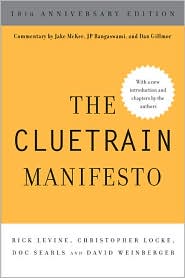
Cluetrain 10th Anniversary edition
Cluetrain 10th Anniversary
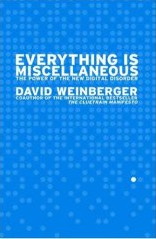
Everything Is Miscellaneous
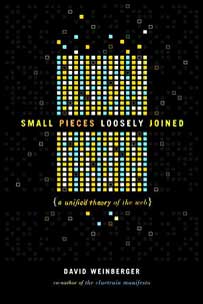
Small Pieces cover
Small Pieces Loosely Joined
Cluetrain cover
Cluetrain Manifesto
My face
Speaker info
Who am I? (Blog Disclosure Form) Copy this link as RSS address Atom Feed

August 5, 2006

[wikimania] Wikis and libraries

Mary Chimato who works in a medical library at SUNY Stonybrook gave a terrific presentation on how she introduced a wiki into her millieu. She reassured people that they could make no mistakes that couldn’t easily be undone. Sounds totally human. E.g., the staff training sessions — which everyone dreads — were Hawaiian themed parties. As people started using the “sandbox,” experimenting with the wiki, others read what they were writing. People discovered interests. People who hadn’t ever spoken found each other. Sounds just perfect. (They use twiki.)

Maureen Clements of NPR set up an internal wiki for the organization’s 750 employees. It started out for news folks, but as people heard about it, it’s gone corporate-wide. It does lots: Helps reporters find experts. Lists (and plays) pronunciations. Tracks previous guests. Briefing books. It’s designed also to help hosts who may have questions such as “How many Republican governors were elected in the last election.” [I hope she went to the Semantic Web presentation yesterday, where the question they used as an example was “How many female mayors of major cities are there?” In a closed system such as NPR’s, a Semantic Web approach makes tons of sense.]

[Great presentations.] [Tags: wikimania2006 libraries wikis wikipedia npr suny-stonybrook]

Tweet
Follow me

Categories: Uncategorized Tagged with: conference coverage • digital culture Date: August 5th, 2006 dw

Be the first to comment »

August 4, 2006

[wikimedia] Semantic Web

It’s a series of speakers. I’m in the back and can’t hear names. The first points to WiktionaryZ, a multilingual dictionary, in alpha. The second points out how hard it is to find and reuse info in Wikipedia. E.g., try to find a list of all the large cities with female mayors. For this, the information in the articles would have to be encoded in predictable ways. At ontoworld.org, they have a experiment going where facts are related to one another using a standard set of relationships (= ontology). This works well [but requires a lot of set-up]. E.g., the computer now can understand that Berlin is within the European Union because it knows Berlin is the capital of Germany and Germany is in the EU. [I’m leaving early to go to another session I want to go to. This session is interesting, though…] [Tags: wikimania2006 wikipedia semantic_web ]

Tweet
Follow me

Categories: Uncategorized Tagged with: conference coverage • everythingIsMiscellaneous Date: August 4th, 2006 dw

2 Comments »

[wikimedia] Lessig

Larry Lessig begins by citing John Philip Sousa’s concern in 1906 that the phonograph would end kids hanging around, singing the old songs together. Larry says he was right. A read-write culture was displaced by a read-only culture. [Paraphrasing, of course.] [The audio of LEssig’s talk is here.]

This is not just about cullture, he says. The Republican party started out believing in free labor. Not unpaid, but free to engage its capabilities as it wants. The return of read-write labor is key to Benkler’s Wealth of Networks and also to Wikipedia.

Same for politics where broadcast politics displaced read-write politics.E.g., the Dean campaign that encouraged people to explain their thinking in blogs.

The 20th Century was weirdly totalitarian: R/O culture, politics and labor.Massiv, massively powerful, controlled, read-only society. But, fortunately, that century is over. The 21st Century is the revival of the read-write.

There are two very new cultures being produced by the Internet. The first is a new kind of read-only culture that facilitates the buying and consumption of culture. Poster child: Apple I-Tunes. Trying to increasingly perfect the power of the copyright holder.

The second is a second culture in which people consume and create. E.g., Anime music video that reedits anime and sets them to music. Larry shows one. It’s a remix. [I worry about the emphasis on remixes. The examples are almost always trivial, even if delightful. Remixes of these sorts aren’t the issue. It’s the subtler absorption of cultural elements that’s the issue.]

Words are the Latin of our time, he says. The vulgar, democratic language is pictures, videos and music. [Which is why Larry focuses on those sorts of remixes.]

The law’s attitude to these two cultures is radically different. Copyright law doesn’t like the R/W culture. It loves the R/O culture. The law’s attitude is that every use makes a copy and thus requires permission. This is made worse by the desire to preserve the business model of the R/O culture. The laws and technology will kill the R/W culture unless there’s resistance.

How to resist? Larry’s first instinct was to litigate. He (we) lost 7-2 when the Supremes said Congress can do whatever it wants with copyright. Instead, Larry decided, we need to ignite a popular movement. We need to take two steps:

First, practice free culture.

Second, enable free culture. Make it possible everywhere, not just in the hacker’s den. Wikipedia is an example. Wikipedia shows that it’s possible.

There are lessons about how this extraordinary potential is possible. There is a proprietary instinct, but we’ve learned that freedom is a bigger, more important value. The Defense Dept. ended the cycle of autistic computing — smart machines that couldn’t communicate — by insisting that computers interoperate. Open, free standards facilitates competition and opportunity. We should remember that lesson as we praftice free culture.

But it’s not enough to build the infrastructure. We have to make it possible. There’s a clear and present danger to this freedom. When they build the locks to protect the R/O Internet, they will lock out the R/W Internet.

At the technical layer: Support free codecs. Support free software that enables free culture.

At the legal layer: Protect free culture. Larry points to Creative Commons as an example. Now there are 140 million link backs to CC licenses.

Larry praises Wikipedia but says he also is here to plea that Wikipedia does what it can to increase free culture. He points to two ways: First, help others spread the practice. He points to the PD-Wiki project (public domain wiki). It will launch first in Canada where a database of all published works is becoming available. From this will come, it’s hoped, a better list of what is and is not in the public domain.

Second, Wikipedians should demand a useable platform for freedom. Free culture products aren’t usually interoperable. We need a layer that facilitates interoperability of content enabling it to move among equivalent licenses. Equivalent = means the same thing. E.g., FDL = CC-BY-SA. Re-licensing would create an ecology of licenses. A market of licenses. The legal layer would become a commodity layer. No monopoly. No single source of failure if a court deems a particular license unworkable. License authors ought to add a compability clause that says that derivatives can be relicsensed under equivalent licenses. The Software Freedom Law Center could be the organization that is the center of this. Even if this isn’t the right platform, Wikipedia could be a strong force for establishing some platform for cultural freedom, says Larry.

[Tags: wikimania2006 wikipedia larry_lessig copyright]

Tweet
Follow me

Categories: Uncategorized Tagged with: conference coverage • digital culture • everythingIsMiscellaneous • media • politics Date: August 4th, 2006 dw

5 Comments »

[wikimedia] Donath and Ma

Judith Donath begins by recommending Orality and Literacy by Walter Ong. [As always, I’m at best paraphrasing. I didn’t do a good job with either of these presentations.]

In oral cultures, you have to be part of a community to get information. Now, the last bastion of information that required connections is being moved into the public. What had been personal information — “Do I like you?” — is becoming public. And we’re building out indentities on line. We need to think about the different types of designs we want for this information.

The nature of authority is changing, she says. At the Britannica, it comes from a complex set of academic credentials. At MySpace commentary, people negotiate issues of personal reputation. at eBay, the reputation system is misleading because it’s really about a public display of acceptance of the other.

How do we design to retain the appropriate amount of privacy? How do we make wikis so that our notions of authroship becomes clearer? How do we make them so that we can evaluate the sources? Right now we’re working in a model that says that the text itself is the primary source of authority. When do we want to enable the emergence of a final form? [What Judith is saying will be affected by the lowering of the markup hurdle and the distribution of WP with the $100 laptop: How well will a pseudonym system hold up when there are a gazillion pseudonyms?]

In a world where attention is a scarce resource, Andy Warhol was right about everyone being famous for 15 minutes, she says. What motivates reality tv and anonymous creativity, since both are about publication, attention, control?

Q: In a time when there’s a superabundance of info, how do people know where to go?
A: There’s a lot of social information wayfinding.

She talks a bit about the difference between pseudonymity and anonymity. Pseudonymity enables identities to be built. Pseudonymity lets people “take on the cost” of having an identity [i.e., it costs you something to be a jerk if you have a pseudonymous identity.]

Q: What does this do to the classroom and educational system?
A: We’ll have to teach students how to function within collaborative space. There are lots of different roles in collaborations.

Now Cathy P.S. Ma of U of Hong Kong is talking about Wikipedia & Trust.

She quotes Fukuyama on trust, disagreeing. [She talks quickly. Sorry.] Social capital, she says, has three components: Network, norms, and sanctions.

The three norms are: Be bold, assume good faith, and adopt a neutral point of view. The sanctions are rewards (barnstar) and punishments.

Open networks are good, she says, so the ideal social landscape for Wikipedia would be members with multiple memberships, with community nodes linked together. She gives some examples of ways of bonding within Wikipedia, including Wiki Embassy and new babes [??].

She talks about the importance of transparency, with conmprehensible rules and norms and increasing the role of social interaction. And how formally should rules be codified at Wikipedia? Explicit rules are more likely to lead to bad decisions, e.g., “Delete any article with the word ‘fuck’ in it.” But implicit rules are hard to implement. What to do? Whatever is done, consistency would be good, she says.

[Tags: wikimania2006 wikipedia judith_donath cathy_ma anonymity]

Tweet
Follow me

Categories: Uncategorized Tagged with: conference coverage Date: August 4th, 2006 dw

2 Comments »

[wikimedia] Jimmy Wales

I’m at Wikimania, the Wikipedian convention/conference. Wikipedians are the core group of somehwere under 1,000 people who put in enormous amounts of time writing and editing. The conference is being held at Harvard Law (thank you, Berkman Center!)

Jimmy Wales, the founder of Wikipedia, starts with the hilarious clip from The Colbert Report where he edits Wikipedia on air because “when enough people agree with something, it’s true.” [As always, all my quotations are likely to be wrong. Which would make me a terrible Wikipedian. Also, I’m posting without re-reading. Be prepared for some baaaad blogging.]

(The MP3 of Jimmy’s talk is here.]

He re-states Wikipedia’s mission:

Imagine a world in which every single person is given free access to the sum of all human knowledge.

He goes through some of the stats on the growth of articles.

He lists the Seigenthaler controversy first among the year’s news. “Apparently, there was an error in Wikipedia,” he says, deadpan. (It was as terrible thing that was said about Seigenthaler, he says.) He notes that after he was dragged onto CNN “to be yelled at,” page views tripled began its rise to triple where it was.

Next he talks about the Nature article that compared about 40 science articles in Wikipedia and Britannica. It showed people that “Wikipedia isn’t rubbish,” and that traditional references aren’t as perfect as people imagine. Jimmy notes that Wikipedia lucked out a bit because it’s strong on science. “If the comparison were on articles about poets, we wouldn’t have done nearly as well.” He acknowledges that many of the humanities articles aren’t where they should be. Also, it was lucky because the Nature study ignored style. Some Wikipedia articles are very well written but some are choppy. Also, because Nature was studying articles of similar length, it didn’t look at “stubs” (i.e., undeveloped articles.” “We aren’t as good as Britannica, yet.” Jimmy says in the coming years Wikipedia needs a “turn toward quality.”

He talks a bit about the Foundation, which is coming along. They’ve hired Brad Patrick as general counsel and interim CEO. Wikia has been funded by angel investors. They;ve hired engineers to inmprove wikimedia.

Jimmy launched Campaigns Wikia for dialgoue and understanding around political campaigns.

He makes some announcements. First, the One Laptop Per Child project (= $100 laptop) will include Wikipedia “as the first element in their content repository.” Second, Wikiversity has been established as a “center for the creation and use of free learning materials and activities,” for all levels and languages. It includes learning communities.

Coming up in the next year, they’ll becreating an advisory board. Also, Wikia is working with Socialtext to a wysiwyg editing environment. (Disclosure) He tihnks it’l lbe big. [Yup. Learning the Wikipedia markup language discourages lots of people from correcting small errors. It’ll be fascinating to see if Wikipedia scales when the markup barrier to editing is removed.]

Jimmy says there should be more of a focus on quality. This past year, Wikipedia has refined its policies on biographies. They’ve also made progress on tagging images and ensuring that Wikipedia only uses fair use images.

He says they’re experimenting with a “stable version,” with an experiment with the German version. iut enables “semi-protection” instead of the full protection against vandalism when needed. Having a stable version would mean that anyone could edit the article but there’d still be a reliable version.

Finally, he goes back to the list of ten things that will be free he talked about at last year’s Wikimania.

Free encyclopedia: Yup, in English and German. Still not doing much for people in developing nations. So, the Foundation should seek funding to hire community coordinators and recruiters for important languages where Wikipedia currently does poorly.

Dictionary: See WiktionaryZ, a multilingual dictionary, should be functional later this year.

Complete curiculum in every language. Wikibooks and Wikiversity Beta. He wants to work with people like Taddy Blecher at Cida City Campus in South Africa.

Q: Please allow vendors to list software and services in the articles about them. (Something like that.)
A: It’s a tough question and people should talk about it.

Q: Stable version?
A: The mistake we’ve made is the one we usually don’t make, which is to wait until we’ve figured it all out before trying it. [Tags: wikimedia2006 wikipedia]

Tweet
Follow me

Categories: Uncategorized Tagged with: conference coverage • everythingIsMiscellaneous Date: August 4th, 2006 dw

1 Comment »

August 2, 2006

What I’d do with Mel

Mel, Mel, Mel. What are we going to do with you, my boy?

I do appreciate your apology and your offer to meet with leaders of the Jewish community. But I think you’ve got it wrong.

But so do the leaders of the Jewish comunity cited by the newspapers who say they first want Mel to go visit some death camps.

Here’s what I would do.

First, Mel, get yourself sober. Do the Twelve Steps. Keep them up. I have trust in your ability to do this. I know you love your family. dlo it for them. (The cited Jewish community leaders agree with this advice.)

Then, skip the death camps for now. If you’re really a Holocaust denier, you won’t be convinced, because you probably believe that some Jews were murdered in the camps, just not six million of us. Besides, the death camp tour is unseemly. Get your ticket stamped at six death camps and you’re cured of anti-Semitism? It don’t work that way. And, frankly, the cited Jewish leaders are confusing being a Jew with being a victim. Your beliefs about the Holocaust are secondary.

The conspiracy theory you use to explain why the rest of the world has been duped about the holcaust is, on the other hand, primary .What’s really dangerous, Mel, is your apparent belief that Jews are diabolical. Your portrayal of us in your pain-porn film did real harm in the world. Even worse is your belief that not only did my folks kill your G-d, but my folks are still the money-grubbing, law-without-heart, unevolved folks your folks outgrew.

So, here’s what I’d have you do, Mel. Screw meeting with Jewish leaders. Put off the death camp tour until it’ll mean something to you other than taking a private jet to a half dozen penitential photo opps. Instead, start going to shul. A little shul like the one my wife and son go to. Hang out there with a bunch of old Yids who wouldn’t recognize you if you came dressed up as Mad Max. They’ll notice you eventually. Explain you’re a Christian interested in learning about Judaism. They’ll half ignore you and half teach you. Maybe stay for some Torah discussion. Definitely try the herring.

Mel, this isn’t the religion you think it is. It’s not Christianity-without-Christ. It’s something really different. And really rather wonderful, even to an agnostic like me and, I’m confident, to a Jew-hater like you. [Tags: mel_gibson judaism anti-semitism]

Tweet
Follow me

Categories: misc Tagged with: misc Date: August 2nd, 2006 dw

10 Comments »

Is this a story? Is this a front page story?

The Boston Globe today has a story by Brian MacQuarrie about a local boy who went to Iraq as a tank commander and came back with nothing below his knees. Well-done story. But what put it on the front page, presumably, is that Sgt. Walter Fountaine “now considers the war a military quagmire…” And a week ago, Pres. Bush chatted with Fountaine at the hospital, although the issue of the war did not arise.

Why is this a story at all? There are elements of a war that can only be understood by telling individual stories. The Globe, like all newspapers, tells those stories on occasion. Sometimes it tells them well, as in this case. No one is typical, of course, but without reading about individual soldiers and civilians, we can only see a war through a high-altitude bomb site. Without the summaries, we are blind, but the war cannot be understood only in summary. The legless boys, the burned children, the purple-inked voters are more than their aggregation into an overview.

Why this soldier? Why front page? Because Sgt. Fountaine is now against the war? And if he had come through his experience thinking that his sacrifice was worth it, would that have consigned the story to an inner page? What do we learn from Sgt. Fountaine’s change of heart? Does it point to a trend? If not, if it’s so purely particular and individual, then why is it the headline?

We need individual stories. We need overviews. But in choosing to put this particular story on the front page with a headline and lead focusing on Sgt. Fountaine’s change of heart, the Globe uses his story inappropriately. IMO. [Tags: media iraq boston_globe]

Tweet
Follow me

Categories: Uncategorized Tagged with: media Date: August 2nd, 2006 dw

8 Comments »

The Reluctant Mr. Darwin

David Quammen’s The Reluctant Mr. Darwin puts Darwin into his personal and intellectual context so we can see exactly what he started with and what he gave us. Quammen is particularly interested in the many years between Darwin’s basic insight and the publication of his basic insight. He vividly tells the story of Wallace’s coincident insight and how that prompted Darwin at last to let his idea out.

Quammen contextualizes the ideas superbly and he tells the story engagingly. It’s a page turner and a surprisingly good summer read. [Tags: darwin science david_quammen evolution]

Tweet
Follow me

Categories: Uncategorized Tagged with: everythingIsMiscellaneous Date: August 2nd, 2006 dw

Be the first to comment »

August 1, 2006

Who aggregates

A cool whiff of reality has apparently blown through the Washington Post offices. They announced yesterday that they’re going to start including links to other sources in their online articles, even to competitors. That’s great. It brings real value to their pages, value that users otherwise will seek elsewhere.

So, hats off to the WaPo. Long term, though, I wonder if we’re going to look to the newspapers, third parties, or one another as our aggregators. In any case, we’re going to want newspapers to recognize that their stories, no matter how good they are, gain yet more value when they come with links that point us to more and more and more and more information.


The Boston Globe is running a terrific series on how collection agencies run justice into the ground…and how our justice system doesn’t give a crap. It’s the type of article that newspapers pride themselves on, as they should. But as I read it and appreciate it, it doesn’t seem like an insupperable argument for newspapers. [Tags: media boston_globe washington_post everything_is_miscellaneous]

Tweet
Follow me

Categories: Uncategorized Tagged with: everythingIsMiscellaneous • media Date: August 1st, 2006 dw

3 Comments »

The self-pity index

The Berkshire Eagle today explains how “the heat index” is computed. Saying it’s like wind-chill, the paper explains that it “combines air temperature and relative humidity to dermine how hot it actually feels to the body.”

…Except that wind chill calculates the cooling effect of wind, while the heat index does not. Presumably that’s because we’re interested in indices that make the weather out to be as unpleasant as possible: The wind chill lets us maximize how cold it feels while the heat index maximizes how hot it feels.

Boo hoo. Whatta bunch of babies we are! [Tags: weather self-pity]

Tweet
Follow me

Categories: misc Tagged with: misc Date: August 1st, 2006 dw

6 Comments »

« Previous Page


Creative Commons License
This work is licensed under a Creative Commons Attribution-NonCommercial-ShareAlike 3.0 Unported License.
TL;DR: Share this post freely, but attribute it to me (name (David Weinberger) and link to it), and don't use it commercially without my permission.

Joho the Blog uses WordPress blogging software.
Thank you, WordPress!