

logo
EverydayChaos
Everyday Chaos
Too Big to Know
Too Big to Know
Cluetrain 10th Anniversary edition
Cluetrain 10th Anniversary
Everything Is Miscellaneous
Small Pieces cover
Small Pieces Loosely Joined
Cluetrain cover
Cluetrain Manifesto
My face
Speaker info
Who am I? (Blog Disclosure Form) Copy this link as RSS address Atom Feed

August 16, 2006

Anonymity as the default, and why digital ID should be a solution, not a platform

Eric Norlin has posted using my piece on pseudonymity as a springboard. Unfortunately, comments on his site are not showing up. Then, Kim Cameron, digital ID architect at Microsoft, reprinted Eric’s piece, but I’m unable to leave a comment at his site either. So, I was going to post my comment here. But, since then, the debate has expanded (my contribution seems to have been the phrase “anonymity is the default”): Ben Laurie argues that anonymity should be the substrate of identity systems. (Kim replies.) David Kearns has posted on the topic, arguing that privacy, not anonymity, is the issue. He follows up here. Tom Maddox replies. And Eric has posted again. This time I think his argument is weaker because he defines anonymity in a way that I think probably no one else does — he does not count a cash transaction as anonymous — but this is in service of raising the important question of what we should learn from our real world experience.

So, in lieu of leaving comments on other people’s sites, here’s an attempt to be clearer about what I mean by saying that anonymity should be the default.


The Internet is a social medium. In fact, it is a social world, a new public space. We are in the process of inventing the types of selves and societies that inhabit this public space. Because these are selves, the nuances and subtleties are as great as humans can manage. Nothing is simple.

We do have some experience with this, however. We have a real world. While obviously what we do — and who we are — on the Net keeps surprising us, we would be fools not to learn from the real world. So, here’s something I think the real world teaches us. The term “anonymity” has a bad connotation because it’s used primarily where there’s an expectation of identification. We don’t say that someone entered a movie theater anonymously unless we’re implying that the person had reason to hide her identity, even though, in truth, anyone who pays cash for a theater ticket is entering it anonymously. So, because we use the term “anonymous” mainly where identification is expected, this may lead us to think that being identified is the usual state — the default state — in the real world. In fact, the rarity with which we use the term actually indicates that the opposite is the case: Anonymity is the default in the real world.

That of course doesn’t mean that we’re always anonymous. There are zones where ID becomes the default by law or policy. And, in a small-ish town or within a work community, we may expect to know who everyone is. But, even so, the people in the small town are not entitled (by law or custom) to demand to see a drivers license of a visiting aunt walking down the street. You need a special justification (in the real world) for demanding ID, but you don’t need special justification for not demanding ID.

Of course that doesn’t mean that anonymity should be the default online, just as e-commerce sites shouldn’t replicate the real world experience of waiting on check-out lines. But, it’s worth looking at the real world in this case because it can help undo anonymity’s bad reputation, so that we can make a better judgment about what we want online.

Anonymity (including pseudonymity) does much good online. It also allows bad things to happen, but so does free speech. Before we tinker with the defaults, we ought to at least recognize what we may be giving up in the realms of (1) the political, (2) the social, and (3) the personal.

1. Anonymity allows people to say and do things that those in power don’t like. It enables dissidents to speak and whistleblowers to blow their whistles.

2. Anonymity allows people to say and learn about things from which social conventions otherwise would bar them. It helps a confused teen explore gender issues.

3. Anonymity (and especially pseudonymity) enables a type of playing with our selves (yes, I know what I just said) that may turn out to be transformative of culture and society.

Anonymity also allows some awful things to happen more easily, but we can’t fairly decide what we want to do about it unless we also acknowledge its benefits. Just as with free speech.

As David Kearns points out, some of these issues have to do with privacy. Since I’m interested in norms, I don’t want to stipulate definitions of “privacy” and “anonymity,” which is probably the only way to make their relationship crisply clear. The fact is that the two terms, as we use them in the real world, are murky alone and in relation. Roughly, when we talk about anonymity, we generally mean not knowing who I am, whereas when we talk about privacy, we generally mean not knowing things about me. (Logically, privacy includes anonymity since who I am is something to know about me, but in practice we use the terms separately.) In many instances, a strong right to privacy confers the benefits of anonymity. But, the real not-knowing of anonymity may be required in some regimes for people to feel free to speak. And it may have a subtle, liberating effect on the selves we’re building in the new connected public.

Worse — at least if you insist on clarity — both terms are complex and gradated. Privacy is obviously something we can parcel out in dribs and drabs; that’s what the new digital identity management systems enable. Anonymity sounds more binary, but because “who we are” is complex, so are the ways in which we can hold back information about who we are. An anonymous donor has probably identified herself to the organization that has agreed to withhold her name. An anonymous author may disclose that she has twenty years experience in the trade she’s writing about. An anonymous stranger who runs after you with the wallet you dropped makes no effort to hide her face, even if she refuses to give her name. And the range of ways in which we are pseudonymous is enormous.

We don’t have to sort this out entirely. Privacy, anonymity, publicness, resonsibility, shame, freedom, self, community…these and other core terms are properly in a royal stew of meaning.

Before we have all this clear, we’re going to have to make some decisions. My fear is that we are in the process of building a new platform for identity in order to address some specific problems. We will create a system that, like packaged software, has defaults built in. The most important defaults in this case will not be the ones explicitly built into the system by the software designers. The most important defaults will be set by the contingencies of an economic marketplace that does not particularly value anonymity, privacy, dissent, social role playing, the exploration of what one is ashamed of, and the pure delight of wearing masks in public. Economics will drive the social norms away from the social values emerging. That is my fear.

I have confidence that the people designing these systems are going to create the right software defaults. The people I know firsthand in this are privacy fanatics and insistent that individuals be in control of their data. This is a huge and welcome shift from where digital ID was headed just a few years ago. We all ought to sigh in relief that these folks are on the job.

But, once these systems are in place, vendors of every sort will of course require strong ID from us. If I want to buy from, say, Amazon, they are likely to require me to register with some ID system and authenticate myself to them…far more strongly and securely than I do when I pay with a credit card in my local bookstore. Of course, I don’t have to shop at Amazon. But why won’t B&N make the same demand? And Powells? And then will come the blogs that demand I join an ID system in order to leave a comment. How long before I say, “Oh, to hell with it,” and give in? And then I’ve flipped my default. Rather than being relatively anonymous, I will assume I’m relatively identified.

Does that matter? I think it does, for the political, social and person reasons mentioned above. Don’t make me also argue against being on one’s best behavior and against being accountable for everything one does! I’m willing to do it! I will pull this car over and do it! Just try me!

The basic problem is, in my opinion, that the digital ID crew is approaching this as a platform issue. Most places on the Web have solved the identity problem sufficiently for them to operate. Some ask for the three digits on the back of your credit card. Some only sign you up if you confirm an email. Some only let you on if you can convince an operator you know the name of your first pet and the senior year season record of your high school’s football team. Sites come up with solutions as needed.

Good. Local solutions to local problems are less likely to change norms and defaults. But the push is on for an identity management platform. It’s one solution — federated, to be sure — that solves all identity problems at once. If you want to change a social default, build a platform. That’s not why they’re building it, but that will (I’m afraid) be the effect. It’s not enough that anonymity be possible or permitted by the platform. The default isn’t about what’s permitted but about what’s the norm. If the default changes to being naked at the beach, saying, “Well, you can cover up if you want to,” doesn’t hide the fact that wearing a bathing suit now feels way different. Yes, there’s something wrong – and distracting – about the particulars of this analogy. But I think the overall point is right: We’re talking about defaults, not affordances.

There are serious problems caused by weaknesses in current identity solutions. Identity theft is nothing to sneer at, for example. But are we sure we want to institute a curfew instead of installing better locks?*

[Tags: privacy digital_identity anonymity pseudonymity]


*The curfews-vs.-locks trope has started to sound familar to me. If I swiped it, it was unintentional…


Tweet
Follow me

Categories: Uncategorized Tagged with: digital rights Date: August 16th, 2006 dw

9 Comments »

Wikipedia’s credibility

Katherine Mangu-Ward has an interesting piece in Reason about the value of Wikipedia’s use of warning labels atop articles. “This little tag, I’m convinced, is the secret to Wikipedia’s success. And I’m not alone,” she writes.

I could just recommend the piece to you and leave it there. For example, she captures the Wikipedians’ self-aware sense of humor. (Wikipedia is comedy; Britannica is tragedy?) But I also want to clarify her use of something I said in my keynote. She didn’t get it wrong, the way The Crimson did, but it may leave a false impression. (Well, I thought I’d said that merely appearing in Wikipedia doesn’t make an article credible except in some probabilistic sense, but I was mumbling (audio here) and I’m not sure the phrase even makes sense.) So, just to be clear, here’s an article from the July 23 issue of my newsletter (it’s free!) on this very topic:

Why believe Wikipedia?

Simply appearing in the Encyclopedia Britannica confers authority on an article. Simply appearing in Wikipedia does not, because you might hit the 90 second stretch before some loon’s rewriting of history or science is found and fixed. Yet, Wikipedia is in some ways as reliable as the Britannica, and in some ways it is more reliable. Where does it get its authority?

There are a few reasons we’ll accept a Wikipedia article as credible. First, we apply the same rules of thumb as we do when listening to someone for the first time: Does she sound like she knows what she’s talking about? Does she seem fair? Does she seem to have some perspective? Does she blatantly contradict herself?

And, we are generally more likely to believe a major article than one on an obscure topic because it’s more likely to have been worked on by many people. Plus, we may already know something about the topic. If the article on the JFK assassination says he was poisoned by Rasputin, we’ll be disputin’ that article. The article gains credibility if we see it has a long edit history. It becomes yet more credible if the discussion pages are long and rich. (As someone pointed out to me a few months ago — who were you, dammit? — those pages are going to become remarkable artifacts as future historians try to understand our attitudes and beliefs. Imagine we had discussion pages for the 1950’s Wikipedia page on segregation.)

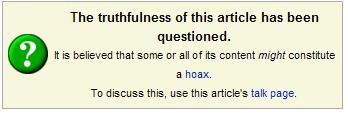
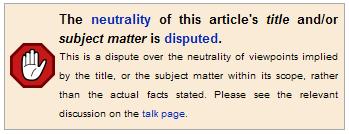
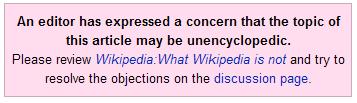
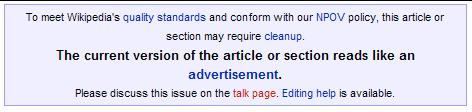
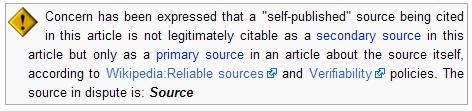
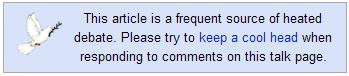
There’s one more sign of credibility of a Wikipedia page: If it contains a warning about the reliability of the page, we’ll trust it more. This is only superficially contradictory. Wikipedia has a page that lists the available notices. Here are some of the warnings available in the Disputes category.

Wikipedia Warning
Wikipedia Warning
Wikipedia Warning
Wikipedia Warning
Wikipedia Warning
Wikipedia Warning
Wikipedia Warning
Wikipedia Warning
Wikipedia Warning
Wikipedia Warning
Wikipedia Warning
Wikipedia Warning
Wikipedia Warning
Wikipedia Warning
Wikipedia Warning

The fact that Wikipedia encourages us to use these notices give us confidence that Wikipedia is putting our interests over its own.

So, why is it that you don’t see such frank notices in traditional sources such as newspapers and encyclopedias? Is it because their articles don’t ever suffer from any of these human weaknesses? Oh, sure, newspapers issue corrections after the fact, and “This is non-neutral opinion” is implicit on the Op-Ed page. But why isn’t there any finer grain framing of the reliability and nature of what’s presented to us in their pages? Can we come to any conclusion except that traditional authorities are more interested in maintaining authority than in helping us reach the truth? Which in the long run will be devastating to their credibility.


danah boyd has a terrific post on her problems getting the entry about her at Wikipedia corrected, pointing out the extent to which Wikipedia relies on the media. As other Wikipedians have pointed out, the person danah was dealing with there does not speak for all Wikipedians. In fact, no one speaks for all Wikipedians. But do check the discussion page at Wikipedia. [Tags: wikipedia katherine_mangu_ward knowledge everything_is_miscellaneous]

Tweet
Follow me

Categories: Uncategorized Tagged with: everythingIsMiscellaneous Date: August 16th, 2006 dw

6 Comments »

August 15, 2006

My kids’ novel

cover of My $100 million secret

I just published my novel for haflings (or “young adults” if you prefer), called My 100 Million Dollar Secret. It’s about a boy who wins $100,000,000 in the lottery, but (for reasons explained) can’t let his parents know and refuses to lie to them. In another sense, it’s about the boy’s growing sense of the moral obligations that come with having so much dang money. It’s also supposed to be a little funny.

I published it through Lulu.com, the on-demand self-publishing outfit. You can get a nicely designed paperback (thank you, Stellio!) for $13.90 plus shipping, or you can read it online there for $4.00. Or you can read it online for free at my site for the book. Or you can download a Word or PDF version for free. There’s also a Google group for anyone who wants to talk about it. (The book is licensed under Creative Commons, although I must have pressed the wrong button at Lulu because there it says it’s got a plain old copyright. I intend the CC rules to be in effect.)

Thanks to the people who read it and commented on it before I posted it!
[Tags: my100million novel kids_books fiction lulu]

Tweet
Follow me

Categories: misc Tagged with: misc Date: August 15th, 2006 dw

1 Comment »

Citizen journalism on Congressional earmarks

A coalition is asking citizens to research the 1,800+ “earmarks” in the appropriations bill for the Departments of Labor, Health and Human Services, and Education. “Earmarks” are special grants aimed at particular groups. They’re a species of pork, and they’ve tripled over the past ten years.

The diverse coalition, which includes the Sunlight Foundation, Citizens Against Government Waste, Porkbusters.com, Human Events Online (Pat Buchanan’s outfit), and Examiner.com, will maintain a single database that they will expose in their own ways. For example, you can see how Sunlight has Google-mapped some of them. More info in Zephyr’s post and here.

This could be a great example of the sort of investigative project better handled by a smart mob than by a single, overworked professional, as proposed by Dan Gillmor and Jay Rosen, among others. [Tags: politics citizen+journalism sunlight_foundation]

Tweet
Follow me

Categories: Uncategorized Tagged with: media • politics Date: August 15th, 2006 dw

3 Comments »

August 14, 2006

Michael Totten reports

You want to hear a strong voice saying what he’s seen? Get over to Michael Totten’s blog where he’s writing from the Israel under fire. Lots of photos, too.

Is it the whole story? Of course not. There is no whole story to be had. But it is just what we hope for from the Blogosphere: The real as seen by a person we’ve come to know.

Lively discussion afterwards. [Tags: israel lebanon michael_totten citizen_journalism blogs]

Tweet
Follow me

Categories: blogs Tagged with: blogs Date: August 14th, 2006 dw

7 Comments »

Million Dollar Idea #583 – the OOMPH

Say you’re a middle-aged man who’s just a little concerned that his heart is going to seize while he’s out on a run. Or that the bear that’s been clawing through garbage pails at night is going to wake up and decide to have a morning snack of Very Slow Runner. Or that you’ll accidentally step on the beloved Agamemnon of warrior ants and they will come tearing after you armed with tiny tridents and head-mounted lasers. It could happen, and if it did, you’d want help pronto!

You don’t want to carry your cellphone with you because, well, think of the amount of energy it’d take to throw your phone the length of the distance you run. Why, your little arms would be all worn out. No, what you’d like is an eensy-weensy, low-featured, clip-on phone, preferably shaped like the always-stylish lima bean.

Introducing the OOMPH — Out Only Micro PHone.

The OOMPH is the size and shape of a lima bean. It has no screen, no dial pad, and just two buttons: On/Off and 911. Press the On button and it calls a service center that charges you a buck or two to call whatever number you tell them to. (It’s got a tiny speaker. Maybe you stick the whole thing in your ear canal when you make a call. I haven’t thought this through yet.) Press the 911 button and it lets you gasp your final words to an emergency operator who is thinking about his next coffee break.

The OOMPH2 lets you record a voice message that gets played when you press the 911 button. You can even update it with oral notes such as “Just passed the TastiCreme on Ave. C. Mmmm. TastiCreme.”

The OOMPH3 does GPS so the EMTs know where to come to collect the body.

The OOMPH4 is the size of an iPod Nano and plays MP3s. In fact, let’s say the OOMPH4 is an iPod Nano with an OOMPH3 built into it.

The OOMPH5 has so many features that you have to tow it in a small cart.

OOMPH — The Lima Bean that Could Save Your Life!

(If I had a nickel for every million dollar idea I’ve had, I’d be rich by now!) [Tags: misc]

Tweet
Follow me

Categories: misc Tagged with: misc Date: August 14th, 2006 dw

8 Comments »

August 13, 2006

Photo stories

Tabblo looks like an easy and attractive way to group photos into mini online albums. Ned Batchelder, who works there (and who I’ve known for a while), has an example of a format that tells a little story. And here’s an example of another format, although this one could use some annotation — what the heck is Ned doing at the White House? You can tag and comment. You can buy prints.

Tidepool provides a different way of stringing together photos. It’s more tag-based, with lots of options for how you want to sort and organize. (Flash demo here.) [Tags: tabblo tidepool ned_batchelder photos tagging everything_is_miscellaneous taxonomy]

Tweet
Follow me

Categories: Uncategorized Tagged with: everythingIsMiscellaneous • photos • taxonomy Date: August 13th, 2006 dw

5 Comments »

Amazing animated music

I first saw this 3 minute animated music clip a few years ago when it came bundled with whatever graphics card I’d just bought. In fact, in that version, you could control your viewing angle. Even viewing it in pure playback modeat pretty low resolution, it’s an awesome piece of work. [Tags: music video animation]

Tweet
Follow me

Categories: Uncategorized Tagged with: entertainment Date: August 13th, 2006 dw

1 Comment »

August 12, 2006

How to catch very bad guys legally

From a msg from Valdis Krebs:

[The right wing] is crowing about how illegal massive data mining uncloaked the recent London terror network. Actually just the opposite happened! MI5 followed the legal, find-a-suspect, uncloak the network, approach I outlined back in 2002.

From The Scotsman…

Based on the information from Pakistan, MI5 began its watching operation last year. The BBC last night reported the operation began in July, but The Scotsman understands it started several months earlier.

In the initial stages, counter-terrorism officers watched from a distance. By sifting telephone records, e-mails and bank records, the MI5 officers built up what insiders call “concentric circles” of information, gradually connecting each suspect to others and building up a detailed picture of the conspiracy.

My “how to” back in 2002…

Valdis notes that Glen Greenwald has blogged about this:

From the very beginning of the NSA scandal, this has been the point — the principal, overarching, never-answered point. There is no reason for the Bush administration to eavesdrop in secret, with no judicial oversight, and in violation of the law precisely because the legal framework that has been in place for the last 28 years empowers the government to eavesdrop aggressively on all of the terrorists they want, with ease.

…Legal eavesdropping, within the FISA framework, is exactly the eavesdropping which Bush critics advocate, and it was precisely that legal eavesdropping which was used to engage in surveillance of suspected terrorists here.

Imagine if we invested the $100 billion we’re spending a year (accurate and realistic numbers are hard to come by) in Iraq to actually make ourselves safer! [Tags: terrorism valdis_krebs]

Tweet
Follow me

Categories: Uncategorized Tagged with: politics Date: August 12th, 2006 dw

1 Comment »

PodCamp UnConference

Sept. 9-10 there will be a BarCamp-style unconference in Boston about podcasting, blogging, etc. It’s called PodCamp and it looks like fun. Wish I could go. [Tags: podcasting conferences podcamp boston]

Tweet
Follow me

Categories: blogs Tagged with: blogs Date: August 12th, 2006 dw

2 Comments »

« Previous Page | Next Page »


Creative Commons License
This work is licensed under a Creative Commons Attribution-NonCommercial-ShareAlike 3.0 Unported License.
TL;DR: Share this post freely, but attribute it to me (name (David Weinberger) and link to it), and don't use it commercially without my permission.

Joho the Blog uses WordPress blogging software.
Thank you, WordPress!