



logo
EverydayChaos
Everyday Chaos
Too Big to Know
Too Big to Know
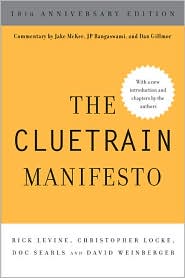
Cluetrain 10th Anniversary edition
Cluetrain 10th Anniversary
Everything Is Miscellaneous
Small Pieces cover
Small Pieces Loosely Joined
Cluetrain cover
Cluetrain Manifesto
My face
Speaker info
Who am I? (Blog Disclosure Form) Copy this link as RSS address Atom Feed

July 6, 2006

Report on China’s clampdown

The Open Net Initiative has released a report on China’s Internet filtering and censorship 2004-2005. And 2006 doesn’t look like it’s going to get one drop better. On the contrary. [Tags: china internet digital_rights oni]

Tweet
Follow me

Categories: Uncategorized Tagged with: digital rights Date: July 6th, 2006 dw

1 Comment »

Internet rumor to start…

Vince Foster killed Ken Lay.

Tweet
Follow me

Categories: Uncategorized Tagged with: humor Date: July 6th, 2006 dw

5 Comments »

July 5, 2006

Ken Lay’s political poser

George W. Bush was friends with Kenny Boy.

George W. Bush is loyal to his friends.

Does it take Karl Rove himself to tell George W. Bush he can’t go to Kenny Boy’s funeral? [Tags: ken_lay george_bush politics]


If you support the death penalty and find yourself saying that you’re sorry Ken Lay died before he served any prison time, then how can you support the death penalty?


It’s too bad Ken Lay died at 64. It’s also really crappy that he robbed people who believed in him of their retirement. I see no sense in trying to evaluate how and in which ways these two match up.

Tweet
Follow me

Categories: Uncategorized Tagged with: politics Date: July 5th, 2006 dw

8 Comments »

Wikipolitics

Jimmy “Wikipedia” Wales is starting his next big project. “[B]roadcast media brought us broadcast politics, and now participatory media will bring us participatory politics. But for this to happen, we have to make it happen.”

Will it work? We won’t know until we invent it.

Mission statement here. Mailing list here. [Tags: politics wikipedia jimmy_wales wikis]

Tweet
Follow me

Categories: Uncategorized Tagged with: digital culture • politics Date: July 5th, 2006 dw

4 Comments »

Marketing global warming

Asi Sharabi asks the world’s marketing/communications gurus to come up with ideas about how to mobilize citizenries to act against global warming. Good idea, although obviously there’s no need to leave it to the marketing folks.

One marketing guru, Seth Godin, makes the good point that the phrase itself, “global warming,” sounds positive: “Global” is a feel-good word and so is “warming.” So, how about calling it the second flood? Yes, this focuses on just one of the bad consequences of frying the planet, but it’s a big ‘un. [Tags: global_warming ecology asi_sharabi marketing al_gore]

Tweet
Follow me

Categories: Uncategorized Tagged with: marketing Date: July 5th, 2006 dw

13 Comments »

July 4, 2006

The fourth freedom

The United States rightly prides itself on having placed freedom at the root of its citizens’ relationship with their government. Not duty, not constraint, not even law. Our freedom drew the limits around our government, and not the other way around.

Among our freedoms, we Americans tend to think of freedom of speech first. After that, we probably list freedom of religion, and lump freedom of the press under free speech. But the fourth of the freedoms guaranteed in the First Amendment, “the right of the people peaceably to assemble, and to petition the Government for a redress of grievances,” comes in a distant last. It seems irrelevant to the current situation: Do we really need a Constitutional right to allow us to hang out with our friends on a street corner?

Yes we do. Individuals pose little threat to the status quo, even if the individuals are using their right to free speech brilliantly. If the government can break up groups, then it can prevent bottom-up change.

The Internet is a powerful medium for free speech, of course. But it is an even more powerful tool of assembly. The real threat to the status quo will come not through speech but through the thick connections we are forming to one another.

It does not diminish freedom of speech to say that it is not enough by itself. Freedom of assembly — not of chanting mobs, but of those whose ideas and courage emerge in the new public — is all that stands between our republic and the disaster of empire.

Happy Independence Day. [Tags: freedom fourth_of_july politics]


Frank Paynter reflects on drawing the line, and then reconciliation.

Tweet
Follow me

Categories: Uncategorized Tagged with: politics Date: July 4th, 2006 dw

4 Comments »

July 3, 2006

Sen. Stevens and David Reed on “What is the Internet?”

I was about to run an explanation by David Reed, one of the folks responsible for the neutrality of the Internet’s architecture, of how the Internet works when Sen. Ted Stevens weighed in with his own. Stevens heads the committee writing the new telecommunications bill. So, I’ve decided to put them head to head in a death match. (If you’ve already seen the Senator’s explanation, which I’m copying from Wired.com, you can click here to go straight to David Reed’s.)

First, Senator Stevens. The fun part is working backwards from what he says to what his staffers told him. And beyond fun, we can gain insight into both what the Net discrimination side thinks and how it sounds to the, um, uninitiated:

There’s one company now you can sign up and you can get a movie delivered to your house daily by delivery service. Okay. And currently it comes to your house, it gets put in the mail box when you get home and you change your order but you pay for that, right.

But this service isn’t going to go through the interent and what you do is you just go to a place on the internet and you order your movie and guess what you can order ten of them delivered to you and the delivery charge is free.

Ten of them streaming across that internet and what happens to your own personal internet?

I just the other day got, an internet was sent by my staff at 10 o’clock in the morning on Friday and I just got it yesterday. Why?

Because it got tangled up with all these things going on the internet commercially.

So you want to talk about the consumer? Let’s talk about you and me. We use this internet to communicate and we aren’t using it for commercial purposes.

We aren’t earning anything by going on that internet. Now I’m not saying you have to or you want to discrimnate against those people […]

The regulatory approach is wrong. Your approach is regulatory in the sense that it says “No one can charge anyone for massively invading this world of the internet”. No, I’m not finished. I want people to understand my position, I’m not going to take a lot of time. [?]

They want to deliver vast amounts of information over the internet. And again, the internet is not something you just dump something on. It’s not a truck.

It’s a series of tubes.

And if you don’t understand those tubes can be filled and if they are filled, when you put your message in, it gets in line and its going to be delayed by anyone that puts into that tube enormous amounts of material, enormous amounts of material.

Now we have a separate Department of Defense internet now, did you know that?

Do you know why?

Because they have to have theirs delivered immediately. They can’t afford getting delayed by other people.

[…]

Now I think these people are arguing whether they should be able to dump all that stuff on the internet ought to consider if they should develop a system themselves.

Maybe there is a place for a commercial net but it’s not using what consumers use every day.

It’s not using the messaging service that is essential to small businesses, to our operation of families.

The whole concept is that we should not go into this until someone shows that there is something that has been done that really is a viloation of net neutraility that hits you and me.

The full audio is here.

Now for David Reed. This comes from an email list, with David’s permission. The list is discussing the DPS Project Net neutrality bill David favors. (Me too.) I’ve added in some links and have lopped off some intro and extro material. David is writing in response to someone who says that the DPS Project bill would stifle innovation.

Why is the Internet different from PSTN [public switched telephone network], cable, or broadcast TV?

The secret is that the Internet architecture was designed so that the transport network itself does not need to be involved in innovations. This is due to following the so-called “end-to-end argument” that I helped describe and name, but which was developed for the specific purpose of leaving the possibilities for innovation as open as possible. I do take credit, not for being old or gray in beard, but for being part of the group who made the Internet work this way.

As Dave Clark has said, the key to the Internet’s ability to absorb and to benefit from innovations for the last 30 years without breaking is the so-called “hourglass” architecture, where the thin neck is at the point where the IP protocol sits. Innovations in technology are deployed either in the layers below IP (which do not affect applicaitons – so that such ideas as all-optical switching, ad hoc wireless meshes, etc. need not change the definition of the Internet one whit) or in the layers above IP (so that ideas such as VoIP, WWW, Internet mail, chat rooms, social networking or Wikis require no change to the Internet to be tried and adopted).

So the only thing we must consider is the IP protocol, which is quite simple and amenable to many mappings.

What the [DPS Project] bill does at its core is require anyone who provides “access to the Internet” to provide access to the consensually defined Internet as of a particular point in time.

What does that mean? Well, it’s quite simple, actually. The Internet merely provides a service such that one has an IP address, and that from that IP address, one can send a message (technically called an IP datagram) to any other IP address. The “envelope” of that message contains a set of fields that specify the source, the destination, and certain handling features such as a “protocol number”. The message itself is a string of bits that are utterly meaningless to any device other than the source or the destination – in fact, the message can be strongly encrypted with a key that is known only to the source and the destination, or formatted in any way that makes sense to the endpoints.

So exactly what kind of innovations would be prevented in the Internet? Well, there is one kind that would be prevented. That is an architecture that requires devices between the source and the destination to decode and understand the messages being sent.

That would be an innovation, but it would be the *last* innovation that ever happens to the Internet, for a very simple reason. Once the network starts to require understanding of the communications that used to be merely the business of the source and the destination, new innovations of services would require permission and redesign of the Internet every time a new service were introduced.

That is why we eschewed putting such processing in the network, and invented the end-to-end arguments that led to the Internet design. We were facilitating a state of constant revolution and change, both in the applications that could be deployed and in the techniques used to move bits from one place to another.

It is this state of constant revolution and change that I am proud to have helped enable. It is for this reason that conservatism in preserving the core architectural principle of the Internet is warranted precisely because it facilitates change and innovation, both above and below the IP layer.

Innovations that don’t refer to a product or service labeled as “access to the Internet” would of course be unaffected [by the DSP Project bill].

[Tags: net_neutrality dave_reed end_to_end ted_stevens internet internet_architecture internet_history]

Tweet
Follow me

Categories: Uncategorized Tagged with: digital rights Date: July 3rd, 2006 dw

7 Comments »

July 2, 2006

Blufr’s bogus questions

Blufr.com, which seems to be a clever way of promoting Answers.com, poses amusing true-false questions. I spent a compulsive seven minutes there this morning instead of doing my email… [Tags: entertainment]

Tweet
Follow me

Categories: Uncategorized Tagged with: entertainment Date: July 2nd, 2006 dw

1 Comment »

July 1, 2006

Cringely on Frankston on owning the last mile

Terrific piece by Robert Cringely based on his conversations with Bob Frankston about why we ought to get together and lay some fiber.

Bob’s explanation of the telco’s model — they’re all about creating billable events — I find persuasive and clarifying. [Tags: bob_frankston robert_cringely wifi net_neutrality]

Tweet
Follow me

Categories: Uncategorized Tagged with: wifi Date: July 1st, 2006 dw

1 Comment »

Another reason to love Open Source

Having just done a reinstall on my wife’s computer, I’ve then had the annoying pleasure of extirpating the various ways arrogant programs try to take the machine over. Norton Antivirus takes up an inch of the task bar. Real thinks it owns everything that makes a sound. Everything installs an entry to the Explorer popup.

But not Open Office, bless its modest soul. During the installation process, when it asks if you’d like it to be the default program for opening Microsoft Office documents, it clearly says:

If you are just trying out OpenOffice.org 2.0, you probably don’t want this to happen, so leave the boxes unchecked

The bigger the app, the more likely I’m going feel I’m at war with it. Except for Open Office. It’s so clearly on our side.

Tweet
Follow me

Categories: Uncategorized Tagged with: business • digital culture • marketing Date: July 1st, 2006 dw

2 Comments »

« Previous Page


Creative Commons License
This work is licensed under a Creative Commons Attribution-NonCommercial-ShareAlike 3.0 Unported License.
TL;DR: Share this post freely, but attribute it to me (name (David Weinberger) and link to it), and don't use it commercially without my permission.

Joho the Blog uses WordPress blogging software.
Thank you, WordPress!