


logo
EverydayChaos
Everyday Chaos
Too Big to Know
Too Big to Know
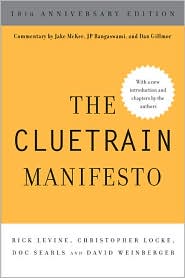
Cluetrain 10th Anniversary edition
Cluetrain 10th Anniversary
Everything Is Miscellaneous
Small Pieces cover
Small Pieces Loosely Joined
Cluetrain cover
Cluetrain Manifesto
My face
Speaker info
Who am I? (Blog Disclosure Form) Copy this link as RSS address Atom Feed

June 8, 2006

[corante] John Hagel

John Hagel has 15 mins to be “provocative.” [As always, I’m paraphrasing and will be getting things wrong.]

He says the big shift is from fighting for shelf space to fighting for attention.

Traditional marketing’s principles are: Intercept customers, isolate them, and inhibit their ability to engage with other vendors over time. The nirvana: 1:1 marketing: One customer, one vendor.

We need a different approach, he says: Attract, assist, affiliate. (Affiliate: Find other services and values to provide to the customer.)

We’re moving from product- and vendor-centric promises (“Buy from me because I have great products and I’m a great vendor”) to customer-centric promises (“Buy from me because I know you as an individual customer better than anyone else and you can trust me to configure the right bundle of products and services”). Those who do this, John says, will have the most powerful brands. He notes that he does not mean customer segment brand promises but actual individual customer promises.

Generally, businesses can answer the two questions: 1. What’s the lifetime value of your customers, and how is that changing? 2. What’s the 80:20 segmentation in your business in terms of customers. But those are going to be critical performance metrics.

We need to focus on Return on Attention, John says.

He points to three ways marketers are falling into old habits:

1. Companies are responding by doing anything they can to grab attention. They’re carving messages into the wool on sheep, and running ads on video screens above the urinals. Instead, marketers ought to put themselves in the customer’s place.

2. Some say marketers should move from the broad notion of attention to intention, i.e., intercepting people who already intend to buy. John recommends focusing on attention more broadly.

3. Some are too enamored with tools. Rather than inventing new stuff, hoiw can we help our customers find and connect to the environments that already exist?

Ultimately, it’s about the assumptions we bring to business. From that stems everything else. So, you should start at the top to introduce organizational change.

[Tags: john_hagel marketing]

Tweet
Follow me

Categories: Uncategorized Tagged with: marketing Date: June 8th, 2006 dw

Be the first to comment »

[corante] Innovation and marketing

I’m at a conference put on by Corante [Disclosure: I may be on their board of advisors. In any case, I occasionally blog at Corante and some Corantists are friends of mine.] and the Center on Global Brand Leadership called 2006 Innovative Marketing Conference, at Colubmia U. (Unfortunately, I missed the keynote by Russ Klein, CMO of Burger King.)

David Sutherland of the Launch Institute does a discussion-opener about “co-creation.” He defines co-creation as “when value is jointly created through an interaction of the firm and its customers,” i.e., “dialogue.” He says companies discover there are three “platforms” for innovation: 1. Insight: Sensing opportunities. 2. Creation: Bringing insights together. 3. Value Capture: Implementation. “Every company that has an innovation process has these three platforms…” At each of those points, you can involve “consumers” and suppliers in a co-creation process.

Co-creation ranges from the latent (e.g., ethnography) to the explicit. e.g., Whirlpool does a lot of ethnography. They videotaped the process people go through in the wash process. They had assumed that cycle time was important, but they found the wash cycle sometimes took days. And they found that people doing lots of laundry often had lots of kids and thus didn’t want the washer/dryer so removed that they have to leave their kids. So, they’re going to introduce socially-acceptable washer/dryers for living areas.

BMW turned sides of buildings into video screens and allowed people to put their own messages onto them. BMW calls this “show to know,” i.e., showing things “in order to understand the people interacting with the brand.”

JetBlue has a “storybooth” where customers get to tell a story about JB. (NPR is suing JetBlue over this, apparently, See Rm116.

Paccar co-creates with suppliers.

David uses Foo camp as an example of co-creation, which feels like a stretch to me.

Then we break into discussion groups…

We had an interesting discussion, focusing more on innovation and co-creation than on marketing. Apparently, the idea for Kraft’s 100-calorie packs of snacks came from customers. And Lego brought together some of the top Legomaniacs. Also Hyatt came up with it’s “stay fit” program by listening to customers, although theidea for the program did not come from a customer; rather it was a response to the customer needs the customers expressed.

We come back to a whole-group discussion, but I’m taking good enough notes on it. One random point: Does co-creation work? How would we know? BMW has run ads boasting that their cars are designed by designers, not by customers. Under what circumstances does it make sense? [Tags: clay_shirky jaron_lanier]

Tweet
Follow me

Categories: Uncategorized Tagged with: marketing Date: June 8th, 2006 dw

Be the first to comment »

Clay on Lanier

Clay responds to Jaron Lanier‘s debunking piece, Digital Maoism. I haven’t read Clay’s response yet (I’m at a conference) but I’m eager too… [Tags: clay_shirky jaron_lanier]

Tweet
Follow me

Categories: Uncategorized Tagged with: taxonomy Date: June 8th, 2006 dw

1 Comment »

Men

Apparently, there’s a consumer electronics store that comes in two versions: One laid out for women 20-30 years old and one for middle-aged men. The one for women gets them in and out quickly. The one for men is designed for leisurely browsing. Yet further evidence that everything men say about women is false about women but true about men. [Tags: marketing men women]

Tweet
Follow me

Categories: Uncategorized Tagged with: marketing Date: June 8th, 2006 dw

1 Comment »

June 7, 2006

Sopranos finale

Warning!!!! SPOILER. Sort of. I don’t actually give away the ending, but if you haven’t seen it, don’t read this post beforehand because I talk about it in general terms and mention some possible endings that didn’t happen. On the other hand, you should feel free to read my predictions from before the start of the season. You’ll be amazed at my prescience. Hahaha.)

[SPOILER]

.
.
.
.
.
.
.
.
.
.
.
.
.
.
.
.
.
.

The finale makes total sense if you assume that The Sopranos is a comedy. Not just sometimes funny. A comedy. A dark comedy. It has always had a comic structure – we see through the characters’ pretensions – and over the seasons it has generally moved toward being a comedy in substance as well.

That’s not to say that Adriana’s murder was hilarious. And the Big Pussy storyline had the inevitability of tragedy. But the overall premise of the show is explicitly about incongruities — a mobster family with the usual suburban problems, except instead of Timmy hiding the broken vase under the couch, Timmy shoots his babysitter in the head and buries her in five locations. The eruptions of brutal violence are not funny, but they are all the more overwhelming because they happen within a comic framework.

The characters are almost all comic. Tony. Artie. Paulie. Silvio. Janice. Dr. Kupferberg. Ralphie. Steve Buscemi’s Tony. Johnny Sack. Tony’s mother. These are great comic turns, transcendently written and acted. Carmela, on the other hand, is pulled between her desire to have a normal, happy family and her recognition that her family life is built on abnormal evil; her reconciliation with Tony was, I thought, tragic. (Melfi is resolutely non-comic, which maybe explains why she’s one of my least favorite characters.)

So, I imagine the writers sitting around trying to figure out what to do with this semi-last season. They want to give Tony some peace. So, they shoot him in the gut as a way of clearing his head. If Tony is given a second chance, how much of the value in his life will he be able to see? How soft can Tony go? Then we had the Vito story line, which was pure comedy. (And more, of course, because it’s the Sopranos.) “I wonder what would happen if we put one of these guys into a sleepy New England town,” said one writer. “Yeah, and made him gay,” said another. “And can we work the word ‘johnnycakes’ into it somehow?” wondered a third. (This entire conversation would have happened entirely in David Chase’s head.)

And then the writers tried to figure out what ending would shock us. Tony kills Carmela? AJ gets whacked? Furio strangles Tony with his pony tail? Paulie Walnuts is appointed head of FEMA? What final scene would we not be ready for?

When they hit on the idea they went with, the writers must have had a good laugh.

I thought it worked. [Tags: sopranos tv entertainment]

Tweet
Follow me

Categories: Uncategorized Tagged with: uncat Date: June 7th, 2006 dw

Be the first to comment »

Attila Weinberger

I got an email msg from Attila Weinberger, a Romanian blues musician who was wondering if we’re related. I told him my father had Hungarian blood, and Attila’s hometown turns out to have been in Hungary for a while. So, there’s a pretty good chance we’re cousins to some degree.

In any case, I promise you that this is the best Transylvanian blues you’ve ever heard. He’s a damn fine musician who was playing the blues even when the Communists didn’t want him to. You can hear some tracks here, or click on AG’s Blues Radio at the upper left of his site. [Tags: attila_weinberger music blues romania]

Tweet
Follow me

Categories: Uncategorized Tagged with: entertainment Date: June 7th, 2006 dw

5 Comments »

June 6, 2006

Dropping Knowledge

DroppingKnowledge.org is trying to create a “blogstorm” to support what seems like a well-intentioned project. The site is trying to collect 100,000 important questions facing the species. Then, on Sept. 9, 113 “scientists, social entrepreneurs, philosophers, writers, artists and activists from around the world” will get together to talk about 100 of them.

If they make progress, great. If they focus attention on important issues, great. But wouldn’t it be wonderful if, instead of relying on 113 experts sitting around a table, there were some medium by which the people of the world themselves — at least the ones with a Net connection — could talk about for themselves, over the long term? If only we had such a medium…if only… [Tags: droppingknowledge]

Tweet
Follow me

Categories: Uncategorized Tagged with: culture • digital culture • politics Date: June 6th, 2006 dw

7 Comments »

McDonalds Games is more in touch with reality than is McDonald’s Rain-Forest-Fed Cow Division

McDonald’s Interactive has left McDonald’s because McDonald’s is leading the planet to “global calamity.” Interactive is now devoting itself to stimulating mass action on the environment. [Tags: environment mcdonalds games]

Tweet
Follow me

Categories: Uncategorized Tagged with: entertainment • politics Date: June 6th, 2006 dw

17 Comments »

AKMA on da Vinci Code

AKMA raises question about The Da Vinci Code that advance the discussion beyond the canapes served at Jesus’ wedding and the resurrection of the mullet. (I read the first page of the book and put it down. And I haven’t seen the movie.) [Tags: akma da_vinci_code movies theology]

Tweet
Follow me

Categories: Uncategorized Tagged with: entertainment • philosophy Date: June 6th, 2006 dw

4 Comments »

June 5, 2006

Data retention explained

Bill McGeveran clarifies and evaluates the Department of Justice’s plan to make ISPs retain data.

IANAL. Bill is. Good stuff. [Tags: bill_mcgeveran digital_rights do js privacy]

Tweet
Follow me

Categories: Uncategorized Tagged with: digital rights Date: June 5th, 2006 dw

1 Comment »

« Previous Page | Next Page »


Creative Commons License
This work is licensed under a Creative Commons Attribution-NonCommercial-ShareAlike 3.0 Unported License.
TL;DR: Share this post freely, but attribute it to me (name (David Weinberger) and link to it), and don't use it commercially without my permission.

Joho the Blog uses WordPress blogging software.
Thank you, WordPress!