


logo
EverydayChaos
Everyday Chaos
Too Big to Know
Too Big to Know
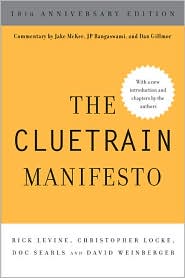
Cluetrain 10th Anniversary edition
Cluetrain 10th Anniversary
Everything Is Miscellaneous
Small Pieces cover
Small Pieces Loosely Joined
Cluetrain cover
Cluetrain Manifesto
My face
Speaker info
Who am I? (Blog Disclosure Form) Copy this link as RSS address Atom Feed

April 20, 2006

Save the Internet: The Contest!

Jeff Pulver has started a contest to come up with a video or an ad to help save the Internet. Cool!

(To begin with, I would have called it “Save Our Internet,” a meme that continues to sweep the Internet the way a cotton swab sweeps the 128 miles of New Jersey coast.)

While you’re at it, support OneWebDay. And the EFF. And the Open Rights Group. Or whatever you think will help. The time is definitely now. [Tags: net_neutrality save_the_internet jeff_pulver contest digital_rights]

Tweet
Follow me

Categories: Uncategorized Tagged with: digital rights Date: April 20th, 2006 dw

2 Comments »

RageBoy’s compiled a little list

Chris Locke has compiled his list of favorite New Age books at Amazon. If you want some context for this, check out MysticSpellingError, the site where he has been thinking through what I hope will be his next book. [Tags: chris_locke rageboy mystic_bourgeoisie new_age amazon books]

Tweet
Follow me

Categories: Uncategorized Tagged with: philosophy Date: April 20th, 2006 dw

1 Comment »

April 19, 2006

Ozzie harries IT

David Kirkpatrick at Fortune.com has a fascinating inside look at the rise of Ray Ozzie at Microsoft. Ozzie was put in charge of “Webifying” Microsoft, and was given wide range to Make It So.

The question is whether this effort is going to Microsoft-ify the Web as it Webifies Microsoft. How much of the Web’s values have to be undermined to make it safe for Microsoft? [Tags: microsoft ray_ozzie]

Tweet
Follow me

Categories: Uncategorized Tagged with: digital culture Date: April 19th, 2006 dw

6 Comments »

My 100 Million Dollar Secret

About five or six years ago, I started writing a novel for kids. (I think the industry calls them “young adults,” although I personally prefer “halflings” or “Hey, you, get off of my lawn!”) It’s about a kid who wins $100,000,000 in the lottery but can’t tell anyone. II finished it a few months ago and have shown it to a couple of publishers and a couple of agents, each of whom has wildly praised it as (if I may quote) “Not right for us.”

So, here’s my plan.

I’m going to post an html version of it on the Web for free, and sell a softcover version of it through Lulu.com. Sound like a good plan?

Before I put it up for general release, though, I’d love to have someone take an editing pass at it. I’m most interested in copy editing (= nit picking) at this point, primarily because it wouldn’t be fun to do a major rewrite. (Maybe I’ll post the whole thing on a wiki once I go live with it so that the wisdom of the crowds can do the next round of drafts.)

So, if you’d like to comment on it, let me know (self evident.com) and I’ll send you the current version in Word format. (It’s 63,000 words, which formats to a 220pp 6×9″ Lulu book.)

Also, I’d like to set up a discussion forum for readers once I post the book on its web site. Any suggestions for an easy way to do that? [Tags: my100milliondollarsecret books bad_writing]

Tweet
Follow me

Categories: Uncategorized Tagged with: uncat Date: April 19th, 2006 dw

9 Comments »

Frappr hits my social circle

This morning my inbox is peppered with notices from Frappr that someone in my social network — a mysterious list that seems to include none of my relatives but everyone I ever said “Gezundheit!” to in public — has created a Frappr map that shows on a Google map the physical location of all their friends. It’s a cool app, but the epidemiology of Net viruses is even cooler.

(Hmm. A quick check shows that in fact I only have six people in my social network, none of whom has ever sneezed on me.) [Tags: frappr social_networks no_one_likes_me]

Tweet
Follow me

Categories: Uncategorized Tagged with: digital culture Date: April 19th, 2006 dw

3 Comments »

Spiritual Youth – An on-line HS research project

Mark Federman‘s daughter, a high school junior, is doing a project for her World Religions course. She’s using the Web to collect stories about how people age 12-25 have been “affected by their experiences of religion and spirituality.” Her blog is here.

Tweet
Follow me

Categories: Uncategorized Tagged with: uncat Date: April 19th, 2006 dw

Be the first to comment »

April 18, 2006

[berkman] Yochai Benkler

Yochai Benkler is giving a talk about his new book, the aptly named the Wealth of Networks. He asks: What can we say about the new economics and understand it as something stable, not a passing fad? What does the change mean to our core commitments to democracy, etc. [As always, these are notes and thus are not accurate, complete or reliable.]

Between 1835 and 1850, Yochai says, the cost of starting a mass circulation paper rose from $10,000 and $2.5M (in current dollars). This signalled a “stark bifurcation between producers and consumers.” Readers became passive. This lasted for 150 years.

In 2002, the fastest supercomputer was Japanese. In 2004, IBM just barely inched it out. Meanwhile, the SETI@Home project enabled 4.5M to share their spare cycles, creating a far bigger computer. “We’re seeing a radically decentralized capitalization” of computation, storage and communications capacity. “Every connected person on the planet has the physical capcity to create information, knowledge and culture.” Human creativity, intuition, experience and motivation are widely distributed. Put together the capitalization and the human capabilities, and behaviors that used to be on the edge move into the core: Commons-based production and peer-production. Commons-based production is production without exclusion: Everyone can use the product. Peer production is large scale collaborative production without price or management. Peer production obviously works, as proved by Apache’s 70% market share. Or Wikipedia. Or DMOZ…

There are new opportunities, he says, most importantly shifting from finished information and cultural goods to platforms for self-expression and collaboration. Social production is a fact, not a fad. It is “the critical long term shift caused by the Internet.” But it is a threat to, and threatened by, incumbent business models.

Why should we care about the outcome of this political debate, he asks? Because of our core commitments to autonomy, democracy, and justice & development.

Autonomy: In shifting from consumers to users, we have to do more for ourselves and in looser association with others. But we get pages such as the lead hit on “viking ships” at Google, which is produced by a 5th grade teacher in GreenlandGander, Newfoundland. Or you get Project Gutenberg.

Democracy: Our democracy is a mass mediated public sphere. What do you get when you have peer production in such a democracy? You used to get The Pentagon Papers, which required several newspapers and the Supreme Court to get published. Now you get Bev Harris at BlackBoxVoting.org exposing Diebold. The Diebold code is opened up to public inspection. By the time Diebold sues the various places it’s been posted, it’s been distributed widely via email and Freenet and Overnet…

Does the Internet democratize or fragment? The first generation critique (Cass Sunstein) is that the Internet “Babel-izes” culture. The second generation (Clay Shirky) says that power laws mean that only a tiny number of sites actually get read; it’s the same as with broadcast. But, the claim needs to be assessed not against the utopia but against the access provided by mass media. And the claims are empirical and need to be examined. Yes, there are topical clusters. But thereare many entry points for discussion, there is something like “peer review” of claims, and some superstars who are known across clusters. The Internet, Yochai concludes, is indeed more democratic than what we’ve had.

He sees the re-emergence of a new form of folk culture based on active participation. This he views as a return to norms of the pre-broadcast world.

Justice: Much of what makes for human welfare depends on information, knowledge and culture. Commons-based and peer production can help. E.g., open source, open academic publishing, open source agricultural innovation, bio informatics, open source biomedical innovation, etc. He gives three quick examples: Free High School Science Text. The International HapMap Project. Biological Innovation for an Open Society.

We’re in a battle of institutional ecology, he says: DMCA, Net Neutrality, “trusted” computing, etc. Law is pushing in favor of the incumbents, he says. But that doesn’t mean they’ll win. E.g., the market doesn’t want “trusted” machines. (He says they’re trusted in that the content creators can create it not to do what customers want.) The sharing culture is increasing. The battle has begun and is worth waging. [Fantastic talk.] [Tags: yochai_benkler digital_rights berkman]

Tweet
Follow me

Categories: Uncategorized Tagged with: digital rights Date: April 18th, 2006 dw

7 Comments »

[berkman] Academic copyright and fair use

Bill McGeveran, a fellow at the Berkman Center, points to how education is spreading all over, including online syllabi, non-traditional resources (e.g., www.RedHotJazz.com), open source education (e.g., Wikipedia.org, the Samuel Pepys diary), etc. But, e.g., the Center for History and New Media has had to constrain what they can share because, while teachers are permitted to use some copyrighted materials, they can’t share them. And academic access to music is restricted.

Bill’s group found four general categories of problems: 1. The law is unclear. 2. DRM. 3. It’s hard and expensive to clear rights. 4. The gatekeepers — e.g., school systems — are very cautious about digital rights, primarily because of the first three problems.

The law is not keeping up, he says.

Jackie Harlow, a Harvard Law student who works on the project, talks about the problems DRM — the unprecedented ability to locked content down (and lock users out) — raises when it comes to education using legitimate materials. Stuff gets locked in inadvertantly or to avoid litgation. E.g., Blackboard software locks content to others who use that software. (And just about every school uses Blackboard.)

Bill says that it can be very difficult to obtain a license. You have to figure out if it’s covered by Fair Use. You have to track down the license owner. The fees can be high. Key intermediaries are often ignorant and/or “chicken.”

Jackie says the “paths toward reform” include advancing the educational use exception to DMCA, educating educational users about DRM and promoting the adoption of open tools, working with content providers to develop educational-usable content, and changing gatekeeper attitudes. Bill says there are “interesting moves” toward automated copyright clearance. [Tags: education digital_rights berkman bill_mcgeveran jackie_harlow]

Tweet
Follow me

Categories: Uncategorized Tagged with: digital rights Date: April 18th, 2006 dw

3 Comments »

Libraries and the long tail

Lorcan Dempsey of the OCLC has a fascinating article on what the long tail means for libraries. For example, 10% of titles in libraries account for 90% of loans. But, users of services such as Netflix go deep into the catalog. What can libraries do, Lorcan wonders, to help patrons find what they don’t know is there and they may not know they’re interested in? (I’ve put this too simply…) [Tags: libraries lorcan_dempsey long_tail oclc ranganathan everything_is_miscellaneous]

Tweet
Follow me

Categories: Uncategorized Tagged with: everythingIsMiscellaneous • taxonomy Date: April 18th, 2006 dw

3 Comments »

April 17, 2006

Global Voices and Reuters up a tree…

Global Voices has announced an alliance with Reuters. Reuters has made a “major contribution” to GV via the Berkman Center, which is the home of GV. Reuters will use content created by GV editors and contributors on its Web sites.

I’m finding it hard to be cynical and pessimistic about this. GV gets funded, Reuters has no say in what GV talks about, Reuters’ stories get bottom-up context, and the global voices at Global Voices get heard more broadly. Sounds like good news for news. [Disclosure: I’m a fellow at the Berkman Center, and the founders of GV are good friends.] [Tags: media reuters gv global_voices citizen_journalism journalism]

Tweet
Follow me

Categories: Uncategorized Tagged with: bridgeblog • media Date: April 17th, 2006 dw

3 Comments »

« Previous Page | Next Page »


Creative Commons License
This work is licensed under a Creative Commons Attribution-NonCommercial-ShareAlike 3.0 Unported License.
TL;DR: Share this post freely, but attribute it to me (name (David Weinberger) and link to it), and don't use it commercially without my permission.

Joho the Blog uses WordPress blogging software.
Thank you, WordPress!