


logo
EverydayChaos
Everyday Chaos
Too Big to Know
Too Big to Know
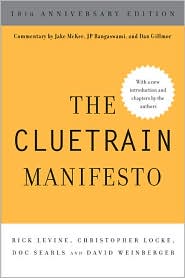
Cluetrain 10th Anniversary edition
Cluetrain 10th Anniversary
Everything Is Miscellaneous
Small Pieces cover
Small Pieces Loosely Joined
Cluetrain cover
Cluetrain Manifesto
My face
Speaker info
Who am I? (Blog Disclosure Form) Copy this link as RSS address Atom Feed

March 11, 2006

How to tie your shoelaces

After fifty years of a signature shambling walk due to the fact that my shoes always come untied, my wife has shown me that I have been tying my shoes wrong. After 30 days of empirical testing, I have concluded what I knew at the beginning: She’s right. I’d been putting the loop under the other loop, or maybe over it. I’m not very topological. But whatever the right way is, it requires bending your fingers 60 degrees backwards at the tips and spinning your shoes twice in a clockwise direction (counterclockwise in Australia).

In any case, my fingers know how to do it even though my brain can’t follow. Not only does the knot work, but I can still release my aching dogs with a single pull on the emergency cord, unlike our son who double-knots his laces and thus wastes precious time pulling twice. I keep telling him that he’s not going to get those nanoseconds back, but will he listen to the voice of experience? No, especially not when it comes from a 55-year-old adult who’s just learned how to tie his shoes.

Here’s a page with some knot-tying techniques. I believe I had been a victim of an ineptly tied Two Loop Shoelace Knot.

[Tags: shoes knots shambling adult_idiocy]

Tweet
Follow me

Categories: misc Tagged with: misc Date: March 11th, 2006 dw

2 Comments »

March 10, 2006

Wikimania call for papers

Wikimania is coming to Boston, August 4-6. If you want to propose a paper or workshop for this global gathering of Wikipedians — and aren’t we all Wikipedians, after all? — go here and propose away. [Tags: wikipedia wikimania]

Tweet
Follow me

Categories: Uncategorized Tagged with: digital culture Date: March 10th, 2006 dw

Be the first to comment »

March 9, 2006

[ad club] Joe Jaffe – A world without advertising

Joe Jaffe, author of Life after the 30 Second Spot, gives one of the lunchtime talks at the Boston Ad Club. [As always, this is a rough, abbreviated paraphrase.]

Change is the only constant in marketing, he says. Marketers resist it. Technology is the change agent. “I don’t believe customers are empowered at all.” We like to be entertained. Nevertheless, marketers are powerless. “Top of mind” is being replaced by “top of page” (where Google is the page). The “funnel of interest” is being replaced by the “funnel of trust.” Prime time is being replaced with my time.

The Four P’s are becoming commoditized. You can’t own a position for decades any more. Pricing is commoditized. Place is now the world. Promotion can’t make it through the mass clutter.

Chief Marketing Officers have an average tenure of 22.9 nmonths, compared to 53.8 for CEOs.

Marketing is paying more for ads and getting less exposure.

We have to be more “consumer-centric.”

It’s time to kill the 30-second ad. We need a fresh start. We need to reintroduce “consumers” to ads. Budweiser is talking about “Bud TV” that will go straight to consumers. If we don’t do our job, we may be bypassed.

Advertising is not consumer centric. The entire mass marketing model is not consumer centric. We tell consumers what and where to buy.

Markets are outgrowing their agencies. We’ve gone from ad agencies to media companies to interactives to search engine optimization companies to boutiques. So, clients have 15-20 agencies, competing and making noise. Next the PR companies will take over.

We need to save advertisifng from extinction (S.A.F.E.), which we can only do by not being safe. We need to figure out how to make relevant advertising again. Ads need relevant, utility, entertainment [RUE]. Advertising should be out to involve and demonstrate. Embrace the new marketing.

Who’s doing a great job? We are. “If you’re here today it’s because you’re part of the new wave of leadership.” “We” means we have to let consumers have their say. We’ve moved from one-to-many to one-to-one and then one-from-one (= search). Now we have many to many. “The brand is a part of the conversation.” The conversation was around before the brand was and will outlast it. “At best we can hope to enjoy the conversation, to facilitate, to stimulate, to be invited to participate in the conversation.”

Broadband, networks, wireless and search are transforming marketing: Always on, anywhere, on their terms, connected to everyone. “It used to be fool me once, shame on you. Fool me twice, shame on me. Now it’s fool me once, screw you…and I’ll tell one million of my closest strangers.” The new paradigm is conversation, permission, involvement…[I missed one of the four members of the new paradigm.]

“The digitization of media is the cause, the effect, the symptom, the cure, the problem, the solution, the by-product, the chicken and the egg.”

In the game Triple Play, the ballpark seems artificial and wrong because the ads hung on the walls are phony. “Advertising is quite comforting.”

Do product placements only when they make sense and fit.

“When consumers view advertising as content everyone wins.”

Consumer generated content is important. Don’t forge it.

Stand for something.

In the future, consumers will pay for content with their time or money. Those who elect to watch ads will be able to customise their “quotas.” We need performance-based pricing.

He points to the Loctite stunt of gluing a monitor to the wall.

[Tags: joe+jaffe advertising marketing]

Tweet
Follow me

Categories: Uncategorized Tagged with: conference coverage • marketing Date: March 9th, 2006 dw

9 Comments »

[Ad Club] Josh McCall – Buzz and Experiential Marketing

I’m at lunch the Boston Ad Club meeting where I gave a talk on blogging a few minutes ago. Josh McCall is the CEO of Jack Morton, the leader in “experiential marketing.” He’s giving the lunchtime address.

He takes Cristo’s Gates in NYC Central Park as his model. They created an experience, bringing to NYC millions of people and hundreds of millions of dollars.

Example: Pontiac Solstice launched with a surprise concert by Jet. 75% of people say that participating in an event would make them more receptive to advertising. (All figures come from Jack Morton surveys.)

Word of mouth can reach resistant “consumers.” E.g., Nokia made a “lifestyle connection” with “hipsters” by holding a party at a hip museum.

Experiential marketing can put products in the hands of “consumers,” setting off “cascading waves” of word of mouth. Example: Levis set up the dressing room of the future that automatically measures you and presents you with a custom shopping list. “Over 80% of those touched by the experience actually tried on jeans” and in many stores, sales exceeded projections by over 100%.

Events can also turn employees into a word of mouth army. Example: Glaxo marketed through employees.,

“Word of mouth is more desirable than ever and experiential marketing is one of its most potent causes.” 80% of word of mouth occurs in face-to-face settings. Online accounts for 7-10% of word of mouth.

Imagine if customs at Heathrow immersed visitors in an compelling experience instead of the endless hallway and bad lighting? [In Boston, you get endless lines for visitors and quick lines for citizens, plus CNN complete with Administration propaganda as ads. Delightful.]

[Tags: marketing advertising jack+morton]

Tweet
Follow me

Categories: Uncategorized Tagged with: conference coverage • marketing Date: March 9th, 2006 dw

1 Comment »

Implicit computing

For my book, I’m looking for great examples of sites and apps that note what users do and use that inadvertently created data to help the users. For example, suppose Flickr notices how many people view a photo a second time and uses that to raise the photo’s “interestingness” quotient; the viewers aren’t viewing it a second time in order to raise the quotient. Or maybe there’s an app that figures out your social network by looking at your email inbox and outbox. The more subtle the clue, the better.

I wouldn’t mind examples of abuse, either.

Please do not assume I must know about this or that case. What I don’t know — but you do — could fill a book.

Thanks in advance. [Tags: EverythingIsMiscellaneous everything_is_miscellaneous]

Tweet
Follow me

Categories: Uncategorized Tagged with: everythingIsMiscellaneous Date: March 9th, 2006 dw

5 Comments »

March 8, 2006

Basic respect

I didn’t know Dana Reeve, but I was saddened by her death. Her strength and determination touched me.

But…

I am amazed that the mainstream media couldn’t be bothered to get her name right. Yesterday, the NYTimes.com spelled her last name “Reeve” in the headline and “Reeves” in the text in its frontpage “teaser” that linked to the main article. Likewise in their main article, since silently fixed. ABCnews.com’s article gets it wrong today. The US Newswire can’t get it right either. Neither could CBS 2, although they’ve fixed it now. The same is apparently the case with the BBC. The Daily Record in the UK manages to spell Christopher Reeve’s name correctly in one sentence and Dana Reeve’s name incorrectly in the next.

What is the mainstream media, a bunch of bloggers??

[Notes: NYTimes.com no longer has the misspelling up, but as Dan Gillmor is my witness, it was there; you can see the error in the main article by searching at Yahoo. Other misspellings courtesy of the news search facilities at Google, Yahoo and MSN. And my closing comment about bloggers was meant ironically. The real issue isn’t that the mainstream media should become perfect but that they should stop ragging on bloggers because we’re imperfect.]

Overly-scrupulous Disclosure: I am on a marketing advisory board of the Christopher Reeve Foundation. Note to the WSJ: Advisors to non-profits don’t get paid. [Tags: dana_reeve media blogging]

Tweet
Follow me

Categories: Uncategorized Tagged with: media Date: March 8th, 2006 dw

4 Comments »

Reading Heidegger and Derrida

The Philosophers’ Magazine has a good, brief review by Alison Ainley of two books, How to Read Heidegger and How to Read Derrida. Both books sound highly worthwhile.

Now if there were only How to Read the Instructions for How to Replace a Faucet. Also, I could use a book on how to read Deleuze since the book I bought that explains Deleuze actually removed whatever pathetic shred of understanding I thought I had. [Tags: philosophy heidegger derrida]

Tweet
Follow me

Categories: Uncategorized Tagged with: philosophy Date: March 8th, 2006 dw

8 Comments »

Wiki Wednesday in Boston

The international Wikipedian SJ Klein is hosting the first Wiki Wednesday tonight at 6pm. It’s a time to talk about wiki development and implementation. Check SJ’s blog for details… [Tags: wikipedia sj_klein]

Tweet
Follow me

Categories: Uncategorized Tagged with: web Date: March 8th, 2006 dw

Be the first to comment »

March 7, 2006

[ipdi] Over the horizon

[ipdi] Over the horizon

This session is about looking ahead.

Micah Sifry starts with advice for organizers: Find the connectors among all those speaking. Go to the watering holes where people already are rather than expecting them to come to you. Online social networks that are tuned to work on politics may be the next big thing.

Eli Pariser of MoveOn.org warns that darkness may be over the horizon. There is a threat to our medium: We need to preserve Net neutrality, the lack of gatekeepers and the low barrier to entry. The threat is that cable companies and ISPs are trying to change the fundamental rules of the Internet. This should be an issue of personal concern to everyone at this conference. “Intellligence at the edge rather than control in the center is the fundamental design principle of the Internet,” said Vint Cerf, Eli says. There are two reasons for hope, he says: 1. Google and Amazon et al. are in a clash of the titans against AOL/Time-Warner, etc., so intervention can be effective. 2. This is an issue that people across partisan lines can agree on. He recommends NetFreedomNow.com

Valdis Krebs asks how you build networks. Not as part of a campaign effort once every two or four years, he answers. People make real connections by working together on some project. Influence is local; that’s where decisions are made.

Q: What about “GoodMail” from AOL
A: MoveOn has been concerned about this for the same reasons we worry about Net neutrality. “As soon as you move email into a tiered system in which there is commercially certified mail and then everyone else…” When MoveOn first started, it wouldn’t have the funds to deliver the mail. AOL’s white list stops all bulk mailers, so either AOL will continue to invest large amounts of money on its white list or they can say that it’s GoodMail’s problem. We think they’ll do the latter, which will mean if you’re a small or mid-sized entity that sends email, you’re going to have to pay that fee. Tiered email poses all the same problems as a tiered Internet would.

Micah talks about some tech for building genuinely local networks. All the panelists agree that the strong networks aren’t formed for politics but have other interests and centers. Micah, however, thinks that America is a relatively non-political culture. But laterally-connected online groups are changing this because people believe their ideas and contributions matter; by being connected to others, people don’t feel so powerless.

[Tags: micah+sifry eli+pariser valdis+krebs politics moveon]

Tweet
Follow me

Categories: Uncategorized Tagged with: conference coverage • politics Date: March 7th, 2006 dw

2 Comments »

[ipdi] Media landscape

Micah Sifry has semi-transcribed the panel discussion this morning at the Politics Online Conference. The panelists were Alex Jones, Dan Gillmor and me, moderated by the estimable Chris Nolan. My favorite quote: “Sincerity is the Achilles’ heel of blogging the way objectivity is the Achilles’ heel of journalism” – Alex Jones. [Tags: media politics]


Dan Gillmor has an interesting post on this as well, from the point of view of an ex-journalist of unquestioned integrity.

Tweet
Follow me

Categories: Uncategorized Tagged with: politics Date: March 7th, 2006 dw

Be the first to comment »

« Previous Page | Next Page »


Creative Commons License
This work is licensed under a Creative Commons Attribution-NonCommercial-ShareAlike 3.0 Unported License.
TL;DR: Share this post freely, but attribute it to me (name (David Weinberger) and link to it), and don't use it commercially without my permission.

Joho the Blog uses WordPress blogging software.
Thank you, WordPress!