


logo
EverydayChaos
Everyday Chaos
Too Big to Know
Too Big to Know
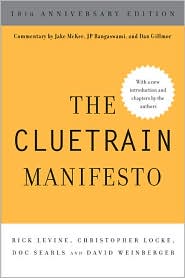
Cluetrain 10th Anniversary edition
Cluetrain 10th Anniversary
Everything Is Miscellaneous
Small Pieces cover
Small Pieces Loosely Joined
Cluetrain cover
Cluetrain Manifesto
My face
Speaker info
Who am I? (Blog Disclosure Form) Copy this link as RSS address Atom Feed

February 10, 2006

Wanted: Open Source Gartner

Jeneane wonders whether there’s a more reasonably priced source for the sort of info industry analysts offer:

The major analyst firms either need to offer a price/platform for indies and new media folks, OR new media folks need to start indie analyst groups of their own, offering their findings at a price that’s at least sort of affordable, which is not $3K for a report.

Or even better, a wikipedia version of research and analysis compilations.

It’s an interesting question because the analyst companies sell their authority as much as their data — believe them when they say the size of the Asian bronzed shoe market will be $1.27 billion this year and $1.31 B next year. I wonder what it would take to have an Open Source Gartner not only with the same accuracy but with enough credibility that one could site it with confidence. [Tags: jeneane_sessum gartner wikipedia]


InformationWeek’s cover story this week is on the conflict of interests that plague the big research firms. The article is by Larry Greenmeier and Paul McDougall, and it airs stuff that needs airing. InformationWeek responds to responses here.

Tweet
Follow me

Categories: Uncategorized Tagged with: digital culture Date: February 10th, 2006 dw

2 Comments »

Bush body language

As Dan Walter points out at Trippi’s site, enlarge the photo of the Clintons to get a sense of how the Bushes feel about them.

I’m sure the feeling is mutual. [Tags: george_bush clinton politics joe_trippi dan_walter]

Tweet
Follow me

Categories: Uncategorized Tagged with: politics Date: February 10th, 2006 dw

22 Comments »

February 9, 2006

WIPO morning

The US delegation to WIPO is pushing for a “webcasting” extension that would require you to get permission before you could reproduce content that has been “webcast,” even if that content is in the public domain. “Webcast” means that some combination of “images or sounds” have been made “accessible to the public…at substantially the same time.” If you find that disturbingly vague, join the club. Then pick up the club and let’s see if we can beat this thing into the ground. (More info here. A list of more info here.)

Making this enforceable would require strong DRM and the “trusted” hardware that trusts us users so much that it locks us out of root control of our own systems. (Enjoy the Vista!)

Yesterday morning I joined about twenty concerned citizens in a discussion with Michael Keplinger, a senior counsel at the US Patent and Trademark Office and one of our representatives to WIPO. It was supposed to last an hour. It went on for almost two. Unfortunately, it was mainly us declaiming, rather than an actual discussion. On the other hand, our aim was to ask for public hearings on the US position on webcasting, which is where the discussion should happen.

Almost everyone had prepared a statement and read it. Because the attendees were diverse — lawyers, musicians, democracy activists, even a couple of telcos — the arguments were also diverse. Some were fairly detailed on legal issues; I personally thought they were the most effective. Here are some of the points people made, in no particular order:

Our WIPO delegation is pushing for a treaty that includes requirements the Congress and courts have already rejected. E.g., the Broadcast Flag.

There will be unintended consequences to this type of change that could be ameliorated if the discussion of the provisions were opened up to include all the stakeholders, including technologists, economists, creators, various businesses, and, most of all, citizens.

Although the treaty is presented as an extension of the Rome Treaty on broadcasting from the ’70s (a treaty the US did not sign), it goes much further, restricting recording devices.

The provisions would greatly impede, and perhaps kill, the open software movement/industry.

Constitutionally, Congress is the body authorized to deal with exclusive rights issues.

This bears on Net neutrality. A Google or Yahoo could gather public domain info and works and have the right to create a “toll road” for access to them.

Copyright clearance is already a mess, but this would add another layer. The difficulty of telling whether a work derived from a webcast work would be an overwhelming burden, especially for smaller companies.

If you had to apply to the government for permission to republish public domain works found on someone’s site, it would be laughed out of court. How can the government then empower broadcasters to limit freedom of speech in a way that the government is not allowed to?

This treaty would add a second layer of copyright without the limitations on copyright that have emerged over the years.

Do we need copyright law to incentivize the production of creative works? Judging from the abundance of creative work on the Internet, apparently not. So, what need does this treaty address?

Do you support a mandatory Fair Use provision in the treaty?

The webcaster’s power seems to be renewed every time the material is downloaded. Is it effectively perpetual?

My takeaway from Mr. Keplinger’s brief response was that the process is too far along for there to be any significant changes to it. Keplinger said explicitly that the time for discussion is once the treaty has been ratified by WIPO and it’s presented to Congress. The USPTO doesn’t hold open hearings during the treaty development process. But, as was pointed out, Congress can only say yes or no to the treaty. Now is the time to have discussions that could shape it.

Nevertheless, it seems to me — i.e., I’m repeating opinions held by people who understand this stuff — this is not a done deal. Congress could reject it, other WIPO participants could strike the Webcasting portion of the treaty, or there even could be sufficient outcry to cause some reflection about it.

Fascinating morning.

(By the way, my remarks were brief. I basically said that the Web shouldn’t be reconfigured so it’s more like a broadcast medium and that it’s bad for democracy and culture when we have to ask permission to talk about works.)

[Tags: wipo digital_rights drm]

Tweet
Follow me

Categories: Uncategorized Tagged with: digital rights Date: February 9th, 2006 dw

4 Comments »

WSJ on FON, disclosure, and my friends

[I’m posting this reluctantly. Ultimately I decided I don’t want the WSJ article to be googled without a response.]

The Wall Street Journal today ran an article by Rebecca Buckman that raises an interesting question but fails to generate an interesting answer.

Disclosure: The article talks about Fon. I’m on its board of advisors. It mentions me. More important, the article impugns the integrity of some of the most ethical and good-hearted people I know.

The interesting question Rebecca raises is whether “influential” (her word, not mine) people on the Web can advise a company and still be honest in their blogging. The subtext is: Bloggers need a code of ethics, just as journalists do. (She asked me this in her interview last night.) She failed to find any cases of bloggers not disclosing their business relationships, however, making the article pretty thin.

Here’s the lead:

When Spanish Internet start-up FON Technology SL tried to generate some buzz this past weekend about new funding it had snared from Google Inc. and eBay Inc.’s Skype Technologies, it pitched stories to traditional media outlets.

But the tiny company also got publicity from another source: influential commentators on the Internet who write blogs — including some who may be compensated in the future for advising FON about its business.

You can almost hear the musical sting: Da da da Dum! But now try replacing the second paragraph with this one:

But the tiny company also got publicity from another source: Influential commentators on the Internet who write blogs — each of whom acknowledged in their posts that they are on Fon’s board of advisors, and most of whom also reported on what they saw as the company’s weaknesses.

Since all the Fon advisors disclosed their relationship, the closest she gets to evidence of her thesis that bloggers are not being transparent is this:

The possible conflicts associated with bloggers may be more nuanced than outright pay- for-commentary scandals, such as the Bush administration’s payments to conservative columnist and radio host Armstrong Williams, disclosed last year, to promote its “No Child Left Behind” policy. Similarly, a high-profile former aide to presidential candidate Howard Dean alleged last year that Mr. Dean’s campaign hired two political bloggers as consultants in the hopes they would say positive things about the candidate.

The reference to the Armstrong Willliams case attempts to say that the the blogosphere mirrors the mainstream when it comes to scandals. But the blogging cases she’s referring to are not simply more “nuanced.” They’re very different. Armstrong Williams was paid to say good things and didn’t disclose the fact. The Fon advisors haven’t been paid, aren’t being compensated to say good things about Fon, have said bad things about Fon, and have disclosed their relationship with Fon.

In the second half of that paragraph she gets to her one piece of evidence of corruption in the blogosphere. She’s referring to last year’s dust-up about Kos. Even that is highly ambiguous: Kos had a notice up on his site stating that he was consulting to the Dean campaign about technology, although questions remain about the Dean campaign’s intent. Is this the best evidence Rebecca can find that bloggers aren’t disclosing business relationships?

In the middle of the article, she makes her claim explicit:

That can be a murky issue in today’s clubby blogosphere, where many people including venture capitalists, lawyers and journalists write about Web issues and companies — and often, each other — with little editing. The rebound in Silicon Valley’s economy, coupled with the popularity of cheap, easy-to-use blogging tools, means there are more aspiring commentators than ever opining about start-ups and tech trends on the Web. And increasingly, it is difficult to discern their allegiances.

Good topic for an article. There’s lots to discuss there. I find the question of the “clubby atmosphere” to be especially compelling. The problem is that her article actually provides evidence that her last sentence is wrong. Judging from the fact that the Fon advisors all acknowledged their relationship and that she can find no instance of a blogger who hasn’t, beyond a dubious case from a political campaign two years ago, her conclusion should be that the Web has ushered in an era of greater disclosure and transparency than ever before.

Rebecca singles out one advisor for special attention: Wendy Seltzer, someone for whom I have the deepest respect and admiration. And love. Wendy spent years as an attorney for the Electronic Frontier Foundation (did you remember to join?) fighting for all our rights online. This year she left to become a law professor and do research on these very same issues. Wendy is as smart as they come and could be making a pile of money. But apparently that’s not what motivates her. When last Sunday Martin Varsavsky blogged that Google and Skype had invested in Fon, Wendy did the normal blog thing of note, emote and point,: She noted she was an advisor, explained what Fon does, and expressed her enthusiasm. She also frankly mentioned one of Fon’s limitations and steered users away from downloading the software. (I think every advisor blogged about qualms and limitations.)

Wendy says in her second sentence that she is on the board of advisors and it is true that she doesn’t then say the words Rebecca longs to hear: “Boards of advisors are typically compensated.” The suggestion that Wendy was trying to mislead her readers is absurd; if that were her aim, she would not have mentioned that she is an advisor. Yet the failure of some advisors explicitly to say “And we may be compensated” is the basis of Rebecca’s article. (David Isenberg expresses this well in a post this morning.)

How else can we explain the fact (which Rebecca notes in her article) that there isn’t even yet a proposal on the table for compensating the advisors? May I suggest the only plausible answer is also the true one: We joined the US advisory board because we believe that Fon just might — a bare possibility now amplified by Fon’s new partners — become a positive disruptive force, bringing wifi to places that business-as-usual would leave behind.

Yes, there are stories to be written about the “murkiness” and “nuance” of the relationships of bloggers to their readers and to companies who pay those bloggers. But, Rebecca could not have picked a worse example than the Fon advisory board: We all were transparent about our relationship and not only is there no current compensation package for the advisors, we still haven’t even discussed it with Martin.

This might have been an interesting article. Instead, it imputes misconduct where there has been none and hypothesizes a trend using examples to the contrary. [Tags: fon rebecca_buckman wsj disclosure ethics media]

Tweet
Follow me

Categories: Uncategorized Tagged with: media Date: February 9th, 2006 dw

30 Comments »

February 8, 2006

Jeneane’s beta

Jeneane blogs about what beta means these days. I, too, remember when beta was a term used in the product development process and was Greek to the marketing department. But, as Jeneane says, the walls between customers and companies are tumbling, and the moment of publication/shipment is getting all fuzzified…usefully. [Tags: jeneane sessum beta marketing software]

Tweet
Follow me

Categories: Uncategorized Tagged with: marketing Date: February 8th, 2006 dw

5 Comments »

February 7, 2006

[berkman] Britt Blaser

Britt Blaser is giving a Berkman Tuesday lunch talk. Britt’s bio is difficult to summarize — from fighter pilot to a force behind the development of interesting software by the Howard Dean campaign. (He’s blogged what he intends to say.)

Today he’s talking about The Open Resource Group‘s ORGware, i.e., “Dean Done Right.” ORGware is a “mall” of software that is useful for citizens engaging in democracy. It has blogs, wikis, a little project management, etc. The aim isn’t to come up with new tools but to make them so easy and so flexible that it’s a “mall” for citizens. It is aimed at governance, not campaigning.

Britt says that the organizational tools for open source software are perfect for software development needs. Now we need organizational tools for democracy, Britt says.

He says : “Smart = busy = distracted = stupid.” So, the tools need to be designed for smart, busy, distracted people.

“Strawberry root activisim”: You need hierarchies to get things done. E.g., a group comes to Britt’s group and they get ORGware that provides a home page, a blog, a wiki, etc. Now some members of that group want to do a project. They can use exactly the same software. Multi-group-to-group goodness happens. (The blog software lets you say that a post is an action to be tracked — “simple project management.”)

Q (me): How does this scale socially? If you have 2,000 people commenting on your blog, commenting won’t work even if the software is up to it.

A: This is where the fractal nature of the software is important. You can spin off a new discussion or group.

Q: You want to turn people into “fire breathing activists” by taking them through a set of stepping stones. What are those stones? Comenting on a blog?

A: We don’t know yet. “Deep inviting” is important: Lots of places draw the reader in.

Britt points to PodSlam.org as the first public use of ORGware. [Tags: britt blaser politics howard dean]

Tweet
Follow me

Categories: Uncategorized Tagged with: politics Date: February 7th, 2006 dw

2 Comments »

Shel on Demo

Until recently, if you wanted Shel Israel’s you-are-there (well, more like you-weren’t-there) reports on conferences, you had to pay Conferenza. Now Conferenza is a blog, and Shel is liveblogging Demo. [Tags: demo shel_israel conferenza conferences]

Tweet
Follow me

Categories: Uncategorized Tagged with: conference coverage Date: February 7th, 2006 dw

1 Comment »

Squirming the attorney general

Tim Grieve at Salon has a good report on Alberto Gonzales’ attempts to avoid telling the truth.

When Gonzales was confirmed, he was asked if the president has the right to wiretap Americans with warrants. Gonzales said it was a “hypothetical” question, even though he knew that that was exactly what Bush was doing. Gonzales replied by saying it was hypothetical that the wiretaps are illegal, thus avoiding the plain sense of the question.

But, says Grieve, Republican Lindsey Graham continued to press the issue:

Graham went after both prongs of the administration’s defense of the warrantless spying program. First, he dismissed out of hand the notion that Congress somehow implicitly authorized warrantless spying when it adopted its use-of-force authorization after 9/11, and he cautioned Gonzales about making such a “dangerous” argument: If the White House reads the use-of-force authorization too broadly, Graham said, future Congresses will be wary when future presidents come looking for authority to use force against enemies.

Graham then set his sights on the argument that the president has inherent authority as commander in chief to do what it takes to keep America safe. It’s a fine theory, Graham said, but it’s one that knows “no boundaries.” If the Constitution allows the president to engage in wiretap in seeming contravention of the Foreign Intelligence Surveillance Act of 1978, doesn’t the Constitution also allow the president to ignore the new law that prohibits the United States from engaging in torture? Graham put the question to Gonzales, but the attorney general wouldn’t answer it, exactly, saying that the torture statute isn’t the subject of today’s hearings. Which is another way of saying, we suppose, that questions about it are “hypothetical.”

It turns out usurping Congress’ power is a bipartisan slap in the face.

Plus: Why is the chief law enforcement official in the US squirming, hairsplitting and dissembling? [Tags: george_bush alberto_gonzales politics]

Tweet
Follow me

Categories: Uncategorized Tagged with: politics Date: February 7th, 2006 dw

5 Comments »

Webcasting WIPO meeting

Tomorrow I’m going to a meeting in DC with the US delegates to WIPO to try them to go to Congress before proposing a new “Webcasting” provision that would require you to get permission before you could reproduce content from someone else’s site even if that content is in the public domain. This extends to distributors the (insane) power that content owners currently have. Not only would this further restrict the flow of ideas, it would also require strong DRM be installed on every machine. (I blogged some sources here.)

It looks like about 30 people will be at the meeting. I am among the least qualified to talk on this topic, so I am going in order to be a solid life form with an intent look on its face. Should be interesting… [Tags: wipo digital_rights internet copyright]

Tweet
Follow me

Categories: Uncategorized Tagged with: digital rights • media • politics Date: February 7th, 2006 dw

3 Comments »

February 5, 2006

Google and Skype team on wifi

Martin Varsavsky has just blogged about what I think is an amazing feat: Google and Skype have both invested in a company he started three months ago that aims at enabling a global wifi network bottom up.

Disclosure: I’m on the US board of advisors. And I have to say, the past few months have been quite a ride. Martin has been out doing deals with the energy of eight Jolt-chugging entrepreneurs. It’s coming together beyond anyone’s expectations, though. I would never ever have thought Martin and his tiny team could have pulled this off.

It’s been brought together incredibly quickly so there are still some loose ends and rough edges. Nevertheless, here’s the idea.

Fon does not want to wait for top-down wifi solutions. Instead, it provides a couple of incentives for people to get a wifi router and begin sharing access.

If you’re a “Linus,” you let any other fonero use your hotspot for free. In addition to savoring the joy of altruism, you’re allowed to use any other fonero’ss hotspot for free, anywhere in the world.

If you’re a “Bill,” you get a cut (I think it’s 50%) of the money foneros pay to use your hotspot. You cannot roam the Fon network for free.

If you’re an “Alien,” you register with Fon (for free) and then can use Fon hotspots wherever you find them for a rate far lower than you’re paying T-Mobile or Starbucks, etc. Fees have not been finalized, but it’s going to be way under the $6/hour typical in the US.

The aim is to provide enough incentives, and make it easy enough technically, that thousands of people will start providing Fon hotspots. Bottom up we can have a global network, usable for free by those who choose to share access for free and for an affordable fee by others.

If you know anything about Martin, you know that, having made a bunch of money as an entrepreneur, his heart and hands are all about making the world better. That’s the motivation behind Fon. Fon is especially interested in helping to grow wifi in poorer parts of the world.

But Fon has dreams even beyond this. It can be a platform for innovative community development. There are some really really interesting ideas in the works. Say no more.

There are, however, a couple of hitches.

First, to become a Linus or Bill, you have to have a wifi router with Fon software. The Fon software isn’t yet ready for end-user installation. It’s based on open source code by Sebastian Gostchall (Brainslayer) at www.dd-wrt.org. You can play around with it if you’re techinical enough, but only if you’re prepared for the possibility that you’ll trash your router. The right way to become a Fonero at this point is to buy a wifi router with the Fon software already installed. The Fon site will be selling such routers well below cost to the first 3,000 users. In a few weeks or so, the Fon site will also be offering an open source version of the dd-wrt software that can be installed by non-techie users.

Second, if you have an open hotspot now, you won’t once you’ve flashed it with Fon software. Fon isn’t aimed at people who (like me) already maintain an open hotspot. It’s aimed at the 99.9% of the world who doesn’t know WEP from an analog hole in the ground. By the way, Fon will include open hotspots in the maps of Fon access it’s preparing.

Third, before you become a Fonero, you should read the terms and conditions of your contract with your ISP. Fon is talking with some of them to make sure they’ll allow subscribers to become Foneros. This can be a source of revenue for the ISPs (see Ejovi’s post) and we’re hopeful that some will be enlightened enough.

Fourth, have I mentioned that this thing is moving at lightning speed? The Web site is a draft. But if Fon gets to critical mass — which is smaller than one might think — it could be more significant than perhaps even Martin has dreamed.

And with Skype and Google behind Fon, the impossible is already happening.

[Tags: fon martin_varsavsky google skype wifi]


Additional blog posts on Fon:

Ethan Zuckerman
Wendy Seltzer
David Isenberg
Juantomas Garcia (in Spanish)
Rebecca MacKinnon
Dan Gillmor
Anmtoin O Lachtnain
Doc, Lord of Searls
Antoin O Lachtnain


Follow up to the disclosure statement above: The US advisory board for Fon has been working unusually closely with Martin and Fon’s tiny staff. Martin has been unusually transparent about the process. The advisors are working on this because we believe in the power of wifi and the importance of getting it to places that purely economically motivated players will put last. The advisors are being financially compensated, but we haven’t discussed the terms; that’s not our primary motivation. Since I sometimes write about Google and Skype, you should know that they’ve invested in a company that I apparently have some financial stake in.

Tweet
Follow me

Categories: Uncategorized Tagged with: web Date: February 5th, 2006 dw

15 Comments »

« Previous Page | Next Page »


Creative Commons License
This work is licensed under a Creative Commons Attribution-NonCommercial-ShareAlike 3.0 Unported License.
TL;DR: Share this post freely, but attribute it to me (name (David Weinberger) and link to it), and don't use it commercially without my permission.

Joho the Blog uses WordPress blogging software.
Thank you, WordPress!