



logo
EverydayChaos
Everyday Chaos
Too Big to Know
Too Big to Know
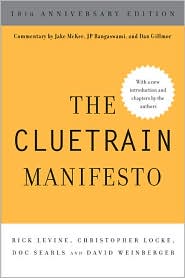
Cluetrain 10th Anniversary edition
Cluetrain 10th Anniversary
Everything Is Miscellaneous
Small Pieces cover
Small Pieces Loosely Joined
Cluetrain cover
Cluetrain Manifesto
My face
Speaker info
Who am I? (Blog Disclosure Form) Copy this link as RSS address Atom Feed

November 17, 2005

Preparing for my Mac

My PowerBook is presumably on its way. My expectation is that the robustness of its hardware will be on a par with my Thinkpad X40 (well, not this particular X40 since it seems to be a lemon) but that its software will be far more robust and require less maintenance. I’ve used Macs on and off for many years, and am the reluctant sys admin for my father-in-laws Mac OS X desktop, so I expect the learning curve to be steep and that I will find it somewhat less elegant and wonderful than y’all think I should.

I’m looking for suggestions for what I need to equip my machine with. I am not looking to spend a lot of money. Also, keep in mind that my big Windows desktop machine is my primary work computer. I’ll be using the Mac for when I travel.

I need:


Powerpoint. I make a good proportion of my living giving speeches and I use just about all of Powerpoint’s animation capabilities. Open Office doesn’t quite match it yet. And seamless integration with Powerpoint on my desktop would make life simpler. Hence, I think the answer is: Powerpoint.

Word-compatible word processor. Since the only way to get Powerpoint is to get it with Word (I believe), I’ll probably be using Word.

Graphics program. Vector and raster editing. I use Paintshop Pro 9 on the PC. I’m not a power user, but I do need to edit images, use some special effects, etc.

HTML editor. I use DreamWeaver on the PC. It’s got lots more than I need, although I like that.

Email client. I expect I’ll either use the one that comes with it or Thunderbird.

Browser. I’m very fond of Firefox on the PC.

I would like:

Programming environment. Don’t throw dead cats at me, but I’m an amateur Visual Basic programmer. I enjoy it. I was a marginally ok amateur C programmer, and once wrote a book on Lisp for beginners (very very beginners), but I crapped out at C++ and Java. Too abstract for me. I like languages that make it easy to create forms/UIs. Any suggestions? Maybe I’ll try Squeak again.

Emulator software? Too much of my work environment is stuff I’ve written in VB. E.g., my blog editing software. Any recommendations about emulators that might possibly run that stuff?

Fun:

Games. Something to play on an airplane. Free would be good.

Music editor. Anything minimal around that will let me paint notes on staves and play back the cacophony?

Hardware:

What do you recommend as essential add-ons?

Utilities and misc.:

IRC. I’ve been using Hydra. Chatzilla is ok, though.

Skype. The one and only.

IM. I use AOL’s. Do I like it? Not particularly.

Text editor. I primarily use TextPad. I’d be ok with any other non-wimpy text editor. Heck, I’d even consider returning to emacs. I hear it’s still In.

What do I not know enough to know I need?

Sites.:

What are the essential sites? For downloading software? For advice? For making fun of those poor, loser m$sft Windoze users?

Jeez, this list is getting expensive. I just remembered another reason I’ve resisted geting a Mac.

Thanks for whatever advice you can give me. [Later: I added some stuff after reading Bryan Strawser’s list of essentials. [Tags: mac macintosh apple]

Tweet
Follow me

Categories: misc Tagged with: misc Date: November 17th, 2005 dw

73 Comments »

Cameron Reilly interview podcast

Cameron Reilly has just posted a 70 minute (!) podcast interview we recorded last night. It was fun and wide-ranging. Best of all, every twenty minutes, we mention Doc.

(You will hear me sputter when Cameron comments about “getting chicks.” I’ve lost my sense of humor on this topic.)


To continue my court-ordered mentioning of Doc every 20 minutes, this morning something else occurred to me about Doc’s seminal piece on the threat to our Internet: Maybe Doc thinks of re-framing as the solution because he’s a writer, a word guy – and, btw, a great re-framer.. It’s like philosophers thinking that humans are primarily rational because philosophers (generally) proceed via reason. [Tags: podcast CameronReilly DocSearls]

Tweet
Follow me

Categories: Uncategorized Tagged with: uncat Date: November 17th, 2005 dw

1 Comment »

Get the IRS out of the pulpit

The IRS has started an investigation into whether the All Saints Episcopal Church in Pasadena should retain its tax exempt status because a few days before the 2004 election campaign the rector emeritus, George Regas, gave a sermon arguing against the Iraq war on moral grounds. The letter from the IRS complains that Regas “delivered a searing indictment of the Bush administration’s policies in Iraq, criticism of the drive to develop more nuclear weapons, and described tax cuts as inimical [opposed] to the values of Jesus.” The church has a long history of supporting progressive activism.

Here’s the sermon: “If Jesus debated Senator Kerry and President Bush.” Regas begins by explicitly acknowledging that people of faith support each candidate, and he’s not going to tell anyone how to vote. Then he looks at how he thinks Bush and Kerry stack up on three issues, war, poverty and hope. The section on war is explicitly a condemnation of Bush’s policies. The section on poverty is neutral until he gets to the question of abortion rights where he explicitly contrasts his views with conservatives’. The hope section is generically uplifting. He ends by urging congregants to take “Jesus, the peacemaker” into the booth with them. (Here’s a copy (pdf) of the sermon at the church on November 13, 2005, about the IRS action.)

This sermon was an argument against Bush’s policies. (There’s almost nothing about Kerry in it.) But so what? The line between religion and state does not and should not keep religious leaders from talking about political issues. From abolition to civil rights to Vietnam, we have a long and admirable tradition of churches being engaged in social and political issues. There was nothing coercive in Regas’ speech. He didn’t tinstruct congregants to vote for Kerry or threaten to excommunicate or shun those who vote for Bush; in fact, Regas acknowledges that faithful, good people may well decide to vote either way. He wasn’t covertly collecting money and using the church to organize voters. He was applying his understanding of his religion’s values to the issues of the day. Isn’t that what we want?

And, yes, I would say the same things about a different sermon that argued that Bush’s policies are exactly What Jesus Would Do.

BTW, the Interfaith Allilance thinks that the IRS action might have been intended to soften opposition to House Bill 235, legislation supported by the religious right that would permit sermons endorsing candidates.

There’s a public statement you can sign here. It tries to find the right balance between permitting our religious organizations to proffer moral advice, and even to rail against the government, and preventing them from becoming political action committees. It is not an easy line to draw, but in this particular case, it seems clear to me that the All Saints church did not cross it. [Tags: religion politics irs]

Tweet
Follow me

Categories: Uncategorized Tagged with: politics Date: November 17th, 2005 dw

3 Comments »

[corante] My opener

Liz Lawley has good coverage of my opening comments at the Corante conference on social software. (Thanks, Liz!) [Tags: coranteSSA LizLawley SocialSoftware]

Tweet
Follow me

Categories: Uncategorized Tagged with: digital culture Date: November 17th, 2005 dw

Be the first to comment »

November 16, 2005

Doc and hope

Doc’s posted a great (and longish) piece on saving our Internet. He cogently lays out the threats from the carriers.

His solution is important and right but, I’m afraid, not enough. Changing how we speak — reframing the issues — takes longer than we have. Plus, this particular framing is entangled with deep and deeply-motivated cognitive-economic systems being driven by the most powerful frame-makers in our culture: The media and government. So, yes, reframe! Never ever ever utter the phrase “intellectual property” again, for example. But I fear that we need much more than that much faster.

My positive proposal? Join me in my trough of despair.

Although yesterday, after giving two interviews in which I was relentlessly hopeless — heartbroken is actually the more accurate term — about the Net’s future, two people said things that gave me a little hope.

Chris Nolan believes that wifi will become enough of a consumer (sorry, Doc!) issue that Congress won’t be able to enact a new telco act that outlaws wifi sharing.

Then I talked with Charlie Nesson of the Berkman who made a case for universities becoming such a bastion of the open Internet and the intertwingling of knowledge that they make it impossible to close our Internet. The could be champions of our Net.

Speaking of universities, Frank Paynter a couple of days ago said he wished the university libraries would take more of the brunt of the challenge to Google Print than Google is. Google is, after all, a public company and many distrust it. It would indeed be very very interesting if Harvard, Oxford, the Univ. of Michigan, etc., were to offer their copies of Google Print’s scans to the public as appropriate. I agree with Frank: I’d rather see the Author’s Guild sue the Harvard Library than Google only because Harvard is out to educate people, not to make money for its shareholders. [Tags: DocSearls SaveOurInternet ChrisNolan CharlieNesson FrankPaynter google GoglePrint berkman]

Tweet
Follow me

Categories: Uncategorized Tagged with: digital culture • digital rights Date: November 16th, 2005 dw

5 Comments »

Palfrey on being filtered in Tunisia

John Palfrey of the Berkman is in Tunisia for the WSIS meeting and writes about the need for the Open Net Initiative. Ethan also writes about the general infophobia of the conference itself. The Berkman Center has in fact just posted the latest in its reports on what sites particular countries are blocking. This report’s subject: Tunisia.

Andy Carvin is rounding up blog reports from the conference. [Tags: wsis JohnPalfrey EthanZuckerman AndyCarvin regulation UN berkman]]

Tweet
Follow me

Categories: Uncategorized Tagged with: digital rights Date: November 16th, 2005 dw

2 Comments »

Hardware woes

My Thinkpad is scheduled to go back to the shop on Thursday. A 5-hour chkdsk session seems to have cleared up some of the disk issues. The remaining problems are:

1. USB ports don’t work. They don’t even work on boot up, so it is not a Windows driver issue.

2. The IBM rescue partition doesn’t load.

3. Performance is worse than sluggish because a process called System (not System Idle) takes up 99% of my CPU. (The System process apparently is a catchall for kernel threads.)

Sigh.

PS: Unless you will personally warrantee the Mac you want me to buy — including you paying roundtrip Fedex if it needs repairs — do not leave a comment that I should be an aforementioned Mac. Thank you. [Tags: thinkpad]


Scott Kirsner argues that Apple is favoring Goliath over David (to use his trope), in an op-ed in the SF Chronicle today.


A PowerBook (12″, 60mb, 528mb ram that I’ll up to a gig) is on its way, thanks to the Harvard discount. And my Thinkpad is on its way to being repaired; I’m not ready to give up on it yet. I’ll blog later about why, as someone who has used Macs on and off since the mid-80s, I am not the fan that the rest of you all seem to be. I’m not saying I’m right. I’m just saying I enter this new phase of my life with trepidation.

Tweet
Follow me

Categories: Uncategorized Tagged with: tech • whines Date: November 16th, 2005 dw

19 Comments »

November 15, 2005

[corante] Social media and politics

Chris Nolan moderates a panel with Zephyr Teachout and Andrew Rasiej.

Andrew says most politicians are technologic idiots. He says that in 2001 Sen. Diane Feinstein said that she didn’t think the Senate should not be on the Internet until the pornography and pedophilia is gone. Sen. Chuck Schumer then asked Andrew: I get 10,000 emails a day. How can I make them stop.

Zephyr talks about a college course she’s teaching on politics and the Internet. She says she has her students studying Estonia, which is highly wired and has integrated governance and the Net.

Z: Even if FEMA had messed up in every way they did, if they had made their data transparent…

Andrew: I went to DC and suggested the creation of the equivalent of a National Guard of techies. Deploy wifi transmitters, etc. It passed 97 to 0 as part of the Homeland Security Office. But no one has done anything about it.

Andrew: During the campaign, I met Michael Bloomberg. He said to me, “Oh, you’re the wifi guy!” [Andrew ran for NYC ombudsman in part on a muniwifi platform.” Bloomberg then asked, “Would we have to dig up the streets?” People in that operating system believe that networks consist of people who have touched one another’s skin. [HE demos a politicians arm grip.] People in the power structure have no threat of risk from these new networks. It’ll take a change in generation.

Q: Much as we may scoff at Bloomberg, et al., we should put ourselves in their mindset. [Discussion ensues.]

Z: In the UK, they have started having limited term engagements with politicians. E.g., a month of chat with an MP. A good way to introduce them.

Chris: The Telcom Act of 1996 is being rewritten. She hopes that wifi will become a consumer issue because then the politicians won’t be able to cut off access. [I wish I agreed.]

Q: Does this start with the cities? With the technorati?

Chris: Yes.

Z: Other campaigns don’t want to hear about any lesson from the Dean campaign beyond building the email list because the rest of it was about losing control…no, that’s the wrong phrase (Z says). It’s about trust.

Andrew: I’ve suggested to MoveOn.org that they introduce their members to one another. But they’re afraid that some group will do something embarrassing, e.g., equate W with Hitler.

[Tags: corante SocialSoftware CoranteSSA]

Tweet
Follow me

Categories: Uncategorized Tagged with: conference coverage Date: November 15th, 2005 dw

5 Comments »

[corante] Social software and the media

JD Lasica leads a panel on what the media will look like. On it are public radio guy Tony Kahn, RocketBoom‘s Amanda Congdon, and Lisa Stone the law blogger.

Amanda: “We think our viewers are smart. That sets us apart from traditional media.” About 20% of RB’s stories come from user suggestions.

Tony: “After 35 years in the media, I finally found this new medium [podcasting Morning Stories] that allows me to have fun.” It began as a broadcdast. It still is: Once a week to 20,000 listeners. The podcdast is downloaded 300,000 times a month. Then it became a videocast, another barrier knocked down. He says that the traditional public radio infrastructure is both fascinated and terrified by the new media.

(JD puts up on the screen NowPublic. Looks interesting.)
Lisa spends time with mainstream news media, evangelizing the new way of thinking. They are aware that the growth in news is online.

Mary Hodder: Please put media into reusable formats. Of the 72 places I’ve found for uploading video, half translate into Flash, which is not reusable.

Amanda: Yes. We’re Creative Commons and Quicktime.

David Cooperstein: Will traditional media insist on owning their communities?

Lisa: Their incentive is to find a way to capitalize on the Web. (She recommends Lisa William’s excellent piece on PressThink.)

Q: Do you align yourself more with newspapers, public radio…?

Amanda: We’re looking for our own model. We have 100,000 downloads a day. In March we could have been bought out by a huge company, but we won’t do it.

Tony: The established markets and ways of doing business won’t be the solution. Something new will be invented. What’s fueling this are individual voices, inspired and passionate…

[Tags: corante SocialSoftware CoranteSSA]

Tweet
Follow me

Categories: Uncategorized Tagged with: conference coverage Date: November 15th, 2005 dw

3 Comments »

[corante] Social software: Lens or mirror?

Liz Lawley leadsa a discussion of issues around how we organize ourselves online. She points out the the hostility toward conversation built into the architecture of this room. She points out that a significant portion of the audience consists of people who see one another at conferences frequently, while the rest are not a part of this permanent floating conversation. (She’s posted a bunch of quotes relevant to the topic on her blog.)

Tina Sharkey of AOL says they try to avoid getting into the middle of the conversations.

Joe Hurd formerly VP of BizDev at Friendster, asks if social software is very much a US thing. Friendster never really took off in Japan, he says, because there is a cultural reluctance to put a lot of information about yourself online, and even more reluctance to make your social network available online.

Tina: Comfort is such an important factor.

Q: The new language of IM. which I see my daughter using, excludes me.

Q: (me) Liz began with a quote from Churchill about us shaping our buildings and then our buildings shaping us. So, how can we shape the software so it doesn’t exclude entire cultures, especially within a global company? Or is it that software has to have some shape, so someone should be excluded?

A: Pay attention to what your users want. Give your users the tools so they can shape their space. [Ok, but the shaping happens at a fundamental level: You have a profile or you don’t. You can use multiple screen names or you can’t.]

Tina says rather than aggregating content, we can aggregate people and the content will follow. E.g., Stowe mentions LastFM (?) that lets you find other people with similar music tastes. [And social groups have formed at del.icio.us around people who use the same tags.]

Liz: There’s also the tyranny of the crowds: “Everyone is linking to that so I should also.”

Q: Large communities are fragile. What keeps communities robust and dynamic? And if you look at Xanga – 23M users, but no one talking with anyone else – it’s not a community of affirmation.

Joe: You keep giving new capabilities, e.g., photo uploading.,

Liz: My students say that a lot of these sites are fun for two weeks, but then there’s nothing left to do there. LiveJournal works because there’s always new content. [Is FaceBook an exception?] [Tags: corante SocialSoftware CoranteSSA]

[Tags: corante SocialSoftware CoranteSSA]

Tweet
Follow me

Categories: Uncategorized Tagged with: conference coverage Date: November 15th, 2005 dw

4 Comments »

« Previous Page | Next Page »


Creative Commons License
This work is licensed under a Creative Commons Attribution-NonCommercial-ShareAlike 3.0 Unported License.
TL;DR: Share this post freely, but attribute it to me (name (David Weinberger) and link to it), and don't use it commercially without my permission.

Joho the Blog uses WordPress blogging software.
Thank you, WordPress!