


logo
EverydayChaos
Everyday Chaos
Too Big to Know
Too Big to Know
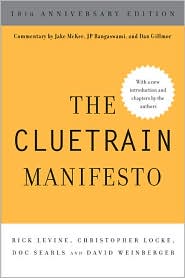
Cluetrain 10th Anniversary edition
Cluetrain 10th Anniversary
Everything Is Miscellaneous
Small Pieces cover
Small Pieces Loosely Joined
Cluetrain cover
Cluetrain Manifesto
My face
Speaker info
Who am I? (Blog Disclosure Form) Copy this link as RSS address Atom Feed

October 3, 2005

[Accountability] Mary Robinson

I’m at a conference called “AccountAbility: Reinventing Accountability for the 21st Century.” A few minutes of conversation discloses that “accountability” means something different here than in the US. In the US, accountability is a magical belief in the power of paperwork to end all corporate crime. Accountability is imposed by the government. In Britain, “accountability” is a term used by social do-gooder groups to beg big corporations to stop killing us and our world. (“Do-gooder” is, for me, a term of high praise.) Conference sponsors: Edelman PR, Shell Foundation, Barloworld. Second-level sponsors: OpenDemocracy, Civicus, Keystone, Great Place to Work.

[Nevertheless, the session I’m participating in seems to use the term in the US sense since it poses accountability as the solution to the “problem” that anyone can say anything she wants on the Internet. Also, the program lists something about “PR” in the subhead, but not in the materials I’ve seen. That explains why Edelman PR (who paid my way here and to whom I consult) is sponsoring the conference and moderating the panel. But since 2 of the 3 panelists are mainstream media news people, and the session blurb is about news and the Internet, I doubt we’ll spend much time on PR.]

About 250 people are here. Quite diverse in gender and color.

Tom Delfgaauw opens the plenary session by saying that the key question of the conference is: What are the accountability innovations required in the next few years to achieve the environmental, economic and social objectives lis

First speaker: Mary Robinson whose resume is too long and astounding to capture here, except maybe to say she’s a former president of Ireland, former UN High Commissioner for Human Rights, and director of the Ethical Globalization Initiative and honorary president of Oxfam. She says 191 countries have agreed to support the rights of children, although not all live up to it. The two countries who have not are Somalia and the US. Human Rights is underfunded by the UN, she says.

Now she talks about the role of business in human rights. She says that Kofi Annan has appointed someone to investigate this very question. “It’s a weak mandate,” she says, but quite important. The WEF is also looking into this.

Because of the rise of importance of “civil society” groups, they need to be accountable, too. (She says they are sometimes called the “second world power,” unknowingly quoting Jim Moore.)

She talks about “accountability innovations”: 1. Business Leaders Initiative on Human rights. This is modeled on the BLI on Climate Change, which is easier to measure. 2. The UN’s Global Compact — she thinks it’s an entry point for global corporate responsibility. She says 800 companies doing business in China have signed up. At Aspen recently, an audience of CEOs had never heard of the Global Compact. She asked why they wouldn’t take the opportunity to help “level the playing field of values.” 3. “Trying to make trade fair by bringing the hman rights approach to it.” She says the reason babies lie in ditches as their mother harvest cotton in Mali is the US’s $4B subsidy or cotton. The EU, she says, is headed in a similarly wrong direction wrt sugar in Mozambique. “Stability of consumers” is in the interest of global business.

She ends by telling of a conversation yesterday with a 24-yr NGO worker outside of Capetown (he works on AIDS and nutrition-related issues) who complained about the appalling level of corruption in NGOs. “There might be a danger that we look how to control those at the top…but how do we make it culturally vibrant for small NGOs to resist being corrupted?” (The 24-year-old, she says, is her son.)

In response to a question, she says that she’s depressed by the political situation in Australia, where steps she considers to be ineffective in increasing security are worsening human rights.

Q: Can we recast accountability as “democratic competence” as a citizenship-building strategy?

A: I’m very interested in reframing it this way. There’s broad support for democracy. If we could harness some of that constituency…

Q: Isn’t the increasing disparity of income and wealth having a determintal effect on accountability?

A: Yes.

Q: What do US companies say about why they’re not signed up to the Global Compact?

A: Three factors: 1. They do not like the UN. 2. Those who have actually looked at it have said,l “We’re doing it anyway. Why should we bother reporting to the UN.” 3. Fear that at some stage it’ll become mandatory.

[Tags: accountability HumanRights ngo]

Tweet
Follow me

Categories: Uncategorized Tagged with: conference coverage Date: October 3rd, 2005 dw

4 Comments »

October 2, 2005

Why accountability now?

Tomorrow, I’m on a panel at an Accountability conference in London. Also on the panel: John Lloyd (editor, Financial Times Mag) and Richard Sambrook (dir., Global News, BBC). (I am a huge admirer of Sambrook. (I don’t know Lloyd.)) Topic: “Democratization of Communications: Technology and Accountability.” The question the panel is addressing: “Transparency…has been lost in translation and the Net is becoming increasingly unaccountable in sourcing misleading information to the general public and even to the media. What accountability approach may preserve this global virtual space for democracy?” Each panelist gets 7 minutes to speechify at the beginning. Here’s something like what I’m thinking of saying:


That this way of formulating the question seems reasonable terrifies me.

Let me put it like this. Suppose we were to listen in on conversations in bars and around dinner tables around the world. We would hear the most appalling ideas. Misinformation. Gossip. Outright lies. It’s a global epidemic! Would we then ask what accountability approach may preserve this global conversation space? Shall we inspect every conversation? Punish people for saying false things? Require them to publicly retract what they said because of the harm they’ve done? That would, IMO, do more harm than good.

I think we have to ask why the word “accountability” is showing up. Why is it now becoming so hot that it’s even paired against transparency, as if they were opposites, which they most decidely are not. Why accountability now?

After all, we have other words that serve well. For example, guilt. If someone does something wrong, they are guilty and some consequences should follow: Retribution, restitution, the cold shoulder, loss of respect…depending. What does “accountability” add to this? It implies a system that tracks each act, which digitally means each bit, in order to catch the few who are guilty. In the real world, such a system would be easily identifiable as totalitarianism, the infrastructure of a police state. So why does it seem plausible and even desirable on the Internet?

First, because on the Internet, we can track every bit. Or we could if we just altered the Internet enough. Say, like in China. If you want to see an accountable internet, that’s where you should look. After all, China simply wants to prevent false ideas from spreading and doing harm to the Chinese people. [Note for the irony-impaired: I am using this as a negative example.]

Second, we’re being seduced by a false vision of fairness perpetrated by traditional content producers and traditional political authorities. The fairness argument goes like this: Fairness consists of an equal exchange of value. If you buy shoes, you get the shoes and the shoe store gets your money. That’s fair. If, however, you pay leather prices for plastic shoes, the exchange was unfair. So, the argument goes, we want a system that maximizes the equal exchange of value.

Sounds right, but what would happen if this fairness were strictly enforceable in the real world? As it stands, if you buy a book, you can read it twice without paying the author again. You can lend it to a friend. She can sell it to a used book store. You and others just keep getting more and more value from the book, but the original bookstore, the author and the publisher don’t see a penny of that. It’s so unfair! [See above note for the irony impaired]

And according to the idea that fairness is the equal exchange idea of value, it is indeed unfair. But that only means that fairness — at least, this type of fairness — is not the highest societal value. Culture works by having ideas, tunes, images appropriated by the members of society. We make them our own. We quote and misquote the phrases, we whistle and mis-whistle the tunes, we combine them into messes and forget where we got the initial ideas. We build on them. We mutate them. We make them ours. A niggling idea of fairness would kill culture. Ideas succeed by becoming unaccounted-for.

We’ve allowed the trampling of this idea of fairness because we had no choice. But in the digital world, we can track every turn of the page. Culture is rapidly moving online. n the name of fairness, we are going to kill culture.

This ability to track every bit makes accountability possible, to protect “content” and to prevent the spread of ideas that are wrong…or that we just can’t tolerate. Accountability is now more attractive than ever because we are afraid of what will happen if everyone is allowed to speak, to explore, to get things right and wrong. But it’s more important to democracy, culture, the advancement of thought and the healing of the world to permit open, free, anonymous, playful talk than it is to tag every bit so it can be held against you.

So, yes, we need ways to counter the bad and sometimes fatally wrong ideas on the Internet. Let me suggest three. What would you do if you found out that human conversation was frequently way off track? First, engage in the conversation. Second, let’s work on educational systems that face the fact that the walls are down. Third, where more transparency and accountability are required, then let the people who are engaged in the discussion work on ways to improve the discussion; the Net has a remarkable history of enabling solutions to emerge that are far better than what outsiders would have imposed.

In short, keep your hands of our Internet.


[Disclosure: Edelman PR, to whom I consult, put the panel together and is paying my expenses.] [Tags: accoutnability DigitalRights anonymity]

Tweet
Follow me

Categories: Uncategorized Tagged with: digital rights Date: October 2nd, 2005 dw

8 Comments »

October 1, 2005

Upping the embarrassment

I’m conflicted about blogging about this because I don’t know how to do it without sounding self-righteous. But I also think we generally need to surface stuff like this. So here goes.

Last week I was invited to attend a day of discussions about a tech topic with cultural and economic consequences. But, because I hadn’t responded to the first invitation (the msg got lost in my spam stream, I think), the organizers sent me a followup that included the list of about 20 attendees. The list of attendees is amazing. A fantastic group. I’d love to spend time with them. But everyone on the last was a man. The list wasn’t mainly or predominately male. It was 100% male. (The other attendees had not seen the list, so they did not know of its homogeneity.)

I want to go primarily because I want to meet these folks. I want to know them. I want them to know and like me. It’s the networking that attracts me. In other words, this is exactly how the old boy network is built and maintained.

When I told the organizers why I wasn’t coming, they replied that they had invited three women who turned out to be unavailable. After our conversation they have invited some more women. But, only a few because, they told me, they’re trying to keep the total number of participants down so it will be more intimate – more better bonding! I told them they could use my spot to invite another woman. Have I mentioned that this is how the old boy network is formed?

I’m not naming names because that’s not the point. The organizers certainly weren’t trying to create an all-boy meeting. It was bad luck that the three women they invited were unavailable. But three isn’t enough, and the fact they ended up with none didn’t strike them as a problem. And that is the problem. This isn’t a matter of quotas. It’s not about math. It’s about power. It’s about men strengthening bonds that have real consequences. The perfect gender homogeneity of this meeting is inadvertent but it’s inexcusable. We have to get to the point where this is prima facie shameful and unacceptable. We have to get to the point where this is just plain embarrassing.

Tweet
Follow me

Categories: Uncategorized Tagged with: politics Date: October 1st, 2005 dw

27 Comments »

Bloggy dinner in London on Sunday?

I’m flying to London tonight for a conference on Monday. So, any London-ish bloggers want to get together for dinner Sunday night? Indian food maybe? I’ll be jet-lagged and especially cranky!

My email: self@evident.com.


Ok, it looks like a small group of us will be eating at Preem, 120 Brick Lane, at 7pm on Sunday. Woohoo! (Please try to let me know by email if you’re interested so we can gauge the size. Thx.)

Tweet
Follow me

Categories: Uncategorized Tagged with: travel Date: October 1st, 2005 dw

5 Comments »

« Previous Page


Creative Commons License
This work is licensed under a Creative Commons Attribution-NonCommercial-ShareAlike 3.0 Unported License.
TL;DR: Share this post freely, but attribute it to me (name (David Weinberger) and link to it), and don't use it commercially without my permission.

Joho the Blog uses WordPress blogging software.
Thank you, WordPress!