


logo
EverydayChaos
Everyday Chaos
Too Big to Know
Too Big to Know
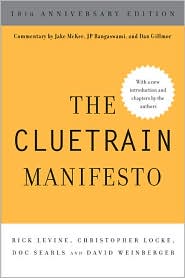
Cluetrain 10th Anniversary edition
Cluetrain 10th Anniversary
Everything Is Miscellaneous
Small Pieces cover
Small Pieces Loosely Joined
Cluetrain cover
Cluetrain Manifesto
My face
Speaker info
Who am I? (Blog Disclosure Form) Copy this link as RSS address Atom Feed

September 15, 2005

Permission-free saves lives

Jennifer Granick explains why the fact that we don’t have to ask permission to access unsecured computers on the Net enables the growth of innovative and potentially life-saving technology. Her example: KatrinaList.net. (Thanks to David Isenberg for the link.)

Tweet
Follow me

Categories: Uncategorized Tagged with: digital rights Date: September 15th, 2005 dw

1 Comment »

The Bush Notes

The Reuters photo of President Bush scribbling a note to Condi in the UN asking for a bathroom break is just the first.

Real Bush note
Real photo. Click for the bigger picture

Here are the other notes they caught on film.

Fake Bush note
Fake Bush note
Fake Bush note
Fake Bush note

Please feel free to contribute your own cheap shots.


It turns out that the person who took the photo didn’t know what it said until Reuters enlarged it.

Tweet
Follow me

Categories: Uncategorized Tagged with: humor Date: September 15th, 2005 dw

7 Comments »

Mitt’s big idea

Reacting to concern about Catholic terrorist actions in Ireland and elsewhere, Massacusetts Governor Mitt Romney today suggested wiretapping churches…

…except that in reality he recommended wiretapping mosques. (Substitute “churches” and you can see how outrageous the idea is.) Mitt is telling the world that we think Islam, not Islamic terrorists, is our enemy. Mitt’s given the terrorist propagandists a gift and we are all less safe because of it.

Blanket wiretapping of mosques would also be a huge erosion of our civil liberties: We can monitor and wiretap your faith-based conversations, so to speak, simply because you belong to one of the West’s three major religions?

Mitt, a self-proclaimined expert in homeland security, is going in entirely the wrong direction. The Globe quotes Ali Noorani, exec. dir. of the Massachusetts Immigrants and Refugee Advocacy Coalition:

”Blanket eavesdropping and blanket profiling only erodes the safety and security of our country,” Noorani said. ”People who really know what national security is and what intelligence is realize that we need to build trust between law enforcement and immigrant communities.”

I can’t wait until Mitt, a man without political integrity, is out of Massachusetts. Given his recent statements and schedule, it sounds like he can’t wait to leave either. Win win. [Tags: MittRomney security]

Tweet
Follow me

Categories: Uncategorized Tagged with: politics Date: September 15th, 2005 dw

21 Comments »

Local Katrina aid

Jessica Lipnack blogs about her friend, Sophia Bracy Harris, the founder of Federation of Alabama Child Care Centers, who is raising money for child care centers bit by Katrina. This is a very personal effor. The money goes straight to child-care scholarships, rebuilding grants, and scholarship administration and planning.

For more information, including on how to donate, see Jessica’s blog. ( I know Jessica and trust her 100%.) [Tags: HurricaneKatrina]

Tweet
Follow me

Categories: Uncategorized Tagged with: uncat Date: September 15th, 2005 dw

1 Comment »

September 14, 2005

Passive-aggressive howdy to Blogsearch.Google

Dave Sifry, founder of Technorati, blogs a welcome to Google’s blog search beta with a paragraph of genuine respect for the Google team and a paragraph of things Technorati does that the Google blog index doesn’t. [Note: I am an advisor to Technorati. I’m emotionally attached to it and to Google.] [Tags: technorati google blogs]

Tweet
Follow me

Categories: blogs Tagged with: blogs Date: September 14th, 2005 dw

Be the first to comment »

Google searches blogs

Google’s blog search engine (Goognorati?) is available in beta. There will be lots of questions that others will answer — how comprehensive? Is it paying special attention to tags? Will Google lower the google juice on blogs when searching its main index? — but one thing’s for sure: It’s a snappy performer. [Tags: google technorati blogs]

Tweet
Follow me

Categories: Uncategorized Tagged with: web Date: September 14th, 2005 dw

2 Comments »

Hossein Eslamabolchi on the future of the network

Dr. Hossein Eslambolchi, AT&T’s CTO, CIO and Fellow, and President of Global Networking Technology Servifces, is giving a talk at Harvard. Later, he’ll talk informally at the Berkman Center.

Some notes:

State of the telecom industry: Coming out of a period of: Overcapacity, fraud, regulatory uncertainty, pricing pressure, brankruptices, competitive technologies. In late 2001, AT&T faced a “perfect storm” or “nuclear winter.”

Top Ten Technology Trends

10. Ethernet everywhere. Home LANs proliferate. Bandwidth is the killer app. Just about everything will have Ethernet connectivity.

9. Knowledge mining will transform the way we do business — moving from information managing. [So long as I don’t have to ever hear the phrase “wisdom mining”?]

Vendor dependency > Open networks, architecture and API
8. Wireless and wired lines will converge. Accelerating virtualization. Wire line communication will be history by 2020. Already, the number of wireless lines exceeds the number of wire lines.

7. Broadband will be the death of locality. When you get an IP-based infrastructure, geography means nothing. Martha Stewart’s 212 number rang in her cell in Virginia.

6. e-Collaboration will dominate the workplace, enabled by speech recognition.

5. Sensor networks everywhere. We need lots more addresses. We need IPv6 which gives enough for every millimeter of the planet. E.g., cars will have IP addresses so you can have them tuned as you drive. (Hence, lots of sensors.)

4. “Wireless internet will be big.” Moore’s Law says that in 2010 we’ll have 40mb/second. In 2020 we get 1gb/sec. [That seems unoptimistic. Do we really have to wait that long? LATER: David Isenberg has explained to me that Dr. E was referring to average broadband speeds, not maximums. Sorry!] We’ll need quantum computing for this.

3. Convergence of communications and apps will be real: The network will be the computer. Most of the work will be done on the edges.

2. Security is critical. We need a better infrastructure [= not end-to-end?] or we’ll have a virus hitting our computer every 5 seconds.

1. IP will eat everything. In 15-20 years, it will be application-based routing. [I don’t understand that. Damn smart people!]

In 2010, we’ll have self-healing networks. They’ll have cognitive intelligence. [Smart networks.] We’ll have cognitive radio, eliminating the need for FCC to regulate spectrum. [Yay!] Speech-to-speech translation.

2015: Network moves from hardware based to software based: on-demand, reconfigurable.

202: Last phone number will be retired because we’ll all be wireless. Holographic storage. Tele-immersion. Holographic teleconferencing.

Future network direction

Now, we have pipes and ports. Once it’s all IP, we’ll have application-centric services.

Now we have individual networks > Then we’ll have “converged collaborative network.”

Users buy fixed capacites now > Buy it as an on-demand utility.

IPv4 > IPv6, multicast, unilink, VPLS [Over my head.]

Heterogeneity required > Heterogeneous by choice

Frame relay, ATM, IP > Converged IP-MPLS

Wired > Wireless, free space, wired

P2P > ebonding, network of things – Think about all the communities of interest you could pull together just looking at the attempts to place calls. [A little scary.]

“IP has eaten everything.” [Yup.]

Dr. E gives an example of converged services over IP that sounds like a Semantic Web app, but I think he sees this happening by making the ntework itself smarter, rather than adding layers of metadata.

He says we need to handle different types of data differently via packet routing, e.g., to avoid jitter in VOIP. [Wouldn’t increased bandwidth remove the need for this “optimization”?]

He likes Wimax as an alternative to T1/DSL/cable wireline access. It works up to 75mb/sec over 75 miles. By packing more bits per herz, we can get to 100mb/sec at home over the next 5-10 years. [I want 10 gigabits! Don’t bogart that bandwidth, Dr. E!]

Dr. E says: The “end to end bigots” missed that it’s impossible to scale that architeture when it comes to security. We need to build intelligence into the core of the network. Woiuld you rather have your firewall in one place or in billions of places? The center of the network has a global view. [Actually, I definitely don’t want a centralized firewall. Very very dangerous politically and, I’m guessing, actually less secure because there’s a single point of infection.]

He ends by saying he’s been fighting the forces of control and fighting for the forces of freedom.

From passive recipients to active participation

From newscasts to blogcasts and personal studios.

Proprietary solutions > Standards bodies

Proprietary sw > Open Source for greater reliability

Closed control > Open control [Say more!]

Licensed spectrum > Unlicensed spectrum. either more unlicensed and/or cognitive radios

Regulated access > open access [Say more!]

Ending joke. Some say, “If it ain’t broke, don’t fix it.” At AT&T Labs we say, “If it ain’t broke, it ain’t got enough features.”

Q&A

Q: What about RBOCs and VOIP?
A: The future is IP. But Skype is like a toy. About 6.25% of traffic will be voip to voip [assuming – if I got this right – we assume that 25% of calls start with voip and 25% end with voip, leaving 50% going over the plain old phone network].

Q: How about the weaknessdes and vulnerabilities of non-end-to-end architectures? What will that do to innovation?
A: We need both. E.g., intruder detection systems are only 95% accurate. Firewalls at the edge of the network haven’t worked sufficiently and hackers will target your particular weaknesses. So you have to catch this stuff in the network. You need a lot of sensors to be able to catch it, and that has to be done in the center. We have 150 terabytes of traffic (a day?) and we can scan it in 15 seconds. Yes, this may impede SSL handshakes. That’s why we need to rethink the network. We could collaborate with Harvard to redesign it.

Q: What data can you keep? You seem to be equating traffic with data…
A: Look at just the voice traffic. About 400M call attempts/day. We don’t record the voice data, just who you called. From this we build community of interests. Now, take that model to an IP basis. If you 2.6 petabytes per day, it’s too much. So we have a unique sampling algorithm that looks at the header. (We can’t look at the content for privacy reasons.) We save the voice data as long as 6 months; I won’t go through the detail because of security. Some data we store as much as 7 years.

[Fascinating talk. He’s laid out the vision of what a smart network could do, and he’s aiming at openness more than we could have imagined AT&T might have even just a few years ago. But who owns and controls the smart network? What do we give up if we compromise the end-to-end principle?]

Tweet
Follow me

Categories: Uncategorized Tagged with: tech Date: September 14th, 2005 dw

6 Comments »

[Berkman] Glorianna Davenport

The Berkman Tuesday lunchtime speaker was Glorianna Davenport from the MIT Media Lab. She wants to get more video and images on the Web. “I love to have a camera in my hands,” she says.

In 1986, she put 6 hours of video about New Orleans on disk. 250 scenes. 50 major characters. This required creating a random access editing system as well as thinking through hypertext issues. Now she’s been making a diary of her family for the past twelve years. And she’s trying to find ways to annotate video (she thinks of video, etc., as “collections” that tend to be quite large and on a particular topic), a daunting challenge because there are so many types of information in them.

She’s currently talking with a Cambridge school that wants to video just about everything, in part to see if they can find new ways of evaluating students. E.g., how about portfolios instead of tests? Q: What about this being the same as surveillance? A: It’s being discussed. (Students are involved in the discussion.)

She’s interested in “continuity” not in Hollywood’s sense of making sure the cigarette is dangling from the same side of the mouth from shot to shot but as a cognitive binding. Google is fabulous, she says, but not fabulous at showing ideas within their stories and “fabric.”

She has a vision of a society in which everyone provides the stories and information from which histories are written or gathered. We get that somewhat with blogs, she says, but it’s generally only text. Her vision is open access — “The Internet has clearly done a wonderful job but it has quite a ways to go” — that gets over the digital divide.

The discussion centers for a while around what having so many points of view does to our ability to have a shared history.

Would a flickr-like measurement of “interestingness” help people pull together pieces? Glorianna thinks not because interests are often highly individual and idiosyncratic.

“It’ll be a long long time, if ever, that a machine wil lbe able to look at the bits and tell what it’s about.”

Q: How about the legal issues? Now, the person who takes the video has legal rights over it.

A: We’re using Creative Commons. But, she says, it’s thorny. [Tags: berkman GloriannaDavenport multimedia blogs]

Tweet
Follow me

Categories: Uncategorized Tagged with: web Date: September 14th, 2005 dw

Be the first to comment »

Rasiej gets creamed – but added sugar to politics

Andrew Rasiej got 5% of the vote in his campaign to be NYC’s Public Advocate. The incumbent, with the power of the incumbency and the NY Times’ endorsement, got 48%. Too bad. Andrew would have been good for NYC, would have invigorated the office, and would have been good for the Net.

Here’s part of Andrew’s concession/victory speech:

I don’t consider this to be anything other than a victory speech…We changed the whole notion of what the Public Advocate’s office could be…It doesn’t matter what the percentages are, we created a real debate about what the Public Advocate’s office could be and we raised a lot of important ideas…In case you didn’t hear, today the New York Parks Department announced that they will be giving free Wi-Fi in most of the city’s parks today.

Andrew, I’m glad you ran. You ran a campaign of ideas. You were honest, open and transparent. You pulled together a community of supporters who will go on to the next fight and the next one. You showed us some of what’s possible in the new connected world. Thank you, Andrew.

We’ll get there. [Tags: AndrewRasiej nyc politics]

Tweet
Follow me

Categories: Uncategorized Tagged with: politics Date: September 14th, 2005 dw

Be the first to comment »

September 13, 2005

Web of Ideas: Wednesday at 6:30 with David Isenberg

We’re set: The first in this year’s Web of Ideas discussion series at the Berkman Center will be this Wednesday, 6:30-7:45. David Isenberg will be our guest. We’ll be talking about how to preserve and extend our Freedom to Connect. It’s open to anyone and, yes, there will be pizza. [Map]

Tweet
Follow me

Categories: Uncategorized Tagged with: uncat Date: September 13th, 2005 dw

2 Comments »

« Previous Page | Next Page »


Creative Commons License
This work is licensed under a Creative Commons Attribution-NonCommercial-ShareAlike 3.0 Unported License.
TL;DR: Share this post freely, but attribute it to me (name (David Weinberger) and link to it), and don't use it commercially without my permission.

Joho the Blog uses WordPress blogging software.
Thank you, WordPress!