


logo
EverydayChaos
Everyday Chaos
Too Big to Know
Too Big to Know
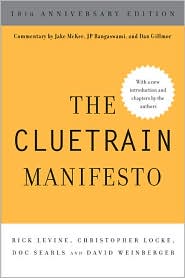
Cluetrain 10th Anniversary edition
Cluetrain 10th Anniversary
Everything Is Miscellaneous
Small Pieces cover
Small Pieces Loosely Joined
Cluetrain cover
Cluetrain Manifesto
My face
Speaker info
Who am I? (Blog Disclosure Form) Copy this link as RSS address Atom Feed

September 3, 2005

[ars electronica] Melanie Puff

The confrontation between self and other, Melanie Puff says, is paradoxical. She says that communication systems that enforce conformity (and avoid hybridity) are motivated by the will to power. [Isn’t it more complex than that?]

But that’s not the only possibility, she says. “The number of subversive systems is increasing.” These are both inside and outside the system; they are hybrids and paradoxical. “The logical truth of our reality comes to an end.” Identity becomes hybridity. Self can be self and other at the same time. No continuity: sampling instead. An “osciallating continuum with two extreme points at the end.” “The modern western self tends to avoid the other and avoid the loneliness of the self” by creating the concept of authenticity. Instead, we get a denial of logos, a more intuitive self. There’s a danger of a new power game; it is important that hybridity never switch to the extreme points where it would be either self or other. It needs to switch, mix, restore and recreate. We are forced to trust in ourselves and the other. Hybridity is a state of mind and an active practice. [Man, this way of talking goes right past me. It makes it harder to tell what’s true in it. At least for me. I guess the real question is why this mode so provokes me. I admit to having a psychological problem it brings out. (Also, it makes it hard for me to blog it adequately, for which I apologize to Melanie.)] [Technorati tags: ArsElectronica2005]

Tweet
Follow me

Categories: Uncategorized Tagged with: conference coverage Date: September 3rd, 2005 dw

1 Comment »

September 2, 2005

Mayor of News Orlean interview

EthanZ says this radio interview with the mayor of News Orleans is “extraordinary.” I haven’t heard it — I’m sitting in the audience at the Ars Electronica conference — but I trust Ethan when he blogs:

He’s extremely critical of the disaster response thus far, and offers a number of details that aren’t being widely discussed about the situation in Louisiana. It’s worth your time to listen to it

[Technorati tags: katrina EthanZuckerman]

Tweet
Follow me

Categories: Uncategorized Tagged with: media Date: September 2nd, 2005 dw

5 Comments »

[ars electronica] Carlo Formenti

[via translator] Carlo, with whom I had dinner last night (along with Roger Clarke) talks about the links between the Internet and democracy. Democracy, he says, is a compromise that’s worked for a long time.

The Internet can be seen as a new platform that could strengthen democracy or as a new social sphere that’s integrated with political and economic reality. [I’m not trusting that the translator is getting this exactly right.] So, what new political forms can we choose? Do we have to assume a class conflict? Manuel Castells says ____[missed it!]. Richard Florida says there is new class that controls knowledge; we are in a struggle for the control of knowledge. MacKenzie says there’s a new hacker class, and a venture capital class.

Carlo worries that a new elite is arising in the blogosphere. [And no mention of Clay Shirky!] [Technorati tags: ArsElectronica2005 CarloFormenti]

Tweet
Follow me

Categories: Uncategorized Tagged with: conference coverage Date: September 2nd, 2005 dw

Be the first to comment »

[ars electronica] Donatella Della Ratta

Donatella Della Ratta examines the “war of civilizations” assumed by Western media by looking at Arab media.

During the first Fulf War, there were no local Arab media, so the region relied on CNN. Now there are local media. Because of their ownership, it’s hard to tell the difference between private and public; in this, it’s not all that different from Western media, she says. Three major networks absorb most of the advertising dollars from smaller nations; they are Saudi Arabian (the Lebanese one is headquartered there) and entertainment-focused. What’s on these three networks? Survivor. American Idol. [Local versions, of course] A pop music show. A Coke commercial with a pop singer who was paid $2M for it. She also shows a frame from a Coke commercial that tries not to be quite so Western. The same Saudi Arabian culture doing the first type of TV is also doing the second type, she says. Behind both are Western companies like Coke.

She says there is a growing interaction between the Arab world and the West, but mainly through images. Real interaction is decreasing, but interaction through TV and brands is increasing. Exclusively media mediated. Brands are not the best cultural mediator. We need more real interaction.

Some more about Donatella here. [Technorati tags: ArsElectronica2005 medoia DonatellaDellaRatta arab]

Tweet
Follow me

Categories: Uncategorized Tagged with: conference coverage Date: September 2nd, 2005 dw

1 Comment »

[ars electronica] Aminata Traoré

[via translator] Aminata Traoré of Mali begins by saying that she’s representing the African perspective. There’s been no genuine hybridzation in Africa, she says. Rather, there’s been a cultural polarization. Poor countries are getting poorer. “We are left alone with our fear and our loneliness, and you are left alone with yours.”

We don’t believe in globalization, she says. To us this is nothing but Westernization. The West wants to be the center of the world. [Maybe we should retitle Friedman’s The World Is Flat as The Sun Revolves around the Earth.] Globalization is war, war against all. The G8 is using Africa to conceive the mistakes of their own system, she says.

To reach Africa with commnication, sizable investments are made in mobile phones. We’ve reached a point where we can say: “I make phone calls, therefore I am.” We have been reached, but in the worst possible way, she says.

While we are talking about the fate of Africa, thousands of childrens are dying, she says. While you sit at home in your living rooms, you see pictures of starving African children surrounded by flies. The neo-liberal reforms are on the way. But Africa doesn’t work that way. So it’s necessary to justify neo-liberalization by further damaging the part of the world that has already been severely damaged. The prosperity of the Northern hemisphere is largely built on the exploitation of other parts of the world.

We are those who are not wanted.

Debt reduction, etc., is about making your conscience feel better, she says. We know that the war in Iraq is about oil, and we worry about future wars for resources. We don’t hvae a lot to trade, so we don’t know where our place is. We are in a trough, at the bottom. But this does not mean that we’re worse off than others. The entire Southern hemisphere is in this position. If there is globalization it means restructuring the world according to Western standards.

I understand that not everyone in the West benefits from globalization. This gives me hope that maybe Europe and Africa can be partners and Europe can render genuine assistanceship. We should start with agricultural agreements, she says.

Vincenzo: But some Europeans understand…

Aminata: My pain is that I feel more alienated than I did 25 years ago. The West has succeeded in putting Africans against one another through elections. You cannot help Africa with money. You can only help it by understanding it. [Technorati tags: ArsElectronica2005 AminataTraore]

Tweet
Follow me

Categories: Uncategorized Tagged with: conference coverage Date: September 2nd, 2005 dw

4 Comments »

[ars electronica] Vincenzo Susca

Vincenzo Susca, whom I met during my fantastic weekend with Derrick’s grad class in Capri, is in Toronto for the year. He talks about the current technological change in political and power terms. There is a power in the Net, he says, that transcends traditional political structures.Our present culture is like Frankenstein’s monster: It transcends and exceeds its creator’s intention. What type of power does that entail? He introduces a new term: Communocracy. He means both physical and virtual communities. [Sorry for the crappy blogging of this interesting talk.] [Technorati tags: ArsElectronica2005 VincenzoSusca]

Tweet
Follow me

Categories: Uncategorized Tagged with: business Date: September 2nd, 2005 dw

Be the first to comment »

[ars electronica] Neil Gershenfeld

Neil Gershenfeld of MIT’s Center for Bits and Atoms talked (via video) about Internet 0, but my laptop was up on the podium, so I couldn’t take notes.

Internet 0 is a lightweight P2P network that enables objects (light bulbs, appliances…anything electrical) to communicate with one another within subnets. From a PC Magazine article:

By storing essential IP data at each node (say, a light switch), along with rules for updating the data, the house doesn’t need to route messages through servers. So as you plug in lights and appliances, you’re building a giant distributed-data structure. This helps keep building costs down, since a large wiring diagram isn’t necessary to complete construction. It also circumvents the cost of maintaining server hardware.

Here’s a little bit more, from Jon Lebkowsky at WorldChanging. [I’m falling behind in my blogging1 Noooo!] [Technorati tags: ArsElectronica2005 Internet0 NeilGershenfeld]

Tweet
Follow me

Categories: Uncategorized Tagged with: conference coverage Date: September 2nd, 2005 dw

Be the first to comment »

[ars electronica] Wen-Jean Hsueh

Wen-Jean Hsueh is Director of the Creativity Lab in Taiwan. Her theme: How do we use the untouched power of creativity within us?

There is, she says, a single Chinese word that means both danger and opportunity. Taiwan found a “creativity gap.” The engineers and scientists need to be more creative. They’re not in touch with users and customers.

The Lab brings together snthropolgoists, writers, architects, and animators. When the Lab was set up, within the mega-complex of the Technology Institute, they painted their doors different colors with interesting calligraphy to announce that things are different. This gesture took courage in a culture that values conformity, she says.

you generate creativity by having people integrate work and pleasure. Also, diversity encourages creativity. [Power to the miscellaneous! :)] They collaborated with artists to create a performance using traditional dancers, sensors, and image processing. It was a good example to show the engineers that such “cold technologies” can be usd to create scenarios of beauty and enjoyment.

She says the paradigm is shifting in Taiwan: Customers don’t know what to want. So, we need to identify new genres of problems, use intuition, and imagine what’s between the lines. Perspective is more valuable than IQ. Multidisciplinary team work. “Insights often come from ‘Extreme Users’.” Women’s perspectives.

[Technorati tags: ArsElectronica2005]

Tweet
Follow me

Categories: Uncategorized Tagged with: conference coverage Date: September 2nd, 2005 dw

Be the first to comment »

[ars electronica] Roger Clarke

Roger Clarke is the lead-off speaker. He’s an Australian IT guy who’s been thinking about digital personas for a long time. (From his home page: “I’m a consultant specialising in eBusiness, information infrastructure, and data surveillance and information privacy.”)

His theme is that “artefacts are already infilitrating the human. E.g., prostheses (external, exo-, endo-). He presents a survey of the field. e.g., there’s Oscar Pistorius, a double amputee who runs the 200m in 22 seconds using two prostheses and spring-steel feet. And the “three-armed” artist Stelarc. And cochlear implants. And perhaps we should count agents and avatars.

Roger started talking about digital persona in 1994. “Avatars and agents create opportunities for exploitation by organizations,” he says. (Well, that’s what his PowerPoints say.) Your Google persona (what people lean of you through Google) can also be manipulated.

More hybridisation is on the way, he says, in sports, “the aging rich,” “the Homeland Security gravy train,” etc. This will lead to political implications: Social control, power-blanace between humans and “near-human entities.” He says to look for an “extended ability” olympics around 2016.

[Isn’t human existence always hybrid in Roger’s sense? Andy Clark in Being There points out that we’ve always manipulated our environment to help our thinking — from using stones to count sheep to blackboards to work through math problems to computers for advanced computations. Doesn’t that mean that human thought has been hybrid from its beginning?] [Technorati tags: ArsElectronica2005 RogerClarke]

Tweet
Follow me

Categories: Uncategorized Tagged with: conference coverage Date: September 2nd, 2005 dw

1 Comment »

The poorest

Brendan Greeley is in Lake Provdence, once of the poorest regions in America. Relief efforts are not reaching there. So he’s set up a PayPal account for donations. From his blog:

Since Sunday, hundreds of evacuees from New Orleans have arrived in Lake Providence and the surrounding area. They can’t get to Red Cross shelters in Monroe, the nearest city; they are out of gas and money and energy. Providence Church has emerged as a shelter, not because the town planned for it, but because evacuees stopped at the church and stayed.

The most immediate priority is food, water and toiletries, and then to help get some of these evacuees to Red Cross shelters in Monroe, the nearest city or family that can take them in. Some of them will end up staying, though, and will need help getting settled and getting their children into local schools.

I trust Brendan 100%. And I love him the more for doing this. [Technorati tags: katrina]

Tweet
Follow me

Categories: misc Tagged with: misc Date: September 2nd, 2005 dw

5 Comments »

« Previous Page | Next Page »


Creative Commons License
This work is licensed under a Creative Commons Attribution-NonCommercial-ShareAlike 3.0 Unported License.
TL;DR: Share this post freely, but attribute it to me (name (David Weinberger) and link to it), and don't use it commercially without my permission.

Joho the Blog uses WordPress blogging software.
Thank you, WordPress!