


logo
EverydayChaos
Everyday Chaos
Too Big to Know
Too Big to Know
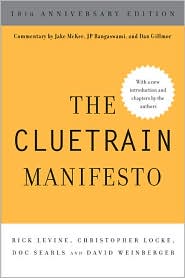
Cluetrain 10th Anniversary edition
Cluetrain 10th Anniversary
Everything Is Miscellaneous
Small Pieces cover
Small Pieces Loosely Joined
Cluetrain cover
Cluetrain Manifesto
My face
Speaker info
Who am I? (Blog Disclosure Form) Copy this link as RSS address Atom Feed

July 18, 2005

RageBoy’s two new blogs

Judging from the title of the first of RB’s two new blogs — Ex Blogging Officer — I’m guessing that his tenure at HighBeam has ended. Too bad for HighBeam. Chris was doing someting very cool for them: Writing about what interests him, using their service for research, thereby demonstrating the utility of their product. I believe doing this is called something like “ganja marketing” or “gorgonzola marketing”…

Chris followed this up by launching the blog for the book he’s been working on, frequently at his former Highbeam blog: Mystic Bourgeoisie. Chris says that he was going to wait until the site and the book outline were perfect, but then remembered that he’s among friends. Take a look. There are more ideas packed into a single MB chapter than there are glazed fruit cubes in a fruitcake.
[Technorati tags: RageBoy ChrisLocke mysticbourgeoisie]

Tweet
Follow me

Categories: blogs Tagged with: blogs Date: July 18th, 2005 dw

1 Comment »

July 17, 2005

Highbeam lights up my little world

Thanks to RageBoy’s Chief Blogging Officer gig, I’ve known about HighBeam, but it’s only as I buckle down to some serious writing — I’m working on Chapter 2 — that I’ve discovered just how great resource it is. I’ve been looking into how libraries organized books before Dewey decimalized classification and HighBeam is turning up lots of great stuff from its collection 34 million articles. I’m impressed. You can even turn your queries into RSS feeds.

Plus, they make it easy to blog an article and point to its full text. For example, suppose I want to quote this from an article I found there:

What if however, a major focus upon classification as a research goal leads not to a rigorous and robust body of knowledge in presidential studies as Glad predicts but rather to a version of the emperor’s encyclopedia described by Jorge Luis Borges…?

By clicking the “Blog this article” link, HighBeam generates the html-ized citation info:

from: Borges’s encyclopedia and classification in presidential studies. by Abbott, Philip
source: Presidential Studies Quarterly, December 1, 2004.
via: HighBeam Research Logo HighBeam™ Research
COPYRIGHT 2004 Center for the Study of the Presidency

I will be using HighBeam a whole heck of a lot. It’s $100/year or $20/month. (One missing feature: I’d like to have a button that will create a bibliographic citation for me, in text, html or rtf.) [Technorati tags: highbeam rageboy]

Tweet
Follow me

Categories: Uncategorized Tagged with: uncat Date: July 17th, 2005 dw

5 Comments »

Jeneane on PR

Jeneane jumps into the pr-blogging discussion. Good thoughts, good links. [Technorati tags: JeneaneSessum pr]

Tweet
Follow me

Categories: Uncategorized Tagged with: business Date: July 17th, 2005 dw

1 Comment »

July 16, 2005

Headlines I really, really misread

The Governor forced to shake Mr. Muscle

Headline on an AP story in the Globe and Mail about Arnold Schwarzenegger. I’m embarrassed to say this, but at first I thought “Mr. Muscle” was his pet name for, um, The Urinator.

Tweet
Follow me

Categories: Uncategorized Tagged with: humor Date: July 16th, 2005 dw

2 Comments »

From public relations to public relationships

Tim Bray has a terrific post on the Old and New public relations.

Here’s how I think about what’s going on with PR. (Note: Sweeping generalizations ahead.)

For decades there’s been a split in the industry between The Spinners and the Connectors. The Spinners think their job is to manipulate the truth for the one-sided benefit of their clients. They think they’re behind enemy lines and allowed to use every trick in the book to Win. The Connectors think their job is to connect the media and their clients and then get (pretty much) out of the way. Both, of course, do both. Connectors coach their clients in how to speak clearly, where “clarity” inevitably has elements of spinning, and Spinners work hard to get their spun words into the press.

Both bow at the altar of Brand. Brand is to be promoted. Brand is to be protected. All hail Brand.

About 20 years ago, Brand got spun, but in a useful way. Progressive PR folks started talking about Reputation Management instead of Brand Management. RM is exactly the same as BM (oh hush up, you children!) except that it recognizes two limits. First, reputations have to be based at least a little bit in reality; they are earned and can’t be merely spun out of nothing. Second, the customer has some say in it. BM too frequently thought it could foist any image on the market. You want to associate Coke with world peace? Just make up a catchy jingle about the world singing together. That’s BM. You want Coke to earn a reputation as being for world peace? Coke had better actually take some stands, donate some serious money, run some programs that help make the world peaceful without stamping the Coke brand on the forehead of every activist. (Two notes: 1. RM has strong elements of brand and spinning in it, of course. It’s a crazy, mixed up world. 2. See Chris Locke‘s Gonzo Marketing.)

Now I think PR is entering a phase where it sees itself as helping companies with their public relationships. (“Public Relationships — Adding hips to public relations”?) I first heard this term at EdelmanPR (disclosure: to whom I’m a consultant), but I don’t know who coined it. I find the phrase useful because it asserts a connection to traditional PR while pointing to a new dominant possibility. It implies, in line with Tim’s thinking, that PR needs to get out of the intermediation business. It means that more voices have to be allowed to speak from within the corporation, since relationships based on a committee-produced controlled voice will fail. It explains why blogs are such a useful tool: They are public relationships. It assumes there’s persistence to the relationship, not merely press releases thrown in our faces whenever the company has some new crap to flog. It assumes mutuality. It relies on the relationships being based on frankness and transparency.

Building public relationships seems to me to be a useful rubric for all that PR agencies do, including the traditional services they will continue to provide. For example, PR agencies are going to continue to scan editorial calendars looking for opportunities to get coverage for their clients, and they’ll continue to monitor and measure what’s being said. But if they do that within the context of building public relationships, perhaps they can help their clients get past their obsession with column inches. It’s not about that and it never was. It’s about building long-term, continuing, honest, mutual public relationships. (Richard Edelman, who blogged last week about some of the same points that Tim makes (and gives me too much credit), thinks that, in addition, PR agencies will find new business in producing substantive, factual content for their clients; this is an anti-spin position.)

And, like it or not, PR agencies will also continue to advise clients what to say. The CEO is always going to call an advisor she trusts to help figure out whether the main point about the acquisition of XYZ, Inc. is that it expands the company’s European presence or that it puts 300 new sales folks on the street to generate revenue. Inevitably this is spinning, but now (we hope) in a context where truth quickly embarrasses those who spin out of control and where the spun words are only a couple of threads in a far wider web.

I don’t know what the PR industry will be like in ten years. But I’m convinced that spinning — even truths expressed in words that sound phony — will be have the same effect as a salesclerk gobbing on a customer. [Technorati tags: pr PublicRelations TimBray RichardEdelman GonzoMarketing RageBoy Marketing Brand]

Tweet
Follow me

Categories: Uncategorized Tagged with: business Date: July 16th, 2005 dw

11 Comments »

July 15, 2005

HijackThis Explainer

I am not a geek lets you paste in your HijackThis log, creating a version with links from most entries to a database of explanations… [Technorati tags: spyware hijackthis]

Tweet
Follow me

Categories: Uncategorized Tagged with: tech Date: July 15th, 2005 dw

1 Comment »

Berlind on Scoble on Technorati’s numbers

David Berlind does some research to explain why Scoble’s criticism of Technorati is likely off the mark. (I linked to Scoble’s comments. And as I said there, I’m an advisor to Technorati.) [Technorati tags: technorati Scoble DavidBerlind]

Tweet
Follow me

Categories: Uncategorized Tagged with: web Date: July 15th, 2005 dw

2 Comments »

Ongoing investigation

Press Secretary Scott McLellan gets Amanda Congdon drunk over at Rocketboom today. [Technorati tags: rocketboom]

Tweet
Follow me

Categories: Uncategorized Tagged with: humor Date: July 15th, 2005 dw

Be the first to comment »

Congressional view of email

Personal Democracy Forum has a really interesting article by Kate Kaye on a study of how the US Congress views email. A sample:

…the majority of Congressional offices don’t respond to constituent email with email; in fact just 17 percent of House offices and 38 percent of Senate offices use email for this purpose. As it turns out, most survey respondents who don’t use email to respond worry that their messages could be altered and forwarded, thus misrepresenting their bosses’ positions.

Tweet
Follow me

Categories: Uncategorized Tagged with: politics Date: July 15th, 2005 dw

3 Comments »

IDs: Freeing us for messiness

Obvious thought of the day:

Messiness is disorder where place is the basis of order. E.g., if your top drawer is the place for socks, having socks in your living room floor is messy. Places order space by putting like next to like, a one-dimensional way of organizing.

Digital space, unlike physical space, does not demand that we pick one dominant trait — one way of being alike — over all others; data about two products that differ only in color may be stored in your database in non-contiguous RAM, and you don’t care. In this environment, things do not need to be placed at all; they only need to be found. So give things unique IDs — e.g., the BBC’s SMEF for content, Life Science IDs, CommonLanguage‘s telecom identifiers — and they will be radically messy (miscellaneous) but not disordered. Rather, they are ready to be ordered on demand, differently each time depending on the user’s needs and assumptions.

Now I have to go pick up my socks. [Technorati tags: taxonomy EverythingIsMiscellaneous]

Tweet
Follow me

Categories: Uncategorized Tagged with: everythingIsMiscellaneous Date: July 15th, 2005 dw

5 Comments »

« Previous Page | Next Page »


Creative Commons License
This work is licensed under a Creative Commons Attribution-NonCommercial-ShareAlike 3.0 Unported License.
TL;DR: Share this post freely, but attribute it to me (name (David Weinberger) and link to it), and don't use it commercially without my permission.

Joho the Blog uses WordPress blogging software.
Thank you, WordPress!