

logo
EverydayChaos
Everyday Chaos
Too Big to Know
Too Big to Know
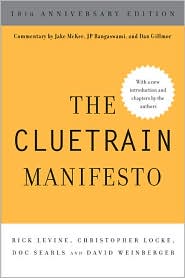
Cluetrain 10th Anniversary edition
Cluetrain 10th Anniversary
Everything Is Miscellaneous
Small Pieces cover
Small Pieces Loosely Joined
Cluetrain cover
Cluetrain Manifesto
My face
Speaker info
Who am I? (Blog Disclosure Form) Copy this link as RSS address Atom Feed

July 5, 2005

Worse.Comb-over.Ever.

As a follicly challenged American, and nothing to write home about even with a full head of hair, it is with some sympathy and reluctance that I post this photo. But, like a tourist who happens to be taking a snapshot when a UFO zooms past, on a date I won’t reveal in a city I won’t mention I snapped a street scene only to discover this person. At first I thought he was wearing a leather skull cap or had dipped his head in fast-drying liquid plastic. As I zoomed in, only with difficulty did my brain parse the retinal image…

Combover

Tweet
Follow me

Categories: Uncategorized Tagged with: humor Date: July 5th, 2005 dw

1 Comment »

July 4, 2005

Live 8: Cause or fashion statement?

Ethan responds reasonably and forcefully to Brian‘s response to his snarky-but-telling post about Live 8.

For me it comes down to this: I can’t imagine that people going to a big rock concert will change the mind of any G8 leader, but if Live 8 makes debt relief trendy, I’m all for it. After all, trendiness seemed to have an effect on ending Apartheid in the 80s.

Tweet
Follow me

Categories: Uncategorized Tagged with: bridgeblog Date: July 4th, 2005 dw

8 Comments »

Air frickin’ France

On the flight home from Paris a few days ago, one of the attendants announced over the intercom the creation of a new frickin’ flyer program. It took me a few seconds to realize she wasn’t cursing at us, but was instead talking about a frequent flyer program.

(Yes, I understand that I am in no position to make fun of the accent of a French woman speaking English since my point-and-grunt grasp of French sounds like the noise made by a drunk monkey.)

Tweet
Follow me

Categories: Uncategorized Tagged with: humor Date: July 4th, 2005 dw

Be the first to comment »

Missing Stephen Jay Gould

Thanks to alert commenters Katherine Bertolucci and Richard Carter, I spent yesterday morning reading Stephen Jay Gould’s The Lying Stones of Marrakech and remembering how much I miss him. What a mind and what a writer! And I admired his political engagement as well.

In the essay Katherine points to, Gould finds a marginal change Lamarck made in one of his own books. From that Gould shows how Lamarck’s intellectual honesty led him not only to undo his own theory, but to come to a new vision of the role of contingency (history, accidents) in the development of species — a view with much less order, logic and obvious divinity than before. Gould sweeps from the minute to the grand, at every level explaining clearly the scientific, historic and social contexts.

The closest I came to knowing him personally is through my sister-in-law who sang in choir with him. But I feel that I know him personally through his writing. It’s so sad that he died so young.


One passing comment from the book: Gould refers to the New England farmer who has a box of string labeled “Pieces of string too short to keep.” [Technorati tag: StephenJayGould]

Tweet
Follow me

Categories: Uncategorized Tagged with: taxonomy Date: July 4th, 2005 dw

3 Comments »

July 3, 2005

NECC talk on line

A video of my keynote to the National Educational Computing Conference last week is available at KidzOnline. (I come after Ben Franklin (!) and the NECC’s president, maybe 20 minutes in.) (Free registration and Windows Media Player required.)


As a result of my talk, I heard from The Old Friar, who just retired after 38 years as a teacher and administrator and has started a blog addressing fundamental educational questions.

Tweet
Follow me

Categories: Uncategorized Tagged with: taxonomy Date: July 3rd, 2005 dw

1 Comment »

The opposite of the broadcast mentality

IT Conversations just keeps pushing ahead, doing good in the world. Doug Kaye has now let out the news:

Every day there are scores or even hundreds of fascinating and important conference sessions, lectures or other presentations that are lost. They simply evaporate because no one captures or records them. Some of these presentations are by the greatest and most inspiring minds of our time, and many could be important to people in the far reaches of the planet, if only they could hear them.

My new project is to capture (record) all of these presentations, post-produce them, and make them available worldwide for free.

To record tens of thousands of events each year, we will appeal to the social conscience of the worldwide army of podcasters Ð 10,000 today, and 25,000-50,000 within a year Ð who I believe will be enthusiastic about the opportunity to give back to their communities and to the world. As a side benefit, these ‘podcaster stringers’ will hone and extend their skills and build their reputations in ways that could benefit them financially and otherwise.

We will build an online ‘dating service’ that will match podcasters with events in their communities. Likewise, we will recruit volunteer writers and producers to create and edit the metadata and descriptions that accompany the recordings. Content will be managed, and quality will be maintained, by a Wikipedia-like system and community. High-volume content will be delivered by a combination of BitTorrent and partners such as the Internet Archive.

We will cover not just IT or even technology, but literally every topic about which someone speaks and another person finds it valuable enough to capture.

Doug podcasts about this here.

Woohoo!

Doug also notes that because IT Conversations is now available via iTunes, “Tueday was an all-time record day for IT Conversations traffic: 378.32GB.” Holy mother of downloads, that’s a lot of listening! [Technorati tags: podcasts DougKaye ITConversastions media]

Tweet
Follow me

Categories: Uncategorized Tagged with: media Date: July 3rd, 2005 dw

1 Comment »

Doc’s at it again

Doc posts to recommend Dave’s post and podcast on why locking content is a bad idea. Doc concludes with a last line that is pure-Doc-ism:

This is important, because right now the publishing and entertainment industries are becoming enamored of DRM and paywalls. They think it’s the future. But if they listen to software developers with long experience, they’ll find out it’s already in the past. Been there, done that, burned the t-shirt.

[Technorati tags: DocSearls drm DaveWiner]

Tweet
Follow me

Categories: Uncategorized Tagged with: digital rights Date: July 3rd, 2005 dw

Be the first to comment »

July 2, 2005

A theory of intelligence

I read Jeff Hawkins’ On Intelligence today. Fascinating. He gives what seems to be a coherent unifying theory. (Caveats: I don’t know any brain science, so I can’t tell if he’s right, if his facts are right, if he’s being fair, if he’s saying something old that just sounds new to me, etc.)

His theory has the virtue (and possibly the vice, but I can’t tell) of simplicity: The same process explains all the senses and all intelligence. As I understand it, our cortex has six layers, each of which stores patterns at different degrees of abstraction. Hawkins emphasizes the bidrectionality of the signaling: it’s not simply your optic nerve jangling the optic neurons which then get pattern-recognized; rather, the movement goes both ways, from the lower-order to the higher-order, and vice versa.

I’m not going to go any further into it because I probably already go it wrong. But here’s why I liked the book. First, it gets past the “brain is a computer” analogy. Instead, Hawkins says the brain is all memory, no CPU. It has no programs other than the most basic pattern-matching “algorithm” — and I don’t think that’s the right word…the ocean does a good job of sorting rocks on the beach without using any algorithms. Second, it gives a simple explanation that (if right) accommodates enormous complexity. Third, he gives us an experiment to try at home: Get a dummy hand, or, at worst, draw an outline of your hand on a piece of paper. Put it and your hand on a table, posed identically. Put up a divider so you can’t see your hand. Look at the dummy hand. Now have a friend touch both hands in identical ways simultaneously. Hawkins says that your brain will quickly get confused and “You will actually feel the sensations being applied to the dummy hand as if it were your own.” (p. 60-1.) The description is unclear so I don’t actually know what to expect, but I can’t wait to try it. (Despite that lapse, the book is generally well written, with much of the credit probably going to the tiny-type co-author, Sandra Blakeslee.)

I was bothered, however, by the use of mental language throughout. He talks about the cortex predicting, commanding, trying to interpret, etc. That felt sloppy to me, especially since he doesn’t always break those terms down into neural behavior. Also, towards the end he speculates on whether consciousness is something more than neural behavior and he concludes that “consciousness is simply what it feels like to have a neocortex.” (p. 196) That’s cute but it cheats: Expand “feels like” and we are back at the question that this phrase is supposed to answer. The the phenomenology of consciousness is outside the scope of his book is not a criticism.


Hawkins’ theory has some relevance to the book I’m writing because I want to know whether hierarchical thinking is basic to the brain or is something our culture has learned.

Hawkins postulates a physical correlate to the hierarchy of concepts: Functionally, the brain is a “branching hierarchy,” he says (44). As the sensory input of your face changes (you change expression, the light shifts, our vision twitches three times a second), the highest order neurons maintain a steady “That is a face” state. (His theory also builds ambiguity into the functioning of the brain: The higher-order neurons remember relationships, but not details. p. 75) If Hawkins is right, however, it’s hard for me to imagine what constitutes the highest level patterns. Do we have a bridge pattern sufficiently general that it recognizes both The Golden Gate and the bent blade of grass I watch the ants crossing? And that pattern sufficiently distinguishes bridges from the letter H? Do we have pre-existing patterns for all separable qualities? For orange? For metal? For constructed rather than natural? For things in San Francisco? For things you have to pay to cross? I suppose we must, but even though it’s all learned, having stored patterns for every which way we might understand our world feels so a priori. And how do we put these together? Or do we only take them apart? Most important, how badly am I misunderstanding Hawkins? I think quite badly. [Technorati tags: EverythingIsMiscellaneous JeffHawkins brain OnIntelligence]


Susan Crawford in April posted a terrific explanation of what’s new and exciting in the the Hawkins book. Run to it!

Tweet
Follow me

Categories: Uncategorized Tagged with: everythingIsMiscellaneous Date: July 2nd, 2005 dw

2 Comments »

Amazon’s capitalized Phrases

Amazon has added a new auto-tagging feature: It’s now listing the capitalized phrases in books and letting you see all the books that use those phrases. (More at the You’re It blog.)

Tweet
Follow me

Categories: Uncategorized Tagged with: taxonomy Date: July 2nd, 2005 dw

Be the first to comment »

Flu wiki

Ross Mayfield over at Many2Many notes a new wiki dedicated to gathering and improving information about the spread of flu. It’s just getting started, but it’s an experiment worth watching… [Technorati tags: wiki SocialSoftware influenza]

Tweet
Follow me

Categories: Uncategorized Tagged with: web Date: July 2nd, 2005 dw

Be the first to comment »

« Previous Page | Next Page »


Creative Commons License
This work is licensed under a Creative Commons Attribution-NonCommercial-ShareAlike 3.0 Unported License.
TL;DR: Share this post freely, but attribute it to me (name (David Weinberger) and link to it), and don't use it commercially without my permission.

Joho the Blog uses WordPress blogging software.
Thank you, WordPress!