

logo
EverydayChaos
Everyday Chaos
Too Big to Know
Too Big to Know
Cluetrain 10th Anniversary edition
Cluetrain 10th Anniversary
Everything Is Miscellaneous
Small Pieces cover
Small Pieces Loosely Joined
Cluetrain cover
Cluetrain Manifesto
My face
Speaker info
Who am I? (Blog Disclosure Form) Copy this link as RSS address Atom Feed

June 17, 2005

Japanese numbers

Joi runs the startling results of a survey of Japanese Internet usage. Some highlights:

36.2% of homes have broadband.

72.5% have heard of blogs, about double last year.,

25% of women in their teens and 20’s have blogs. (!)

Wow.
Tweet
Follow me

Categories: blogs Tagged with: blogs Date: June 17th, 2005 dw

1 Comment »

June 16, 2005

Fr**dom of sp**ch

Rebecca tried to create a Chinese language MSN Spaces blog with the title “I love freedom of speech, human rights, and democracy” in Chinese and got the error message “You must enter a title for your space. The title must not contain prohibited language, such as profanity. Please type a different title.”

She’s got screenshots, and links to Bennet Haselton’s Freedom Hack Instructions.

(I blogged about Microsoft’s enabling of Chinese censorship here.) [Technorati tags: GlobalVoices china blogs microsoft]

Tweet
Follow me

Categories: blogs Tagged with: blogs Date: June 16th, 2005 dw

5 Comments »

Linnaeus’ paper

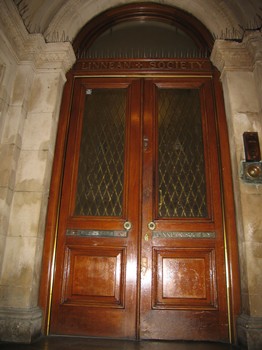
The Linnean Society‘s entrance is tucked away in plain sight, just another stone portico and another dark oak door, across from the Royal Geological Society, and sharing a courtyard with the far larger Royal Academy of Arts. Inside, the headquarters is done in mustard and parchment white, with wood trim and brass, all very British and 19th Century.

Linnean Society entranceway

Go up a flight of portrait-lined stairs and you are in the two-story library decorated with prints of carefully drawn specimens (flowers, worms, ticks, “Syncorme pulchella”), portraits of people important in the Society’s history, and a three-foot-high statue of the man himself, at the base of which someone has laid ornamental squash and drying flowers.

Tucked away near the entrance is a 12-drawer card catalog of the library’s books arranged by author. In the work room across the hall sits a computer that allows you to search by abstract, key words, notes, titles, and subjects. There is no hierarchical topic listing.

I wander back to the first floor and pull back the cloth on a couple of glass-topped tables that exhibit some of Linnaeus’ original specimens, the reference points for disputes about whether a particular binomial — the genus-species names Linnaeus pioneered — refers to this or that creature. If you want to be sure, you can look at the remains of the being Linnaeus held in his hand when he said “I name thee…thus!”, the very moment represented in his triumphal statue outside the courtyard, part of the Royal Academy. To the statue’s right are Cuvier and Leibniz. Above him and to his left stand Newton, Bentham, Milton and Harvey. Static hierarchies force tough choices.

When Mike Olmert’s undergraduates from the University of Maryland arrive, Gina Douglas, Librarian and Archivist, takes us all into the Meeting Room. There, on extraordinarily uncomfortable benches — I feel like a cry baby when one of the brochures brags about the modern padding — we listen to Ms. Douglas explain that Linnaeus’ collection ended up in London because his widow sold it for dowery money for her daughters. The buyer was a rich young British scientist eager to make his mark. It worked, as the prominence of his oil portrait proves.

Linneaus, she tells us, knew his classification system was artificial and looked forward to the day when it would be replaced by the “real” one. (Without a theory of animals descending from other animals, it’s hard to imagine what would make one set of morphological likeness more real than another. I should re-read Foucault.)

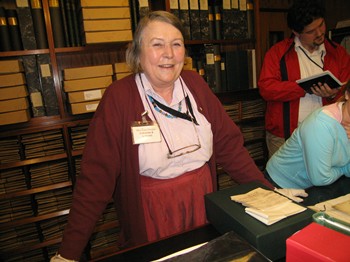
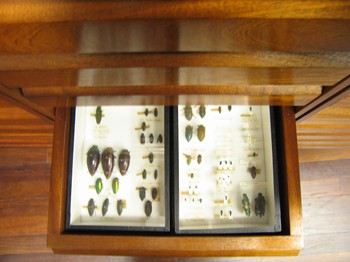
Ms. Douglas divides the group in two and takes the first half down one flight to the collection room, a room protected by a 6-inch thick metal door and designed to survive a nuclear bomb. “The whole of the taxonomic world depends on the legal concept of the type,” she explains. The brochure says: “The Linnaean Collection comprises the specimens of plants (14,000), fish (158), shells (1,564) and insects (3,198) acquired from the widow of Carl Linnaeus in 1784 by James Edward Smith.” It doesn’t seem possible that this room contains all those specimens, plus all of Linnaeus’ own book collection.

Gina Douglas in Linnean collection vault

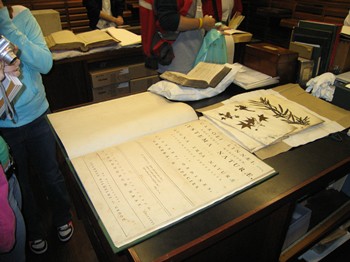
The room is about 15 feet square, lined with specimen drawers and book shelves. Ms. Douglas opens an oversized book, a first edition of Linnaeus’ classification system. There he has named and organized God’s creatures so that we can have a common way to talk about them. She turns the pages: Animals, vegetables, minerals…so common to us now that they have almost become a nursery rhyme. In this book they are new.

Linnaeus first edition

She draws our attention to the two page spread devoted to the Animal Kingdom. On the extreme right is the category “Vermes” (worms) which Linnaeus used as a catchall. If it wasn’t an insect, he put it into the Worms, as close as Linnaeus came to having a “Misc.” category.

A specimen drawer in the Linnean collection

Ms. Douglas spreads out some specimen pages, each with one plant type, gray as dust, attached. “Notice the K on that one,” she says, pointing to a small letter at the bottom of the page. “That tells us who collected it. It’s rare for a page to have that information.” Too bad because some of the specimens I saw in the cases upstairs had been misidentified: Linnaeus grew Solanum quecifolium from seeds that he thought were from Peru but were actually from somewhere near Mongolia. If only he had had better metadata to work with…

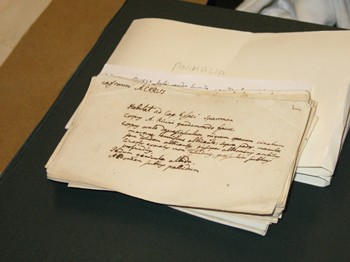
Ms. Douglas takes out a thin pile of 3×5 cards, as soft as handkerchiefs. On each, Linnaeus has recorded in his fine hand one classified species.

Linnaeus 3x5 cards

This moment, as close as I’ll ever get to seeing Linnaeus at work, makes clear how the requirements of the physical world silently persuade us to shape our understanding: Linnaeus’ classification resulted from the nature of paper. Because you only have one card for each species, your order will give each species one and only one place. You will organize them by putting cards near cards like them, naturally producing an ordered series or a set of clusters. As you lay out your cards, like next to like, you are drawing a map of knowledge. That’s why Systema Naturae is oversized: a map makes the most sense when you can see it all at once. (The size of the paper also determines the degree of detail possible on the map.) The largest units in Linnaeus’ classification are kingdoms not because Animals, Vegetables and Minerals somehow lord it over the particular creatures they contain, but because kingdoms are the most inclusive territories on political maps. Knowledge thus derives its nature from the paper that expresses it: Bounded, unchanging, the same for all, two-dimensional and thus difficult to represent exceptions and complex overlaps, and all laid out in a glance with no dark corners.

Our time is up. The next half of the group waits quietly for us to ascend the narrow stairway. [Technorati tags: EverythingIsMiscellaneous taxonomy linnaeus]

Tweet
Follow me

Categories: Uncategorized Tagged with: everythingIsMiscellaneous Date: June 16th, 2005 dw

18 Comments »

Rhythmic static

I’ve occasionally noticed static playing over speakers in roughly the same rhythm: a quarter note and three triplets. Deeeeet dit-dit-dit dit-dit-dit dit-dit-dit. At first I thought it was something wrong with my PC speakers or sound card. But I’ve also heard it over the headphones while waiting to go live at a professional radio station. And I heard it over the speakers in the back of a London cab yesterday.

Deeeeet dit-dit-dit dit-dit-dit dit-dit-dit. Deeeeet dit-dit-dit dit-dit-dit dit-dit-dit.

Is this some predictable electrical noise, like a 60-cycle hum? Or is it a coded message from our equipment?

Tweet
Follow me

Categories: misc Tagged with: misc Date: June 16th, 2005 dw

11 Comments »

My book has a home

Times Books has agreed to publish my book, Everything is Miscellaneous.

I’m very happy about this. They are a great publisher and my editor, Robin Dennis, is going to give the guidance I need to write the book in a way that people (we hope!) will want to read. She is, by the way, Jay Rosen’s editor as well.

I have a year to write it and should come out in Jan. 2007, which only sounds like a long time away if you’re not facing it as a deadline. [Technorati tag: EverythingIsMiscellaneous]


Speaking of Jay, his blog won the Reporters without Borders Freedom Blog award. Woohoo! Where would we be without PressThink?

Jay graciously points to his fellow winners:

It’s a serious honor to share that page with Shared Pains, which is a blog from Afghanistan in Arabic, with Al Jinane, written in French by a Moroccan, with ICTlex, which is like an Italian Lessig, with netzpolitik.org, or Net Politics in German, and especially with Mojtaba Saminejad of Iran> (whose story of imprisonment is told here and here) and Screenshots…by Jeff Ooi (see Dan Gillmor on Ooi’s struggle with the thought police in Malaysia.) For them, international recognition is vital, possibly a matter of life and death.

[Technorati tags: JayRosen BridgeBlogs GlobalVoices]

Tweet
Follow me

Categories: Uncategorized Tagged with: everythingIsMiscellaneous Date: June 16th, 2005 dw

6 Comments »

June 15, 2005

BBC and Linnaeus

I spent a fascinating day at the BBC yesterday, and much of the day before, researching an article for Wired. There is so much stuff going on there, both technically and culturally. The Beeb is making a serious effort to serve its constituency by moving beyond the traditional broadcasting model. Wherever it can, it’s using the digitizing of content to give control back to their audience: Control over the when, what and where of listening/watching (on-demand, interactive, on multiple devices)and control over what you can do with their content (remix it, redistribute it non-comercially). Rather than feeling beleaguered the way so many big media companies do when they look out over the Internet sea, the BBC-ers use words like “liberated.” Invigorating, to say the least. (Now all I have to do is figure out how to turn 75 pages of notes into a 2,500-word article.)

Today, after meeting with another BBC’er, I join a tour of the Linnaeus Society headquarters in Piccadilly. This is for my book (about which I’ll post some news tomorrow), which has something to do with what happens to how we organize stuff when we snip the connection to the physical. Linnaeus, the great classifier, had a sample specimen for each of the species he categorized, which is a very definite tie to the physical. But I’m not sure what I’m going to learn there. Which is why I’m going.

Tonight I fly home. Good. I miss my family. [Technorati tags: Linnaeus BBC taxonomy]

Tweet
Follow me

Categories: Uncategorized Tagged with: travel Date: June 15th, 2005 dw

10 Comments »

On the road

Joshua “Outlandish” Koenig and two of his friends are spending the summer driving around the US and promises to regale us with tales via email.

The first post is here. In it Joshua says the road trip’s been around “for maybe ten years or so.” Uh uh. National Lampoon’s road trips may be that young but traveling as a type of freedom goes way back. At the very least Joshua should bring along a copy of Kerouac’s On the Road.

But here’s how much of a dreary parent I’ve become: I’m worried by the boys naming their trip’s site — and ten years ago, how weird would that phrase have been? — “Vagabender,” putting the “bender” front and center. Yo, Josh, drink in moderation. And don’t forget to put on your galoshes. [Technorati tag: JoshKoenig]

Tweet
Follow me

Categories: misc Tagged with: misc Date: June 15th, 2005 dw

Be the first to comment »

June 14, 2005

Worthwhile mag column

I write a column for Worthwhile magazine and occasionally blog there as well. The magazine has posted a pdf of my column in the current issue; it’s on why “Don’t be evil” doesn’t do much for me as a slogan.

Hey, I just realized that in the photo of me, they airbrushed out my moles! I knew I looked funny! [Technorati tags: worthwhilemag marketing]

Tweet
Follow me

Categories: Uncategorized Tagged with: business Date: June 14th, 2005 dw

1 Comment »

EFF’s guide for bloggers

Donna Wentworth at the Electronic Frontier Foundation has put together a set of FAQs that address the legal rights of bloggers. Read it before you get your next cease-and-desist order. (And join the EFF already!) [Technorati tags: eff DonnaWentworth]

Tweet
Follow me

Categories: blogs Tagged with: blogs Date: June 14th, 2005 dw

Be the first to comment »

Emergency VoIP

Susan Crawford explains the FCC’s requirement that VoIP providers enable their users to call 911, reach the right local number, and automatically provide the local operator with location information.

VoIP providers in the US will have to negotiate separate contracts with 6000 emergency answering points, persuade the Bells to give them access to the necessary facilities at a sensible cost, and load up routers and databases with the right information. And compliance will be sufficiently expensive to make it no longer worthwhile to do business — unless you’re Vonage.

Susan continues:

This seems to be an unprincipled and blatantly political order designed to protect the incumbents’ ability to control the market for online voice services. Although the Commission is coy about the basis for its jurisdiction (how strange is that?), to the extent it decides to lean on Title I the DC Circuit has already said harsh things about the FCC’s overreaching in that statutory context. It’s a good bet that a good lawyer could attack jurisdiction effectively here.

Susan in her next post points to a report that explains the “complexity in every direction” of VoIP systems providing 911 services. [Technorati tags: voip fcc SusanCrawford]

Tweet
Follow me

Categories: Uncategorized Tagged with: politics Date: June 14th, 2005 dw

2 Comments »

« Previous Page | Next Page »


Creative Commons License
This work is licensed under a Creative Commons Attribution-NonCommercial-ShareAlike 3.0 Unported License.
TL;DR: Share this post freely, but attribute it to me (name (David Weinberger) and link to it), and don't use it commercially without my permission.

Joho the Blog uses WordPress blogging software.
Thank you, WordPress!