


logo
EverydayChaos
Everyday Chaos
Too Big to Know
Too Big to Know
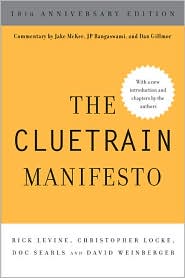
Cluetrain 10th Anniversary edition
Cluetrain 10th Anniversary
Everything Is Miscellaneous
Small Pieces cover
Small Pieces Loosely Joined
Cluetrain cover
Cluetrain Manifesto
My face
Speaker info
Who am I? (Blog Disclosure Form) Copy this link as RSS address Atom Feed

January 17, 2005

Pollard’s list

Dave Pollard lists the 10 most important ideas of 2004: Blogs and the Internet. Good list. I’d point out that #10 and #6 are not in perfect harmony, but maybe #10 is the goal and #6 is a present reality we need to fix. (Dave accurately cites me as disagreeing with #6. I think #6 — forming “echo chambers” — is a temptation but that we should be careful not to call all conversations except arguments “echo chambers.”)

I wish I could compile lists. I’m terrible at it. In fact, I once had to ask my boss to stop calling on me at meetings when he would ask everyone to list things like the three biggest threats facing the company in the next five years. Instead, we agreed I could send him a memo.

Tweet
Follow me

Categories: Uncategorized Tagged with: web Date: January 17th, 2005 dw

2 Comments »

January 16, 2005

Poynting the way

Bill Mitchell and Bob Steele of the Poynter Institute have put together a paper for the upcoming conference on blogging, journalism and credibility. It’s called “Earn Your Own Trust, Roll Your Own Ethics: Transparency and Beyond,” and I like it. They don’t assume that the only way to stay ethical is to live by an established code of ethics.

The idea, in brief, is for bloggers to invite questions from their audience about what questions they have about the blog, what might increase their level of trust, etc. The questions would vary with the blog. The blogger might then build an FAQ responding to such questions and could update the FAQ new questions arise.

Finally, the blogger could be guided by those questions in creating a principles and policies statement addressing issues of trust and credibility. The blogger could describe the principles he or she is committed to, e.g., fairness, independence, accuracy, etc. In addition, bloggers creating such a page could describe the processes they’d use in order to uphold their principles. They might explain how they handle updates and corrections on their blogs, for example, as well as an explanation of how they handle comments. And if the blogger wants to offer some personal background — where they’re coming from, as Jay Rosen puts it — so much the better.

Individual bloggers will have to make their own decisions about whatever principles and processes guide their behavior, of course. The most effective standards and codes are not imposed from the outside. The idea that the journalism establishment would have the standing or influence to impose ethical standards on the blogosphere seems especially disconnected from reality.

Excellent idea. Codes of ethics are great for professionals. For the rest of us (even professionals in their off hours), our lack of explicit, codified sets of ethical principles governing our every activity doesn’t mean we’re unethical. It just means we humans generally do what’s right and resort to ethical discussions when we go wrong or get confused.

Tweet
Follow me

Categories: Uncategorized Tagged with: web Date: January 16th, 2005 dw

2 Comments »

X marks the mnemonic

Our son Nathan, 14, last night figured out a mnemonic for remembering which way the X axis goes on a graph:

X is a-cross

X is a cross. X is across. Works for me.

Tweet
Follow me

Categories: Uncategorized Tagged with: uncat Date: January 16th, 2005 dw

5 Comments »

Jay on removing the Versus between journalists and bloggers

Jay Rosen has a terrific post arguing that the B vs. J debate is over. I don’t think it’s actually over until we figure out — invent — together the new world that’s emerging, but Jay points to five important premises. I’ll post the five here, but the piece is worth reading in its entirety:

1.) Freedom of the press belongs to those who own one, and blogging means anyone can own one. That is the Number One reason why weblogs matter. It is the broadest and deepest of all factors making this conference urgent.

2.) Instead of starting with “do blogs have credibility?” or “should blogging obey journalism ethics?” we should begin in a broader territory, which is trust. Trust as it is generated in different settings, online and off, in both blogging and in journalism — or in life.

3.) Look around: blogging partakes of a re-surgent spirit of amateurism now being seen in many fields earlier colonized by professionals.

4.) If news as lecture could yield to news as conversation, as some have recommended, it might transform the credibility puzzle because it would feed good information to journalists about the trusters and what they do and do not put their trust in.

5.) Among bloggers there is the type “stand alone journalist,” and this is why among journalists there is now the type: blogger.

Yup.

Tweet
Follow me

Categories: Uncategorized Tagged with: media • web Date: January 16th, 2005 dw

2 Comments »

A note on Dave’s interview of Trippi

Dave Winer interviewed Trippi (transcript) about the Zephyr affair. In the course of it, Dave says:

Let me just say this. The times, the New York Times, interviewed — go back through the archive, it’d be interesting to see — but I believe the New York Times interviewed people who were on the Dean advisory board — like David Weinberger, who was the tech advisor to the Dean campaign without saying that he was basically, you know, not exactly an employee, but although for all I know maybe they were getting money

For the record: No, I wasn’t paid in any form. I was not an employee or sort of an employee. I was a volunteer and proud to be one. But I can see why Dave might be confused: Joe gave me the title Senior Internet Advisor to the campaign. When I got interviewed I always tried to make my role clear as a volunteer consultant who deserves no credit for the brilliance of the campaign; for that I’d point primarily to Joe, Zephyr and Mathew. (And while I’m setting “the record” straight, I was a policy advisor, not a tech advisor.)

One more thing. Trippi says: “On the Sleepless Summer tour, we were letting any blogger that wanted to travel with us go.” That wasn’t my impression. I got a call from Mathew Gross, Dean’s chief blogger, a day before the tour was to begin, saying one blogger had been invited for each of the four legs, and would I like to do the first leg. And how! I was, I believe, the only external blogger on the flight, and my posts were cross-posted on to the official campaign blog. I even said something like the following to Joe on the flight: “Hey, I’m the first blogger to be credentialed to go on a presidential candidate’s press plane.” So, my impression is that the Sleepless Summer Tour was not open to any blogger that wanted to travel with it. On the other hand, I was just an advisor to the campaign and my memory totally sucks.

Disclosure: The campaign paid for my flight to DC, the first stop on the Sleepless Summer Tour. Here is the disclosure statement I made at the time (Aug. 22, 2003):

[Disclosure: I work for the Dean campaign as Senior Internet Advisor. No money changes hands, but the campaign is paying my airfare. I am partisan.]

Tweet
Follow me

Categories: Uncategorized Tagged with: uncat Date: January 16th, 2005 dw

4 Comments »

January 15, 2005

Hey, you don’t keep studying it after you’ve passed the test!

NOAA [National Oceanic and Atmospheric Adminstration]
Loses Funding to Gather Long-Term Climate Data

Congress has eliminated funding for a fledgling network of 110 observation stations intended to provide a definitive, long-term climate record for the United States.

If only terrorists were behind global warming!

This comes from Science (subscription required), via Gary Stock.

Tweet
Follow me

Categories: Uncategorized Tagged with: politics Date: January 15th, 2005 dw

Be the first to comment »

Blog blogging

I’m enjoying Dave Pell’s TheBlogBlog, a blog about the blogosphere.


Clive Thompson at CollisionDetection, picks up on Daniel Luke’s idea that we ought to be able to aggregate all the comments we’ve left on other people’s sites. It’s a cool idea that’s being implemented at frassle where all content is equally grist for the dynamic publication mill. The comments on Clive’s article have links to other work as well.

Tweet
Follow me

Categories: Uncategorized Tagged with: uncat Date: January 15th, 2005 dw

3 Comments »

January 14, 2005

The tagging revolution continues…

Technorati, a site that indexes 4.5 million weblogs, is now enabling us to sort blog posts by tag. This is way way cool. In fact, it marks a next step in the rapid evolution of the tagging economy. [Disclosure: I am on Technorati’s Board of Advisors. But I would have been excited about this anyway.]

The tags come from three sources. First, if you’ve uploaded a photo to Flickr and have tagged it (or if one of your pals has tagged it), it will show up under that tag at technorati. Second, if you’ve bookmarked a page using del.icio.us, it will show up under that tag at technorati. Third, if your blogging software supports categories, your blog posts will show up under the categories you’ve assigned; categories are now tags in the eyes of Technorati.

Even if your blogging software doesn’t know from categories, you can still tag a post with, say, “weasels” by inserting into it the following line:

<a href=”http://technorati.com/tag/weasels” rel=”tag”>Weasly stuff</a>

It’s easy to imagine this becoming a standard part of the footer of blog entries.

Take a look at this page to see how Technorati aggregates all the blogs, flickr photos and del.icio.us bookmarks tagged as “humor.” This page shows the top 100 or so (I didn’t count) tags in alphabetical order, with font size representing the number of tagged items.

This is exciting to me not only because it’s useful but because it marks a needed advance in how we get value from tags. Thanks to del.icio.us and then flickr in particular, hundreds of thousands of people have been introduced to bottom-up tagging: Just slap a tag on something and now its value becomes social, not individual. As these tags are added willy-nilly, two issues arise: We want to get more value from them and we want to work out the scaling problems — it’s one thing when there are 30 things tagged with “weasels” and another when there are 300,000. A site like technorati, which already gets its value as an aggregator, is in a good position to innovate around both issues.

Now for some observations and guesses.

First, categories are not tags. I’m guessing that the average number of categories used by any single blogger is in the 3-15 range. Many of us want to keep our categories broad because they are intended to help a reader see all of our posts, and we want to be inclusive rather than fine-grained. If that’s the case, then tags commonly used by categories are not going to be very useful when aggregated by Technorati. Actually, they might be useful to researchers but not very useful to casual readers. That’s not a criticism; I’m glad Technorati is treating categories as tags. But I suspect that the hand-tagged tags are going to turn out to be more useful because we’ll hand-tag them with their aggregation by Technorati in mind. (Bogus Contest: How many hours before some posts a bookmarklet to ease the hand-tagging of multiple tags?)

Second, it will be fascinating to watch the social effects as people adjust their tag sets in order to get aggregated either into the most popular tags or to be segmented into smaller groupings. That is, if you want to be found when people are searching for blogs about America, you will learn to tag it with (say) “USA” and not “U.S.A.”, “US,” or “America.” And if you want to have your posts be found by people searching for posts written by members of your Dungeons & Dragon’s group, your group will make up a tag that no one else would use. How this sort of stuff occurs at Technorati depends to a large degree — but not entirely — on how Technorati chooses to enhance the system. Little changes will have rippling effects.

Third, this represents the externalization of tagging. That is, Technorati is a broker of tags, not a place where you create tags. There are other important functions that could be handled externally, including the creation of thesauruses so that items tagged as “USA” get clustered with ones tagged “America” and “Etats-Unis.” The particular apps where you tag stuff can, of course, compile their own thesaursi. And, they’re likely to be compiled automatically by noticing the different tags that are applied to the same item. But having a thesaurus compiled from a superset would help smaller-scale apps cluster tagged items well and would provide additional useful information to all clustering apps. Local thesauri are always going to contain the most valuable information, but info from the aggregated thesaurus can also help. But, there will be social effects from having external thesauri. I don’t know what those effects will be, but I suspect that they’ll be significant since thesauri are about meaning across groups differentiated by meaning.

Fourth, why can’t I subscribe at Technorati to an RSS feed for a particular tag? [Note: Dave Sifry tells me that RSS and API support are coming soon; they wanted to get the release out faster rather than completer.]

Fifth, Yay! This is a big day for tagging.

My first technorati tags: Technorati tags taxonomy

Tweet
Follow me

Categories: Uncategorized Tagged with: taxonomy Date: January 14th, 2005 dw

47 Comments »

January 13, 2005

Search-ready language

At eBay, if you look for a DVD burner than record on two layers, you’ll turn up hits for “dual double layer” burners. No, they don’t burn on four layers. They’re just trying to be found by people searching on “dual” or “double.” I bet there are lots of better examples of this twisting of language to make up for the literal-mindedness of search engines…

Tweet
Follow me

Categories: Uncategorized Tagged with: uncat Date: January 13th, 2005 dw

1 Comment »

Web as world

Last night on the short drive to the session I was leading at the Berkman Center, I decided to change the planned topic — is the Web a medium or a world? — because it struck me as just too boring. Also, I’m not happy with how I’ve been leading these sessions. So, we talked about tagging instead.

Here’s what I’d planned to say. Sort of.

The question of whether the Web is a medium or a world matters if you think it’s a medium and nothing more. A medium is something through which a message travels from A to B. The communication succeeds if the message arrives at B unaltered. Obviously, the Net is a medium in that sense, complete with noise and error-correction, etc. But if that’s where you stop — and who does? — you don’t ever see the Web and can’t explain why it matters to us. I don’t even think it’s enough to talk about how the nature of the medium affects the type of communications and relationships that occur through it, although that’s obviously a valuable discussion.

I’d say that discussions of the Web as a medium are too low down on the stack, but that analogy slights the magic that lives between the layers: Just as something beyond human ken occurs between brain and awareness, there’s a thin layer of inexplicability between the Net as a medium and the Net we experience.

The communications theory that explains language as a medium has always struck me as demeaning to our experience of language. (Note: I’m about to get all Heideggerian.) Language isn’t how isolated individuals get connected. It’s how we turn together towards our shared world. Your language reveals the world to me in a particular way. Our conversation does that together.

The world towards which we turn in language has the same properties as language: It’s referential in its meaning, those meanings have a history rooted in our cultures, and it is necessarily ambiguous and poorly edged. Both world and language are ultimately founded in the fact that we humans care about ourselves, others, and the world itself; take away caring and you take away the capacity for attention and the ability to let the world show itself in any particular ways.

The Web also has those properties. It’s a referential (linked) context. The links express meaning rooted in our historical, cultural, linguistic situation. The meanings of the links are ambiguous. The clusters of links are poorly edged.

The Web isn’t the first world the big world has spawned. There’s the world of business and the show biz world, for example. But they’re domain-specific. The Web is unusual in that it isn’t. It is co-extensive with human interest. (Yes, it’s confined to those able to connect to it.)

But who cares if the Web is a world? I think it matters, sort-of and kind-of, in a few ways.

First, if you’re a reductionist, it’s good to pay homage to the unreduced phenomenon we experience. Tip o’ the hat. Keeps your reductionism honest.

Second, it can help you avoid the urge to want to fix the ambiguity and messiness of the Web. Within particular domains, that’s fine, of course: If no one can find anything on your site, you ought to straighten it up. But ambiguity and messiness are not only inherent in the Web, they are enablers of it and its value.

Third, some things become clearer if you do not start with the premise that people are fundamentally isolated and battle against noise in order to connect with others. Instead, we find ourselves in a world shared by others. Connection comes first. Isolation and alienation are withdrawals from the pre-existence of what is shared. I think that helps explain why some sites “work” and others don’t. Many of the sites that work for me are ones in which I see that my participation helps create and enrich this shared world; I have that sense at del.icio.us and Flickr, at every place I leave a review or join in a discussion, and every time I blog. I can’t explain that by thinking of the Web only as a medium, but I can explain it if it’s a shared world that we are building together.

By the way, if you want to see a group that misunderstands the Web and the value of its own products because it thinks of the Net as a medium, look at the RIAA. To the RIAA, the Net is a medium through which bits are sent, some of which are owned by record companies. And that’s as far as the RIAA gets in its understanding.

So, I do think it’s helpful to think of the Web as a world. And I believe that I have proven in this post that it is, in any case, quite a boring topic.


I’m leading a series of discussions at the Berkman Center and I’m not happy enough with them. Some have been good and even very good, but they could be better, and I haven’t felt fully comfortable. I started off by throwing some supposedly provocative question out to instigate a discussion. Haphazard results. I moved towards doing 15-20 minute presentations on what I thought about the question and then opening it up, and I think that worked better. Last night, we instead simply talked about what’s going on with tagging and why it matters. Because this is something I’ve been researching, I talked for maybe 10 minutes to lay out what I think are the basic issues. And then we had a great time.

So, I’m going to make some changes and build on what’s worked. First, I will continue to mix up the formats somewhat. For example, I thought the session in which I interviewed David Reed was really interesting because David is so interesting; I want to do more of that. Second, I’m going to try to choose smaller-scoped questions about which reasonable people may not only disagree but about which they might care. E.g., I’m interested in whether the Web is a world, but I don’t expect anyone else to be. Third, when I know stuff, I’m going to be less apologetic about presenting it; I know something about tagging and taxonomy because I’ve been interviewing people about it, so, damn it, I’m just going to tell you what I know. Fourth, more pop quizzes! (Just kidding.)


Dave Rogers has followed up our conversation in the comments section with a thoughtful response on his site.

Tweet
Follow me

Categories: Uncategorized Tagged with: web Date: January 13th, 2005 dw

14 Comments »

« Previous Page | Next Page »


Creative Commons License
This work is licensed under a Creative Commons Attribution-NonCommercial-ShareAlike 3.0 Unported License.
TL;DR: Share this post freely, but attribute it to me (name (David Weinberger) and link to it), and don't use it commercially without my permission.

Joho the Blog uses WordPress blogging software.
Thank you, WordPress!