

logo
EverydayChaos
Everyday Chaos
Too Big to Know
Too Big to Know
Cluetrain 10th Anniversary edition
Cluetrain 10th Anniversary
Everything Is Miscellaneous
Small Pieces cover
Small Pieces Loosely Joined
Cluetrain cover
Cluetrain Manifesto
My face
Speaker info
Who am I? (Blog Disclosure Form) Copy this link as RSS address Atom Feed

January 21, 2005

[bjc] Friday afternoon – First ten minutes

[Links to the participants] [Conference blog aggregator] [IRC channel: #webcred at freenode.net]

Topic: How can institutional journalists adopt what’s good about blogging? And what happens to bloggers?

Bill Mitchell of Poynter Online was commissioned to write a paper about transparency. He raises three questions for discussion: 1) What kinds of promises might be made to create the relationships we want between readers and writers. 2) If transparency isn’t enough to create trust, what will? 3) What’s the coolest tool we could create that would help us get at better representations of reality. [My answer to #3 is simple: Weblogs.]

Karen Schneider says she represents the end of the info transaction. In her professoin (librarian), the code of ethics says that users should do less of the work, despite Dan Gillmor’s saying that we’re going to have to do more work.

[And then I stopped trying to keep up. Things got good ‘n’ heated. Sorry. But it’s being transcribed at #webcredtrans at irc.freenode.net]

Tweet
Follow me

Categories: Uncategorized Tagged with: conference coverage Date: January 21st, 2005 dw

Be the first to comment »

Wikipedia breaks news

Jimmy Wales, at the BJC conference’s backchannel, has pointed out that Wikipedia has broken news that has not yet been picked up by the media: Unrest in Belize. Fascinating.

Tweet
Follow me

Categories: Uncategorized Tagged with: web Date: January 21st, 2005 dw

1 Comment »

Degrees of belief

One of the differences between the journalists and the rest of us: Journalists have a tiny vocabulary for expressing incredulity: “alleged,” “reportedly,” “claimed,” “suspected.” The rest of us have a rich rhetoric of semi-belief, starting with a simple “I think that…” and going all the way to “I find it really hard to believe anything that lying fathead says, but…”

Part of the value of traditional journalists is that they only tell us what they know. But that’s a more fragile credibility. And it forces uncertainty out of stories, or, worse, allows it only in what isn’t said.

Tweet
Follow me

Categories: Uncategorized Tagged with: web Date: January 21st, 2005 dw

4 Comments »

[bjc] Judith Donath

Judith Donath
Judith Donath

Look at credibility in terms of signals that occur even among animals where if the signal is costly, it’s more likely to be honest. E.g., a moose with big antlers actually is strong. There’s also reputation among animals. Sparrows have pecking orders based on having a black mark on their chest that doesn’t signal any real property. A scientist painted a black mark on one. It gained in status. When the sparrows figured out that it was painted on [how?], the other sparrows pecked it to death.

What do the webs of links among bloggers mean? How do they build a reputation system and credibility? What are the reprecussions of lying about them? And will readers care enough to put energy into discerning the credibility of what and who they read? There’s a cost to that evaluation. People will look for cheaper shortcuts. E.g., they might look to the journalistic elite: Newspapers check the reps of their writers on behalf of their readers. We can’t rely on the audience to do that vetting. At what point will bloggers set up collectives and risk their reputation for one another, vouching for their reputations?

Jimmy Wales of Wikipedia speculates that it’d be interesting to have a group blog where the contributors group edit their work and the work is published as a group product.

Jane Singer says with regard to credibility the relevant signal is what I do, not what I say about myself.

Jonathan Zittrain: What you say, what you do and perhaps how you live? The journalists at the conference have been less active participants in this discussion. How much of telling truth to others means standing apart from life? [Technorati tags: bjc donath

Tweet
Follow me

Categories: Uncategorized Tagged with: conference coverage Date: January 21st, 2005 dw

11 Comments »

Halley interviews Dan

Dan Gillmor, who I think we ought to start calling The Dan, is interviewed by Halley at IT Conversations. (I haven’t heard it yet because I’m at a conference, but how could it be bad?)

Tweet
Follow me

Categories: Uncategorized Tagged with: web Date: January 21st, 2005 dw

Be the first to comment »

[bjc] Friday morning

[Links to the participants] Conference blog aggregator IRC channel: #webcred at freenode.net]

Three attendees
Jan Schaffer, Jimmy Wales, Faye Anderson

Three attendees
jon Bonne, Kathy Im, Alex Jones

Jay Rosen leads off with a brief talk about the paper commissioned for this conference, “Bloggers cs. Journalists Is Over.” [I like the idea of conferences commissioning papers. Also maybe next time: music.] He sees the paper as a “peace-making” document that’s also “trouble-making.” Peace: The war and the cartoon dialogue should be over. It doesn’t mean that the discussion is over. The tension is inevitable. But look at how independent citizens were able to contribute to the tsunami story.

Jay says there’s a powershift from producers to “consumers.” This has led to a loss of sovereignty, a loss of exclusive control. As Rebecca Blood says, blogging and journalism exist in a shared media space. [I actually don’t think blogging is a type of medium. [Note: In the comments to this post, Rebecca Blood clarifies and corrects my statement. Thanks and sorry, Rebecca!] The people pushing it forward are in general not the professional journalists but people on the Web. He says the majority of readers of the NY Times read it on line, but the reporters at the NY Times generally feel they’re writing for a traditional paper that happens to have an online supplement.

Dave Winer responds. He says what’s great about Jay is that he came from the world of ink and really understood what we’re doing. It’s not about blogging replacing and destroying journalism. It’s really hard to find the boundaries. One way to get there would be for the journalists to look at some of the practices of blogging. E.g., full transcripts of every interview.

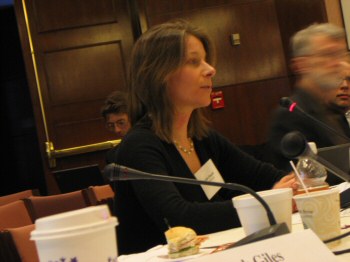
Bob giles of the Nierman Foundation says he’s never thought about it as adversarial. Corporate news organizations ingest ideas very slowly. Ed Cone is doing very interesting work in Greensboro.

Open discussion:

Jon Garfunkel responds to Jay’s points, saying (overall) that Jay gives too much credit to bloggers.

Dorothy Zinberg: What is the psychological gap? How would an ink person think differently if she were writing for a blog?

Jay: Every reader is a writer. Every reader is connected horizontally to all the other readers. In Web publishing, the editing occurs after publication.

Jeff Jarvis: Yes, there isn’t a war. At some point we won’t be able to tell the difference between journalism and citizen journalism, but now they are distinct and there’s a tensions.

Lee Rainie of the Pew Internet project says that it’s recognized now that trust and credibility are social processes: The process of deciding what to believe in and act on is a conversational process. In his research, he sees this happening in the health community where the omnipotent doctor is giving way to online support groups of various sorts.

Chris Lydon argues against the reconciliation. As Dave Winer says, bloggers are evangelists. The blogosphere is a better metaphor for God than the NY Times. “I used to think of the NY Times as God’s memo on the day.” The new metaphor is technorati: You can scan the home page and see a million bloggers…

Ed Clone: I’m a journalist and I didn’t understand blogging until I got one. He points to Greensboro101.com and the fact that there’s plenty of space for citizen journalists. “I’m a writer and reporter and I feel tremendously empowered by these tools.”

Jan Schaffer says the question is: What will news look like in the future?

Rebecca Mackinnon asks if participatory journalism will result in feedback loops where people only hear wht they want ot hear and not what they don’t want to hear?

Dan Gillmor, in response to Chris Lydon, says that the NY Times of the rich and powerful and the blogosphere is the trade journal of us and how we live our daily lives. And we need ways to track the conversations better.

Hoder (via IRC): Blogs have more credibility in closed societies.

John Hinderaker: I want to put in a good word for objectivity. I define it as neutrality, fairness, accuracy, and it should remain an important goal for people doing primary news reporting. Objectivity is never perfect; all journalists know that.

Jeff Jarvis: John, who do you think is doing a good job of it?

John: Many reporters do an excellent job. The problem with the NY Times, Washington Post and CBS is they lack diversity: Almost all the editors are liberals.

Dave W: Objectivity leads to you not disclosing your point of view and to a lack of transparency. Newspapers ought to provide a dossier of all previous articles, what school they went to, etc.

Alex Jones: Winer is onto something important. Objectivity is important to traditional journalism. Accountability and transparency may be the greatest things the blogosphere can bring to journalism. I don’t think the question of who you are is important to mainstream journalism gaining credibility, but it ought to be responsible for how they made the choices they did. The “who” issue gets in the way: A Democratic can write about a Republican. The “who” would be used mainly to discredit people.

Faye Anderson: Bloggers are more easily transparent because we have links and more context.

Jeff: Objectivity is a sink hole. What we really want to do is be honest and tell the truth.

Me: Objectivity is a methodology and a rhetoric. (And newspapers in their objectivity also tell us what we should find interesting.) The rise of blogs tells us that we’re interested in other forms of rhetoric and are taking over the question of what we found interesting.

Me: Three possible dimensions of tension between j and b: Economics, truth and reputation.

Xiang Qiang: We should focus on the collective effect of the blogosphere.

Bill Buzenberg: We’ve created a big data of people in our audience who are willing to give us info. It’s a revolution in sourcing.

Dan: We need to expect more of what used to be alled “the audience.” They have more work to do.

David Sifry: I care a lot about objectivity, but what’s most important to me when I read the media is trust. Do I trust the person I’m listening to. Knowing that there are fact checkers and an attempt to be objective helps me to trust a newspaper. But I can lso check what the bloggers are saying and watch what they do over time and what other people are saying about them…that gives me a huge amount of info about whether I can trust them. And that’s were the common ground is.

Jane Singer: How do we get people to go read people they don’t agree with?

Susan Tifft: The younger generation generally doesn’t know what blogs are and is confused about what journalism is.

Jeff: More voices are good and we link to lots of voices.

Lee: Our research shows that the most fervent information seekers (about 15-20% of the general population of adult Americans) are aware of many more political arguments than those who do not. They are not only going to sites that reinforce their views.

Chris: The conflict is between the blogosphere and the media powers that be. The crisis is that we’re not well-informed. The goal of journalism is popular wisdom [= making the populace wise] and we’re in deep trouble.

Jay: Bill Buzenberg’s comment represents a big change in American journalism. The old idea is that the audience lacks knowledge and that’s why they need the journalists. Bill’s idea is really different. WRT objectivity, of course we want people to step outside their own beliefs. That’s integrity, not objectivty. We used to be able to believe that the quality of info comes from professionalism, having a strong organization, having good intentions. Now we’re realizing that it’s deeply related to the quality of your connection to the people you’re trying to inform. Without good conection, there won’t be good information. Bloggers have that connection.

Jonathan Zittrain: This conference started out with a lot of excitement and buzz. Journalism is ill right now. What’s at stake is how we frame our view of the world. We need to find ways to frame the world in less than a 1:1 ratio.

Tweet
Follow me

Categories: Uncategorized Tagged with: conference coverage Date: January 21st, 2005 dw

6 Comments »

[bjc] First (and last?) photos

I’m at the Blogging, Journalism and Credibility conference, sponsored by Berkman, Shorenstein and the ALA.

Here are the first two photos I’ve taken, and quite possibly the last just because the conf looks like it will be pretty intense.

Meeting room
Lovely meeting room. The South Vietnamese will be on the left, the North Vietnamese on the right, and Henry Kissinger will be in the middle

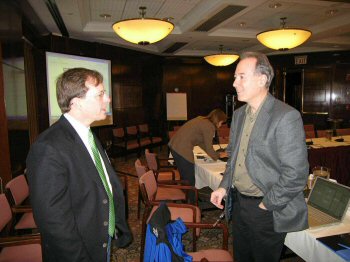
Gillmor and Hinderaker
Dan Gillmor, chief citizen journalist, and John Hinderaker of Powerline

Tweet
Follow me

Categories: Uncategorized Tagged with: conference coverage Date: January 21st, 2005 dw

1 Comment »

Berkman Web of Ideas: Everything Is Miscellaneous

This coming Wednesday I’m holding another in a series of open sessions on, well, ideas I’m interested in. This time will be a little different because I want to try out a presentation I’m giving at the TTI Vanguard meeting in SF in a few weeks. The title is “Everything Is Miscellaneous,” and I’m really not yet settled on what I’m actually going to say. But here’s the blurb:

For 2,500 years, knowledge was shaped like a tree. It had a root,
branches and leaves. Now that we’re digitizing all the information we
can lay our mitts on, it’s becoming clear that trees make sense within
the constraints of the real world but are far too limited when it comes
to organizing information in the digital world: Trees assume a leaf
really should be on only one branch, favor neatness over mess, are owned
by the people who own the knowledge, and assume the universe can be
known ahead of time. We are instead rapidly inventing new principles of
organization, from faceted classification to bottom-up
folksonomies. If we change the most basic principles of organization,
what will happen to knowledge and to the institutions that take their
shape from knowledge?

The session is open to anyone. It runs from 6-7:30pm at the Berkman Center’s Baker House in Cambridge (map). Best of all: Free pizza.

Tweet
Follow me

Categories: Uncategorized Tagged with: web Date: January 21st, 2005 dw

8 Comments »

Blogs as a moral presence

A few days ago, I got an email from a reader outraged that I hadn’t commented on Harvard President Lawrence Summers’ discouraging remarks. I replied to her that I hadn’t had anything interesting to say and I don’t feel obligated to comment on every issue of note. From her point of view, because I’m paid (a little bit) by Harvard, my failure to blog was a failure of courage. (I eventually did blog about it, but my affiliation with Harvard is temporary and so far below Summers’ radar that it took 0.0 pounds of courage.)

Then Jay Rosen blogged about the silence of PR bloggers about Ketchum’s sliminess in the Armstrong Willilams affair. Jay points to an exception: The CEO of Edelman PR, Richard Edelman, blogged twice in no uncertain terms about Ketcham’s culpability. In the comments, Jay asks me if I think the existence of Richard’s blog altered the way he responded. Although I know Richard a little, I obviously can’t speak for him. Nevertheless, it seems to me that in cases like this — if it’s a PR scandal and you head a PR agency, or it’s a Harvard scandal and you work at Harvard — if you have a blog, not addressing the issue is itself a presumptive moral statement. Of course it’s not clear how to take that statement: Maybe you had nothing to say, maybe you’re on a plane, maybe you just don’t feel like it, maybe you’re feeling too confused or too sick at heart. Even so, the blank blog is staring back at you.

Blogs call forth moral presence.

[To disclose yet again: I’ve started consulting to Edelman PR but had nothing to do with Richard’s blogging about Ketchum. I wish that I did.]

Tweet
Follow me

Categories: Uncategorized Tagged with: web Date: January 21st, 2005 dw

5 Comments »

January 20, 2005

Wikipedia topics to love

Heavy Metal Umlauts

Tweet
Follow me

Categories: Uncategorized Tagged with: uncat Date: January 20th, 2005 dw

2 Comments »

« Previous Page | Next Page »


Creative Commons License
This work is licensed under a Creative Commons Attribution-NonCommercial-ShareAlike 3.0 Unported License.
TL;DR: Share this post freely, but attribute it to me (name (David Weinberger) and link to it), and don't use it commercially without my permission.

Joho the Blog uses WordPress blogging software.
Thank you, WordPress!