


logo
EverydayChaos
Everyday Chaos
Too Big to Know
Too Big to Know
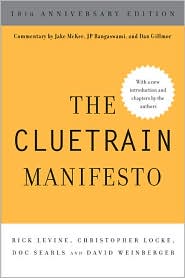
Cluetrain 10th Anniversary edition
Cluetrain 10th Anniversary
Everything Is Miscellaneous
Small Pieces cover
Small Pieces Loosely Joined
Cluetrain cover
Cluetrain Manifesto
My face
Speaker info
Who am I? (Blog Disclosure Form) Copy this link as RSS address Atom Feed

October 21, 2004

[PT] Tom Barnett

Tom is the author of The Pentagon’s New Map. I’ve been reading his stuff for a while. I don’t know enough to be able to tell if what he says is right, but it sure seems coherent and compelling.

You ought to go read his stuff.

Tweet
Follow me

Categories: Uncategorized Tagged with: conference coverage Date: October 21st, 2004 dw

4 Comments »

[PT] Jim Rygiel

Jim was the visual effects supervisor on Lord of the Rings. He’s got a looong list of credits, LOTR is enough for me. “I could do Lord of the Rings on a laptop right now,” he says. It would take longer — they had 6,000 CPUs on LOTR — but you could do it.

He shows clips of the animation process. He says that he doesn’t expect digital effects to replace actors, except for stunts. [Last year at PopTech, one of the Pixar guys said that they won’t replace actors because acting is an art that actors do better than animators.] He shows the big elephant battle from LOTR III (I know that’s not what Tolkien called ’em, so just back off), variously exposing the layers of digital effects. It is a crazy-ass piece of footage, and seeing the layers was amazing. I went back to see the movie a second time when it first came out primarily to see that scene again.

He shows side-by-side clips of Andy Serkis and and Gollum in dramatic moments, closeups, to make the case that Serkis should have gotten a Best Actor Oscar.

He says that the industry is holding off putting in digital projectors because when that happens, anyone can make a movie and have it shown in a theater. The audience applauds.

Tweet
Follow me

Categories: Uncategorized Tagged with: conference coverage Date: October 21st, 2004 dw

5 Comments »

[PT] Richard Florida

Florida says that the rise of the creative economy — where the real value is derived from creativity — is a fundamental change. You need not only technological creativity. You also need aesthetic creativity. You need cultural creativity. You need a people culture. And for that you’ll do better by going to a place that’s open culturally, that has lots of job opportunities, that has “energy.”

Tweet
Follow me

Categories: Uncategorized Tagged with: conference coverage Date: October 21st, 2004 dw

Be the first to comment »

[PT] Joel Garreau & first session Q&A

The thesis of his upcoming book, Our New Selves, is that we’re at a hinge in history because for the first time technology is being applied inwardly more than outwardly. Are we engineering new types of humans? He says that every super power in the comics is either here now or will be “before your mortgage is paid off.”

[I got swept up in the backchannel chat and have obviously done a crappy job blogging this talk. Sorry.]


Gladwell: Not all the superpowers ar here yet. E.g., we can’t know what evil lurks in the hearts of men. [Also, no creepy stretchiness.]

Garreau: We’re developing infallible lie detectors.

Gladwell: If I don’t know if I’m telling a lie, how can you know?

de Waal: The people in the fields you (Garreau) are talking about don’t know enough about primate behavior. Anger can be beneficial. Alter that, for example, and who knows what you will screw up?

Metcalfe: The guy who designed the Pepsi Challenge is in our audience. Was Malcolm’s characterization accurate?

Guy: Yeah, about 75%.

Malcolm: My point is that things are more complex than these tests often think. E.g., people react to the packaging as if they’re reacting to the product. It’s better to observe human behavior than test it or ask for explicit explanations.

de Waal: I don’t trust questionnaires at all. Observation!

de Waal: I get jittery about proposal to change human nature because we know so little about it and everything is tied to something else.

Metcalfe: Do you, Dr. de Waal, think that we should behave more like chimps.

de Waal: [laughs] No, we’re all unique. For example, we have pair-bonding and families, which chimps don’t. We should be aware of our primate tendencies.


Jonathan Coulton is doing songs to close out sessions. He was great last year and now is singing a love song to his Mac.

Tweet
Follow me

Categories: Uncategorized Tagged with: conference coverage Date: October 21st, 2004 dw

2 Comments »

[PT] Frans de Waal

Frans says he’s going to convince us that we’re apes. He says that aggression also provides opportunities for reconciliation; aggression doesn’t just drive us apart. He has lots of funny examples of how the body laguage of politicians establish dominance hierarchies — including the political reconciliation of Bush and McCain. And he goes through the ways in which chimps and capuchins support basic ideas of fairness and sharing. [Totally enjoyable talk.]

Tweet
Follow me

Categories: Uncategorized Tagged with: conference coverage Date: October 21st, 2004 dw

2 Comments »

[PT] Malcolm Gladwell

He’s giving us a preview of Chapter 3 of his new book, Blink. He’s going to talk about the development of the Aeron office chair. When it was first tested, the testers said they hated it because it was ugly. Yet, it’s become the best selling chair in the history of chairs. But after it became popular, the same groups said the chair is beautiful.

We find out what people like by asking them, he says. But the story of the Aeron chair shows that something gets lost between the feeling of a preference and the expression of a preference. What does this tell us about human nature? “Our preferences are extraordinarily unstable.”

He points to problems with blind taste tests like the ones Coke and Pepsi run. First problem: If you only take a sip, you’ll almost always prefer the one that’s sweeter, but not when you drink the whole can. Home use tests give different answers than sip tests. Second: People pick up cues unconsciously. We can’t explain how we do things or why we prefer them. Third: Asking people to think about what they prefer changes their preferences.

The real problem is that we have trouble distinguishing between things that are truly ugly and things we have trouble being articulate about because they’re too new.

Conclusion: We have to be skeptical when customers say “No.” And we have to understand that we don’t always understand our own hearts.

[Excellent talk and a great start for PopTech. And Gladwell is so good at making points by telling stories. But I’m a little confused. In some of his examples, the problem is that our prefs are unstable. In others, the prefs are real but we don’t report them accurately. In others, the test itself is flawed so the real prefs that we express accurately – we really do like the sip of Pepsi better than the sip of Coke – don’t reflect prefs outside of the testing environment. I assume the book lays all this out

Tweet
Follow me

Categories: Uncategorized Tagged with: conference coverage Date: October 21st, 2004 dw

4 Comments »

[PT] Audio stream

IT Conversations is (are?) streaming PopTech live, here.

Tweet
Follow me

Categories: Uncategorized Tagged with: conference coverage Date: October 21st, 2004 dw

Be the first to comment »

[PT] At PopTech

I’m at PopTech for the next few days, which looks like it’ll be an exceptional conference. I’m helping out with the official backchannel chat for attendees, which will probably prevent me from live-blogging it. But I don’t like live-blogging anyway. I only do it because Im too lazy to go back to my motel room and actually think about what I’ve heard.

I’m sitting in the blogger’s corner of the Camden, Maine, opera house. We have the power. No, really, this corner is where the power outlets are. I’m sitting next to Halley. Lots of friends in the audience.

Shh. The upbeat shut-up-we’re-starting-music is beginning and Bob Metcalfe is about to come on stage to kick things off…

Theme of the conference: The Next Renaissance. First session’s speakers: Frans de Waal, Joel Garreau, and Malcolm Gladwell. Not bad!

Tweet
Follow me

Categories: Uncategorized Tagged with: conference coverage Date: October 21st, 2004 dw

1 Comment »

October 20, 2004

Shelley’s Blogopedia

Shelley’s had a damn fine idea for how to create an overview of blogging:

The purpose behind the IT Kitchen was to provide an overview of weblogging, the nuances and the ins and outs and that sort of thing. Sort of like many of the handbooks about weblogging that have been published online by various people (see Rebecca Blood’s). However, instead of just providing static content, there’s an interactive element to it, a community participation, which allows people to ask questions as the material is published, or even provide their own material in support of a topic.

Want to know how to blog? Interested in the nuances? This blog-and-wiki is going to be one of your first stops.

Meanwhile, this is causing wikiphobia in Jeneane. (My guess is that Jeneane’s over it already, so don’t bother sending the get-well cards.)

Tweet
Follow me

Categories: Uncategorized Tagged with: web Date: October 20th, 2004 dw

3 Comments »

Metadata without tears

Peter Merholz, AKA peterme, has an excellent article at Adaptive Path called Metadata for the Masses:

But what if we could somehow peek inside our users’ thought processes to figure out how they view the world? One way to do that is through ethnoclassification [1] — how people classify and categorize the world around them.

He takes del.icio.us and Flickr as examples of “ethnoclassification” (a phrase he tracks back to Susan Leigh Star),. (I am enamored of the branch of ethnoclassification on exhibit at del.icio.us if only because people have started calling it “folksonomy.”) He looks at the benefits. Then he addresses the problems, and suggests the paths out of the forest we’re making for ourselves.

Jay Fienberg points us also to Jon Udell’s article on “collaborative knowledge gardening.” I’ve also been looking at some related issues (e.g., here, here, here, here and here), but Peter has the advantage of knowing what he’s talking about.

Tweet
Follow me

Categories: Uncategorized Tagged with: taxonomy Date: October 20th, 2004 dw

6 Comments »

« Previous Page | Next Page »


Creative Commons License
This work is licensed under a Creative Commons Attribution-NonCommercial-ShareAlike 3.0 Unported License.
TL;DR: Share this post freely, but attribute it to me (name (David Weinberger) and link to it), and don't use it commercially without my permission.

Joho the Blog uses WordPress blogging software.
Thank you, WordPress!