



logo
EverydayChaos
Everyday Chaos
Too Big to Know
Too Big to Know
Cluetrain 10th Anniversary edition
Cluetrain 10th Anniversary
Everything Is Miscellaneous
Small Pieces cover
Small Pieces Loosely Joined
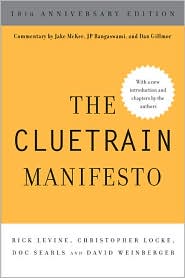
Cluetrain cover
Cluetrain Manifesto
My face
Speaker info
Who am I? (Blog Disclosure Form) Copy this link as RSS address Atom Feed

September 14, 2004

Saudi site blocking

At the Berkman Center this afternoon, the lunch-time topic was countries that block access to particular sites. We heard about the Berkman’s study of Saudi Arabia’s practices.

Jonathan Zittrain helped start the project when he realized that many people assume that if you could overcome the economic obstacles to global access, everyone would magically be on line. But even when the connection is there, countries are imposing limitations on what can be accessed. The project checks what’s being filtered by the local ISPs. The study began in 2000 and is being done in conjunction with U of Toronto and U of Cambridge. Jeff Engerman, a student Fellow at the Center, gave the presentation.

Before allowing access, the Saudi government did a three year study of public access beginning in 1994, and then spent two years building a firewall. Public access began in 1999. All traffic runs through central government servers and outbound urls are chaecked against a government-specified blacklist. (See here for the policy statement about filtering.) Users can request a block; apparently, about 200 requests are made per day, 30% of which are accepted. About 3% of requests to unblock are implemented.

The requests to block pages outnumber the number of blocked pages, which Saudi officials take as a sign of public support. One newspaper reported 45% of Saudis think there’s too much blocking, 41% think it’s reasonable, and 14% want more. People sell hacked access to blocked sites for around $50 — it’s done through open proxies. (The Chinese, on the other hand, don’t just use a blacklist but look for strings, etc., to dynamically determine the acceptability of content.)

The project found the 98% of the porn sites they checked were blocked, 93% of gambling, 65% of drugs (marijuana 74%, but not treatment sites (5%)), and 41% of the proxies used to skirt around the filters.

For religious sites, 0.7% were blocked, 12% of Bahai were blocked, 5% of Islam, 1% of Scientology, and 0% of Judaism, Christianity and Catholicism.

5% of pages about Israel/Palestine were blocked, 8% on terrorism, the MEMRI list of Islamist websites 29%, gay/lesbian/bisexual 11%, Holocaust 11%, Israel 0%.

There are also blocks on conversion of Muslims to Christianity (e.g., members.aol.com/alnour, arabicbible.com and mutenasserin.org), women’s rights, other Islamic sects.

The “vice” sites are blocked through SmartFilter, a commercially-available filter. There are plenty of anomalies and many cases that are hard to understand: the human rights site www.homa.org is blocked by SmartFilter as nudity, possibly because it has photos of a naked woman showing wounds. SmartFilter’s participation makes it difficult to judge which sites are being targeted. For example, SmartFilter puts Holocaust sites in its “violence” category. Take out the Holocaust sites blocked by SF and the number specifically picked out by the government drops dramatically.

There is some political filtering, including miraserve.com and saudiinstitute.com.

Saudi Arabia’s inconsistent blocking seems to indicate that it’s doing it in part to satisfy internal critics, although they are quite aggressive blocking porn. China, on the other hand, is all bite and no bark.

Fascinating session.

Tweet
Follow me

Categories: Uncategorized Tagged with: web Date: September 14th, 2004 dw

16 Comments »

Meaningless but semantic

At a session at foo camp, I went through the tentative chapter outlines of the book I’m plotting. My aim was to ruthlessly use the attendees, getting them to tell me where I’m going wrong and what I should be writing about. And it worked: They poked at the ideas and pointed me in many helpful directions. Thanks, y’all!

And it just keeps going: I’ve been getting incredibly generous email with yet more information and ideas. For example, one came today from Angela Hey chockablock with examples. She writes about some initiatives that have struggled over how human-readable metadata should be. For example, meaningful codes for telephone equipment help field service people save time by avoiding lookups. (Apparently supermarkets have yet to learn this lesson, as we know from watching the register clerk flip through cards to find the code for asparagus.) On the other hand, she says it took the ANSI committee three years to come up with two letter codes for all 50 states — “Maine, Massachusetts, Mississipi, Minnesota and Michgan being the ones that took up most of the time.” Ah, the politics of initials!

I also learned from Angela that the phone companies worked out four-letter codes for each town for use on envelopes, but the Post Office surprisingly nixed it. I wonder if they were worried about the impersonalism of Old Kinderhook turning intoi OLKI or if having only four letters is like having four engines on a plane, quadrupling the risk of failure: “Mayday! Mayday! We’ve lost letter number four to an electrical disambiguation problem — We can’t tell if it’s an I or an L.”

Tweet
Follow me

Categories: misc Tagged with: misc Date: September 14th, 2004 dw

2 Comments »

Keep the bird burning

Shelley needs some coins in her tips jar.

I can’t imagine the blogosphere without her strong voice…

Tweet
Follow me

Categories: Uncategorized Tagged with: web Date: September 14th, 2004 dw

1 Comment »

September 13, 2004

Blogsnow – Now without the US!

I hadn’t been to BlogsNow before (thanks for the link, mas ri). It is a rolling aggregation of links harvested from fresh blogs. And now they’ve added a feature: A version that strips out the .com and .us sites so that links to other countries get some visibility.

Tweet
Follow me

Categories: Uncategorized Tagged with: web Date: September 13th, 2004 dw

Be the first to comment »

September 12, 2004

The case of the fonts – 50 years ago

In 1948, the young Richard Nixon made his bones by questioning Alger Hiss . And it all depended on a discussion of fonts.

Alger Hiss was an aristocratic lawyer who worked for the State Department, and was prominent enough to have served as Secretary General at the founding meeting of the UN. Whittaker Chambers was a grubby-looking ex-Communist who claimed before the House Un-American Activities Committee (HUAC) in August 1948 that Hiss was a close friend and a member of the Party. Hiss — at the time, the president of the Carnegie Endowment for International Peace — demanded to address the Committee where he insisted he had never been a Communist and had never met Chambers. Hiss was so convincing that it looked like HUAC had made a mistake. But one Congressman, Richard M. Nixon, pressed on. The Committee charged Nixon with discovering which of the two witnesses was lying.

Nixon held first-ever televised hearings (to a grand total of 325,000 existing TV sets in the US) where he questioned Chambers about the details of his alleged friend. Chambers seemed to know details only a friend would know. Hiss then admitted that he might have known Chambers passingly under a different name. Hiss came out of the hearings looking like a liar.

Hiss sued Chambers for libel, claiming $75,000 in damages, and required Chambers to produce any and all correspondence that might be relevant. Chambers went to the home of his nephew’s mother and pulled out an envelope from a dumbwaiter. Inside were 65 typed copies of State Department documents and four written by hand, along with 5 strips of 35mm film. The HUAC got wind that there was yet more evidence, for which Nixon issued a subpoena. Chambers led investigators to a pumpkin patch on his farm and pulled five rolls of film out of a hollowed-out pumpkin. The film turned out to contain photos of government documents from the 1930s.

Nixon with film strip

Because of the statute of limitations, Hiss couldn’t be tried for espionage. So he was tried for perjury. After besmirching Chambers’ non-aristocratic life, Hiss’ lawyer claimed that the documents were forged and the whole event was timed to hurt Truman’s electoral campaign.

Most damning to Hiss’ case was testimony by an FBI agent that, based on analysis of the typefaces, the letters had been typed on Hiss’ old typewriter. Hiss argued that he’d given the typewriter to a domestic servant before 1938. Three members of the servant’s family supported that claim. But Hiss’ wife had told the grand jury that he might have given it away as late as 1943. Plus, she was caught on the stand lying about whether she had ever been a registered Socialist.

The jury was unable to decide on a verdict.

At the re-trial, a psychologist brought in to show that Chambers was a “psychopathic personality” was famously shredded on the stand. Hiss’ lawyer admitted that the documents had been typed on Hiss’ typewriter, but argued that Hiss wasn’t the typist. Hiss was found guilty and sentenced to 5 years in jail for perjury.

The case made Nixon into a hero. In 1952, Eisenhower chose him as his running mate. Shortly afterwards, Joseph McCarthy began his own hearings, supposedly to ferret out spies within the government. Ronald Reagan said that Chambers’ autobiography was the catalyst that converted him from Democrat to Republican; in 1984, Reagan posthumously gave Chambers the Medal of Freedom.

Hiss maintained his innocence until his death, even in the face of the release of material from the USSR released in 1996 that seems to indicate that he was indeed a spy.

Sources and links:

Douglas Linder, The Trials of Alger Hiss: A Commentary

Nova

Angelfire

Stanley Cutler’s review of Alger Hiss’s Looking Glass War, a book by G. Edward White

Susan E. Evans’ “The Alger hiss Case: The Real Trial of the Century”

Court TV’s “The Shadowy Mr. Crosley” has dramatics excerpts from the Nixon interrogation of Hiss.

Here’s a pro-Hiss site managed by the lawyer who represented Hiss in his later attempt to get his conviction reversed. At that site is a deposition from an expert claiming the Hiss typewriter had been deliberately altered, a mainstay of the liberal defense of Hiss. Plus, newsreel footage!

Tweet
Follow me

Categories: Uncategorized Tagged with: politics Date: September 12th, 2004 dw

4 Comments »

September 11, 2004

[foo] Designing shared ontologies

Jason Cole lead a session on how to design a tool he wants to build. He says most academic technology is aimed at teachers. How do we build tools that support learning? His wife just started grad school and wants a tool that will build a personal knowledge base. But it should work with her friends’ bases. And you’d like to find others working on the same issues. That means merging disparate ontologies.

What do you do about degree of belief? Ontologies are binary, but people don’t think in that binary way. “The problem with monolithic ontologies is that interesting ideas get averaged out.” RDF doesn’t allow degrees of belief, but there are other W3C specs that can be layered on top to do that.

Suggestion: Create multiples of RDF relationships, e.g. “X with_.01_probability_is_a Y.”

Allan Noren: The Adaptive Book Project from CMU lets a student rearrange a syllabus in a way that makes sense to her.

(Then the conversation got interesting in a variety of directions and I forgot to record it.)

In the last ten minutes, we brainstormed features: Should look like Google, should spider for counter-examples, should require no extra work to build the ontology, retain the link from source when items are moved…

Tweet
Follow me

Categories: Uncategorized Tagged with: conference coverage Date: September 11th, 2004 dw

15 Comments »

[foo] Endangered Devices – Buy an HDTV for Freedom! (Offer not good after 7/05)

Wendy Seltzer, lawyer for the EFF (join here), talks about the drive to mandate building restrictions devices into hardware that plays media content.

The broadcast flag requires HDTV devices to check for a “do not redistribute” flag in the content they receive. With the flag, they can’t output high-def digital or record it. She says that this mitigates against open source software since it is modifiable; all tuners would have to be closed source. “In the post broadcast flag world, no one can bulid a TiVo without first asking permission from the FCC.”

Until July 1, 2005, it’s capable to manufacture HDTV tuner cards that ignore the broadcast flag, and they’ll work fine after the regulation goes into effect. So, stock up on those HDTVs now, kids!

Don Marti asks if the restriction applies to drivers. Wendy thinks not. Interesting line of thought… (Don says: “Any DRM system effective enough to work is effective enough to destroy civilization.”)

Wendy says the EFF is challenging the ruling in court but is also building lots of devices that show what can be done if the technology is allowed to remain open.

A discussion ensues about the value of DRM and the strategies for combatting it, from “working with it” to hoping that we’ll “route around” the broadcast flag. (IMO, “routing around it” means becoming a cultural hermit, which will seem like a viable option mainly to hardcore DeadHeads.)

Wendy differentiates two issues: First, copyright holders should be able to protect their content. Second, the government shouldn’t mandate restricted devices to enforce a particular copyright regulation scheme.

Don says that the content it’s most important for you to be able to reuse is precisely the content that people want to restrict you from using.

These are preemptive restrictions — prior restraint — says Wendy. Ray Ozzie says that we’ve had prior restraint frequently in the communications field, e.g., CALEA. VoIP will be regulated and Skype will be put out of business, he thinks. This is not something that makes him happy.

The conversation devolves into a discussion of whether DRM is good or bad. The actual point is, I think, that – granting that artists should be able to protect their copyrights – having the government design and mandate a particular technological solution is a bad idea, first because the government isn’t good at tech design and, second, because the chosen implementation will restrict us from doing things that move culture forward.

Tweet
Follow me

Categories: Uncategorized Tagged with: conference coverage Date: September 11th, 2004 dw

3 Comments »

[foo] Mag stripes

Billy Hoffman wondered what was encoded in the mag stripe inside his various cards. A friend had a reader, that he got from Germany for about $300. He discovered that some encoded his social security number for no apparent reason.

a mag stripe is PVC, magnetic particles and glue. The particles are arranged in magnetized vertical strips. There are 3-4 tracks on each. Stripe 1 can have 100 characters, stripe 2 can have 40, and stripe 3 is journalized. (I’m not sure why journalizing it is useful.)

There’s nothing available for reading cards except expensive, proprietary models. So Billy wrote stripesnoop that displays the contents of a magstripe. You can build a reader for $10-15. They’re developing a writer that will write to all three tracks, for about $75, instead of the $900+ you’ll pay for a proprietary model.

It was an informative talk. Billy’s going to set up his reader and let us see what’s encoded on our cards. (The stripesnoop site has most of the information if you want to get more than this sketch.)

Tweet
Follow me

Categories: Uncategorized Tagged with: tech Date: September 11th, 2004 dw

Be the first to comment »

[foo] Tim on book sales

Tim O’Reilly is giving a talk on what book sales tell us about the industry.

He says that .Net O’Reilly books have sea creatures on the cover because Microsoft would like to cover most of the earth’s surface.

Java titles are trending down (in terms of market share), but C# and PHP are on the upswing. C and C++ sales are steady.

Oracle is down. MySQL is up.

Reference books don’t do nearly as well as tips ‘n’ tricks because reference works so well on the Web.

In any particular thematic area (e.g., programming books), a few books do very well and the rest don’t. Books that do well for O’Reilly bring in %8K-$30K/week, although I missed the beginning of what he said and thus may have gotten that wrong.

The Red Hat book market has dropped 60% over a few months, but books for other distributions of linux have taken up the slack.

Mac, which has 3% market share, has 25% of the book share. (This to me proves that the Mac is too hard to use :)

Tweet
Follow me

Categories: misc Tagged with: misc Date: September 11th, 2004 dw

3 Comments »

Post-social at foo

I’m at Friends of O’Reilly, the geeks-in-tents get-together that’s just too much fun. Since I’m on east coast time, I was up at 4:30 and came to the largish room where people go for focused computing time. Now at 9:30 there are about 20 stellar geeks sitting around tables arranged into a U, each staring into her/his laptop, now and then snorting in laughter and drawing their neighbors’ attention to yet some new wonder on the Web.

From the faces each two feet from the next but focused on the glowing screens, it’d be easy to mistake this for anti-social behavior. In fact, it’s sociality once again escaping from the fascination of loneliness, as always has been the case.

Tweet
Follow me

Categories: Uncategorized Tagged with: conference coverage Date: September 11th, 2004 dw

Be the first to comment »

« Previous Page | Next Page »


Creative Commons License
This work is licensed under a Creative Commons Attribution-NonCommercial-ShareAlike 3.0 Unported License.
TL;DR: Share this post freely, but attribute it to me (name (David Weinberger) and link to it), and don't use it commercially without my permission.

Joho the Blog uses WordPress blogging software.
Thank you, WordPress!