



logo
EverydayChaos
Everyday Chaos
Too Big to Know
Too Big to Know
Cluetrain 10th Anniversary edition
Cluetrain 10th Anniversary
Everything Is Miscellaneous
Small Pieces cover
Small Pieces Loosely Joined
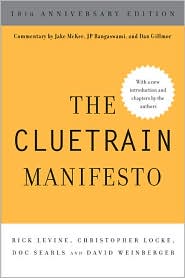
Cluetrain cover
Cluetrain Manifesto
My face
Speaker info
Who am I? (Blog Disclosure Form) Copy this link as RSS address Atom Feed

September 28, 2004

[bn] Justification for Regulation

It’s a six-person panel:

Rebecca Arbogast, LeggMason
Prof. Nemo*
Harold Feld, Media Access Project
James Gattuso, Heritage Foundation
Russell Hanser, FCC (speaking for himself and off the record [Blog off])
David Isenberg, isen.com
Eli Noam, Columbia U. economics
Christopher Savage, Cole, Raywid & Braverman

Susan Crawford moderates. She asks that if there weren’t a Broadcast Act from the ’30s, what’s spoecial about the Internet that means it needs regulation? Russell gives a reasonable, coherent answer that I am not allowed to report.

Isenberg says that Congress shall make no law abridging freedom of the press. Suppose Congress makes a law that makes it a million times more expensive to own a printing press. Maybe the hypothetical law regulates press prices directly, controls the price of paper, etc. Doesn’t matter. It’d be unconstitutional. Suppose the law made presses only twice as expensive…Now that we’ve established what telcom regulation is, we’re just arguing about the price. “So, when I see Americans struggling with crippled kilobit systems when gigabit is avialable, I want to call the police.” Likewise, spectrum that is owned when it doesn’t have to be owned, broadcast flag, deep packet inspection without a warrant, I want to punish the criminals who are denying me my constitutional right. The Internet puts a printing press in everyone’s house. But it’s more than that. It’s freedom of assembly: The Internet is group-forming…The duty of the Congress and the FCC if they take the FirstAmendment seriously is to remove whatever” stands between the user and the use of the Internet. “We’re rapidly becoming a third world connectivity nation.” [Whooo! Go David!]

Q: Is there a difference between the economic and the social?

Arbogast: Microsoft has to get permission from the FCC for Longhorn. That’s the sort of thing that would drive a lot of people here over the edge. Currently there’s no regulation of VoIP, but I’m not sure why there should be no regulation of it. Right now, the main reason is that it’s a fairly marginal service.

Noam: The Net is an information system, a communication system, and an inkblot onto which people project their fears. We should be talking about regulation in society, not just the Internet. Would we really stand for Internet as a conduit for child pornography from Thailand, gambling, etc.? We can talk about deregulation of communications, but we have to be consistent. The “island of libertarianism” in a regulated environment doesn’t make sense.

Gattuso: I don’t think the Net is exceptional just because it’s the Net. The thing that the Internet changes is the overall premise that’s guided telcom regulation, i.e., that there’s no competition. Bringing competition in changes the basis for regulation. We have to be careful about over-ruling consumers.

The FCC guy has an interesting comment but I’m not allowed to tell you what he said.

Savage: We regulate not only when there are monopolies. E.g., you regulate taxicabs (where there’s plenty of competition) because once you’re in the cab, you’re stuck. Best approach: Create multiple actors to solve as much of this as possible.

Arbogast: For me what makes a lot of the dsicussion more complicated is that underneath is the broadband platform where there isn’t a lot of competition.

Noam: We should see universal service as a societal benefit, not just a tax.

Q: Should we have a central Internet agency to deal with spam, spyware, copyright, etc.?

Gattuso: No, if there’s regulation it ought to be in the agencies that traditionally deal with it,.

Nemo: I’m alarmed by the NPRM‘s [Notice of Proposed Rule Making] very aggressive UN [?] preemption.

Savage: In the Pulver Case, the FCC applied existing law to the question. They woke up and realized there’s a body of law here.

Nemo: The FCC tries to putting this on a constitutional footing (“dormant commerce”?) but ignores 100 years of jurisprudence… [over my head]

Isenberg: What makes the Internet different is that layer 3 of the Internet Protocol defines a publicly known clean interface between what’s underneath the physical network and what’s on top. We should be very clear that the whole justification for regulation has changed because the Internet is now no longer a special purpose industry where one application, such as voice or video entertainment, is tied to one network, such as twisted pair or concentric pair. And we should be really really careful when we say we need Internet regulation because spam is a problem or phishing is a problem. These are applications and need to be addressed at the app level. When we say Internet technology isn’t what it should be, so we have too little unlicensed spectrum or we need fiber, then we’re talking about stuff that’s below that line.

Q: The Net isn’t thing. It’s really an agreement about how to cut things into packets and reassemble them at the other end.

Noam: I don’t care if it’s in this layer or that layer, you have to deal with the problems as they come.

Gattuso: What matters isn’t whether it’s a thing or not, it’s whether consumers can get what they want. [Damn. Wanted the conversation to go further down this path.]

Arbogast: In many areas, we have a duopoly. That makes it hard for regulators to figure out what do.

Savage: Regulatory arbitrage is a good thing. It’s a signal that things are messed up with the regulatory system. You fix it not by killing the canary quicker. E.g., if VoIP only works because it’s escaping the evil access charges, that’s a sign that you ought to get rid of the access charges. Our national policy ought to be to disadvantage the incumbents. [He stresses that he’s speaking for himself, not for his clients.] In our entire history, never has an insurgent taken over from an incmbent networked technology without the government putting its finger firmly on the scales in favor of the insurgents. E.g., land grants for railroads, displacing the value of canals.

Nemo: We should just have the debate about the world we want to see and then figure out the best way to get there. We’ve been most successful where we define particular social goals and create market mechanisms that would give us those goals.

Arbogast: Some people don’t want to pay $50-60 for broadband. She met with Europeans who wanted to stimulate demand because they saw it as a social good…

*NOTE: Originally, I had blogged Prof. Nemo as Daniel Benoliel. In Oct., I received the following from him:

I was not a part of the first panel, as wrongly assumed. The
organizers of the event made the mistake of placing my name tag on the
table.

The source of this confusion derived from the fact that I was indeed
asked to cover this panel on behalf of Yale ISP.

Since, I don’t know who was actually behind Daniel’s name sign, I am referring to him as “Prof. Nemo.” Sorry for the ignorance and the subsequent confusion.

Tweet
Follow me

Categories: Uncategorized Tagged with: conference coverage Date: September 28th, 2004 dw

3 Comments »

[nb] Bruce Mehlman: Internet Innovation Alliance

Bruce says it’s all about accelerated change.

He explains the advantages of Voice over IP: Lower cost, more features, greater competition. It’ll make us more productive, stimulate broadband adoption, and enable innovation.

When it comes to VoIP and the government, we hae three boxes:

Unavoidable priorities such as CALEA, E911, Life Line (?) and Access for the Disabled.

Political realities such as universal service (urban subsidizing rural)

Avoidable mistakes: Applying legacy access charge subsidies (telephonic protectionism) and importing heavy telecom taxation: If you want broadband to grow, don’t tax it.

The path forward: First, do no harm. Then, regulate less. And consider ways of using technology to achieve social policy objectives.

Tweet
Follow me

Categories: Uncategorized Tagged with: conference coverage Date: September 28th, 2004 dw

3 Comments »

[bn] Bob Pepper

Bob Pepper, Chief of Poilicy Development at the FCC, says the bellhead/nethead dichotomy is false. The FCC doesn’t want to take over the Net. He’s going to talk about the effect of “Everything over IP,” not just Voice over IP. [Bob is a great person to send to this. He “gets” the Net and is open to actual discussion.]

The old rules were written, he said, back when there was a non-competitive model because there were “natural monopolies.” The regulations were written to protect producers in the name of consumers. And they were written when the conduits told you something about the content and defined boundaries. They were based on an economic model that no longer holds; the metric — minutes of voice — doesn’t make sense any more. In a broadband packet world, it’s not just voice, and minutes is an irrelevant measure. Besides, he says, what sense does “acoustic regulation” make?

With VoIP, we’re now getting state regulations and even lawsuits from unions. The FCC has an Internet Poilicy Working Group, guiding FCC decisions. He says, “This is not the FCC taking over the internet. In fact, I have people I’ve been working with for over a decade to keep the FCC at bay from the Internet.” [Doesn’t that imply that the FCC wants to take over the Internet? Why else keep it at bay?] Billions of dollars are at stake: In 2002, local revenue for the telcos was $88.7B. Revenues from wireless now is higher than from wire-line. The Universal service fund (subsidies?) in 2003: $713M for low income, $1.64B for libraries and schools. Revenues from interstate switch access minutes (long distance) has declained 23% in the past four years to something like $280B. The total billable wireless minutes has increased 400%. [Warning: As always, I am more likely to get numbers wrong than right.]

“In a global packet world, what’s the role of a state regulatory? If you’re worried about the FCC…where have most of these regulations popped up?” In the states and in other countries, he answers. He lays out a set of question: Who decides? What gets regulated? How do you achieve the social goals? How do you define the stuff to be regulated?

VoIP: An Agenda for Change

Separate economic regulation for social policy: Find new ways to maintain social policy goals regardless of economic regulation.

Reform/ratonalize regulated economic relations

FCC proceedings

Legislation? Some people, like Dan Gillmor (Bob says) want more legislation to preserve the net freedoms Michael Power has outlined: Freedom to access content, to use applications, to connect personal devices, to obtain service plan information. [Why does “access content” send a chill down my spine? Ah, it’s because it’s the wrong paradigm/metaphor/frame.]

[I’m not convinced yet that the FCC is looking out for my interests as a Netizen. I’m glad Bob’s there, though.]

Tweet
Follow me

Categories: Uncategorized Tagged with: conference coverage Date: September 28th, 2004 dw

Be the first to comment »

[bn] At Bellhead/Nethead conference

I’m at a conference in NYC called “Bellhead Nethead: The FCC takes on the Internet.” There are about 60 of us here; I don’t know what the split between the bells and the nets is, although I hope to find out during the skins vs. shirts game of hoops scheduled for 10 am. It’s being put on by the Floersheimer Center for Constitutional Democracy, hosted by the Cardozo School of Law, organized by the remarkable Susan Crawford, who teaches at Cardozo.

Susan introduces the session. She says that her aim is to get a conversation going about whether the Internet is just another communications network, subject to FCC regulation. She’s particularly interested in CALEA,/a> (Communications Assistance for Law Enforcement Agencies … EFF take on it here), as well as other social policies. The FCC doesn’t always understand, she says, how different it is for people providing IP-enabled services to come to the government to have to get permission. “The staff at the FCC is bright and wise and interested.” She says the FCC says that we shouldn’t be worried because only incremental steps are being studied. But, says Susan, these small steps can result in major changes. The two sides see the Internet so differently, she says.

Last night, I went to a presentation by Dan Gillmor about his book. He tells the story – how the reader/writer distinction is being erased and what this means for broadcast media – primarily with a series of stories. Great presentation of a seminal book.

[Disclosure: The conference paid my expenses, in part so I can blog it.]

Tweet
Follow me

Categories: Uncategorized Tagged with: conference coverage Date: September 28th, 2004 dw

1 Comment »

September 27, 2004

Article in Wired

Apparently, my article on how we’re going to manage when we each have tens of thousands of photos on our hard drives is in the latest issue of Wired. As usual, I’m afraid to read it.

Tweet
Follow me

Categories: Uncategorized Tagged with: tech Date: September 27th, 2004 dw

2 Comments »

Networked devices

Jon Lebkowsky at WorldChanging blogs a message posted by Frank Coluccio referring to the October Scientific American (which I have not yet seen) that talks about “Internet Zero,” “an architecture that defines the protocols and internetworking relationships of everyday objects found in the home and the business place.” As Jon says, “As networks grow and evolve and we add more devices (as with Internet Zero), it’s important to be explicit and forceful about the requirement to deep it open and ‘dumb’.”

Around 1990, I had this great idea: DataTotes. Y’see, you plug this little device into the household objects you want to configure — thermostat, VCR, A/C — so it could read the current settings. Then you plug the little device (a DataTote, get it?) into your PC where you could use your keyboard and mouse to configure the settings the way you want. Then you make one more trip back to the device to upload the new settings. And all it would require is for every manufacturer to insert a chip and a dataport into every item they manufactured, and agree to accept my data standard. A million dollar idea! I was just ahead of my time, in the sense of being wrong about every piece of how “datatoting” would be accomplished. starting with the fact that data wouldn’t be toted.

Tweet
Follow me

Categories: Uncategorized Tagged with: tech Date: September 27th, 2004 dw

1 Comment »

Singapore fair use

I’m giving a couple of talks in Singapore in December and one of my kind hosts has sent me a form on which I’m to list every copyrighted and non-copyrighted source I use in the handouts, along with this explanation of what constitutes fair use in Singapore.

I’d say that this is what we have to worry about our copyright law doing to the free expression of ideas, but I’m afraid you’re going to tell me that this is in fact where our copyright law already is.

Sigh.

Tweet
Follow me

Categories: Uncategorized Tagged with: web Date: September 27th, 2004 dw

3 Comments »

September 26, 2004

Erasing the tail

The NY Times Magazine article on blogs makes the same old error. Viewing blogs through the media lens, only the left-hand of the side of the power curve is visible. As Matthew Klam, the article’s author says:

In a recent national survey, the Pew Internet and American Life Project found that more than two million Americans have their own blog. Most of them, nobody reads

Thus, the tail of the power curve — which is probably at least 5 million blogs long — gets erased. In fact, the tail is where blog are having their most important effects. That’s where self and community, public and private, owned and shared are re-drawing their boundaries.

Further, Klam thinks that our flocking to blogs indicates a lack of interest in balanced news. First, I think it more likely that is shows our disdain for the bloodlessness and baked-in bias of the mainstream media. Second, you could only conclude that if you knew that people who read The Daily Kos don’t also read other sources. Kos’ readership may have gone up sharply, but it’s unlikely that that’s the only source people are reading. It’s not like picking your daily newspaper.

His concludes by drawing the only conclusion visible through the lens of the media: Bloggers are becoming just like them.

Tweet
Follow me

Categories: Uncategorized Tagged with: web Date: September 26th, 2004 dw

12 Comments »

September 25, 2004

Atonement

It’s Yom Kippur. My family is in shul, but I’m here blogging. I’m also fasting, but that’s because I’m a meta-agnostic: I’m not sure if I don’t know if there’s a G-d.

Yom Kippur is about getting beyond all the crappiness we humans have managed to do to one another in the past year and starting again. It’s not a free pass. You have to make right what you’ve made wrong. But, the relationship isn’t symmetrical: You don’t get to demand justice from those lousy bastards who treated you like dirt. You forgive them. And if you don’t, you are now the lousy bastard.

Forgiveness makes no sense in terms of justice or psychology. Someone broke the rules, and you’re supposed to let it go? Someone hurt you and you’re supposed to act as if they didn’t? Forgiveness only makes sense because we’re so fallible, so flawed. Is there anything we get right all the way? We forgive because we couldn’t share a planet if we enforced all the rules all the way that perfect justice demands. We forgive one another because being human is the price of being human. We forgive because otherwise love would be an other-worldly value.

The Web exalts forgivness, but computers do not. To live on the Web, if you want to connect, you have to let lots slide. And you don’t even notice. You breeze past the typos, errors, disjointed thoughts, half-baked premises, outlandish assumptions, gross manners, inappropriate remarks and eye-burning color-schemes because there’s something to love in what — and who — you’re reading.

Computers, on the other hand, only know from rules. If one bit goes out of order, the whole house of charges can tumble. Computers’ obsessive-compulsive need to manage every bit — it’s what they were born to do — is proving too much of a temptation for us. In our fear-based belief that the perfect order is perfectly rule-based, we are falling prey to creeping Accountabalism, the belief that there’s no harm in tracking every bit. We’re eating ourselves alive.

But, while computers are rule-based, we are not. We need leeway to live together. We need openness to build a world we can’t predict. We need forgiveness so we can love one another or at least not beat each other to death with tree branches.

So, because I live so much on the Web where I can’t know exactly whom I’ve hurt, I know I owe apologies to many of you for not treating you the way you deserve. I can’t apologize in general and if I don’t know I’ve hurt you, I can’t apologize specifically. If I can make it up to you, let me know. I will try to do better.

Tweet
Follow me

Categories: Uncategorized Tagged with: uncat Date: September 25th, 2004 dw

12 Comments »

Fact check, please!

Someone sent me a link to a grainy video that seems to show a US helicopter pilot blowing up a dozen people in Fallujah.

I don’t know if this is an unaltered video.

I don’t know if it in fact shows an incident recently in Fallujah.

I don’t know if the event it shows is as unjustifiable as it seems to be.

Do you?

Tweet
Follow me

Categories: Uncategorized Tagged with: uncat Date: September 25th, 2004 dw

9 Comments »

« Previous Page | Next Page »


Creative Commons License
This work is licensed under a Creative Commons Attribution-NonCommercial-ShareAlike 3.0 Unported License.
TL;DR: Share this post freely, but attribute it to me (name (David Weinberger) and link to it), and don't use it commercially without my permission.

Joho the Blog uses WordPress blogging software.
Thank you, WordPress!