


logo
EverydayChaos
Everyday Chaos
Too Big to Know
Too Big to Know
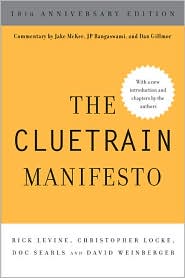
Cluetrain 10th Anniversary edition
Cluetrain 10th Anniversary
Everything Is Miscellaneous
Small Pieces cover
Small Pieces Loosely Joined
Cluetrain cover
Cluetrain Manifesto
My face
Speaker info
Who am I? (Blog Disclosure Form) Copy this link as RSS address Atom Feed

June 27, 2004

Free art! Then 50% of the profits

Andrius Kulikauskas’ lab is initiating a new way of selling art that gets around the annoying fact that artists don’t get any cut of the profits speculators make when selling and re-selling their work. According to the new plan, the artist gives the artwork to someone who agrees to give her 50% of any future sale, and promises to sell only to someone who agrees to the same terms. More here.

Tweet
Follow me

Categories: misc Tagged with: misc Date: June 27th, 2004 dw

Be the first to comment »

Freeway Blogger

Enjoying the Freeway Blogger this morning…

Tweet
Follow me

Categories: Uncategorized Tagged with: politics Date: June 27th, 2004 dw

Be the first to comment »

June 26, 2004

Burningbird’s words and pictures

Shelley’s story, “The Mockingbird’s Wish” is now available in audio form, beautifully read by Nicholas Avenell (aka Aquarion). And Missouri Life is going to feature her stunning photographs of Missouri rivers, lakes and ponds.

Congratulations, Shelley!

Tweet
Follow me

Categories: misc Tagged with: misc Date: June 26th, 2004 dw

2 Comments »

Metaphysics, Book Alpha

I read Book Alpha of Aristotle’s Metaphysics this afternoon (trans. Richard Hope). (A book is about 40 pages.) He reads like Bach sounds.

Book Alpha takes on a different cast when you read it looking for clues about the way in which things organize themselves into genuses and species. For example, the book begins, famoulsy, “All men naturally have an impulse to get knowledge.” This is not an unargued premise. Aristotle presents evidence for it: “A sign of this is the way we prize our senses.” We most highly value sight, even when “we have nothing practical in view.” Why? “The reason is that of all the senses it can best bring us knowledge and best discerns the many differences among things.”

So, now we know that knowledge has to do with seeing the differences among things. But, if you only see what makes something distinct, the world becomes populated by unique things, and knowledge is impossible: I need to distinguish Plato from Critias, yet see that both are men, and distinguish men from chickens yet see both are bipeds. So, knowledge requires the distinctions and groupings that a genus-species arrangement gives.

We see this in Aristotle’s critique of Plato. Most of Book Alpha is given over to showing how Aristotle’s predecessors got it wrong. Aristotle spends more time on Plato, his old teacher, than on anyone else. (Go have students!) Here’s one of his complaints about Plato’s notion of Ideas:

Also, there will be more than one pattern of the same thing, therefore more than one idea; of man, for example, animal and biped and at the same time also man-himself. [991a.25, p. 29]

Again, this is a problem that a nested, hierarchical view solves.

In Book Alpha the Less, Aristotle argues for a single “root,” a single first principle. But, of course, this first principle is not just an abstract category. It is also what gives traits to what follows from it:

To explain a thing it is necessary to know which among a number of things that have some trait in common gives that trait to others. So, fire, being hottestst, is the reason why other things are hot. So, too, what is most true is the reason why other things are derivatively true. Hence, the principles of eternal things are necessarily most truel for they are true always not not merely sometimes; and there is nothing which explains their being what they are, for it is they that explain the being of other things. Consequently, status in being governs status in truth.” [993b.20, p. 36]

So, we’re not looking merely at the order of knowledge but also at the order of being.

BTW, it’s hard for me to tell, but I think Aristotle is making a joke in this section:

Some require accuracy in everything; others are irritated by accuracy, either because they cannot follow a closely reasoned argument, or because they fear hair-splitting. There is something about accuracy that makes it seem unworthy to certain free spirits, either in business contracts or in rational exposition. [995a.10, p. 39]

Hoho! Good one, Ari! And, say, what’s a Grecian urn?

Tweet
Follow me

Categories: Uncategorized Tagged with: philosophy Date: June 26th, 2004 dw

7 Comments »

Beginning Aristotle

I’m excited. I haven’t read Aristotle in 25 years, but I pulled down The Metaphysics and Randall’s “Aristotle” this morning, because for the book I’m pre-writing, I want to remember what he says about genera and species. In particular, I’m curious whether his nested view of categories explicitly reflects the way political entities are nested: animal contains human the way Greece contains Athens.

I thumbed through both books for about two minutes after blowing the dust off of them, and had a flash of why I used to love Aristotle. He believed that careful thought could understand the world, which implies that the world is orderly and beautiful, and that language, thought, action and world all could be aligned perfectly.

If only I can clear out enough spam to make room for beginning to read him again.

Tweet
Follow me

Categories: Uncategorized Tagged with: philosophy Date: June 26th, 2004 dw

36 Comments »

June 25, 2004

David Reed on Kerry on Tech

David Reed is underwhelmed by Kerry’s tech proposals. Excerpt:

If Kerry’s team could understand that the issue should not be about allocating “spectrum” but instead about encouraging open wireless networking for scalable and interoperable systems (a wireless equivalent of the original goals of the Internet), he could really have an impact, and create a worthy challenge whereby America could lead the world.

Tweet
Follow me

Categories: Uncategorized Tagged with: politics Date: June 25th, 2004 dw

6 Comments »

How not to regulate spam, or, Where does end-to-end apply?

An article by Paul Jamieson, “$t0pp^ng $p@m!!“, in Legal Affairs, argues that the government needs to get out of the business of regulating spam:

…legal measures may be largely powerless to affect the spam problem because the architecture of e-mail is resistant to traditional methods of government regulation. While members of Congress and the Federal Trade Commission will be quick to claim credit in the event that the spam problem is reduced, the role they play is small

I of course like this point. I’m less certain about Paul’s prescriptions:

Consumers and businesses suffering from the torrent of spam must look for relief not from formal law developed on Capitol Hill or in a watchdog agency, but from the people who write the code that makes the Internet run, and then from the private businesses that put the code to work.

He points, seemingly approvingly, to Bill Gates’ Global Infrastructure Alliance for Internet Safety, efforts to charge postage for email, challenge-response systems, and systems that verify the sender’s email address. I know just enough about these to be nervous to varying degrees, but not enough to have actual opinions worth stating. But Paul’s conclusion worries me:

To solve the spam problem, the federal government should create incentives for the private sector to develop solutions. It could subsidize effective technological solutions to spam, much like what the government does to subsidize the availability of Internet access in the nation’s schools and libraries. Or it could require that a company license any truly effective solution to anyone who wants it. Government could also be more aggressive in supporting industry consortia, including the recognition of an industry standards-setting body that would develop practices to combat spam and share the best ones. If it turned out that the best anti-spam strategy required ISPs to employ a particular method of authentication, the government could mandate compliance with that standard.

If the government is going to pick favorites and enforce compliance, we might as well have it doing the regulating in the first place.

Here’s where I get confused: I like the end-to-end principle because it maximizes options. That principle is meant to apply low down on the stack. But I think it applies higher up, too, where the “center” isn’t defined by protocols for packets but by economic forces. If one company has an effective monopoly on, say, the browser or DRM software, then even though no packet headers are being changed, we have in effect lost the ability to innovate that the end-to-end principle is about. A government mandated authentication scheme feels to me like a violation of the end-to-end principle, just higher up the stack.

Don’t get me wrong. I don’t know what to do about spam, I don’t know how to evaluate the ideas being presented, and I recognize that there are times when the end-to-end principle needs to be over-ridden by more pressing concerns. But, IMO, only only only when the case is so compelling and is so much in the interest of users and the long-term effects have been so carefully thought through and we are sure that not only are there no other options but no one is going to come up with one tomorrow…

Tweet
Follow me

Categories: Uncategorized Tagged with: web Date: June 25th, 2004 dw

3 Comments »

Being towards death

Being towards death

Hanan Cohen intertwines the mortality of blogs with our own mortality:

We think that we will live forever. We think that the files we have stored on machines powered by electricity will also live forever. Our files have no other purpose than to be online. We think that if our files are not available to the web, they are dead.

In a way, thinking about the death of our files is like thinking about our own death.

Meanwhile, over at Ereignis, the English-language Heidegger site, there’s a link to Christopher Ellis’ article that argues that Heidegger’s ideas about death are inadequate because they are oddly a-historic. Ellis touches on Heidegger’s failure to incorporate the ways in which we are animals in addition to being “ecstatic Dasein.” He recommends that Heidegger swallow a big dose of Hegel and re-think the historical particularities of, say, the Holocaust.

This article is aimed at the Heideggerian in-crowd, but I think its critique is trenchant. “No one can die my death for me,” wrote Heidegger. Ellis shows that this view of death-as-individuating is rooted in history, not in the inescapable basis of human existence. Besides, no one can take my shower for me either. Heidegger’s disinterest in us as embodied creatures has always seemed to me to be a weird and obvious flaw in his thinking. (And yet, Heidegger remains for me the person who got most of It right. And I mean the big big It.)

Tweet
Follow me

Categories: misc Tagged with: misc Date: June 25th, 2004 dw

10 Comments »

June 24, 2004

Kerry’s tech policy

John Kerry gave a speech today on the importance of innovation. Here are the main points. And I’ve posted a transcript.

Tweet
Follow me

Categories: Uncategorized Tagged with: politics Date: June 24th, 2004 dw

2 Comments »

Gore blurts out the truth

Fantastic speech by Gore today about the administration’s dangerous consolidation of executive power:

The seductive exercise of unilateral power has led this president to interpret his powers under the constitution in a way that would have been the worst nightmare of our framers…

…In the end, for this administration, it is all about power. This lie about the invented connection between al Qaeda and Iraq was and is the key to justifying the current ongoing Constitutional power grab by the President. So long as their big flamboyant lie remains an established fact in the public’s mind, President Bush will be seen as justified in taking for himself the power to make war on his whim. He will be seen as justified in acting to selectively suspend civil liberties – again on his personal discretion – and he will continue to intimidate the press and thereby distort the political reality experienced by the American people during his bid for re-election.

And here I thought The Daily Show was the only place capable of telling the plain truth. Wait … Gore cites The Daily Show:

Ironically, his [Cheney’s] interview ended up being fodder for the Daily Show with Jon Stewart. Stewart played Cheney’s outright denial that he had ever said that representatives of Al Qaeda and Iraqi intelligence met in Prague. Then Stewart froze Cheney’s image and played the exact video clip in which Cheney had indeed directly claimed linkage between the two, catching him on videotape in a lie. At that point Stewart said, addressing himself to Cheney’s frozen image on the television screen, “It’s my duty to inform you that your pants are on fire.”

Until I find where this is posted on line officially, I’ve unofficially posted it here.

Tweet
Follow me

Categories: Uncategorized Tagged with: uncat Date: June 24th, 2004 dw

10 Comments »

« Previous Page | Next Page »


Creative Commons License
This work is licensed under a Creative Commons Attribution-NonCommercial-ShareAlike 3.0 Unported License.
TL;DR: Share this post freely, but attribute it to me (name (David Weinberger) and link to it), and don't use it commercially without my permission.

Joho the Blog uses WordPress blogging software.
Thank you, WordPress!