


logo
EverydayChaos
Everyday Chaos
Too Big to Know
Too Big to Know
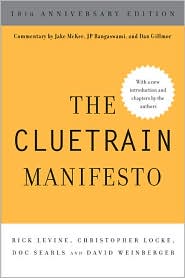
Cluetrain 10th Anniversary edition
Cluetrain 10th Anniversary
Everything Is Miscellaneous
Small Pieces cover
Small Pieces Loosely Joined
Cluetrain cover
Cluetrain Manifesto
My face
Speaker info
Who am I? (Blog Disclosure Form) Copy this link as RSS address Atom Feed

February 6, 2004

12 minutes on the value of the unspoken

I just stumbled across an 12-minute video talk I did for Vignette last spring on the value of ambiguity, messiness and the unspoken. I just watched it and I agree with myself, even 7 months later.

Tweet
Follow me

Categories: misc Tagged with: misc Date: February 6th, 2004 dw

5 Comments »

February 5, 2004

Got a Mac, so shut up already

I just installed OS X on the used G4 I bought for my father-in-law. Having installed Windows scores of times — probably more than a 100 in my lifetime — and having installed Linux a few times with mixed success, I was interested in how the Mac would do.

Answer: Pretty durn easy. As easy as Windows XP, and definitely easier than Red Hat or Mandrake.

And then the fun began.

The UI effects are real crowd-pleasers. It matters to me that the droplets of water play catch as you wait for something to install. Let’s not say I’m superficial. Let’s just say I’m attuned to visual payfulness. (Also, I’m easily amused. It’s a gift.)

I love the built-in Bayesian filtering in the email client. It beats the integration of Outlook and Popfile to bits.

Sherlock is so cool that it seems like a proof of concept, not the functional app that it is.

And I’ve just started kicking it around. I expect to find even more to like.

Of course, I still have things to whine about. For example:

The installation disk doesn’t tell you to hold down the c key in order to get the machine to boot from the CD

Windows XP gets you hooked up to the Internet without throwing DHCP/proxy gobbledygook in your face.

The Mac registration process doesn’t give you enough choices and doesn’t let you opt out of questions such as “What are you going to use your Mac for?” Annoying.

The one-button mouse still feels like a really bad idea to me.

There’s only one corner you can drag on a Mac window to resize it. There’s no way to size a window up or left, only down and right. Or am I missing something obvious?

Internet Explorer has already crashed. I was checking a stock quote at www.tse.com and the window simply disappeared on me. (I hadn’t yet discovered Safari. Now I have.)

The real test: Will my father-in-law take to it like a cat takes to a one-button mouse, or will he come down with a case of the eensy little gotchas?

Tweet
Follow me

Categories: Uncategorized Tagged with: tech Date: February 5th, 2004 dw

11 Comments »

Blogging over at Many2Many

It’s official! I’ve been added to the august team of bloggers over at Many2Many. where social software issues and implications are discussed. I’m honored.

Tweet
Follow me

Categories: misc Tagged with: misc Date: February 5th, 2004 dw

Be the first to comment »

See Ralph Not Run

Ralph Nader is showing signs of leaning heavily towards running again. If, like me, you think that that would be a bad thing in the current context, you can send a message to his exploratory committee at [email protected]. There’s also a site set up to urge him to support the Democratic candidate so that Bush won’t get reelected.

Tweet
Follow me

Categories: Uncategorized Tagged with: politics Date: February 5th, 2004 dw

4 Comments »

Orkut Follies

Michael O’Connor Clarke is writing funnily (here and here) about the foibles of Orkut.

His Monopoly card reminds me of a fake screen capture I used when talking about Artificial Social Networks (ASN) such as Orkut.

Mock Friendster relationship choices
Click for larger view

Just in case it’s not obvious, the point is that you can’t get over ASNs’ inherent binary nature by adding more binary choices. That is, the problem isn’t just that the choices are too precise; the problem is also that the choices are necessarily explicit. Social relationships depend on being implicit, hidden, dark and unspoken.

Tweet
Follow me

Categories: Uncategorized Tagged with: web Date: February 5th, 2004 dw

15 Comments »

February 4, 2004

The Semantic Earth

I spent all of December and half of January working on an article for Esther Dyson’s Release 1.0. Man, did I learn a lot, including that Esther and Christina Koukkos are uniquely demanding yet patient editors.

The article’s just come out. Here’s the abstract:

The Semantic Earth

Every business in the world is headquartered on earth. Every employee works somewhere. Every customer is at some location at every moment. Every product is delivered to some spot and every service is performed at some coordinates. Every transaction involves at least one place and usually more than one. And yet, until recently, businesses have systematically managed location information only for processes directly concerned with moving people and goods. Why has the literal common ground of business been largely absent from business applications?

The answer is obvious: Integrating information about locations – beyond including an address field in your customer database – has required specialized skills and a budget that often was larger than the potential benefits of such a project. And now we are integrating not just information about locations, but information into locations: PCs and PDAs and other user or sensor devices are aware of where they are and what surrounds them, often receiving local information in realtime and giving feedback. Location is more complex than simple longitude and latitude in a database, involving a world full of objects, people and processes that are moving around relative to one another and to the earth, referred to in terms that humans understand quite precisely but that can be impossible for computers to parse. Therefore, Geographic Information Systems (GIS) have been stuck where information retrieval was in the early ’90s: a technology that could have transformative effects if only it didn’t require high priests to build and maintain it.

The problems of the GIS industry are so tough precisely because the earth is so simple. The earth is a wet rock. We inhabit it with meaning. Whether those meanings are discovered, invented or revealed, they are dependent on us. You see that dependency clearly in the diversity of maps we draw. Maps can be inconsistent and contradictory in every aspect – what objects we see, at what scale we draw them, where we etch the boundaries, which words we use as labels – because our human projects are inconsistent and contradictory. There is no more hope for a single, universal map than there is for a single, universal language, because the thing we are mapping – the earth – has no language, no culture and no projects of its own. It is too real for that. All its meanings are attributed.

The GIS industry is now breaking out of its box. The technology, data representation, economics and security-driven needs for real-time geographic information are coming together. Businesses are becoming location-aware, making existing processes more efficient and enabling new processes and new relationships to emerge.

But something even bigger is happening.

Thanks to the constellation of technology that enables digital networks to be laid over the places of the earth, wherever we are we will be able to hear the human conversation that has occurred about that place – the history that occurred there, the aesthetics to be savored, the commerce transpiring at that very moment, recommendations offered by strangers and friends. The mute places of the earth are being given voice, and the voices are, of course, ours. Meanwhile, the places themselves are becoming digitally alive and are noting our presence, too.

This is happening now. It is not just spawning innovative new businesses. It will change our most basic sense of what it means to be in a place.

Tweet
Follow me

Categories: Uncategorized Tagged with: tech Date: February 4th, 2004 dw

10 Comments »

Isenberg: WTF?

David Isenberg has posted more about his free-form gathering of interesting people. It’s called WTF and it doesn’t stand for anything yet.

Tweet
Follow me

Categories: Uncategorized Tagged with: uncat Date: February 4th, 2004 dw

Be the first to comment »

Poetry blog

Pete the Beat who has been blogging his poems in my back pages (um, comments) has started his own blog, Beat Way Down. Here’s how one entry begins :

The art of highballs and cocktails
cannot reach Mars on Main…

Tweet
Follow me

Categories: misc Tagged with: misc Date: February 4th, 2004 dw

21 Comments »

February 3, 2004

SuperBowl Note (Caution: Contains no gratuitous nudity)

My son and I went on a bonding trip to the supermarket a few minutes before the SuperBowl began — I think it’s the only sports event we’ve ever watched, except for Olympic ice skating — and were amused to see that the salty snackfood shelves had been just about cleared out.

Of course, our glee was tempered by the fact that we were there to buy salty snackfoods.


Tom Hespos at Online Spin reports that each SuperBowl ad cost $2.3 million. Here’s an extract:

TV ratings decline every year.

Media consumption habits continue to diversify, resulting in a fragmented landscape in which an increasing percentage of people are unlikely to ever be reached by incremental spending in TV.

Yet prices go up every year.

And TV continues to be the foundation of national advertising plans.

Tweet
Follow me

Categories: misc Tagged with: misc Date: February 3rd, 2004 dw

3 Comments »

February 2, 2004

Alternative to Orkut

OnePotMeal announces a new Artificial Social Network for those of us griping about Orkut: Urkel.

Tweet
Follow me

Categories: Uncategorized Tagged with: humor Date: February 2nd, 2004 dw

67 Comments »

« Previous Page | Next Page »


Creative Commons License
This work is licensed under a Creative Commons Attribution-NonCommercial-ShareAlike 3.0 Unported License.
TL;DR: Share this post freely, but attribute it to me (name (David Weinberger) and link to it), and don't use it commercially without my permission.

Joho the Blog uses WordPress blogging software.
Thank you, WordPress!